Category: War & Remembrance

  • Not angels or saints – Women

    Illustration from the post “Not angels or saints – Women”

    This is a story about three women who were described as the Angel of Arnhem, the Virtuous One and Queen of Okoyong.

    Kate ter Horst was called an angel by those who received her heroic care under fire. The mother of five children, she lived happily with her husband Jan at Oosterbeek, near Arnhem, where part of the Allied assault, Operation Market Garden took place in September 1944.

    As the battle for Arnhem Bridge intensified, an army doctor by the name of Randal Martin knocked on Kate’s door and asked if he could bring some lightly wounded men there for shelter, as their field hospital was running out of room. With her husband away helping the Dutch Resistance, Kate agreed, and putting her children safely in the cellar with their nanny, she opened her doors to the wounded, the men of the British Parachute Brigade.

    They never stopped coming as the battle raged, until over three hundred wounded and dying were crammed into every available space, where there was no room to step anywhere, she told her children afterwards. When the house became a target, she improvised water for her unexpected house guests siphoning off water from the boiler and the toilet cistern. But mostly she comforted and supported the wounded. Talking to them, reading the Bible and prayers to those who wished, holding their hands when they died. She infused the house with calm, and loving kindness.

    Liv Ullman plays Kate in the film, ‘A Bridge Too Far’, with great soul and sensitivity, so that one knows how much the shattered soldiers loved her, and clung to her steady, gentle kindness. “She brought light into darkness,” a wounded general said afterwards. Over three hundred men finally lay on the polished oak floors, on the stairs, on sofas and make-shift beds. The young English doctor was wounded twice as relentless sniper fire targeted the house and explosions rocked it. Fifty-seven dead soldiers were hastily buried in the garden, and when the Germans finally marched in, Kate and her children were expelled from their home, walking away with nothing.

    They called her the Angel of Arnhem and never forgot her. When the war was over, those who survived and the families of those who didn’t, came back to thank her and to be with her once again. Dr Randal Martin, like some others, became a life-long friend, and when Kate was killed in a car accident in 1992 and her husband badly injured, Randall flew over to Holland to care for him. They were awarded an MBE by the King, and when Kate died, the British Parliament stood to honour and pay tribute to her.

    Her daughter Sophie continued to live in their re-stored house. She said: “I cherish this house and feel privileged to live here. It’s where British men gave their lives to free Europe. I’ve lived with their memories all my life. I think of them all the time.”

    (of the 10,000 men who fought at Arnhem, only 2,400 returned). Her mother turned the garden into a shrine to the young men who had died there, and when her husband became mayor, he started the custom of all the children in the town being responsible for one grave, which they tended and decorated with flowers since the families of the dead were too far away. It continues to this day.

    Gladys Aylward was also involved in a war – the terrible conflict between the Chinese and Japanese. A house-maid before she had saved enough to pay for the cheapest fare available to go to China – she had two pounds and nine pence when she set out on the dangerous journey overland to become a missionary. Missionaries have had a bad rap over the years, along with the British Empire (which abolished suttee – the burning of widows on their husband’s funeral pyre, helped abolish foot-binding in China and tackled infanticide in parts of Africa)

    When thirty- three year old Gladys arrived in China she joined a seventy- three year old missionary, Jeannie Lawson, in a remote part of the country, where the two women restored a ruined haunted hotel, and made a warm welcoming stop for mule trains… while they ate their food, one of the women would tell them Bible stories, in the hope the muleteers would pass them on! When the elderly Jeannie died from a fall, Gladys took over on her own. She overcame local hostility and prejudice against all ‘foreign devils’, learned the language, became a Chinese citizen, quelled a local prison riot and obtained decent conditions for the prisoners.

    She became an official employee of the government to abolish the barbaric practise of foot binding, having great success in remote regions in spite of the resistance of the men. (footbinding involved breaking the toes and the instep, binding the toes to the sole very tightly and creating a foot of four inches, on which women could hardly hobble and were trapped at home. They often fell and broke their bones which became more brittle than unhandicapped women’s. It was agonising, and considered a sign of beauty) At the same time Gladys was adopting orphans whenever they came her way! The locals loved her and gave her a Chinese name – Virtuous One.

    She ended up at the outbreak of war having to lead a hundred orphans of all ages to a safe town, away from the Japanese, who were destroying all the towns and villages, and killing everyone.

    Her epic trek over the mountains with the children for twelve days, almost starving, sleeping in the open, trudging through rain and up and down steep mountain passes was the subject of a film, ‘The Inn of the Sixth Happiness’ a distorted Hollywood account which included a fictional love affair, which the modest Gladys hated.

    At the end of the journey she collapsed with typhus and fought for her life, before going back to work with her beloved orphans. With the coming of Mao she had to escape China, and she ended her life caring for orphans in Taiwan. Not bad for a four foot ten inch London parlour maid.

    Mary Slessor was a Scots girl, who from the age of eleven had to work to help support her family, who were unsupported by an alcoholic father. She worked in a weaving mill until she was twenty eight, when she felt able to leave home, and sailed off to Africa to be come a missionary. She went to Calabar in Nigeria, and after a short time at the mission, she set off into the unknown interior of the great continent.

    Back in 1878, this really was darkest Africa, with many hostile tribes, particularly brutal forms of slavery, constant tribal wars and barbaric and brutal customs which made everyone’s life a fragile dangerous ordeal. Other missionaries who had tried to spread their message there had been killed. Undaunted, Mary learned Efik, the local language, and bringing nothing with her but love and a desire to help the oppressed, she set off.

    She spent the rest of her life exploring and serving this part of Nigeria and with sheer force of personality taming murderous chiefs, curbing the power of witch- doctors, trying to end the practise of chaining the wrists of a suspect and pouring boiling oil over them -if he was innocent, he would not be harmed! She rescued slaves condemned to death for trivial mis-demeanours, and saved the lives of many women from being killed for irrational reasons, stopped the practice of finding someone to blame when someone died and taking their life too, put a stop to all the chief’s wives and servants being killed when he died, to go with him, and everywhere she went, building her own house, chopping logs and fixing roofs, and always having her adopted children with her.

    Her most powerful achievement was to end the killing of twins, whose parents were deemed cursed by their communities and the mother driven off to die in the jungle and the father considered a ‘devil child’. She scoured the dense undergrowth whenever the grapevine told her twins had been born and rescued hundreds of the abandoned babies, nursed their broken mothers back to health, tried to re-unite the parents, and above all, worked on the chiefs to get them to stop this cruel practice. She cared for the babies, finding homes for them and adopted four girls and a boy herself.

    The people adored her for the loving and unstinting energy she gave to improving their lot and trying to change things for the better. Mary had contracted malaria soon after her arrival in Nigeria, and struggled with it for all the years she worked in Africa until she died a sixty- seven in 1915.

    But until then she never gave into it, and battled through fever, debilitation and pain to the rescue of endangered women, or to stand in the path to stop an invading tribe attacking. Though she was a timid woman, hiding in doorways if she saw a dog in her native Dundee, here in Africa, using prayer to sustain her she showed such courage that all, European and Africans alike, were awed by her achievements. Her focus was on teaching Christianity, settling disputes, encouraging trade, establishing social changes and introducing Western education. She changed many lives simply by her example.

    She had an extensive correspondence with children back in Scotland, and even with the crippled son of hotel owners in the Canary Islands. Knowing the labour of hand writing long letters, this reaching out with loving encouragement to these children was an extraordinary service on top of all her other self-appointed duties.

    The British Government in Nigeria cooperated with Mary’s efforts to stop the killing of twins and passed a law against it. They also made Mary the local consul with the power to preside as a magistrate and keep the peace in her area. By now, she was known by all, as the Queen of Okorong, for all the tribes and chefs deferred to her and brought their disputes to her, knowing she would resolve their problems with fairness and kindness as she knew their ways and customs. Everyone trusted her.

    Mary refused a salary for this important post saying she was serving God, not the government, so the government paid her salary to her local mission. The frail missionary became beloved by all who knew her, and though George V honoured her with the award of the Order of St John of Jerusalem, she valued far more the love of her adopted children and all those she worked with and served. When she died, the colonial authorities gave the red-haired blue-eyed Scottish girl from the Dundee slums the equivalent of a state funeral

    All these women brought light into darkness, and they are an inspiration. Gladys and Mary and Kate are well-known, but at the same time, in each place in the world where they laboured, there were many other women (and men) bringing light, and kindness among people who needed hope; people struggling against centuries of oppression, poverty and the cruelties inflicted by the powerful, as well as by the tragedies of war.

    The tapestry of the past is composed of dark and light, but by looking at the light, and acknowledging it, instead of focusing only on the dark, we can see how the light has showed us the way to a more just, more compassionate present. The light can inspire and lead us out of the darkness of injustice or cruelty into the possibilities of a fairer kinder future.

    Dale Carnegie had a point when he said two men looked out from prison bars, one saw the mud, the other saw stars. These women were stars and their lights still shine for those who choose to see it.

    Food for Threadbare Gourmets.

    Not for the first time, Nigella Lawson has enhanced my life! I read her tip to cook chips in COLD oil. This looked too good to be true. But using a deep saucepan, instead of a frying pan, I tipped chips into cold vegetable oil and left them to cook. Miracle – crisp outside, soft and fluffy inside, and they took half the time and no hot oil spattering. Next time I tried with kumara/sweet potato as well – just as good but they cook a lot quicker.

    So then, in a separate pan, I tried chopped onion in cold oil. The recipient, an aficionado of fried onions, said they were the most deliciously crisp of any I had cooked before. I tip them onto kitchen paper, to dry out a bit of the oil, but they seem to be less oily than ordinary chips. Must be vegetable oil, so I use grape-seed.

    Food for Thought

    What is civilization? I answer, the power of good women.

    Ralph Waldo Emerson

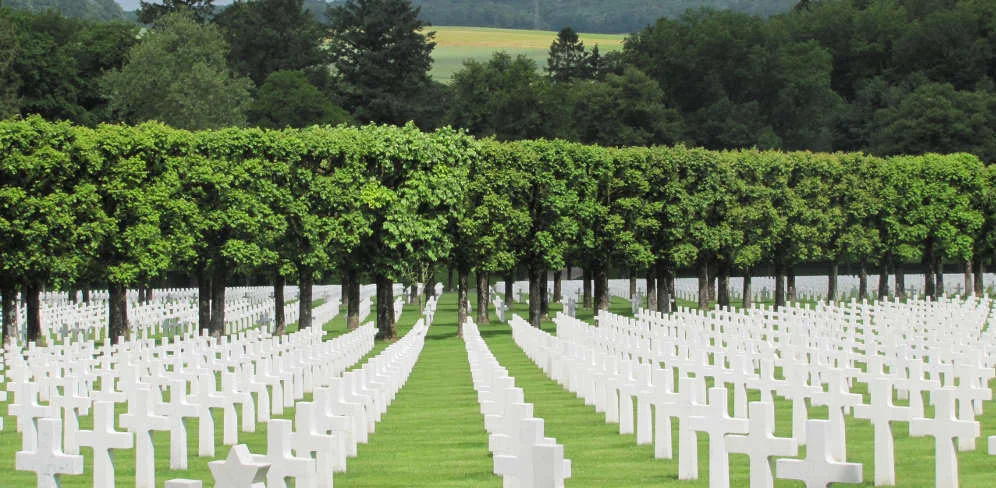
  • The Soldiers – ‘A Richer Dust Concealed’

    The beginning of July is pock- marked for me with remembrances, memorials and history… the birthday of my father, the day I shattered my leg four years ago, spending two and a half months in hospital, and the unforgettable anniversary of one of the worst battles of the First World War.

    Illustration from the post “The Soldiers – ‘A Richer Dust Concealed’”

    It was a hundred and four years ago, when my step-grandfather stepped out with thousands of other young men on the first day of the Battle of the Somme. The first of July, 1916.

    He was a north countryman from Northumberland, and the four Northumberland regiments were the first to walk into battle at 7 30 am on a blue sunny morning with the birds singing. The four Geordie regiments stepped purposefully towards the German lines which were supposed to have been bombarded into nothing after five days of thunderous firing – the barbed wire cut by the bombardment also.

    For a moment, these fine young men walked into the sudden silence, and then the German machine guns began to fire. The bombardment had neither cut the wire nor killed the enemy, who had moved out of range. The German guns now simply swept the battle field, as their targets continued walking steadily towards them, and line after line of brave young men fell. These regiments belonged to what was known as the New Army, bodies of men who had joined up from their towns, villages and workplaces, calling themselves names like the Grimsby Chums, and the Manchester Pals. They were, to use a cliché which has meaning in this context, the flower of the country’s youth. They had set off that morning believing that this battle would end the war.

    Percy, my step-grandfather, didn’t become one of the 60,000 dead British soldiers killed on that one day, but just one of over 30,000 wounded. He was a young officer, and like them all, easily distinguishable to the German machine-gunners. Officers went into battle wearing their service dress, collar and tie, shining leather Sam Browne belts, and carrying a pistol, not a rifle. By the end of the day, seventy five per cent of officers had been killed, compared with fifty per cent of men. The three colonels of the four Geordie regiments were dead, the fourth badly wounded.

    Percy was shot in the face, and later buried in a huge crater after a mine had exploded. He was found four days later, still alive – just – and he grabbed a helmet lying on the ground to drink from it and quench his terrible thirst. The helmet was full of chemicals and poisons from the battlefield, and Percy ruined his insides. The face wound healed, he returned to the battlefield, and unlike so many of the men who endured the hell of the First World War, he survived to see peace.

    The day that 60,000 brave young men died on the Somme was the worst day of that terrible war. Waterloo was accounted a bloody battle, but Wellington lost only 25 per cent of his army, 8458 men. El Alamein, an eleven- day battle, cost 1,125 men a day, while on D-Day the British and Canadian casualties cost 4000 men.

    So my step-grandmother, living in a north country village, had seen all the young men march proudly through the streets on their way to fight for their country, trumpets blowing, banners flying, girls throwing flowers. Now all the houses had their blinds down, mourning their sons and husbands, brothers and fiancees, friends and neighbours. It wasn’t the same back in Germany. The Germans had not been slaughtered. For every seven British soldiers killed, they had lost one, from a much bigger population.

    Paddy Kennedy, a soldier with the Manchester Pals, another regiment which was destroyed that day, helped to take a German post at Montauban. In the German trenches he found a small black frightened kitten, the pet of a dead soldier. Feeling sorry for it, he fastened it inside his pack, and took it with him. During lulls in the fighting he took it out and played with it. A few days later, he gave it to the company cooks as a mascot, and got on with his job… the following year, the kitten, now known as Nigger, went back to England hidden in a soldier’s battledress.

    The young man took it home on leave to his family in Rochdale, and left it with them. He was killed at Passchendale shortly afterwards. But Paddy Kennedy, who’d gone back home to Manchester after the war, had not forgotten the cat. Throughout the twenties he went to visit Nigger at Rochdale.

    This reminded me of the Dogs Cage on the beach at Dover. As the soldiers arrived back from Dunkirk in 1940, hungry, wounded, shattered, they brought with them dogs and puppies which they’d rescued from the deserted, burning town of Dunkirk. Since rabies could not be allowed to invade the British Isles, the commanding officer at Dover organised for the dogs to be labelled, and their addresses recorded; and after six months in quarantine, these French dogs were delivered to their rescuer’s homes around the British Isles. I suppose that by then they knew what ‘sit,’ and ‘stay’ were in English…

    These loving actions by soldiers in the midst of fighting, somehow ease the heart when one reads the horror of those battles. So when I think of Percy and all those other wonderful young men, whose deaths wring the heart – “theirs not to reason why, theirs but to do and die”, I think of their kindness and courage and decency – and try not to think of the warmongers who forced war on the world, of the devastated people in Belgium and Northern France, who suffered atrocities perpetrated by Germans, not Nazis, who conveniently took the blame for similar atrocities in the next world war.

    When some of those young men rescued the frightened black kitten, they lovingly gave it a name which is now anathematized in some parts of the western world, and I wonder what those brave young men would have thought of our world now.

    Of the million white slaves in the Middle East, some would have been the ancestors of these soldiers, some would have ancestors who slaved in the mines, others impressed in the navy for seven years, and many more who scurried up and down stairs as over- worked and underpaid servants. Most soldiers would have come from families whose members had always been poor, overworked, and downtrodden throughout the history of their country.

    But they loved it, and wanted to protect it. They didn’t want to impose it and their way of life, and their culture on others. And they died trying to save it.

    The title comes from Rupert Brooke’s famous (and now unfashionable) poem, The Soldier.

    Food for Threadbare Gourmets

    I’m just emerging from a bad bout of ‘flu, so apologies to all the wonderful friends who commented on my previous post, and I will be getting back to you. I also had a posse of zoo researchers coming to dinner, before they began their nights research into our almost extinct species of frogs and lizards in the forest.

    I wondered how I was going to put on dinner for five – the spirit was willing but the body was weak, so I turned to my newly acquired slow cooker for rescue. Brilliant! Into the pre-heated container went chopped onion, garlic, a stick of chopped celery, chopped mushrooms, and a few rashers of chopped bacon. Then a layer of chopped chicken- good sized chunks – I used boneless thighs and tenderloins, then smothered the whole with a tin of condensed chicken soup plus a chicken stock cube and hot stock, plus a liberal helping of cream, and salt and pepper.

    I put the lid on, and it cooked for four hours on high. Then I added a packet of lasagne, made sure the liquid covered it, by adding a bit more hot chicken stock, and continued cooking for another hour and a bit till the pasta was ready. With a green salad, and freshly grated parmesan, it was a doddle.

    And for an easy pudding, I whipped up cream, added the same amount of apricot yogurt, plus succulent chopped peaches I’d freezed in summer, some sugar, and a tin of mandarin oranges to decorate the top. In a crystal dish, it looked good enough to eat!

    Food for Thought

    Lord, Thou knowest how busy I must be this day. If I forget Thee, do not Thou forget me.

    The prayer of Cavalier, Sir Jacob Astley before the Battle of Edgehill 1642

  • Take a knee

    Illustration from the post “Take a knee”

    “Military men are just dumb, stupid animals to be used as pawns in foreign policy.” Said Henry Kissinger.

    I had thought of these callous words when I copied the food for thought in my last post: “The soldier above all others prays for peace, for it is the soldier who must suffer and bear the deepest wounds and scars of war.”

    As a military daughter, wife, sister, serving officer myself, and descendant of soldiers, I’ve sometimes found myself defending military men, as I did once at a Quaker meeting where everyone is committed to pacifism. And I thought of these stories of profound wisdom by three military men in recent wars.

    In 2005, Dan Baum wrote this inspiring tale in the New Yorker: “During the early weeks of the Iraq war, the television set in my office was tuned all day to CNN, with the sound muted. On the morning of April 3rd, as the Army and the Marines were closing in on Baghdad, I happened to look up at what appeared to be a disaster in the making. A small unit of American soldiers was walking along a street in Najaf when hundreds of Iraqis poured out of the buildings on either side. Fists waving, throats taut, they pressed in on the Americans, who glanced at one another in terror.

    “I reached for the remote and turned up the sound. The Iraqis were shrieking, frantic with rage. From the way the lens was lurching, the cameraman seemed as frightened as the soldiers. This is it, I thought. A shot will come from somewhere, the Americans will open fire, and the world will witness the My Lai massacre of the Iraq war.

    “At that moment, an American officer stepped through the crowd holding his rifle high over his head with the barrel pointed to the ground. Against the backdrop of the seething crowd, it was a striking gesture—almost Biblical. “Take a knee,” the officer said, impassive behind surfer sunglasses.

    “The soldiers looked at him as if he were crazy. Then, one after another, swaying in their bulky body armour and gear, they knelt before the boiling crowd and pointed their guns at the ground. The Iraqis fell silent, and their anger subsided. The officer ordered his men to withdraw.”

    It took Dan Baum two months to track down Lieutenant Colonel Chris Hughes to hear his story, and his spontaneous reaction to the peril he and his men were in.

    Major Chris Keeble was a British soldier fighting in the Falklands War. During the Battle of Goose Green, he inherited command of the 2nd Battalion of The Parachute Regiment when Lieutenant-Colonel H. Jones was killed in action. Keeble was a devout Christian. The battalion was at a point when its attack upon the Argentine Army position had broken down, having lost one in six of its men; it had almost run out of ammunition, had been without sleep for 40 hours, and was in a debilitated condition in Arctic conditions facing the unknown potential of a counter-attack from the Argentine forces all around.

    After kneeling alone in prayer amongst the burning gorse seeking guidance as to what to do, Major Keeble conceived the idea of refraining from more attacks to try a psychological ploy. He released several captured Argentine prisoners of war in the direction of their Goose Green garrison, carrying messages to the commander requiring its surrender or threatening it with a fictitious large-scale assault by the British forces, supported by artillery. The Argentine commander, subsequently surrendered the garrison to the Parachute Regiment without further fighting.

    Keeble said later that: “perhaps the most profound factor of all, was that 112 civilians were locked up in the Community Hall in Goose Green! This fact, discovered overnight, re-emphasized the need to use more subtle means than the bayonet! After all, we had not journeyed 8,000 miles merely to destroy the very people we had come to save.

    “And so, standing in a small tin shed on the airfield next day, with the Battery Commander, and our two bewildered journalists, Robert Fox and David Norris, we confronted the Argies.” They surrendered their forces which were three times bigger than the British forces.

    And these are the spontaneous and noble, almost Shakespearean words of another soldier – the eve-of-battle speech made by Colonel Tim Collins to the 1st Battalion of the Royal Irish Regiment in Iraq in 2003. Luckily there was a reporter there who took down in shorthand the only record of these inspiring words.

    “We go to liberate, not to conquer. We will not fly our flags in their country. We are entering Iraq to free a people and the only flag which will be flown in that ancient land is their own. Show respect for them.

    “There are some who are alive at this moment who will not be alive shortly. Those who do not wish to go on that journey, we will not send. As for the others, I expect you to rock their world. Wipe them out if that is what they choose. But if you are ferocious in battle remember to be magnanimous in victory.

    “Iraq is steeped in history. It is the site of the Garden of Eden, of the Great Flood and the birthplace of Abraham. Tread lightly there. You will see things that no man could pay to see – and you will have to go a long way to find a more decent, generous and upright people than the Iraqis.

    “You will be embarrassed by their hospitality even though they have nothing. Don’t treat them as refugees for they are in their own country. Their children will be poor, in years to come they will know that the light of liberation in their lives was brought by you.

    “If there are casualties of war then remember that when they woke up and got dressed in the morning they did not plan to die this day. Allow them dignity in death. Bury them properly and mark their graves.

    “It is my foremost intention to bring every single one of you out alive. But there may be people among us who will not see the end of this campaign. We will put them in their sleeping bags and send them back. There will be no time for sorrow.

    “The enemy should be in no doubt that we are his nemesis and that we are bringing about his rightful destruction. As they die they will know their deeds have brought them to this place. Show them no pity.

    “It is a big step to take another human life. It is not to be done lightly. I know of men who have taken life needlessly in other conflicts. I can assure you they live with the mark of Cain upon them.

    “If someone surrenders to you then remember they have that right in international law and ensure that one day they go home to their family. The ones who wish to fight, well, we aim to please.

    “If you harm the regiment or its history by over-enthusiasm in killing or in cowardice, know it is your family who will suffer. You will be shunned unless your conduct is of the highest – for your deeds will follow you down through history.

    “We will bring shame on neither our uniform or our nation. As for ourselves, let’s bring everyone home and leave Iraq a better place for us having been there. Our business now is North. “

    No, Mr Kissinger, military men are not just dumb stupid animals, their lives and words and deeds matter. As Rudyard Kipling wrote:

    ‘For it’s Tommy this, an’ Tommy that, an’ “Chuck him out, the brute!”

    But it’s “Saviour of ‘is country” when the guns begin to shoot… Food for Threadbare Gourmets

    At a little end- of- lockdown soiree, I made these nibbles, which disappeared very fast. Cut parsnips into fingers, slightly thicker than a finger. Dunk them thoroughly in beaten egg, and then roll them in freshly grated Parmesan cheese. Arrange in a baking tin so they don’t touch each other. Bake in a hot oven for twenty minutes or so, until cooked. Eat warm or cold.

  • What’s wrong with a stiff upper lip?

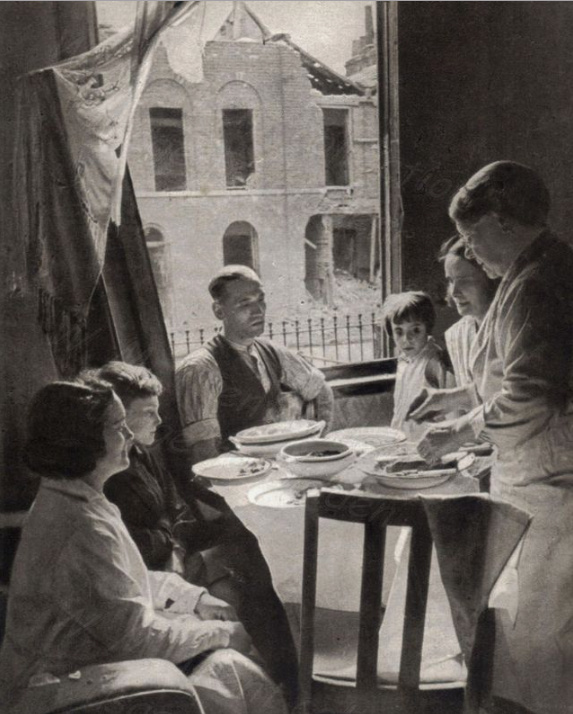
    The East End of London during the Bitz. The woman on the right lived in the bombed building opposite. Their food was cooked on a campfire in the basement.

    Illustration from the post “What’s wrong with a stiff upper lip?”

    Victors or victims? These thoughts came to me when I chanced upon these words in a book I’d written some time ago.

    “I’ve been re-reading Robert Massie’s ‘Dreadnought’ very slowly, trying to take in and remember all the detail. As I worked my way through all the biographical stuff on the various late Victorian and Edwardian English statesmen of the period, I began to notice a rather surprising pattern – which was not repeated in the biographies of their German counterparts.

    “It began with an account of the great Lord Salisbury’s childhood, and how he survived his mother’s death before he was ten and the indifference and hostility of his father who thought he was hopeless. Then there was his brilliant and equally successful nephew, Arthur Balfour, who also became prime minister like his uncle. Balfour’s father died when he was seven, and his highly- strung mother Blanche struggled to bring up a large family alone.

    “ Herbert Asquith, another prime minister of that time, grew up in an impoverished solo parent home after his father died when he was eight, of a twisted intestine after a village cricket match. My favourite statesman of the period, Sir Edward Grey (“ the lights are going out all over Europe, we shall not see them lit again in our lifetime”), was also fatherless by the age of eight, while Admiral Jackie Fisher, the great mover and shaker of the navy, was sent back from Ceylon at the age of six, never to see his father again, who died when he was sixteen, and Fisher was an adult before seeing his indigent and disinterested mother again.

    “Winston Churchill’s childhood was famously deprived, brought up by his nanny, deprived of her when sent to boarding school at eight, and writing letters begging his parents to come and see him – they never did. On one occasion his mother, a famous beauty, returned his letter after reading one page. She required him to write to her in French, and she told him his French was so appalling, she had no intention of reading any further. The emotional deprivation and abuse he suffered is legendary, yet not he, nor any of the others, ever made excuses that the challenges of their childhoods interfered with living a useful constructive life. They lived lives full of achievement, unhampered by chips on their shoulders, theories of deprivation and emotional maladjustment or of feeling victim.

    “It was much the same with an earlier hero, the great philanthropist Lord Shaftesbury, who among many other causes, stopped the employment of children as young as five in coal mines. He also opened Ragged Schools for slum children, opposed vivisection, and stopped climbing boys being sent up hot sooty chimneys from the age of five onwards, (small boys, because only small boys could squeeze up the chimneys to clean them).

    “Like Churchill, he too was neglected and emotionally deprived by his hostile parents, and the only love he received as a child was also from his nanny, Maria Mills, who died when he was nine. Then there was wonderful William Wilberforce, orphaned at nine when his father died, and a year later sent to live with relatives. These men also endured dreadful years at bullying, inhumane schools.

    “Yet in spite of all the angst we hear now, about children of single parents being handicapped in the so-called race of life, these people all achieved great things, and apart from Balfour, who never married, all had loving marriages too. Was it because the communities they grew up in were united by values, principles and religion? They also all believed in a Divine Source to sustain them, and perhaps just as important, their sole parent usually had no money worries, so that they were properly educated and thus equipped to make their way.”

    During the years I was a solo parent, I was constantly coming up against the stereotype of one parent children being handicapped or deprived, which caused me much heart-ache. This lasted until my son’s teacher, a solo parent herself, asserted that many of the children in her class came from dysfunctional two-parent families, and that loved children with a sane intelligent mother were the lucky ones. I took her at her word.

    One of the common features of these men and others, was that they were the possessors of that much maligned British stiff upper lip. I may even have possessed one myself. Laugh and the world laughs with you, weep and you weep alone, was always in my mind, as I navigated disasters that sometimes felt overwhelming.

    When I was at boarding school, several of my friends has been passengers on the troopship Empire Windrush when it caught fire in the Mediterranean and sank. They only referred to it in terms of having lost all their clothes and possessions. Recently I Googled the Windrush, and found several newsreels about the disaster. On them is recorded the amazing behaviour of all the women and children as well as the military wounded and servicemen from Korea.

    The electricity was affected by the fire, so the life boats couldn’t be lowered and were eventually dropped into the sea. Neither could the intercom work, so all the passengers had to be awakened at 6.30 and they climbed off the ship into the life boats in their dressing gowns and pyjamas.

    I watched moving newsreels of mothers holding their babies, children holding the hands of toddlers, all in their night clothes, climbing off a rescue ship which conveyed them to Tangiers. They walked in a quiet orderly procession along the dock, no tears, no hysterics, just calmly disciplined. No panic, no fuss, just that wonderful stiff upper lip as all ages coped efficiently and courageously. This was the story my school friends had omitted to tell when they mentioned in a matter of fact way that they’d lost all their possessions when their ship caught fire on their way home from the East.

    That same stiff upper lip was what carried my parent’s generation through the second world war, living through perils and dangers, deprivation and destruction. The bombing, sleeplessness from air-raids, invasion fears, stern rationing, black outs, no petrol for travel, working in factories, on the land, in the army and the navy and air force in horrendous conditions, families traumatised by years of separation and sometimes death in battle, or at sea, or in the air, and the nightmares and undiagnosed PTSD, all had to be endured and survived.

    No tranquillisers, anti-depressants, therapists or other emotional support were available. Cigarettes were the nearest thing! They didn’t see themselves as victims, both civilians and servicemen just stoically soldiered on for six years until they achieved victory.

    It was another Edwardian, Captain Scott of the Antarctic who famously gave voice to the stoicism and courage which is disguised by that stiff upper lip. Once a hero, then derided by revisionist historians, he has had his reputation restored to heroic status recently, by the advances of science.

    Researchers and modern scientists have discovered that when the dog teams with food failed to rendezvous in spite of Scott’s written orders, his party were abandoned in the ten-day Antarctic winter blizzard. Scott and his men perished in a blizzard which was a once in a thousand-year event and the cold was colder than anyone had ever experienced, – 40 degrees Fahrenheit, too cold for human beings to survive in.

    As he lay dying in his snow bound tent, the others already dead, Captain Scott wrote the immortal words in which he took full responsibility for their fate – never complaining, never making excuses, never wallowing in self-pity.

    He didn’t see himself as a victim. Instead he wrote: “We took risks, we knew we took them: things have come out against us and therefore we have no cause for complaint, but bow to the will of Providence, determined to do our best to the last”.

    The difference between being a victor or a victim is simply a change of perspective. When we can accept that the choices we made, have brought us to this point (and some believe that these choices were made before we returned to this plane of existence), we can see the events of our lives from a different perspective.

    We can choose to see our lives through a different lens. The quickest way to shift from the misery of self-pity and victim-hood, to the freedom of accepting responsibility, is to begin to feel grateful for our life, the highs and the lows, knowing there is a point or a purpose to all challenges. We may not see them straight away but when we look back, we see there are no accidents and no mis- steps. We can see that all our actions and decisions have led us to this point.

    English House and Garden magazine editor, Sue Crewe began keeping a daily gratitude diary after a period of heartbreak in her life. Every day she listed five things. Some years later she wrote:

    ‘The most transformative revelation is the power of gratitude itself: it takes up so much room that everything coercive and depressing is squeezed to the margins. It seems to push out resentment, fear, envy, self-pity and all the other ugly sentiments that bring you down, leaving room for serenity, contentment and optimism to take up residence.’

    What a glorious way to live life.

    Food for threadbare gourmets

    Potatoes without butter are not the same… mashed potatoes, potatoes baked in their jackets, potatoes baked in cream, new potatoes anointed with melted butter… what is a potato without butter or cream?

    The answer is potatoes cooked the way I’ve discovered! Simply cube them, peeled or unpeeled -not too small, about three- quarters of an inch squarish. Boil them till soft but still firm. Drain, and tip flour over them. Put the lid back on the pan, and toss the potatoes in the flour before frying batches in hot oil. When crisp, drain them on kitchen paper as you tackle each batch, and keep them warm. They end up crisp outside and soft inside. Serve these delicious crisp morsels with sea-salt, and chicken, sausages or whatever takes your fancy.

    P.S. For an extraordinary story of courage and stiff upper lip, GP Cox’s blog today, about Mrs Ruby Boye in the Pacific War takes some beating.

  • The Land between the Rock and the Hard Place

    Illustration from the post “The Land between the Rock and the Hard Place”

    Am too technically incompetent to reduce the size of this outrageously large picture

    A Life – another instalment of my autobiography before I revert to my normal blogs

    I loved my time in the army. I made friends I still have today. I could afford holidays with them in Provence, and Majorca when it was still empty and unknown. I had beautiful clothes. I had a social life that swung between visiting married friends at weekends, to parties with dashing cavalry officers and staying with their titled parents, to holidays on my own roaming the beloved dales and the moors of Swaledale, or riding across Exmoor and Lorna Doone country on my best friend’s horses with her family.

    My army career blossomed, I received promotions very early and was given responsibility far beyond my rank and years, being promoted to captain when I was twenty- two. My last dream job was lecturing all over England and Wales armed with a car and a driver, which also meant staying in the best hotels and in my spare time exploring cathedral towns and remote villages in glorious country-side.

    It all came crashing down one day at home on leave. A letter arrived for me from my step-grandfather. I thought it might be a suggestion to meet for lunch as we sometimes did. But it was a deeply underlined request to come to his flat secretly one evening – and tell no-one – in capital letters.

    My stepmother saw her father’s hand-writing and insisted on reading it. She hit the roof and accused me of having a fully- fledged affair with him. Her dislike for me – we could only be in each other’s company for short periods before her hostility began to manifest – now crystallised into loathing, and she blamed me for leading him on, and aiming to get my hands on his money – a gold digger she called me.

    I left home feeling I could never return, and when my father, who had never taken the episode seriously, began secretly coming to see me I felt that I must be causing trouble between him and my stepmother. I felt the only way out of the impasse was to get married and make a home of my own, and then it would be natural that I wouldn’t be coming home.

    With that intention I soon met someone, convinced myself that I loved him, and we became engaged. The engagement survived the freezing legendary winter of ‘62/63, driving around in his unheated MG in a sheepskin coat, and I was grateful too, that this was the year woolly tights were invented.

    My engagement ring somehow symbolised the future. I had just wanted an in-expensive antique ring, but my future mother- in- law apparently deemed this unsuitable. She invited me to tea, and as we finished our cherry cake, a knock on the door produced the local jeweller with a tray of conventional rings with no price tags. I was mortified, but chose the ring I disliked least, feigning delight, and knowing that she was paying for it, not my fiancée.

    Trying to be like all my friends and pretending that I had a normal loving home like everyone else – it had always felt so shameful not to be loved – I organised a traditional wedding and paid for it…from the engagement notices in the Times and Telegraph and printed invitations, to the flowers and church, the wedding cake and reception, the cars and the white satin dress. During this time, I had returned home, and paid my stepmother an in-ordinate sum for the privilege of sleeping on the sofa, since my step- grandmother now lived in my bedroom.

    My new husband had grandiose ideas, so we were booked into the Savoy Hotel for the first night of our honeymoon, before travelling first class to Cornwall, where after a night in another expensive hotel we caught a plane to the Scilly Isles for two weeks in another expensive hotel.

    Our first night in the Scilly Isles life came crashing down again. My husband asked me for a cheque to pay for the honeymoon, pay off all his debts, and his overdraft at the bank. “I promised the bank manager I’d pay it with your money as soon as we were married”, he told me. (I’ve sometimes wondered what the bank manager must have thought of this promise)

    The amount swallowed nearly all my savings after the expense of the wedding. It felt as though a prison cell door had just banged shut behind me. I wept and rolled around on the bed in agony. My husband simply couldn’t understand why I was so upset. He simply couldn’t see why it felt like a betrayal. And I was right to fear the future. This was only the first of many betrayals awaiting me.

    Somehow, I put the misery to one side, and tried to make the best of things. Just as well, as within a couple of weeks I was felled with morning sickness. Only it wasn’t morning sickness. It was all day sickness. I carried a saucepan around with me, in the house and in the car. In 1963, two years after thalidomide had been withdrawn, the doctor was not going to give me anything to help, he just said it would pass, so I tried every folk remedy from raw carrots to ginger biscuits!

    I also got hopelessly behind with things like the washing! Being something of a dandy, my husband owned fifty- two shirts, and one hot June day we came to the end of them. They were all piled into the dirty linen basket. With a handful of other young married couples, we had gathered in someone’s army quarter to pass round The News of The World and read the latest instalment of the Profumo scandal.

    My husband was down to his last shirt – so old it had no sleeves, but he’d hidden this deficiency with a tweed sports jacket. Everyone ribbed him mercilessly until he ruefully took off the jacket – with an apologetic glance in my direction – revealing the humiliating shirt and my in-adequacy!

    It was worse when we were visiting his mother at Christmas. She was a perfectionist who ruled her family with an iron hand, but not with that velvet glove. She found her precious son was wearing summer pyjamas in winter. She was mystified – I gave him lots of warm viyella pyjamas – she kept saying until I confessed they were all stuffed in the dirty linen basket… but pregnancy was no excuse for not looking after her son properly!

    Towards the end of November, sitting on the sofa, feeling ill as usual, and waiting for my husband to come home, he arrived through the door in some haste at twenty-past seven. He hurried to the radio and turned it on saying President Kennedy had been shot. As I was pooh-poohing any truth in it, citing De Gaulle’s escape from 140 bullets the year before, the Archers – the long running farming serial – was interrupted.

    An announcer told us that President Kennedy had just died. Like everyone else, we were stunned – it seemed unbelievable. The life and light of a leader who personified hope for the world just snuffed out. The inspiration of our generation gone, with no warning. Only grief and disbelief left to us.

    Two days later we were at dinner in Winchester with my oldest school friend from Malaya. Her husband turned on the television to watch the news. As we watched, still shaken and shocked from the assassination, we saw Jack Ruby shoot Lee Harvey Oswald, there under our very eyes as we watched – at that very moment in time. That, too, seemed unbelievable. The whole world seemed to rock.

    Lack of money beset us from the start of the marriage, as my new husband was a year too young to receive ration allowance, which started when officers were twenty-five. The idea was to discourage early marriage so young officers were keener to go out and be killed fighting than if they had a wife and family!

    With all my savings gone, in the last few weeks of pregnancy we were so skint, that I gave my husband the only good piece of jewellery I had ever bought for myself – an amethyst ring – to go and sell to raise some money. Predictably we didn’t get very much… just enough to buy food for that weekend.

    We had moved house, from a posting in Wiltshire to an army quarter in Essex, in the last month of pregnancy, and I had managed to get a bed in a London teaching hospital. Still vomiting to the last, I weighed a stone less the day after the birth. To the envy of the other mothers, my clothes were hanging off me after the baby was born – unscathed by her mother’s ordeal- bouncing, bonny and over seven and a half pounds.

    I had never gone back to the unhelpful doctor, so had missed out on pre-natal information, and had no idea what birth was actually about, my best information being from’ Gone with the Wind’ and Melanie hanging onto a knotted towel so as not to groan.

    No knotted towel, but gritted teeth meant that I heard the nurse in the labour ward tell my husband he might as well go home since I was asleep. So he did, even though I raised my head and said I was awake! When the baby was born later that night, it was one of the most beautiful moments of my life when she was placed in my arms already sucking her thumb.

    That beautiful moment was somewhat marred some hours later when a trainee African doctor from Khartoum who hardly spoke any English, and didn’t seem to have heard of anaesthetics, marched in, ignored my protests and sewed me up with nothing to dull the pain.

    When that was over, I was handed a telegram which had just reached the hospital. The words simply said: “Gone to Cyprus”. My husband’s regiment had been sent – as the last men standing – to douse the flames of civil war in Cyprus. The month before in January, after Zanzibar had exploded, the armies of Tanganyika, Uganda and Kenya had mutinied over pay and conditions, and each government had asked Britain to send troops to help. It felt as though half Africa was in a state of insurrection with British troops flying everywhere.

    My husband’s regiment was on standby for the next emergency, and it had arrived- Greeks and Turks at each other’s throats in Cyprus. The Daily Express wrote that “25,000 Turks have already been forced to leave their homes”, and the Guardian reported a massacre of Turkish-Cypriots at Limassol on 16 February 1964, the day my daughter was born.

    It’s hard to explain how vulnerable I felt – psychologically I needed someone to care for me while I cared for the new baby, while we were suddenly much worse off financially with me in one place, and him in another. I hardly knew the house we had just moved to, and I was terrified of my new born baby, not having any idea how to care for her.

    I left hospital after a week and went to stay with my in-laws for two weeks. Then my father drove me back to the army quarter I’d briefly lived in. Painters had come in while I was away, and the house was cold, damp and depressing with white paint spots over everything, including my bright new, stainless steel, wedding present pop-up toaster. The painters had obviously not bothered to use drop cloths. All my neighbours – other army wives – had packed up and gone home to their families, so I was high and dry and alone.

    I couldn’t drive the car parked in the garage, had no phone, and had to walk pram and baby through the cold foggy February weather to the village shop two miles away, to get shillings to feed the gas meter for heating. I was frightened and depressed. And the baby had colic. She cried for most of the day and night while I paced up and down with her in my arms, before collapsing with a fierce migraine when she was six weeks old.

    So now, like the other wives, I packed up too and went to stay with my in-laws in London for a few weeks before taking the train to Manorbier at the furthest tip of Wales, where my best friend from our army days now lived. Her baby was a year older, and the weeks spent here were full of joyful jokes, as though we were still carefree and unmarried. Her friendly husband watched us in tolerant amusement. We still hark back in our letters to the fun we had then, and I turned my life around in that time. My daughter thrived and I got my courage back again.

    When I returned to the house in Essex, I had enough energy now to tackle the over grown lawn, mowing three square feet with a push lawn mower every night after the baby was in bed, until I completed it. I began walking the pram into town a couple of miles away and attending the baby clinic every week for weighing and measuring, until they said I only needed to bring the baby every two weeks. It never occurred to me to tell them that this was the only time I saw anyone to talk to.

    And now a few old friends came to stay, and one or two families trickled back into neighbouring army quarters. I stopped fearing that my husband would be shot by Greeks or Turks. His regiment had now become part of the UN peacekeeping force, patrolling the Green Line.

    After six months he returned and I was rather taken aback to find a cache of new clothes made by a local tailor in his luggage, and also to discover that he had learned to swim, thanks to the friendship of a girl from the Foreign Office. He hadn’t mentioned either of these things in his in-articulate weekly letters, but I pushed my surprise to the back of my mind. The second day he was back, I realised as we sat in the sunshine in the garden, that I was bored, and supposed that this was one of the inevitable stages of marriage.

    To be continued…

    Food for threadbare gourmets

    I’m not really a meat eater, especially when it comes to beef. So cooking one of Himself’s favourite things – spaghetti Bolognaise – is always a bit of a chore. But I’ve just discovered the answer for me – in the Daily Mail of all places. Only three ingredients needed, and the whole thing can bubble away while I beef up the Bolognaise! I halved the amount, so used one tin of tomatoes, the recommended onion, and three tablespoons of butter. For four people, double the ingredients, apart from the onion. Don’t chop the onion, just peel and cut in half. Put everything in a saucepan and let it all bubble gently for forty -five minutes, stirring occasionally. Just before serving, fish out the onion. The resulting rich smooth tomato sauce over pasta and sprinkled with freshly grated parmesan is food for the gods. Who needs beef?

    Food for thought

    ‘Life beats down and crushes the soul, and art reminds you that you have one.’ Stella Adler – actress and acting teacher

  • A soldier’s life is terrible hard! (says Alice)

    Image result for duchess of kent in wrac uniform A life – another instalment of my autobiography before I revert to my normal blogs

    Gentle in manner, resolute in deed, was the motto of the lady-like group of women I now joined – no rifles, mud-covered faces, raucous corporals or killing fields for us. The picture above is our Colonel Commandant, the Duchess of Kent, and my company commander, Major Betty Metcalfe- veteran of the war, and a blonde, elegant blue- eyed woman.

    The recruiting officer had sent me to the Regular Commissions Board to see if I was officer material. Here I had had a pleasant surprise – though I was the youngest, everyone else was young and full of fun – and life began to look up. I jumped through all the hoops for three days, and was eventually informed that I was indeed officer material.

    Back home waiting for the date to join up, when I continued to drive my parents mad dreaming around the place, and my father had uttered with relish threats like: “they’ll wake you up when you join the army”, and: “you’re going to get the shock of your life when you get there”, I wasn’t too worried.

    I got to the WRAC Depot on the wrong day, just as I’d got the dates wrong all my life, taking half term holidays when every-one else was at school, arriving to catch the plane as it landed the other end, taking a train to Chester instead of York, or Birmingham instead of Cardiff.

    My unheralded arrival at the depot caused great consternation, and several anxious conferences I discovered later. It was decided to park me with the recruit company which was already half way through its training. The quartermaster resolutely refused to issue me with a uniform, because it would screw up her account books, but was prevailed upon to allow me a pair of shoes in order to do all the marching I was about to embark on.

    Not knowing the procedure, when they took me to the quartermaster’s stores, I took fitting my shoes as seriously as though I was in Russell and Bromley buying some fabulously expensive gear. I pinched the toes, checked the heels, worried about the width, and walked up and down trying several different ones for size, while the quartermaster’s staff looked on in dumb disbelief, and allowed me to get away with it, since I was obviously away with the fairies! Later I discovered that it was just a question of saying your size and taking what you were given. Ignorance/innocence was bliss…

    I was then escorted to the barrack-room, with a corporal helping me to carry my suit case. As we neared the entrance, I heard the clatter of seventy pairs of shoes thundering along wooden floors, and can still remember my subconscious thought, “Oh, they must have taken the carpets up for cleaning…”

    Since the quartermaster – a fearsome figure – had dug her toes in over my uniform, I had to trail around at the end of the squad in my old red raincoat, the only thing I had to wear. Every time the Colonel – another fearsome figure – saw my red mac, it was worse than a red rag to a bull, because she then trounced the harried Adjutant for the incompetence of everyone down the chain of command who hadn’t issued me with uniform. Thus, unbeknown to me, I became famous or rather, infamous throughout the depot.

    Meanwhile I solemnly got on with the job of being a recruit, with a lot of help from my fellows, who thought I was going to be a clerk or a cook like them. Since I was out of sequence with the other officer cadets, I was in with a room of diverse and fascinating girls, some escaping the slums, some escaping their parents, others escaping an unhappy marriage, or a cruel employer. There were also two girls from the Gorbals, the notorious Glasgow slums, whose speech was salted with curses and swear words – most of them new to my ears.

    One night, after another exhausting day of: “by the right, by the left”, right wheeling, left wheeling, right form, and lectures, with the same programme awaiting us the next day, I got tired of their strident voices and obscenities keeping us all awake while we tried to get our much- needed sleep. I said to them very crisply in my pukka Queen’s English, down the length of the barrack room – “Good Bloody Night !” There followed a deafening silence and I went straight off to sleep.

    At lunch-time the next day, a deputation from the barrack room came to me, and asked me very seriously not to be corrupted, and start using bad language. They gently told me I’d been brought up properly, and they didn’t want me to be influenced by people who didn’t know any better! I promised them I’d be a good girl, thinking of my father, and wondering if he would think I was getting that shock to the system that was going to wake me up!

    Because I’d muddled up my dates, when I emerged as a fully- fledged recruit, my fellow officer cadets were still some weeks behind me, so I was a spare wheel. They invented a temporary rank for me, and I was called a Senior Private. I had the job of marching the new recruits to the cookhouse, which was no sinecure, because you had to remember the right military words of command, shout them loud enough for a long column to hear, and get them timed for the right feet to come to a halt in sequence.

    My counting was a shambles so the girls stumbled instead of coming to a brisk halt, and the worst time was when we’d reached the cook house and I couldn’t remember the word for Halt! Finally, as they were in danger of piling up against the door, continuing to march with no word of command to halt them, I shouted “Stop!” in desperation, and I could hear them all muttering things like, “we didn’t get the right foot… she didn’t give us the right command… what’s wrong with her”… responsibility is a terrible thing, I would have told Alice.

    By now I was in a new barrack room with all the tough old hands, and one morning in the first week, someone dropped their highly polished shoes for parade, and exclaimed: “Shit”. There was a heavy intake of breath around the room, and then silence. She turned to me and said “I’m sorry”. “Why apologise to me?” I asked in amazement. “Because we all decided we wouldn’t swear when you came into this room,” she said!

    My poor father would have been sadly disappointed – coddled and protected, when was I going to wake up? But a soldier’s life was terrible fun! So after my somewhat chequered career as a recruit I set off for officer cadet school with the rest of my intake – all eleven of us who had surfaced from the forty other applicants.

    I learned later that it was no coincidence that the Colonel happened to come past the transport as we left, looking keenly at me! Oblivious to the impact I had had on various unfortunates at the depot, I discovered that officer cadet school was just like going back to boarding school, only better – I got paid!. As the youngest, and just out of school, I probably found it easier than the rest who had enjoyed their freedom. But to me, regular study periods, meals in the dining room, putting on uniform every day, was just more of the same.

    Cadet school was set in a camp left behind by the Canadians after D –Day. Our nearest neighbours were the TB patients in the next- door sanatorium. No potential there for hobnobbing with the opposite sex. The camp was surrounded by silver birch woods, which stretched for miles to the nearest village, and on still June nights I would wake to hear nightingales singing in the moonlight.

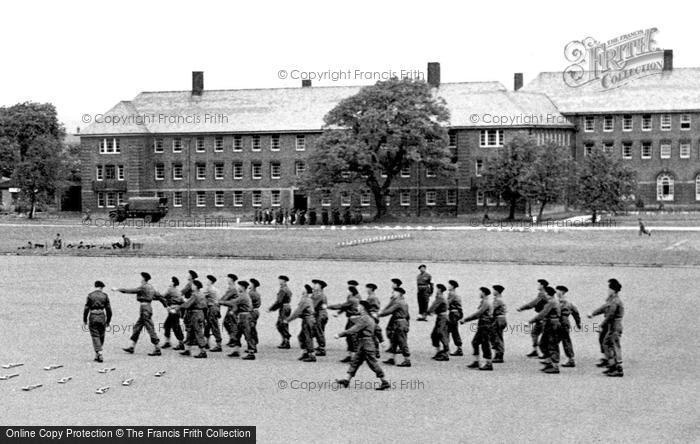
    The only difference to boarding school was the hours spent on the huge parade ground being drilled by a tiny sergeant major, less than five feet tall, whose mighty voice echoed not just around the parade square but on and beyond to the main Portsmouth road. As the eleven of us wheeled and drilled, and right formed, and fell into line, came to a halt, and about turned, a line of lorry drivers would pull up on the side of the road to watch us for their amusement, while they ate their sandwiches for lunch.

    Thus it felt all the more humiliating, when dreaming about the un-read pages of the timid love letter stuffed hastily into my battledress top to read in our break, that I missed a step, failed to hear the word of command and carried on marching in the opposite direction when the rest had about turned. Love letters – or what passed for them – were a fairly scarce commodity at cadet school, as we might as well have been in a nunnery, we saw so few men or even boys.

    The highlights of each term were the invitations to the house of an elderly couple who invited batches of Sandhurst cadets and us girls to hear talks on Moral Re-Armament. Their house just missed being stately, their servants were helpful, their food was heavenly, the worthy talks were utterly boring to frivolous young women, but the chaps might be interesting, we hoped. They never were but hope always sprang eternal.

    Apart from the daily morning parades, and the hours spent perfecting our drill and learning to shout commands that one day would be directed at our platoons when we took them on parade, we spent a great deal of time in lectures on arcane subjects like pay scales, army regulations, map-reading and leadership.

    No rifle drill for us, but instead lectures from a series of university lecturers on constitutional history, current affairs, scientific trends and something called Clear Thinking, which involved logic, and fallacies and syllogisms – all considered necessary for a well-educated officer back in 1957!

    Constitutional history was taught by the scion of a famous German intellectual family who’d escaped Hitler before the war, but the name of this gentleman was so long that generations of philistine and irreverent cadets just called him ‘Footy’, which he pretended not to know. He also pretended not to know that we never listened to a word he told us about constitutional history and the balance of power between the Commons and the House of Lords, but sat instead endlessly practising our signatures, or planning what to wear on our next trip to London.

    Scientific Trends was taught by another mid-European lecturer, only unlike Footy who’d grown up in England, this very gentle man had a very thick accent and a deadly monotone. He showed films to illustrate the latest scientific trends, and as his lectures were conducted in the cadet sitting room, where there was a film screen, we just curled up in an arm chair in the dark with a bar of chocolate, and usually dozed off.

    The rest of the syllabus was devoted to giving us an understanding of life, and the background many of our future charges came from, so we visited a Lyons Swiss roll factory to see what life on a conveyor belt was like, attended a Petty Sessions where we saw sad souls parade before the magistrates, and I felt like a voyeur, and worst of all, went to the Old Bailey. The day we were there we watched a murderer condemned to death, after a crime passionel. His voice after sentence had been passed was like the rustling of dry leaves.

    The most challenging part of officer training was the two days I spent in the cook house, discovering how hard life really was. My worst crime was to leave the potatoes so long in the potato peeling machine that they came out the size of marshmallows. The kindly cooks who actually had to deal with this catastrophe, covered up for me, and my copybook was not as blotted as it might have been.

    A handful of lectures on strategy and army organisation at Sandhurst were memorable for the lunch breaks when we mingled with the Sandhurst cadets. My most lasting memory is going for a punt on the lake, and it sinking, and my partner in this exploit – John Blashford-Snell, who has since become a famous explorer who did the first descent of the Blue Nile, explored the whole Congo River, and the Amazon, shooting many rapids unscathed – had to wade ignominiously back to shore, towing me sitting on the end of the leaky vessel.

    The one thing I did master while at cadet school were the steps to the Charleston, then back in fashion. I perfected the knock knees, pigeon toes and tight sideways kick by holding onto the back of my chair in the lecture room as we waited for the next lecturer to arrive. I practised my dancing until I was foot perfect, and by the time we Passed- Out was acknowledged as top of the class by my peers in this useful social accomplishment.

    At the end of this gruelling training, interspersed with dances, parties and uniformed guest nights – when we practised the solemn ritual of Passing the Port – you Never lift the decanter from the table and only slide it in the coaster from right to left so it goes around in a circle, using Only the right hand – five of us emerged as second lieutenants. And now reality hit us.

    Second lieutenants, we discovered, were despised by all, except new recruits. Everyone knew we hadn’t the faintest idea of what we had to do, from the regimental sergeant major down to the newest corporal. We were saluted, and called ma’am, but we knew that behind this ritual was the thinly concealed contempt of ‘old hands’. Wet behind the ears, my father would have called us.

    Many of the old hands had been through the war, like my motherly platoon sergeant who told me they knew D-Day must be in the offing, when they had to give up all the sheets from their beds, so that the huge new detachments of American soldiers arriving nearby could have the same sheets on their beds! And in the end, it was my platoon sergeant and the company sergeant major who taught me what I needed to know. Which seemed to be mostly to do what they told me!

    Their commands varied from: “Here’s the pay books to sign, ma’am”, to: “Time to inspect the recruits, ma’am”, to: “Time to have your tea ma’am”. My requests varied from: “What shall I do now, Sergeant Major?” to: “D’you know where Private Smith is ? She hasn’t made the tea yet.” A soldier’s life is terrible hard…with apologies to AA Milne and Christopher Robin

    To be continued

    Food for threadbare gourmets

    Raw food isn’t really my thing, but I found this recipe for mushroom pate rather delicious. Chop twelve to fifteen baby mushrooms or two really big portobello mushrooms, and marinate them in two tablespoons of olive oil and the same of tamari soya sauce, for half an hour. Put half a cup of walnuts in a food processor and pulse until slightly broken down, and add the mushrooms and a clove of garlic. Pulse until the mixture is slightly chunky and add salt and black pepper to taste. Good on crackers with a glass of wine, or sherry…

    Food for thought

    Clanmother sent me this time ago, and I love it. She wrote: ” J.R.R. Tolkien lost his best friends in WWI. One of my favourite quotes on war comes from his work, “The Return of the King,” ‘It is not our part to master all the tides of the world, but to do what is in us for the succour of those years wherein we are set, uprooting the evil in the fields that we know, so that those who live after may have clean earth to till. What weather they shall have is not ours to rule.’

  • A heroine, an eccentric, a Muslim attack and a paradise

    Image result for la times muslim sultans torchlight birthday parade

    A life – another instalment of my autobiography before I revert to my normal blogs

    The last holidays were spent in Kota Bahru, where my father had been exiled after another stoush with another commanding officer. In his game of snakes and ladders with his career, he was heading towards the top of the ladder again, when he landed on a snake, picked an unnecessary and unreasonable point of principle with the colonel, and slithered down the board again, missing out on a medal, ending up with a mere mention in dispatches and a posting as far away from the regiment as possible.

    Kota Bahru, up on the east coast near what was then the Siamese border, was idyllic, with long, unspoiled beaches edged with casuarina trees, and gaily -painted fishermen’s boats lined up beneath them. The men wore piratical- looking turbans in bright oranges and reds and blues, and the women’s clothes were richly- coloured unlike the drab, brown batiks of the sarongs on the rest of the Malayan peninsula. Thanks to a mixed Siamese/ Malay heritage, the women here were famed for their beauty, combining the voluptuousness of the Malay with the sculptured bone structure of what are known as Thais now.

    We lived in a pink stucco house near the mouth of the river, some way out of the town, and not far from the airfield which had seen hard fighting when the Japanese landed. The house looked across at a peaceful little kampong beneath the trees. Great clumps of purple water hyacinth often drifted slowly down river, and we watched the bronzed, brown bodies of children jumping and playing in the water. Early in the morning, or at dusk, the girls would stand and discreetly bathe beneath their sarongs, and their grandfather sat and fished all day, a still, meditative figure across the water.

    The house still bore the machine gun holes from twelve years before when the Japanese had made their sudden appearance from the sea at dawn in December 1941. The hub of the community we were now part of, was the Kelantan Club, where Europeans gathered to meet each other. They were a mix of the local judge and policemen, diplomats and doctors, nurses and rubber planters, and representatives of various historic far eastern trading houses.

    The rubber planters had mostly lived here since before the war, and were in many ways, thirtyish Somerset Maugham characters. They had all been interned together at Changi Camp in Singapore during the war, and those who had survived were a close -knit band of brothers.

    There was Ted Kurtain, famous for swearing, whose waterfall and rock pool was a favourite picnic spot for the favoured few, including us. His closest friend was a dignified quiet man, Hugh Jackson, who had had a Thai mistress for nineteen years before the Japanese came. She waited for him during the war years he spent in Changi, and they were re-united when he came back to his rubber plantation.

    Deaf to the misgivings of his well- connected English family, he sent his mistress to a Swiss finishing school, and then married her. On visits to his spacious bungalow, filled with books and English china and antiques, she entertained us as though it was an English country house party. She was beautiful, dignified, her grooming immaculate, and exquisitely dressed.

    Alf, one of the two eccentric local police chiefs, had a head as bald as Yul Brynner’s, and underneath his intimidating exterior was a gentle, kind and lonely man. When his mandatory leaves came around every three years, he took a boat to Aden where he disembarked and bought a flock of goats. These he would drive north up the Arabian Peninsula, using the goats as food and currency, and when he reached Port Said took a boat to Liverpool.

    Here he would spend a fortnight with his sister before returning to his post in the East. The other police chief was a much younger Englishman who had converted to the Muslim faith and kept his distance from we alcoholic and godless infidels!

    As well as the Kelantan Club, the other meeting place was the Palm Court Hotel, a complete contrast to the old wooden club house with its planter’s chairs and rattan furniture. Palm Court was all concrete and tiles and chrome, and run by Mammy, a giant White Russian lady in late middle age. She wore ankle length caftans before they had been invented, had frizzy, short hair and thick pebble spectacles. But behind her facade of jolliness, I noticed loneliness and sadness.

    When writing a blog, I pieced together the remarkable story of this unusual woman. Luba Ruperti was a White Russian born in 1896. She fled with her parents from the Bolshevik Revolution in 1918 via Shanghai to the safety of British Singapore, after her sister had been killed by a revolutionary mob.

    In those years before the war, Luba would have felt safe in this seemingly impregnable British colony. She married a Russian rotter, who bankrupted them both and left her. Then after their grim appearance in Kelantan, the Japanese reached Singapore, and in that mayhem of murder and bombings, killing of patients in hospital beds, raping of nurses, and killing of all Chinese, somehow Luba got to the dock and managed to board SS Kuala. It was overloaded with five hundred or so other women, children and babies, including a number of Australian and New Zealand nurses.

    The next day the Japanese sank the ship, setting it on fire and mothers threw their children overboard trying to get them into the rafts below. As women and children struggled in the sea, wounded, bleeding, drowning, trying to hold onto rafts and floating debris, the Japanese machine-gunned them in the water.

    Those who survived terrible thirst, hunger, horrendous wounds, madness and burning sun to make it to shore, were machine gunned in the water and as they staggered over rocks and up the beach into the shelter of the trees. They had reached Pom Pong Island which had no food, and only a tiny source of fresh water, after three hours in the sea. “My fat be blessed for that!” Luba told a reporter after the war.

    A few days later the SS Tandjong Pinang arrived at Pom Pong Island from Sumatra to rescue the small band of between a hundred and a hundred and fifty survivors from the original five hundred. Hardly had they embarked than the Japanese were back, and sank this ship too. Luba was one of only handful of survivors of this second disaster.

    The few the Japanese captured on shore ended up suffering and usually dying in the terrible conditions of internment. Luba got away, and somehow ended up in India, via Ceylon, where she made her living cooking for thousands of U.S. troops in Delhi, before returning to Singapore after the war.

    While in India, in February 1943, Luba gave her great gift to all those who had died, suffered or survived. She had compiled a long list of the names of the people who had boarded the SS Kuala at Singapore and who had survived to board the SS Tandjong Pindang. In the chaos and panic during the bombing of the docks in Singapore as frantic passengers tried to board the ship, no records had been taken.

    No-one knew who had boarded, escaped, drowned or survived. Families would never have known if their loved ones were still alive in some corner of the world. Luba must have started compiling her lists during their terrible ordeal on Pom Pong island, as there was no way otherwise that she could have known so comprehensively who was there.

    It was an act not just of heroism in those hellish days, but of responsibility and altruism in conditions when it could very well have been everyone for himself. Her act of witnessing and recording rescued both the dead and the living from oblivion, telling their story – a story that no one else was able to share with the world for another three years when the war ended, when a pitifully small handful of survivors could then tell of their sufferings.

    In an archival story I found a reference to her being back in Singapore by 1958, and by the mid-1960’s nearing seventy, she was: “utterly dependent for her living by making and selling exquisite dolls dressed in the costumes of old Russia, complete with tiny earrings, bracelets and rings on the dolly fingers,” according to quotes from a story in the Singapore Straits Times. The same archival entry comments that: “she appears at this stage of her life to have been still the exuberant woman who had lived through so much fear, chaos and loss without losing her innate spirit”.

    This feisty open-hearted woman… who never seemed to be defeated by the perils and tragedies of her extraordinary odyssey from Czarist Russia to post- Colonial Malaya, via Shanghai, Singapore, Indonesia, India and back to Singapore, surviving death, abandonment and poverty, loneliness, bombings, torpedoed ships and dangerous journeys was the person most people thought was a joke.

    But in spite of Mammy’s joyful welcome at the Palm Court, most people preferred the relaxed, slightly ramshackle atmosphere of the Kelantan Club. Everyone turned up for the weekly cinema show on Friday when an old black and white film was shown on an ancient and not very efficient projector.

    On Saturday nights, we enjoyed Scottish dancing, and there was a full complement of balls to mark every possible occasion. At Christmas I was asked to paint two huge festive murals on the walls, with red-coated Father Christmas, reindeers, sleighs, snow and the rest.

    The most enjoyable part of this creative endeavour was at lunchtime when all the chaps would drop by to chat and share a fresh lime with me… to be the only unmarried female under forty in a town crammed with young men was a fate worth enjoying! None of these nice young men ever crossed the line with a naive and ignorant seventeen- year -old schoolgirl and they treated me with respect and consideration.

    By contrast, one evening we left our peaceful riverside to go into Kota Bahru and watch the colourful Sultan’s Birthday Torchlight procession. My small fair- haired brother sat on my father’s shoulders so he could see. When we’d finished watching we turned to go back to the car, and as we pushed our way through the tight throng of mostly Malay men I felt a slight ripple as though they were converging on us. With my brother high on my father’s shoulders acting as a beacon, they pressed up against us as we struggled along in single file, my father, I think, unaware of what was happening behind him. My stepmother clung to him and behind her, I clutched her hand tightly.

    I became the focus of this angry hostile crowd. They had hands and knowing fingers so hard I felt I was being punched as they prodded, pinched and poked me, finding soft places that no-one had ever found before. I was terrified and humiliated at the same time. When we got to the car and out of the melee I was too shocked and shamed to mention this ordeal to my parents.

    It was only fifty years later, yarning with my brother, that I talked for the first time of what had felt like a shocking and unprovoked attack by angry hostile Muslims… was it my sex, my race or my religion which provoked it – or all three?

    One memorable day the British Resident invited us to join him and General Bourne to sail out to the deserted Perhentian Islands. Thousands of brilliantly coloured and richly patterned tiny tropical fish swirled through the clear turquoise waters, so clear that thirty feet deep looked like three. A solitary fisherman climbed a coconut palm for us to drink the ice- cold coconut milk in the heart of the great green globe. No other soul was there. It seemed like the most beautiful place on earth, untouched, unspoiled, a pristine, perfect paradise.

    Yet now, it’s impossible to find a photo of the islands which doesn’t have hotels and boats and people and jumbled sand from footsteps on every silver beach. Shortly after this idyll, we returned to Penang and the Runnymede, which felt like home, before setting sail for England in a Blue Funnel ship, where we enjoyed utter luxury once more.

    I look at old photos of that time and the memories return so vividly – my stepmother wearing a purple linen dress which looked wonderful with her black hair and pale skin, sitting in a rattan chair chatting to charming Tungku Abdul Rahman, the ‘father’ of Merdeka. They both held the inevitable cigarette between their fingers, he with his de rigueur glass of orange juice for a Muslim in the other hand, the orange juice fortified, my stepmother told me with a laugh, with a big slug of whisky.

    There’s my father, hot, tired and unkempt, squatting on a beer box in the jungle stripped to the waist, about to eat his bread and cheese and drink his beer, the food he had dropped into the jungle instead of army rations… nearby butterflies hovered over the sweaty socks he’d just taken off, savouring the delicious pheromones.

    And my small half- brother and I, me standing to attention in a new dress I was so thrilled with, at a parade on the padang at Kota Bahru, and he, sitting cross-legged at my feet, looking puzzled, not sure what he was supposed to be doing.

    Penang is like most thriving eastern cities these days… as busy, crowded, built up and polluted as any western city – no longer the elegant peaceful place I once knew. Yet back then as we sailed away from Penang, and it faded into the misty blue distance my heart hurt so much that I couldn’t bear to say good-bye to all that beauty, and I promised myself I would return. But I never have.

    To be continued

    Food for threadbare gourmets

    Re-cycling is one of my favourite hobbies, whether it’s re-cycling from the rubbish tip or leftovers from the fridge. In this case, I had a cup of leek and potato soup left over from the day before. Waste not, want not – I checked out a pea soup recipe, and found that leeks were one of the ingredients.

    I also had a big cup of steamed cauliflower in the fridge, so tipping it into the soup, I added a good gob of garlic from a jar, a couple of cups of good chicken stock, salt and pepper, and when hot, two cups of frozen peas. When the peas were cooked in a few minutes, I whizzed it all smooth in the stick blender, and hey presto, we enjoyed a delicious pea soup that took only five minutes or so to cook.

    I love croutons that always cheer up a soup, but didn’t have any good sour dough bread for them, only soft white sliced sandwich bread bought for sandwiches. I simply cut a slice into four and fried the pieces in olive oil. Sprinkled with salt, they were better than croutons, crunchy and satisfying.

    Food for thought

    Nothing living should ever be treated with contempt. Whatever it is that lives, a man, a tree, or a bird, should be touched gently, because the time is short. Civilization is another word for respect for life… Elizabeth Goudge , writer

  • Over the top

    Image result for images battle of somme A life – this is another instalment of an autobiographical series before I revert to my normal blogs.

    My step-grandfather had been a very successful business man, and a member of the Liberal Council, who in the 1945 general election, just failed to get elected to Parliament as a Liberal. “I nearly had them,” he would regretfully say to me, about the tough Geordies who he wooed in his homeland of Northumberland.

    Shortly after the election, while on a lecture tour in the US, the stock market crashed, and he lost all his money. The small amount he managed to salvage when he returned, he invested in South African gold which gave him an opportunity to carry on an enjoyable, long-running and acrimonious correspondence on the immorality of apartheid with his agent in South Africa.

    He had suffered from shell shock for many years after the Great War of 1914-18, and from the results of his dreadful injuries. He and his wife were both bitter about it, she because of what she said she had to put up with, he because he felt he got no sympathy or support. As a young officer in the Northumberland regiment which was the first to go over the top and step out towards the German lines on the morning of the Somme battle, he was an irresistible target in his breeches and officer’s Sam Browne belt and holster, and was shot in the face. There were 60,000 casualties on that first day of battle, and he was one of them. Sixty per cent of officers died that day, a much higher number than their men.

    Recovered, a year later in the muddy martyrdom that was Passchendaele, he was buried for two days in a bomb crater, and when dug out, grabbed a helmet filled with liquid, gulping it down to quench his thirst. It was filled with a noxious mix of battlefield poisons which damaged his insides, and he suffered the effects of this for the rest of his life.

    He was famous in the family for being bloody-minded, and his injuries may have had something to do with this. One story about him was how after an argument at lunch with a few cronies, over the meaning of Magna Carta, he stormed off to the British Museum to check on the wording. On arrival, after finding his way through the labyrinths of the Museum, he discovered it was not on display. He wrote a biting letter to the Director, who replied saying the matter had been rectified.

    Uncle Bill once again made a sortie to the Museum, and finding Magna Carta on a lectern, wrote another critical letter to the Director. The next time, when he visited to check on the situation, matters were only slightly improved. There was a translation now available at the side of the famous document, but Uncle Bill was still not satisfied. On his last visit, everything was finally arranged to his satisfaction, with the lectern lowered, a translation out, and a chair provided on which to sit and read the manuscript. In these days of tight security, it’s probably back in a safe.

    In his retirement he went to every rugby match of note at Twickenham, and attended every cricket test at Lords or the Oval. Afterwards, often accompanied by his son and grandsons, he would call in on his wife for a generous high tea of toasted, buttered tea-cakes and rich fruit-cake, and everyone would be regaled with the stupidities and missed opportunities of the occasion, rugby or cricket.

    He would also have taken the number of any bus which had been speeding, was late, had crashed the lights or had a conductor who was not up to speed. The family suspected that the local police station probably had a file especially for his complaints.

    But it was still politics which would cause his ire to rise more quickly than any other subject. As a Liberal he was often at odds with the rest of the family who were Conservative to a man, so there were plenty of bones to pick over. I could never follow a word of these heated debates.

    They also caused his wife to say after he had left: “now you know what he’s like… ” as if anyone was in any doubt. He and my father tolerated each other – my father once told me he was shallow, while Uncle Bill wrote to me when my father died saying he was his own worst enemy. This hurt me, whatever the truth of it.

    When I was a late teenager and in my early twenties we still rendezvoused in London several times a year… we’d go to the Tate or the National Gallery, and then he’d take me for lunch to the famous Simpson’s- in -the- Strand where we feasted. Huge haunches of roast beef and Yorkshire pudding or roast lamb were wheeled up to the table on silver domed trolleys and carved for us in the dining room which was unchanged since 1828. This was followed by delectable treacle pudding… (P.G.Wodehouse loved Simpson’s too. A hundred years ago he wrote:’ Here, if he wishes, the Briton may … stupefy himself with food. The God of Fatted Plenty has the place under his protection. Its keynote is solid comfort. It is a pleasant, soothing, hearty place – a restful temple of food. No strident orchestra forces the diner to bolt beef in ragtime… There he sits, alone with his food, while white-robed priests, wheeling their smoking trucks, move to and fro, ever ready with fresh supplies.

    Another favourite foodie place we visited was Charbonnel et Walker in Bond Street, chocolate shop extraordinaire since 1875, and favourite rendezvous for our family of chocoholics. In those days the truffles were numbered, and my memory is that my step-grandmother had a passion for number thirty-eight. I too loved number thirty-eight, and was mightily put out when my Christmas present was crystallised pineapple lumps instead of the truffles. We were in good company you could say, as other chocoholics who devoured these goodies included not just the Royal Family, but Noel Coward, Lauren Bacall, Sir John Gielgud and Princess Diana to name a few.

    Every Christmas Uncle Bill gave the family a large, wooden box of Fortnum and Mason crystallised fruits laid out in rows on lacy paper doilies. Nothing since has tasted as delicious as those goodies. The exception to the crystallised fruits was when we lived in Malaya, when he instructed Harrods to send ten pounds of hand-made chocolates especially packed for the tropics in a very large tin, and lined with tin foil to protect them from ants, cockroaches and heat. Those were the days …

    The best gift he ever gave us was for Christmas just before we went to Malaya. As well as both her parents, my stepmother had invited her brother and his wife, and her two nephews who she loved almost as much as her only son. Uncle Bill arrived first, full of enthusiasm and bringing with him two new inventions.

    The first was a Black and Decker hedge cutter and he couldn’t wait to use it on our miles of privet hedge surrounding the front garden, the back garden, the vegetable garden and the grass tennis court. Alas, before long the air was blue with curses and smoke… he had chopped through the long electric cord dangling from a socket inside the kitchen window and that was the end of the hedge cutting project.

    The other item he brought with him changed my life. It was a box of detergent called Tide which had just come on the market in England. It was the first heavy-duty synthetic detergent and had been invented in America, where it had been available since 1946.

    Since it was my job to do the washing- up, and there were eleven of us for every meal that Christmas, this was a gift beyond price. I had always been squeamish. But now, instead of fishing around in revolting greasy water with a feeble mop-head on a stick, here was a magic white powder which dissolved the horrid mess and washed away all the nauseating aftermath of gravy, grub and grease! Hallelujah! Joy to the world, life had really changed for the exceedingly better.

    And it was to change even more when we packed up our lives again six weeks later, and embarked on the adventure of Malaya during the Emergency – called the Emergency so that rubber planters could claim on insurance for their losses to the communist bandits, whereas insurers are absolved from paying out in a war!

    More to come, as we used to write at the bottom of each page in the old days of print newspapers

    Food for threadbare gourmets

    Apples are back! it’s that time of year when the shops and way-wide stalls are loaded with freshly harvested apples-my favourite fruit. I love apple cakes and apple puddings, and this one is a goodie.

    Peel a pound of Bramleys or Grannie Smiths apples and cook in a saucepan with 3 ounces of brown sugar and approximately 2 tablespoons of water. Simmer gently until soft, and then arrange this mix in the bottom of a greased baking dish.

    In a mixing bowl, cream four ounces of soft butter and four ounces of caster sugar until pale and fluffy and then beat in two large eggs a little at a time. When all the egg is in, carefully and lightly fold in four ounces of ground almonds. Spread this mixture over the apples, and even out the surface with the back of a tablespoon. Then bake on a middling shelf in the oven for exactly 1 hour.

    This delicious pudding is good eaten warm or cold – with cream. Once cooled, it will keep in the fridge for 3 or 4 days

    Food for Thought

    An oldie, but a goodie –An old Cherokee is teaching his grandson about life. “A fight is going on inside me,” he said to the boy.

    “It is a terrible fight and it is between two wolves. One is evil – he is anger, envy, sorrow, regret, greed, arrogance, self-pity, guilt, resentment, inferiority, lies, false pride, superiority, and ego.” He continued, “The other is good – he is joy, peace, love, hope, serenity, humility, kindness, benevolence, empathy, generosity, truth, compassion, and faith. The same fight is going on inside you – and inside every other person, too.”

    The grandson thought about it for a minute and then asked his grandfather, “Which wolf will win?”

    The old Cherokee simply replied, “The one you feed.”

  • My army life

    A life – This is the tenth instalment of an autobiographical series before I revert to my normal blogs

    Illustration from the post “My army life”

    I had left the convent and started the state high school at the same time that an army quarter became available at Catterick Camp, where my father’s cavalry regiment was stationed. Not only was it a place where thousands of young men trained and soldiered, it was also home to generations of children like myself, who grew up with the names of old battles in our ears. Catterick was divided into smaller camps, each one like a small town, and each with its own name, Cambrai, Kemmel, Somme, Ypres. My father’s regiment occupied Menin Lines. The roads were named after Generals. We lived in Haig Road, next door to French Road, and then Rawlinson Road. Long before I knew anything about the First World War, I knew all the names and places.

    We children also knew the regiments our fathers belonged to, and took as much pride in them as though we were serving in them ourselves, indulging in the same military snobberies that our parents did. Those of us with fathers in cavalry regiments felt infinitely superior to the rest. We acknowledged girls with fathers in infantry regiments, but felt only pity for children with parents in corps, so that Caroline, who lived in the largest house in the street because her father was a brigadier, was somewhat patronised by we children, because her father was ‘only’ in the Royal Signals.

    As I walked home from school, and passed each army quarter I would amuse myself by chanting under my breath the names of the historic regiments that each inhabitant belonged to… 17/21st Lancers, Royal Signals, 15/19th Hussars, Royal Army Service Corps, 12th Lancers, Fifth Inniskilling Dragoon Guards, (Captain Oates of the Antarctic’s regiment), and the 14/20 Kings Hussars.

    My father had given me all Wellington’s Peninsula campaigns to read, including Captain Titus Oates’ favourite reading in the Antarctic -Napier’s History of the Peninsula Wars – so I was well up on the history of many of these old regiments. Conan Doyle’s tales about Sir Nigel and the White Company in medieval France, combined with Joan Grant’s books on Egypt and re- incarnation, The Three Musketeers’, The Scarlet Pimpernel’, ‘I Claudius’ and lots of John Buchan were also part of my eclectic reading list.

    Rare excursions to the cinema were so exciting. I was allowed to see ‘Hamlet’, ‘Henry V, and ‘Oliver Twist’, and it was considered that ‘Scott of the Antarctic’ was also suitably educational. The moment when they killed the ponies – rather sanitised, in hindsight – is preserved in amber in my memory. Forget the men, it was the ponies I cried for.

    Like everyone else, my father had his own batman, who, like everyone else’s batman, did lots of domestic chores like cleaning the silver, fetching coal, chopping wood, and even vacuuming, when he’d finished polishing brass buttons and chain mail, leather Sam Browne, shoes, long, leather Wellington boots and silver spurs.

    Maloney was a tall gawky Irishman, with buck teeth and a drinking problem. I knew this because when he arrived at eight in the morning, I would smell it on his breath when I sneaked out to the scullery where he was polishing shoes, to ask him the time. The bus went at eight twenty- five, and there was just time to walk the mile from the bus-stop the other end to get to school for nine o’clock.

    th My parents had trouble getting up every morning, and though I was expected to cook breakfast for them at the weekends, my stepmother became angry if I started to cook the breakfast during the week, as this implied criticism of her. From seven- thirty every day of my life I hovered in the kitchen in an agony of suspense, as the minutes ticked by, getting to the point where I would miss the bus. As long as she arrived in the kitchen by ten past eight there was just time to gobble the food, grab my coat and satchel and run.

    I prepared as much of the breakfast as I could, to make it a lightning cooking operation when my stepmother appeared, but too often I bolted down the bacon, egg, tomato, and fried bread so I felt sick as I ran to the main road for the bus. I begged just to have toast for breakfast, but my stepmother was adamant that we should all have a “good breakfast”.

    I don’t know how much good it would have done, eaten at that level of tension. At the other end at school, there was disgrace, and punishment for being late, as if children had any control over their comings and goings. There were also the embarrassing interviews with the headmistress over why I wasn’t wearing school uniform… I walked around in a blue tweed skirt when everyone else was kitted out by their proud parents in the navy school uniform. When I finally got mine it had to last for the next three years through five inches of growth and two more schools, both with brown uniforms, not navy blue, and I darned the seat until the repairs were breaking away from the worn, shiny fabric.

    This was a humiliating experience for a suppressed fashionista who overheard sotto voce remarks from clever classmates about genteel poverty, and whose siblings at private schools were immaculately equipped. I only had thin white cotton socks even in winter, and my feet were so frozen in the north country cold that I was in real pain while they thawed out at school. The excruciating chilblains which covered my legs and fingers were partly from this I suppose, and partly from magnesium deficiency, probably the result of the level of tension I lived at.

    Maloney, the batman, was terrified of my parents too, and he would silently show me his watch as the minutes ticked by. Whenever he went home to Ireland on leave, he couldn’t face coming back, and would go absent without leave until the Military Police found him in some Irish pub, and returned him, and he would then serve his time in “the glasshouse”, as my parents called it, though I never knew why.

    And then, he would re- appear one morning, looking sheepish. I always missed him, as well as his watch, when he went on leave. During the holidays, there was a different sort of tension, both in the morning and after lunch before my father went back to his office. Every officer carried a swagger stick in those days, and my father was always mislaying his. If I was around I was expected to look for it, and find it. The dreaded cry would go up: “I’ve lost my stick”, and I’d fly into frenzied action, not always successfully.

    The children who lived around us fell into two, very distinctive groups just after the war, those who were afraid of their parents and those who weren’t. The lucky ones had fathers who had bonded with them again when the war was over – these fathers had usually been in non-combatant corps. Others had fathers like mine who had fought bloody battles for six years, and who now spent just as many years recovering from the war, went on having nightmares regularly, drank heavily to deaden the pain, and often treated their children like the soldiers in their command. They’d be treated for post- traumatic stress disorder in these more enlightened days.

    Many of us had post-war brothers and sisters who had displaced us. I recognised, even then, the faint air of anxiety in the mothers of several of my friends who were torn between alcoholic husbands- sometimes violent- their first pre-war child, and the new baby.

    Like me, the older child would be shunted out to Sunday School, and sent to do the weekly shopping. Like me, the older child would have chores in the house to do, while the other group were out playing. We tended to play with the children in our own group. It was hard to explain to children who had tolerant or reasonable parents why we couldn’t do such and such, or why we were so terrified if we were late home, or tore a dress, or lost a hair ribbon.

    In those days, I never came by elastic bands to hold the ribbons on my plaits. I don’t even know if they were available, or whether my stepmother had decided they were an unnecessary extravagance when we were hard-up. Whatever the reason, my hair ribbons were always slipping off my plaits, and I spent hours re-tracing my foot-steps, looking for a crushed bow on the pavement. The children with parents like ours understood instantly when we went into panic over some trivial incident or couldn’t invite them home.

    We all wordlessly envied the other group, whose individuals we sometimes described as being “spoiled”. Children like William, for example, whose mother doted on him, and Priscilla and Jane whose parents never minded if they brought us home, Caroline, an only child whose mother encouraged her to invite me to tea and to play. I was allowed to have her back for tea once, and it was so stiff with us all trying to behave like a relaxed, happy family that I never tried again.

    Melanie and her brother had horsy, hunting parents, and whereas Melanie didn’t mind riding, her seven-year old brother Conrad was permanently in disgrace because he was terrified, and often vomited before his riding lesson. This didn’t save him. Their mother spent most of her time hunting and judging hunter trials. Their father became an MFH (Master of the Fox Hounds) when he retired from the regiment. I saw Melanie’s wedding photo in Tatler at fashionable St Margaret’s, Westminster, years later. Her eyes were now ice-cold blue like her mother’s, her face a frozen mask.

    Moira was such a wreck at eight years old, that my stepmother recognised it, and told me to be kind to her because she had a hard time. She never defined what the hard time was, though I knew. The awful thing about it was that none of us children could stand Moira because she personified how we felt at our very worst. And she was like it all the time. Her mother was tall and elegant, with a beaky nose and long red painted nails, and was like a vulture pecking incessantly at the truly wretched child. Today we’d call it emotional abuse, and it’s still the easiest form of sadism to inflict on a child without being discovered.

    I myself seemed to spend a lot of time in disgrace, which meant being banished up to my bedroom, until given permission to come down. This sometimes meant all day, and missed meals. It was often freezing in winter. I identified deeply with David Copperfield sitting up in his room, terrified of Mr and Miss Murdstone downstairs. Sometimes I wasn’t told when it was okay to come out of banishment and if I came out too soon, I wasn’t penitent and if I came out too late, I was sulking.

    My misdemeanours were trivial, like the problem with my hair. Every Saturday, after it was washed, I had to towel it dry. This meant I was left with a headful of tangles looking like Medusa. The bakelite combs of those days were brittle and broke easily, and time and again, a tooth would snap. And time and again I was in disgrace for this.

    Another time I was confronted with an old French exercise book my stepmother had found while I was at school. On the last blank page, having no other drawing paper, I had spent a happy Saturday afternoon drawing an oak tree in the field next door. She insisted I must have done it during a French lesson, and when I asked her why she didn’t believe me, she said if I had done it legitimately, I couldn’t have resisted boastfully showing it to them. At this I knew I was beaten. When I cried for hours in my room, I would try to console myself by promising myself that one day I would write about it.

    It was now that I became a ward of court. If it was a bad time for me, in hindsight I realise it was also bad for my parents. With their money draining away on court cases, in which my father had obstinately refused to concede that I should see the mother I never mentioned (of course not, I thought she was a taboo subject, and that no-one knew where she was), he took refuge from that and everything else, in heavy drinking.

    This was an easy thing to do in good company in a rich cavalry regiment after the war. But this left my stepmother short of companionship as well as money in the snobbish society of the regiment. I was at the end of this chain of despair. I knew my stepmother was depressed when she came down to breakfast wearing powder, but no lipstick. She was particularly depressed when she wore a brown and fawn checked, swagger jacket which didn’t suit her, and no lipstick. The tip of her nose used to turn pink when she was angry. I carefully watched for all these signs.

    Christmas parties were a feature of childhood social life in this group. I used to feel sick when I woke in the morning, and knew the day of the party had arrived. We would arrive and be taken upstairs to divest ourselves of our coats. I had long since grown out of my lovely blue coat with velvet collar, and was down to a navy gaberdine school mac. Each little girl would surreptitiously size up each newcomer as she stripped off and revealed her party finery. The fashion was for velvet dresses, and ballet shoes while all I had was a summer dress, and indoor shoes, a deprivation hard to forget even as we played party games and danced to the gramophone.

    One of the best games was called Kim’s Game. A tray laden with small objects would be laid in front of us, and then after a few minutes, taken away, and we had to remember everything, and write a list. I nearly always won this game. We played charades too, and the game ‘Murder in the Dark’, and, best of all. Sir Roger de Coverley, danced just before the party ended, with the nannies and other parents come to collect their children, clapping from the side.

    Then, out into the dark and the cold, to walk home alone, the ordeal over until the next one…back home to wake to the faint sounds of reveille drifting across the sports fields from the regimental barracks, and hearing the haunting strains of the last post as I waited for sleep at night.

    To be continued – next – The pleasures of London

    Food for threadbare gourmets

    After sampling a Dutch neighbour’s gingerbread, I felt I had to rise to the occasion when she came to tea with me. I used a favourite and easy friand recipe. In a bowl place one and a half cups of ground almonds, and the same of sifted icing sugar, half a cup of flour, and combine. Add six lightly beaten egg whites, stir together, then stir in 100 gms of unsalted melted butter and a tablespoon of grated lemon zest.

    Spoon into a greased muffin tin and bake for 20 to 25 minutes in the oven at160c. The friands should be springy to touch, and moist in the centre. Dust with icing sugar and devour!!! This amount makes twelve.

    Food for thought

    Someone I loved once gave me a box full of darkness.

    It took me years to understand that this too was a gift…

    from The Uses of Sorrow by Mary Oliver

  • Ducal splendour and daily deprivation

    On my tenth birthday -wearing my pearls Inline image 1

    A life – This is the eighth instalment of an autobiographical series before I revert to my normal blogs)

    There was a legend that there were no birds in Belsen, that they had fled this dreadful place. That I don’t remember, but I do remember the strange energy, a sense of shifting sands, and unknown menace. The Germans seemed hostile (understandably), and refugees from East Germany trudging past were distant, pre-occupied with despair.

    And as well as the British Army, there were also posse’s of Yugoslav soldiers in navy-blue greatcoats, armed with rifles, who constantly patrolled the place, guarding it, though I never discovered what they were guarding it from or why they were there. They had a reputation for being dangerous and unpredictable, and every now and then, one would shoot himself or a comrade.

    And our succession of German maids left constantly, Helena after stealing tea, Elsa taking nylon stockings, Hilde our meagre meat ration, and finally Hannah who left to get married; Kuntz, the big taciturn batman, suddenly disappeared in a rush of joy, when he had word that his wife who he had thought was dead, had surfaced in Berlin.

    Behind our house was a pine forest, rich in bilberries, where the local Germans would come in autumn to pick this source of food in a starving land, and beyond that, a mile down the road, was the DP’s camp. Displaced Persons were the survivors of Belsen, still waiting for passports or permission to make their way back home across the bomb- blasted continent to find their scattered families.

    One fine summer’s day they torched the pine forest, and our homes were in danger until the fire was checked. The DP’s had set the forest on fire as a desperate gesture to show their frustration and get some action from post -war authorities. I don’t think it made the slightest difference to their plight.

    The Allied authorities were dealing with twenty million people trying to get back to homes and families after the war. Many had no homes, families or countries to go to. The problem grew under our eyes, as refugees, another two million in the next four years, fled from Eastern Europe and the Soviets. They came straggling down Hoppenstadt Strasse carrying bulging bundles wrapped in blankets on the end of sticks hoisted over their shoulders like pictures of Dick Whittington.

    Unlike him they were not seeking streets paved with gold, but something more precious – freedom. Sometimes they were found sleeping or sheltering in our empty garages, or taking desperately needed clothes from the washing line, and were hurried on or arrested by the implacable Military Police.

    The currency was changed from the cardboard money we knew, to the new currency, the Deutschemark. This triggered the months of tension, which even we children were conscious of, when Russia began the process of harassing and then blocking all traffic in and out of Berlin, by road or river. This finally culminated in the historic Berlin Airlift to save the citizens of West Berlin.

    Stalin‘s intention was to starve and freeze the Berliners into submission and oust the Allies. He failed, thanks to the extraordinary air-lift when planes flew in and out of Berlin every four minutes bringing in food and fuel for over two million Berliners, and World War Three was averted.

    The conquerors shared the hardships of ravaged Europe. Our meagre rations were delivered once a fortnight in a cardboard box. I remember my stepmother looking at a small pile of cucumbers, our vegetables for the next two weeks, and asking in despair what we could do with cucumbers for a fortnight. We only ever had revolting, evaporated, tinned milk to drink for there was no organised milk supply and no pasteurised herds.

    Every night for two hours from six till eight the electricity was switched off to save power, and we sat in the darkness playing games like twenty questions to while away the pitch- black hours. There were no candles. Our puppy seized the darkness as an opportunity to chew the rubbers/erasers my father used for the crossword.

    The Daily Telegraph crossword was one of the most popular diversions in the regiment, and I achieved minor fame and popularity in the officers mess then. Whoever wrote the crosswords had a penchant for using ‘Alice in Wonderland’ and ‘The Wind in the Willows’ for clues, and a phone call would come from the mess for me. This would then put my parents on to the clue if they hadn’t already. In retrospect, I think there must have been a daily sweepstake for first past the post, judging by the competition to get the thing finished.

    The officers mess was the Duke of Hanover’s palace, a little way out of Belsen, and splendid it was. (What had he made of the concentration camp on his doorstep?) We went there occasionally for drinks before lunch on Sundays, and for the children’s Christmas Party, when we played musical chairs in the ballroom under the shining chandeliers, slipping and sliding on the marble floor while little gilt chairs were subtracted from the circle. Then, when the party ended, like nearly every other party of my childhood, we danced Sir Roger de Coverley, with all the parents standing round clapping in time to the music.

    Some weekends, we drove out to the Duke’s hunting lodge in the middle of a pine forest, where deer darted out onto the road, and wild boar lurked. This gemutlich little pile was now the officers club, run by a friendly middle-aged German couple. Had they always been the stewards of this place, I wondered later? Did they transfer their loyalties to their new employers in the interim, and hold the place in trust until the Duke regained his ancestral homes – if indeed he did?

    Anyway, their speciality were delicious, lavishly sugared doughnuts, stuffed with butter icing. The glory of these doughnuts in a life of total gastronomic deprivation and war-time rations was utterly memorable (Did the Duke enjoy them too, before and after us?) My parents managed to get some of these dough-nuts for my tenth birthday.

    It was the first birthday I had ever spent with my father, who went off to war when I was ten -months- old and my mother was pregnant with my sister. The previous year when I was nine, we were still in Yorkshire while he was battling his way to Belsen. He seemed more excited than I. The night before, when I went into the garden to say good-night to them, sitting in wicker chairs with their gin and tonics, I was allowed to stay up beyond seven o’clock, so my father could give me my birthday presents.

    He was too excited to wait until morning. He gave me a string of pearls and a black fountain pen with a gold clip and nib. When the next birthday came, it was different, for he and my stepmother had a baby son, and my sister and I were rather a chore by then.

    My stepmother had learned German and French at school, and rather fancied herself as a linguist. So she seized this opportunity to try to turn us into cosmopolitans too. Thanks to the puppy we’d become friendly with the local German vet from Bergen village five miles away. His twenty year old daughter Suzanne became our German teacher, and she came every Sunday afternoon to teach us nouns and verbs and the endless der, die, and das, to be sorted through and applied to each noun.

    She left us with piles of homework to do, and extraordinary medieval -looking text books with print that looked like something straight off Caxton’s press. The print was extra black, and the S’s and F’s and W’s and V’s expressly designed to trick baffled and ignorant nine and ten- year- olds.

    She also told us how lucky we were, because her younger sister Hildegarde and brother Carljurgen had no paper and pencil at school, just broken, leftover stubs, and had to write in the margins of printed books when they wrote answers and essays. I didn’t always feel lucky. Her father, Herr Muller, called regularly, whether our various dogs needed his attentions or not. He regarded my parents as friends – or at any rate, their gin bottle.

    In return for the generous helpings of gin he sipped – unobtainable in civilian Germany – he would bring my stepmother a specimen of the many extraordinary varieties of exotic orchids which he grew. I thought they were awful, not like flowers at all, but fantastically petalled and bearded and contorted in strange fluorescent pinks and acid greens and sharp yellows. He would arrive bearing this gift, and bend over my stepmother’s hand, clicking his heels together and bowing, in a strange old- fashioned Prussian ritual.

    After some months of laborious social intercourse – his English becoming more broken with the quantity of gin consumed – we were invited to his house in Bergen to meet his wife. We had tea on exquisite Meissen china, but because they could get sugar at the time, but no flour, we had no cakes or biscuits, but dipped sour apples from the garden into the sugar, as a substitute for cake. The grownups managed with a cup of tea.

    The vet’s wife was a fair-haired, washed-out, melancholy woman. When I exclaimed enthusiastically over the beautiful porcelain, she told me that they’d hidden it with all their other treasures in a hole under the cellar, so the invaders wouldn’t loot them. Even as a child I thought this was rather tactless. Invaders? Was she talking about us?

    She also reminisced about the awfulness of the war to my parents, she and her daughter Suzanne, our teacher, describing the anguish of seeing their poor, wounded soldiers in blood- stained bandages in passing trains. Back home I heard my stepmother snort indignantly: “If they saw those trains, how come they didn’t know about the others!”

    Since I didn’t understand what she was talking about it stuck in my mind, but some years later, I realised she was referring to the trains of the condemned heading for Belsen. In her book “The Children’s House of Belsen,” Hetty Verolme describes the platform at Celle lined with thirty SS men and Alsation dogs straining at the leash as her train pulled in from Holland. They then, eleven hundred young and old, sick and exhausted, hungry and thirsty, straggled the fifteen miles or so to Belsen on foot and apparently unobserved by the local population, who denied all knowledge of the camp when the British authorities discovered it and questioned them.

    But the friendship limped on. One summer’s day, Hildegarde and Carljurgen, the one with long fair plaits, and wearing a dirndl skirt and long, white, lace socks, the other, just as fair haired and blue-eyed, wearing leather lederhosen, long, white lace socks and black boots, took me driving in their farm cart, rumbling and swaying down narrow farm tracks between fields of blazing blue and purple lupins shimmering with tiny butterflies in the sunshine. Carljurgen let me hold the reins. He avoided that other field, where there were miles and miles of burnt -out German tanks my parents had shown us one dank winter’s day.

    My father said I was learning to ride like a Prussian officer. The army stables were run by an aristocratic Prussian officer- not, of course, using his military rank now – but known merely as Herr Freiser. He took great pains with me, never guessing that I was terrified of the huge jumps he put me over. Fear runs along the reins, I would remember from reading Black Beauty, and hope I was bluffing the huge, far -too- big military horse I rode regularly. A big brushwood jump was one thing, but the fence on the wall was too much, and I came off every time, never knowing what had happened until it was all over.

    Herr Freiser’s blonde, classically beautiful Prussian wife regarded me with loathing, as though I was a pet cockroach her husband was training. But I decided she hated all English, and was probably still a Nazi lady. They lived in the groom’s quarters by the stables, and were lucky to have a job and a home in their ruined country, though she obviously didn’t think so.

    Their gilded furniture, rescued no doubt from their Prussian schloss, was piled right up to the ceiling in one room, while they lived in the other. Herr Freiser seemed as frightened of her as I was. She would stalk through the stable yard in her immaculate jodhpurs, her glare like a blue flame from her icy blue eyes.

    To be continued – back to England

    Food for threadbare gourmets

    Having eaten a lot of curry in hot climates like tropical Malaya and humid Hongkong, it seems quite normal to me to eat it in our hot humid summer days at the moment. Curry Tiffin on Sunday in the Officers Mess was a hallowed ritual, and I used to love the choice of beef, lamb or chicken curry, gently simmering in large casseroles on the long polished table. These days, since I shattered my leg, and am less interested in standing for hours over a hot stove, I’m always looking for short cuts and now use some quick ingredients I’ve shunned in the past.

    So I used both ready-made chopped garlic from a jar and also ginger for this old recipe, and it worked like a treat. I mostly do vegetarian curries these days… chop an onion and a couple of tomatoes, and in a blender whizz them to a paste with two cups of water, a dessert spoonful of prepared garlic, half a dessert spoon of ginger, several dessert spoons of tomato paste, a dessert spoon of curry powder, a good sprinkling of turmeric and half a teaspoon of stevia powder, or brown sugar.

    Tip half this mixture into a pan with half a cup of cream, and let it boil and reduce while five or six chopped mushrooms are gently frying in butter or olive oil.

    Combine the two when the curry mixture has thickened, and add some ginger marmalade to soften the sharpness if necessary. Hard boil an egg and chop it over the curry. This amount serves one greedy person, and I ate it with chopped steamed cauliflower instead of rice. (I try to avoid rice since I read that it contains two to three times the amount of carbohydrate than bread. I would also eat this mix with lentils)

    The other half of the curry sauce I freeze for another time, when I would curry cauliflower and peas instead of mushrooms, or even some chicken.

    Food for thought

    Nobody is superior, nobody is inferior, but nobody is equal either. People are simply unique, incomparable. You are you, I am I. Bhagwan Shree Rajneesh Indian guru

    Some facts about post-war Bergen-Belsen for those who may be interested…

    Adults didn’t tell us much back then… so I’ve done a lot of research to try to understand what was going on around me then. First of all, I discovered, Belsen became the holding place for DP’s from many other camps, who were unable to return to their homes behind the Iron Curtain. The facilities were the best, since they were accommodated in a Panzer training depot next door to the camp, and we all know that Hitler’s military got the best!

    But many DP’s were not only depressed and traumatised but hostile to all authority after their experiences, and not all refugees were upright, honest pillars of the community – there was riff-raff as well. They were very difficult for the British to deal with – who were also tired and traumatised after six years of war, and their own social problems like returning to families who hadn’t seen them for six years.

    The Jewish leader in the camp, Josef Rosensaft, a charismatic Belsen survivor, would only communicate with the frustrated British in Yiddish, even though he was a perfectly fluent English- speaker. He agitated for everyone to go to Palestine, as it then was, instead of trying to find other countries. (The Americans were still only taking in tiny numbers of refugees or displaced persons) And the British were constrained by the Mandate, (a responsibility given them after World War 1) and were not allowed to let unlimited refugees into Palestine.

    The Arabs – rightly as it turns out -were concerned about their place in their own country. After the Balfour declaration, a quota of Jews had trickled in, but this didn’t bother them, when it was two thousand a year. Come Hitler, numbers jumped to 60,000 the first year and continued to rise, until the Arabs were fearful they would be outnumbered (they were right to be fearful). The British were caught in the middle of this.

    Also, Europe was in chaos at the time, and the British Zone had very little farming land, so food was a real problem for the British authorities, both in England and in their zone of Germany. Labour Prime Minister Attlee considered at one stage reducing the ration for the English to 1700 calories a day, they were so up against it, with paying off the huge loans to the Americans for Lend lease – which they finally paid with all the interest in 2006.

    This was also the time of the changing of the currency and the Berlin Airlift. At the same time the Black Market was a nightmare for the authorities, and it was discovered that Belsen was the biggest hub of the Black Market. British Lieutenant General Sir Frederick Morgan, chief of “displaced persons” operations for UNRRA, recorded in his memoir that :‘under Zionist auspices there had been organized at Belsen a vast illegitimate trading organization with worldwide ramifications and dealing in a wide range of goods, principally precious metals and stones. A money market dealt with a wide range of currencies.’

    The British wanted to go in and search the place, and stamp it out. But Josef Rosensaft held them off for nine months, stalling over the idea of German police or British soldiers trespassing on their hallowed refuge after all they’d been through with the Nazis. By the time the British got into the camp, the evidence had been hidden or destroyed. All these events built up real hostility and dislike, which is why, I suppose, so many people, unable to distinguish between the ‘goodies and the baddies’, became unsympathetic to the D.P.s.

    Ninety-six young English medical students volunteered to help the doctors and nurses coping with the disaster they had found in 1945. In the two months following, 14,000 more people died, too far gone from disease and starvation to save. Many could literally no longer stomach food, and many solutions were tried. Apart from the trials of Kramer, his infamous women guards/tormentors, and a dozen or so other guards from Auschwitz as well as Belsen, by the British, no-one else was ever held to account by the Germans for the deaths of more than 50,000 people.