• A perfumed garden and an old gardener

    Illustration from the post “A perfumed garden and an old gardener”

    The white wisteria wafts its scent across the veranda. I can smell it as I sit here writing with the French doors open. The pale purple blossoms of the melia tree, sometimes called the Persian lilac, are scenting the night air too, this tree being the nearest we can get to the real thing in this too temperate climate. Lilac is my favourite shrub, I keep meaning to order a root from afar – actually the South Island – and pile ice around it in winter to fool it into thinking it’s living in a cold climate. I miss not having any lilac.

    The cabbage tree- not an attractive name – puts out long stems of blossom at this time of year covered with the sweetest smelling tiny flowers, which turn a creamy brown when dried, with black stems; like the melia tree the scent seems strongest in the evening. Sweet alyssum wafts its fragrance in sunshine, and best of all, my precious Reine de Violette rose in the pot by the front door is now blooming.

    I’ve carried it in a big square terracotta pot from garden to garden, and its scent pervades the little courtyard by the door for the month that its deep pinky-purple tightly layered petalled heads bloom. So many petals – between 50 and 75 – according to the official description, and bred in France in 1860. Grown from a cutting given by a friend. Later in the summer, the blue petunias in pots will send their sweet smell through the garden, also strongest at night. My summer garden would be incomplete if I didn’t have masses of foaming pale blue petunias in pots – Cambridge blue is their description. And in midsummer we’ll have the strong, night scent of queen of the night, and the datura tree growing in the wilderness part of the garden which spreads its pervasive sweetness when the sun is going down.

    In a few weeks fragrant star jasmine will be blooming, it’s crawling up the walls below the veranda, sprawling over the arch with pink Albertine roses and ivy, and growing outside the bathroom window. And I’ve topiary-ed it so it billows out of two big blue pots the same blue as the petunias, just outside the French doors. The scent will drift everywhere… I’d love to have the exquisite perfume of sweet peas in the garden, but alas, I’ve never been able to grow them successfully.

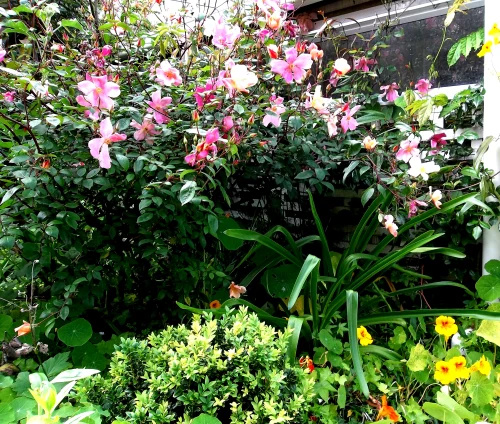
    As I’ve grown older, I’ve whittled down the elements I want in my garden, and top of the list is fragrance, closely followed by white flowers which show up in the dusk. So apart from my blue petunias and pink roses, there are always plenty of white lilies, white geraniums, Shasta daisies, fragrant syringa, white Japanese anemones, marguerites, self-seeded valerian, white agapanthus as well as blue, and my favourite white climbing rose Alberic Barbier. That isn’t to say that there aren’t blue hydrangeas shimmering under the trees, a glorious pale gold rose called Crepuscule clambering up a telegraph pole out on the road,( see above) or pink beauties like Jean Ducher which bloom palely all the year. And then there’s Mutatibilis rose which looks like a bush covered in deep pink butterflies about to take flight.

    There are two other requirements for my garden – masses of green – so ivy everywhere, box plants and acanthus, and I also ask my long-suffering plants to be undemanding and easy-care, though I contract to water them through the droughts. It’s not a tidy or orderly garden, but an exuberant, prolific little plot, with wilful self-seeded plants welcomed wherever they choose to settle, and every chosen flower and shrub scrambling into its neighbours, cosying up, sharing their space, flaunting their freedom.

    Rampant growers like honeysuckle and ivy are allowed to enjoy themselves, instead of wilting under the criticism of real gardeners who despise them for being so invasive. Wandering flaming red and orange nasturtiums have even turned themselves into climbers and threaded themselves through the climbing rose up to the roof, and entangled themselves in an orgy of colour among the pinks and blues of ageratum and lavatera down below in the garden. If it grows, it’s welcome… so though I’m not a discriminating gardener, I am a grateful one!

    I learned about flowers from our appropriately named gardener called Mr Appleby. I was nine, and we were living in a rambling Tudor house in Yorkshire while waiting to go to post-war Germany. It had been a monastery before Henry VIII’s Dissolution, and behind it stretched a high walled garden, built of weathered rose-coloured bricks. On either side of the lawn were deep herbaceous beds, the fashion of those times, and indeed, since Edwardian times. At the end, sheltered by the high wall was the vegetable garden, and after we had been to see Bertram Mills circus and I had fallen in love with the trapeze artist, Lady Elizabeth, I tried to practise my rudimentary trapeze skills on top of this wall, unseen from the house.

    The end of the lawn was dominated by a big pear tree, where we sat in striped deckchairs in its shade having afternoon tea, and where my step-grandfather would sit on summer evenings reading the Times while he smoked a cigar, it’s rich aroma reaching my bedroom window as I peeped out.

    I didn’t go to school while we lived there, and had lessons in the afternoon. In the morning it was my job to arrange the flowers in every room throughout the beautiful old house, and keep them freshly topped up and watered. It was bliss. I had carte blanche to pick flowers! Mr Appleby tended to guard his glorious peonies from me, but let me have enough to keep the vases looking quite ravishing. He taught me the names of his precious plants, and became a great buddy. From his big saggy pockets, he would drag out for me giant gooseberries from his garden, pinkish with long soft hairs all over them, his biggest strawberries, juicy, golden William’s pears, yellow-fleshed purple Victoria plums and red russet apples. I used to hide in the pear tree so as not to have to share these treats.

    He told me the names of the tall, smoky blue delphiniums, rosy hollyhocks, pink foxgloves, serried ranks of pastel coloured lupins, and golden rod. They were massed at the back of the borders. Then there were the middling sized flowers, lavender, peonies, pink and white and deep red, dahlias, (I didn’t pick them, too many earwigs crawling around inside) purple irises, stocks and phlox and larkspurs, day lilies in deep maroon, snapdragons massed in mixed jewel colours, delicate grannies bonnets, scented sweet Williams; in the front of the borders were clusters of cat-mint, the soft, furry sage-coloured leaves and pink flowers of lambs lugs,(the country term for ears), yellow cotton lavender and clumps of pinks, the fluffy ones with a gorgeous pepperminty smell.

    Then there was purple ajuga and harebell-blue campanula, and snow-in-summer nestling in crevices among the stone flags of the terrace. The names felt like poetry. And smothering the trellis which hid the dustbins outside the kitchen door were pink Dorothy Perkins roses.

    Mr Appleby was a weather-beaten, wiry little Yorkshire-man, who wore battered old trousers and an unbuttoned jacket which in novels would be called rusty black, with a grubby white shirt with no collar – in those days you changed the collar, not the shirt, using collar studs, front and back. On his head he wore a flat cap, and he had bright, beady black eyes. He spoke with a broad Yorkshire accent that was hard to understand. Sometimes he took me on walks around the countryside where I learned the North country lingo of becks and scars and fells, which I later learned were the ancient Viking words for stream and cliff and moor. Once he showed me a tiny field mouse peeping out of its miniature nest which was a round grass ball, slung between the top of the stems of two cornstalks growing amidst a forest of other golden stalks, blue cornflowers and red poppies.

    Those things I learned from Mr Appleby one summer nearly sixty five years ago have never been forgotten. Who knows what we ourselves unwittingly leave in the memory of the children we encounter? What words, what thoughts, unconscious sharing of experience, spontaneous gifts given without intent, moments that lingered down the years… what imperishable knowledge that helped to lighten ignorance and enlarge understanding, what fragments of fact that sparked a child’s consciousness ? To be the person behind those memories … that must be a very special sort of immortality.

    Food for threadbare gourmets

    This is a filling meal I make for my husband when I can’t think of anything to give him! Dr de Pomiane, the French-Polish food writer adapted it from a French peasant dish, and this recipe is a much dollied up version of his solid peasant dish. Remove the skin and pips from a medium sized tomato (soaking the tomato in boiling water loosens the skin).

    Toast two thick slices of sour dough bread on one side. Spread the untoasted sides with Dijon mustard, grate two ounces of cheese – Gruyere is recommended for purists – I usually use cheddar which is in the fridge – and pile the cheese mixed with the tomato on the mustard side of the bread. Grill until the cheese goes golden, then lay a couple of rashers of streaky bacon on the cheese mixture. Grill until the bacon starts to brown, and serve with black pepper. (De Pomiane didn’t use bacon or tomato – instead when thick slices of cheese had been grilled, he put butter ON the melted cheese!)

    Food for thought

    “The characteristics of the English are largely unsensational, and since they do not readily fire the imagination they easily slip the memory, but they are nevertheless fundamental and formidable. A love of law and order and a respect for government by consent. A belief in honest administration. A dislike of hurting people and if a hurt be done a great effort to put it right. A tolerant people, offering a hand to victims of intolerance. Skill in devising ways of improving the lot of mankind but a dreadful inability to follow those ideas through. A sweet countryside, but appalling ways of cooking what that countryside produces.”

    President Truman describing the English, on being honoured with an honorary degree at Oxford after his retirement. Dreadfully honest, I suppose you could call this somewhat measured and restrained tribute !

  • A great-grandfather

    Illustration from the post “A great-grandfather”

    While those who were interested in the christening at St James Palace were focused on his famous great- grandmother, I was more interested in the baby’s great-grandfather. The Queen’s husband was a year older than HRH Prince George of Cambridge when he escaped with his life, lying in a hastily improvised cradle which was actually a drawer from a chest of drawers.

    His father, Prince Andrew of Greece and Denmark, had been arrested in a Greek revolution in 1922, five years after the Bolshevik revolution in Russia. His mother, Princess Alice, Queen Victoria’s great-grand-daughter, once known as the prettiest princess in Europe, was the niece of the deposed and dead Russian Tsarina Alexandra.

    One of Victoria’ numerous grandchildren, King George V of England was cousin both to Tsar Nicholas of Russia – in fact they looked so alike it was hard to tell them apart – and also to Tsarina Alexandra, and he had refused them refuge in 1917, for fear of provoking revolution in England. So his cousins and their children, the four ravishing archduchesses, and the haemophiliac Tsarevitch were murdered in the cellar at Ekaterinberg.

    It was this dreadful memory which spurred George V into sending a battleship to rescue his Greek relatives, taking off Philip’s father from Greece, and then picking up Philip, his mother and sisters who were living under surveillance in Corfu. They were all decanted at Malta. The family went to Paris, where it dissolved. Prince Andrew retired to Monte Carlo to become a playboy, Philip’s mother who was born deaf, though she had learned to lip-read in three languages, retired to a sanatorium in Switzerland with schizophrenia, and the sisters married German princelings, one of them at sixteen. The little boy Philip was shuttled between boarding school in England, his sisters in Germany, and his grandmother in England, another of Queen Victoria’s grandchildren, and his uncles, one of whom was Lord Mountbatten, later murdered by the IRA with members of his family. Philip rarely saw his mother.

    When his close sister Cecile, perished in a plane crash on her way to a wedding with her husband, two children and other family members, Philip, by then seventeen, walked in her funeral procession, just as he walked with his grandson William in his mother Diana’s funeral procession sixty years later. In between he’d attended Salem School which aimed to: ‘Build up the imagination of the boy of decision and the will-power of the dreamer, so that in future wise men will have the nerve to lead the way they have shown, and men of action will have the vision to imagine the consequences of their decisions.’ Kurt Hahn, the headmaster, fiercely scrutinised the strength of character of any child admitted to the school. So even though his sister and her idealistic husband subsidised the school, Philip was put through the hoops to prove his worth, and with those values, no wonder the Nazis closed in on Hahn, forcing him to flee to Scotland where he founded Gordonstoun School, and where Philip ended up too.

    When war came, Philip joined the Royal Navy, and so for seven years was cut off from his sisters in Germany. Now he camped with his grandmother and an uncle until they both died, and then moved in with Lord Mountbatten – not an easy childhood, with absent parents and no home. Yet the combination of heredity (and there’s no room here to go into his fascinating forbears), environment, set-backs and an active enquiring intelligence resulted in an interesting man of many parts. He was also one of the handsomest young men in the world, as a quick glance at his wedding photos show.

    No snob either – at his wedding in Westminster Abbey where everyone brought out their jewels and furs for the first time since the war began, he wore his shabby well-worn naval uniform, disdaining to wangle clothing coupons in order to re-place it. But he had changed his name from Schleswig- Holstein – Sonderburg – Glucksburg to Mountbatten – well you would, wouldn’t you?

    He had made a love match with the young Princess Elizabeth, and though they knew what the future held, they didn’t envisage her father dying at 54 and thus changing their lives forever. Philip was devastated, as it meant leaving his naval career. While the Queen is always the soul of discretion, the Duke of Edinburgh, as he became, has always been famous for being outspoken, direct, and frequently controversial. But he’s always brought humour and humanity to the boring protocols of Royalty. When he met Malala at Buckingham Palace recently, he said to her – accurately – “in this country, parents send their children to school to get them out of the house”, causing Malala to break into laughter, and clap her hand over her mouth, and her father to laugh out loud too.

    Unlike the consort of Dutch Queen Juliana, he has never caused a huge scandal over dishonest corporate dealings, and unlike Queen Margaretha of Denmark’s husband, he’s never stomped off in a hissy fit and disappeared for days at a big Royal wedding, because he felt he wasn’t getting the respect he deserved. Unlike the Spanish King, he hasn’t gone off on African safari shooting elephants with a well-established mistress, and unlike the King of Sweden he’s never had a string of other women either. He enjoys the company of women – with four sisters that’s a given, but though Fleet Street has tried very hard, it’s never been able to pin anything on him.

    If Prince George’s parents are sensible, they’ll go to him for advice, as well as to Mrs Middleton. Though the Queen is famous for indulging her children and not reprimanding them, Philip was the head of their family and his philosophy for bringing up children was wise and kind.

    Talking of teenagers he told one biographer “Children go through enormous changes. For a time they’re in phase with life around them, then they go out of phase and become unliveable with, and everything they do is wrong and cross-grained and maddening – and then suddenly it all comes right for a bit – then they go off on another tack…

    “It’s no good saying do this, do that, don’t do this, don’t do that. You can warn them about certain things, that’s about the most you can do, or you can say , this is the situation you’re in, these are the choices, on balance it looks as though this is the sensible one, go away and think it over, and come back and let me know what you think.”

    Philip said he felt that his children’s feelings never went unconsidered or that reasonable requests were denied:

    “It’s very easy when children want to do something, to say no immediately. I think it’s quite important not to give an unequivocal answer at once. Much better to think it over. Then if you eventually say no I think they really accept it. If you start by saying no, and they persist in the argument until you realise you could perfectly well have said yes, you get into a situation where they won’t ask you any more, or you find you’re stopping them doing things which in fact it would be perfectly reasonable for them to do.”

    He’s used his position to further and encourage innovation in industry, and championed the environment and preserving wildlife before anyone else was green. Some would think that the luxury and splendour in which he has lived since becoming the Queen’s consort is a good swap for the normal life he was so reluctant to give up, his career in the navy and his privacy. But for an intelligent man of action, who doesn’t suffer fools gladly, it must have been a tough life, always one step behind his wife. He has often been misunderstood, and often doesn’t get the credit for his indispensable common sense, for his fortitude, and the deep loyalty and love he’s always given his family – Queen and country have been lucky to have him, and so is his great-grandson George.

    Food for Threadbare Gourmets

    The asparagus season is just beginning, and though it’s hard to go past lightly steamed asparagus and melted butter, I also enjoy it placed on some silver foil, sprinkled with olive oil, salt and pepper, covered and baked for 15 minutes or so in a medium oven. Or steamed, blanched, and eaten with a Japanese dressing of one teasp dried mustard, one teasp hot water, one egg yolk, one tablesp dark soy sauce, one teasp freshly chopped ginger or half of dried, and salt to taste. Mix the mustard with the water, add the other ingredients, and pour over the asparagus. Eat within three hours.

    Food for thought

    We have enough people who tell it like it is – now we could use a few who tell it like it can be. Robert Orben, American comedy writer and Gerald Ford’s speech-writer.

  • Birds of a feather

    Illustration from the post “Birds of a feather”

    My heart was in my mouth. I was sitting at the traffic junction in our small town where six roads meet and compete for the lights. Would the traffic stop? A duck was slowly waddling across the road with a clutch of tiny ducklings in tow. They made it to the pavement which would lead them along to the river in the middle of town, with just one hiccup over two slow ducklings who stopped to drink from a puddle, and which an impatient woman nearly cleaned up as she got tired of waiting.

    This is the duck season. We become very conscious of them as they shepherd their progeny across busy roads, oblivious of the killing machines skidding to a halt yards from them.

    A friend told me how in the middle of the busy village street, he stopped to let a mother pass while her babies all scuttled to safety on the pavement, but she wouldn’t move from the middle of the road. As he wondered how long she was going to obstinately stand there, suddenly two recalcitrant toddlers made a dash from the other side to catch up with their mother and siblings. Ducks can count!

    The same thrush (I think) who made life difficult for us last year, by nesting in the honeysuckle by the side door of the garage has returned, and I in-advertently uncovered this year’s nest as I began to trim the overhanging ivy on the arch into the garden from the garage. I saw with horror a beautiful blue egg in the exquisitely woven little nest, and hastily covered it with strands of the trimmed ivy.

    I blocked the arch with a rake and a hoe and a plank of wood across the top of the steps to stop anyone using it, so now everyone has to go the long way round from the garage. (see pic above!) I tiptoed up the next day, to check if the bird had returned, and as I stood peering intently into the tangle of ivy leaves, I suddenly realised that a beady yellow- rimmed eye was staring at me. I backed away very slowly, apologising softly for my intrusion.

    A grey heron unexpectedly circled in front of my car as I drove between spring- green trees and hawthorn hedges encrusted with white blossom this morning; and I noticed that the striking paradise ducks with black, white and sherry coloured plumage who mate for life, seem to have disappeared from their usual haunts – to tend their nests too, I presume.

    Driving home in the dusk a few nights ago, I saw what I thought were burrs on the road in front of me, but they were moving. As I swerved, I realised that the tiny balls of black fluff rolling to the side of the road were probably paradise duck babies. They all start off as balls of fluff, and then the brown mallards develop tiny yellow legs and webbed feet that scurry frantically across the road, beautiful little creatures with not an ugly duckling among them.

    Years ago as we walked down the lane by our house, being towed by two shaggy afghan hounds and a cavalier King Charles spaniel, I was consoling the children about the village fete, and their spurned handicraft entries. “The thing is,” said my ten year old daughter, “other mothers think their ugly ducklings will grow into swans, but you think we’re swans already!”

    Not surprising when I thought about it… swans had been part of my life as a child. We lived close to a lake called the Backwater. It had once been a tidal inlet, until the local authorities had built a bridge which blocked the flow from Weymouth Harbour. Until then the tide had washed up and down this long channel, where there’s evidence that the Romans once had a small port at the end of the inlet where we lived. There’s a legend that later, when the Vikings made their first raid on England at Portland just round the corner, they also pushed their way up the Backwater in AD 787. Later the Saxons settled around here among local British tribes who‘d been inhabiting the area since Mesolithic times – 12,500 BC. (Genetic experiments have shown that a significant segment of the modern population here are descended from those original Mesolithic inhabitants.)

    When I knew the Backwater, neither Stone Age coracle nor Viking long-boat could have rowed up the now tide-less water, for thick beds of reeds had spread to give safe cover for the big, white mute swans to build their nests and hide their cygnets. I used to walk my dolls pram down to the edge of the lake and throw them bits of bread. On the grass the other side of the road edging the water, the Americans had had all their tanks and armoured vehicles lined up row on row before they left for D-day, thus reversing the ancient pattern of invasion, and taking fire and sword back to the mainland.

    There are so many legends and folk tales about swans, the commonest being that their nearly ten foot wide wing span can break a man’s arm. This is one of the long-running jokes in Sue Townsend’s gloriously funny book, ‘Adrian Mole and the Weapons of Mass Destruction.’ Adrian buys a trendy flat in a disused warehouse alongside the river, and discovers too late that a posse of swans consider this place to be their territory. Everyone who visits the hapless Adrian ends up warning him, “A swan can break a man’s arm, you know”.

    They mate for life too, and I love the names of the different species: as well as the mute swans, there are trumpeter swans, whooper swans, tundra swans, and the Bewick, a sub-tribe of the tundra clan. The biggest populations of wild swans live in Russia, and it’s believed that the only reason swans didn’t become extinct in England un medieval times – since they were good eating – was that though everyone cut a notch in the feet of their own swans, birds without the notch were considered to be the sovereign’s property and protected by a royal swan herdsman. This preserved the native species. And as for cygnets, who can forget the all male corps de ballet who performed at Covent Garden, and then made their breath-taking and tantalisingly brief appearance in the film ‘Billy Eliot?’

    We only have the non-native black swan here, immigrants from Australia who now populate various lakes around the North Island in great numbers. I remember my disbelief when I saw the one black swan on the lake at Kew Gardens as a little girl. I love them now. The evil black swan queen in Swan Lake gives black swans an undeserved bad name – they are elegant, peace-loving family-oriented birds, loyal to each other, male and female raising their families of cygnets together year after year.

    It seems appropriate that all our swans here are black, when I consider that New Zealand’s national colour is black… the All- Blacks play rugby, the NZ cricket team wears black, as does our Olympic team, the America’s Cup yachtsmen and all other sports teams. And statuesque Maori women look magnificent in their black mourning with wreaths of green leaves around their heads, as they perform the ancient karakia or grieving chants with their graceful waving arm movements. Black is indeed Beautiful in this country !

    Food for threadbare gourmets

    A green-thumbed – or is it green fingered – neighbour generously left a bag of goodies outside the door the other day. Among them were delicious, tender young leeks and green cauliflower. They deserved a dish of their own so I used a recipe I’d just found. Steam enough cauliflower to fill a cup when mashed. Cut the leeks into rounds, and sauté in butter until tender. (I always put a little oil in too, so the butter doesn’t burn) Mix the cauliflower and tender leeks with an egg, a good quarter of a cup of flour, two tablesp of parsley and one of chopped dill, a good grinding of black pepper and half a teasp of salt. Form the mixture into patties and fry on both sides. I sprinkled them with plenty of Parmesan, but I would think crumbled goats cheese would be good too. Next time I try them I shall use coriander, and mix in some crumbled goats cheese.

    Food for thought

    From Midrashim: Proverbs 6.6

    Go to the ant, you sluggard,

    and watch it lug an object

    forward single file with no short breaks for

    coffee, gossip, a croissant,

    And no stopping to apostrophize

    blossom, by-passed because

    pollen is not its job,

    no pause for trampled companions:

    consider her ways – and be content.

    David Curzon, born 1951 – poet, essayist, translator and United Nations official retiring in 2001.

  • We are all witnesses

    Illustration from the post “We are all witnesses”

    Who would have thought that when a group of murderous men attempted to kill a fourteen year old girl that they would have made her a global heroine and given her cause world-wide coverage? Malala Yousafzai is extraordinary. It’s hard to believe that a school girl should have become such a threat to the oppressive policies of the Taliban that they should try to suppress her and her campaign for women. And so heartening to know that two years later, in spite of her terrible wounds, she is living in peace in England, has written a book, and is still campaigning for the right for all women to an education.

    Her poise, beauty and intelligence as I watched her fluently explaining the situation on TV and how she came to be such a campaigner was so moving, that it seemed even the interviewer was nearly in tears. The next day she had tea with the most powerful man in the world and fearlessly asked him to stop killing her people with drones – that anyone should have to ask – since when has it been OK to kill innocent citizens of countries who are allies – and is reported to have told the President that it was counter-productive and caused resentment. A simple enough deduction that one would think the highly educated men in the White House could have reached for themselves!

    But what is so exciting about sixteen year old Malala is that she is free to spread her message and to resist oppression and tyranny. She can speak and be heard. Her country and her people listen, and it’s only extremists who want to silence her.

    Hers is such a contrast to the life of another inspiring and famous woman who was not free and who had to keep silent. Anna Akhamatova was the beautiful Russian poet whose husband was shot in the Stalin’s terror, and whose son was in and out of gulags until 1956 for the crime of having the parents that he had. In her long poem ‘Requiem’, which took four years to write between 1935 and 1940, she wrote these lines, having resisted the temptation to flee to the West like so many creative people whose lives were also in danger:

    ‘No foreign sky protected me,

    no stranger’s wing shielded my face.

    I stand as witness to the common lot,

    survivor of that time, that place.’

    Later, when the poem was published in 1961, she wrote: ‘Instead of a Preface’.

    ‘In the terrible years of the Yeshov terror I spent seventeen months waiting in line outside the prison in Leningrad. One day somebody in the crowd identified me. Standing behind me was a woman, with lips blue from the cold, who had, of course, never heard me called by name before. Now she started out of the torpor common to us all and asked me in a whisper (everyone whispered there):

    “Can you describe this?”

    And I said: “I can.”

    Then something like a smile passed fleetingly over what had once been her face.’

    Simply because she was a poet, whose writing the Soviet authorities condemned with the usual epithet – bourgeois – Anna’s life was perpetually in danger, and she was banned from most activities. She could have fled, but she stayed to be with her people – their witness – her only weapon, silent passive resistance. Active resistance would simply have meant the anonymity of being one of between forty and fifty million Russians shot, starved or worked to death in the gulag – the common fate of Soviet citizens under Stalin.

    Poets met secretly, they wrote their poems in secret, and read them to each other. They each memorised them, and then the dangerous and incriminating pieces of paper were burned. So Anna became a witness. Witnessing was the only thing she could do.

    And when Stalin died, and conditions eased, she emerged and she described. Her poetry was published and she became famous, and an inspiration to all who had resisted, and a lesson to those who came after her. Her words meant that no-one could forget.

    I’ve often thought about Anna, and how witnessing matters so much to each person who suffers – somehow, to have a witness dignifies and validates the suffering and mitigates the loneliness. And women seem to have always instinctively been witnesses – witnesses at birth and death – witnesses to war, witnesses to life. Watching, validating, and by the very act of being there, loving.

    It’s an unsung gift, but when I listen to a friend who works in a hospice, I realise that it’s one of the greatest gifts. Witnessing requires no words. It’s commitment and unspoken love, whether it’s Anna Akhamatova witnessing her country and her people’s agony and being there for it, or the mother, the daughter, the sister, the friend who watches through the night when the great life dramas of birth or death are being played out.

    And often it isn’t even as dramatic as that. My daughter was driving a lonely immigrant who had no family, to hospital for a breast cancer operation. As she got out of the car, she saw the woman’s face. My daughter rushed round to her side, and stood, arms around her, just holding her, tears flowing down both faces. Frantic, she called out to the door attendant – “is it alright to park here?” “Of course,” this beautiful man replied, “it’s for people like you”. They stayed holding each other until the friend felt strong enough to go inside – my daughter with her.

    And one image is forever imprinted on my mind. I was sitting on a bus with the rain pouring down, dusk just beginning to darken the overcast skies. Something made me look out. There was a man I had got to know on a series of consciousness- raising courses. I hadn’t seen Brian for a while. He was sitting in the gutter in the rain with his arm around the shoulders of a drunk. Being there. Witnessing.

    Food for threadbare gourmets

    Trying to keep to my resolution to simplify life, and stop giving useless objects to people who lack for nothing, I’m making a jar of lemon curd for a friend who has a birthday. I’ve collected over time some of the nicely shaped Bon Maman French jam jars with red and white check screw- top lids – perfect.

    Juice three lemons, and grate the zest. Put in a saucepan with ¾ cup of sugar, 150g of cubed butter, and six free range or organic beaten eggs. Stir over a medium heat until the butter is melted and the mixture has thickened. Don’t boil, take off the heat before it does. Pour into sterilised heat proof containers, and leave to set. Cover and keep in the fridge, and it will last for a month or so.

    Food for thought

    To organise work in such a manner that it becomes meaningless, boring, stultifying, or nerve-wracking for the worker would be little short of criminal; it would indicate a greater concern with goods than with people, an evil lack of compassion and a soul- destroying degree of attachment to the most primitive side of this worldly existence.

    Equally, to strive for leisure as an alternative to work would be considered a complete misunderstanding of one of the basic truths of human existence, namely that work and leisure are complementary parts of the same living process and cannot be separated without destroying the joy of work and the bliss of leisure.

    E.F. Schumacher 1911 – 1977 – discussing Buddhist economics in ‘Small is Beautiful’. Schumacher was an international economist whose thoughts on economics evolved to cover many aspects of environmental protection, as well as the preservation of the integrity of small local economies.

  • Confessions of a bag lady

    I am a bag lady. I cannot resist them. So when I passed a shop with the most beautiful handbag I’d seen for a while, I couldn’t stop myself going in to check the price. It was elegantly flat, not the sort of handbag that I could cram with the wallet that holds all my cards and cash, my photographs that always go with me, and lurking receipts; the other wallet with my cheque books, the small half-empty bottle of Chanel no 5, my spare specs, my lipstick case, my little notebook and diary, my fold-up hairbrush brought back from Holland by a friend, my sparse makeup case, and a pen. It was a soft apricot coloured leather and shrieked class.

    It was half price in a sale and was still three or four times as much as I’d normally pay for a nice handbag – if I needed one. And there-in lies the rub. I have a number of handbags which, each time I bought them were intended to be the last handbag I ever bought, as they were such good quality and so timeless in design that they’d never date, I convinced myself!

    Illustration from the post “Confessions of a bag lady”

    At the bottom of the pile is a very good and hardly used classic tan handbag which I definitely thought would, as my husband is prone to saying – see me out. Hardly used, actually, because superseded by an elegant slim-line dark brown leather handbag… then there’s the exquisite twenties black snakeskin pochette which I often use in the evening, fought for at an auction, and the thirties brown snakeskin clutch discovered in an op-shop, perfect for my brown winter clothes. The Burberry, found for a song in a sale, always sparks up my winter blacks worn with a cream silk scarf as well, and a very nice boxy black satin evening handbag given me by my daughter is also well-used.

    And then there’s the very beautiful black handbag in the softest leather with wide plaited handles, giving it a subtle appearance of haute couture… a wedding anniversary gift after my husband had watched me lusting after it. The large cream leather Dorothy- shaped bag is perfect for summer, and for my landmark 70 birthday I bought the really big red leather handbag which looks so good with black, though I don’t wear it with my red shoes as it looks too dated and matched if I do that. For travelling – wonderful on planes when I want to

    th disguise just how much hand luggage I have – is the huge black tote bag, which has eased many frantic last minute packs and panics. And last year my daughter brought me back from Istanbul (not Constantinople as Danny Kaye would say) the handbag I always use now. It says it’s Prada, and I don’t dare to insult her or hurt her by asking whether it’s real, or a clever beautiful fake. Either way, it’s stood the test of time and looks hardly used.

    So do I really need another handbag? The inner dialogue went on for several days… you don’t need another. You could get rid of all the ones you hardly use. It’s too expensive. But I have my little nest egg saved for these extravagances. In a world of conspicuous consumption, and desperate poverty you should not be buying something you don’t need at huge expense. But it’s half price, and I’ll never have the opportunity to have anything half as beautiful, precious, or valuable ever again. That is the most snobbish and shallow thing to even think. But it would go with all my blacks, and with all my browns, and so many other things. I could wear it to lunch on Friday and it would just make my boring old trousers and top look so much more elegant ….Get over it! This inner battle tormented many waking moments, and even broke in on my sleep as I turned over. Sometimes I would wake up quite clear in my mind that I did Not need another handbag, and then the siren voices began again with all the same persuasions.

    The sale lasted for another week, and I could pick up the bag when I went back to the big smoke to deliver my grandson’s 22nd birthday present. By yesterday I still hadn’t made a decision, leaving it to fate and a last minute gut feeling. I drove into town with the present and a birthday card, and since the grandson’s parents were away, I thought I’d spoil him with all his favourite cakes I used to treat him and the others with when they were little. So parking the car outside the delectable cake-shop, I chose a selection of cream dough-nuts, choc slices, iced tarts, chocolate éclairs and the rest.

    Swinging out with the big box of goodies in my hands, I came on a traffic warden bending over my little car, which was in a free parking space. “Don’t worry”. I beamed at him, “I’m just going.” He looked bleakly at me. “I’m not giving you a parking ticket. I’m giving you an infringement notice”. Walking blindly to my fate, I was unfazed. “What’s an infringement notice?” I blithely inquired. He pointed to the notice on the windscreen, which I have to say, I never bother to look at. “Your warrant of fitness is overdue. It’s a $200 fine.” And he walked off.

    No words came to my lips. No point in saying but they must have forgotten to remind me at the garage like they always do. Conscious that there was no-one to blame but myself I glared at his back as he carried on peering officiously into the windscreens of other cars. A wave of hate swept through me as I thought of his pinched face, cold grey eyes, and pursed prim mouth. And then I thought of all the negative energy and hostility and anger he must attract all day, and I wondered how it was for him and for his family when he went home every night bringing that miasma of misery with him. My anger towards him died, but I was still sore. I tried to remember not to sweat the small stuff, and also to remember that this was one of the things I couldn’t change, so to let it go…I clung to the words I’d read in a small book on Epictetus which I’d found on a second hand book stall two days before… which amounted to not fussing about the stuff you have no control over… but.. but – it didn’t give me as much serenity as I hoped for.

    Why couldn’t ‘they’ give us a week’s warning or something, I thought bitterly to myself. And then I remembered Socrates As he waited in prison to receive the poisoned hemlock for the crime trumped up against him of corrupting the youth of Athens with his ideas, his friends offered to bribe the guards, and help him escape to another city and avoid death. But Socrates refused – saying that if he did so, he would break his social contract with his city, which he had no desire to do, therefore he would abide by their rules. My resentment faded. Yes, I’d flouted the rules of my society by my carelessness or irresponsibility.

    Chastened I delivered the birthday goodies, and drove straight home. The handbag seemed irrelevant now. Not only had I squandered half the money needed for it, but it didn’t seem to matter anymore. Isak Dineson, who had plenty of trials in her life, wrote that all sorrows can be borne if you put them in a story or tell a story about them. She was right… not just the handbag, but the infringement notice are no longer significant… it’s now emotion recollected in tranquillity, to quote Wordsworth. And this morning I was at the garage at 8am to comply with the rules of my society!

    Food for Threadbare Gourmets

    The roasted almond and lentil loaf has had a few takers, so here’s the recipe, not as simple as most of my cooking… wash and boil until soft half a cup of dried lentils. I’ve used red lentils and puy lentils, and they are both good. While the lentils are cooking, gently toast in a frying pan without any fat, a cup of ground almonds. When lightly browned, set aside. Heat a table spoon of oil and gently fry a finely chopped onion, a stalk of chopped celery and a grated carrot with all the moisture squeezed out of it, plus a teaspoon of dried thyme, sage and finely chopped rosemary. When soft, remove from the heat and stir in the toasted almonds, cooked lentils, four slices of bread crumbled into breadcrumbs, quarter of a cup of tomato sauce, one tablespoon of Worcestershire sauce, and one of balsamic vinegar. Salt and pepper. Mix it all together with an egg and press firmly into a loaf tin lined with well-greased cooking paper long enough to overhang the edges. Bake in an oven 180 degrees for forty-five minutes.

    I actually think it tastes best the next day either cold or lightly heated. Cut it in thick slices and serve with the rich gravy from the last post. This is enough for six, and makes a meal served with new potatoes and green beans or asparagus, which is plentiful here in the Antipodes at the moment.

    Food for Thought

    Suffering occurs from trying to control what is uncontrollable, or from neglecting what is within our power. As part of the universal city that is the universe, it is our duty to care for all our fellow men. Those who follow these precepts will achieve happiness and peace of mind.

    Translation of Epictetus’ words. Epictetus AD 55- 135, was an ancient Greek, Stoic philosopher who thought we should live our beliefs. Born a slave, he became a Greek sage. Born in Turkey, taught in Rome, banished to Greece.

  • Robinson Crusoe has a message for us

    My grandmother collected beautiful china and old books. My memories of the china was that it actually wasn’t beautiful… At eight I found her collection of Staffordshire figurines rather clumsy, and her Meissen angels and other pieces a bit gutless and wishy-washy. (I think I still do – but give me Chinese blue and white, Japanese Imari, old Chelsea, and I’d feel differently.)

    Her old books were heavily bound in leather, and were often large quarto volumes. I skimmed Foxe’s Martyrs, was appalled by the despair in the picture of the Slough of Despond in Pilgrim’s Progress, but was very taken with Robinson Crusoe. All these books were illustrated with engravings, protected by a flimsy piece of what seemed like tissue paper.

    I hadn’t learned to take liberties with books back then, so I solemnly plodded through Defoe’s dense prose, until I came to the picture of Crusoe seeing other foot-prints on the island – Man Friday’s. I was as shocked and horrified as Crusoe at the implications of this find.

    The real Robinson Crusoe was Alexander Selkirk, a sailing master, who in 1704 had fallen out with his peppery captain over repairing the ship. The captain refused, and in the resulting row Selkirk said the ship could go to the bottom without him. The captain seized on these words as a pretext to put the troublesome Selkirk ashore on the nearest island, Mas a Tierra being close at hand.

    Marooning was the worst punishment of pirates, and offenders were put ashore with their sea chest, a pistol and one ball. Selkirk, no pirate, regretted his hastiness but it was too late, the captain was implacable. He was lucky in that his seaman’s chest held a Bible, a couple of other books, and various knives and practical items, including some mathematical instruments.

    He built two huts from pimento logs, and lined them with goat-skin for insulation. One was his smokehouse and kitchen, the other, some distance away, was his study and sleeping quarters. He burnt pimento logs for cooking and heating in the winter, and found the wood was almost smokeless, and ‘refreshed him with its fragrant smell’

    For the first few days he was sunk in depression, but in the long term, he constructed an interesting existence. There were plenty of vegetables planted by seamen who had called to replenish their water, goats had been left there to breed as a source of food for other seamen, while rats had swum ashore and bred so prolifically that cats had been released to control them.

    Selkirk quickly ran out of ammunition, so was reduced to killing goats for food with his knife. With no alcohol, no tobacco, no salt-preserved meats, no sugar, dairy, grains or chemicals, no tea or coffee, and with plenty of fresh fruit, vegetables, meat and fish, unpolluted air and water, Selkirk’s health improved so remarkably that he was able to outrun the fleetest goats, and often did so, notching their ears as a record of achievement or sign of ownership, if he needed no meat at the time.

    The rats, which had swum ashore from boats anchored in the shallows while the sailors replenished their water were a pest, nibbling Selkirk’s feet at night, and invading his stores, so he caught kittens and tamed them, and, in time, dozens of cats shared his hut, protecting him and giving him company.

    After a bad fall, he realised that his survival depended on being healthy, so he caught goat kids, lamed them and tamed them too, so that he had a ready source of food. He even taught the cats and some of the kids to dance for a hobby. When his clothes fell to pieces he made replacements out of goat-skins.

    There never was a Man Friday – just two Spanish ships which called for fresh water, and getting a glimpse of Selkirk, fired on him and chased him. He escaped them, preferring to stay on the island to being killed or imprisoned and set to work in a mine. When Selkirk was discovered after five years and rescued by a British ship, he found the salt – meat revolting at first, but when he became used to it again, and resumed the habits of the sailors, within a few weeks on board he had lost his incredible fitness and good health.

    The natives of the Marquesas Islands told missionaries – and whalers also reported – that they didn’t enjoy the taste of white men, they were too salty and very tough. White men could only be made palatable by boiling, rather than the usual baking in earth ovens! Presumably the seamen who constituted this diet were both skinny and underfed, but gristly with muscle from shinning up masts and pulling on ropes, and had salted themselves with all the salt beef and pork they had no choice but to eat.

    So when Selkirk detoxified his body on fish and organically grown meat and vegetables, and lived under these conditions for five years, not just for three weeks at a health farm, he showed how healthy our bodies could be in ideal conditions, compared with the self-inflicted illnesses caused by processed food.

    Now three hundred years later, it’s hard to know what to eat that is actually pure, fish is as much a victim to the pollution of our oceans as vegetables grown with chemicals in modern farming agri-businesses, meat reared on hormones and anti-biotics, or processed dairy products.

    I suppose the one thing we can do is to cut out sugar, but for most of us, it’s a comfort food, and who doesn’t need comfort? At least sugar doesn’t make us drunk and disorderly. So bring on a nice piece of shortbread with our cup of tea, or the chocolate box, or even a simple coffee and walnut meringue gateau with a glass of delicious dessert wine, and let us laugh and be merry and enjoy the sweetness of life!

    Food for Threadbare Gourmets

    From the sublime to the ridiculous. In this case, from the bliss of coffee and walnut meringue gateau to the mundaneity of sausage and mash – one of my husband’s favourites. I found a wonderful gravy cum sauce to spice it up for him. Chop two large onions, and fry gently in butter and oil until golden brown. Add two tablsp of brown sugar and keep frying until it’s a deep satisfying brown. Stir in a tablsp of balsamic vinegar, and enough gravy browning or Oxo powder plus stock to thicken to your taste. Salt and pepper. Let it bubble up and serve with good sausages, or as we sometimes do, with a savoury vegetarian loaf of almonds and lentils. (recipe to come)

    Food for Thought

    I am most entertained by those actions which give me a light into the nature of man.

    Daniel Defoe 1660 -1731 was a far more interesting man than his hero. He is considered one of the fathers of the novel, writing nine, including Moll Flanders. He was merchant, journalist, trader and spy, he wrote over 500 books and pamphlets and political treatises and created several newspapers and magazine which came out several times a week and which were written by him.

    PS Still having production problems, but console myself with the optimistic thought that everything passes, even computer nightmares, and that the blog will be up and running again soon..

  • Home, history and a house

    After three years in foreign parts – tropical ones, with only bougainvillea, cannas and frangipani to excite me, I found myself walking in an English field of shiny buttercups and shimmering green grass … hawthorn hedgerow cascading with pink and white blossom on one side, river on the other. I could hear a cuckoo. It felt like very heaven.

    I was eighteen and this was how I had remembered the scenes of my childhood… shades of Sir Walter Scott’s:

    Breathes there the man with soul so dead

    Who never to himself hath said,

    This is my own, my native land…

    We were living in a house lent to us by friends, far out in green hills and deep valleys. Offa’s Dyke was reputed to end in our garden, just above a huge S-bend in the River Wye. Offa lived from 757 to 796, and invented the penny. His dyke separated Mercia from Wales and stretched for ninety-eight miles from north to south. Whatever the truth of the rumour, behind the un- used stables there was a huge mound stretching into the back garden from the fields and woods beyond, and covered in hazel and hawthorn.

    Our nearest market town sported a magnificent ruined castle stretched above the river, and further out, poetic Tintern Abbey. And at nearby Devil’s Pulpit, a rocky outcrop looking over the river and across to the abbey, there was the usual legend of someone leaping his horse over in the dark, and coming to a sticky end far below.

    The house was part Queen Anne and part Georgian, with a charming regency style wrought iron porch stretching along the garden side of the house. It looked over a lawn, where two ancient lime trees hummed with bees in summer, and seemed like silent sentinels in the wintry mist which hovered among their thick tangle of branches in damp winter months. Beyond the lawn was a ha-ha, but not deep enough to keep out the piebald pony who led a small herd of young steers through the gate-posts, up the drive, over the ha-ha and across the garden while every-one else was at church one morning.

    By the time I’d rushed downstairs to shoo them away, they had meandered on into the little sheltered garden with a sundial, and pushed their way through the scraggy hedge which gave onto a lane, leaving only their deep hoof-prints.

    The lane led down to a farm house, but before I got there, I would branch off through the woods with my puppy, and take the winding path which meandered down to the river. Just below the tree-line, and in the grass which borderedthe riverside was the ruin of a tiny fifth century church, only its outer walls still standing, empty windows framing the sky, ivy climbing part of the grey stone walls, and tangled brambles guarding the foundations. In spring the woods were filled with bluebells and windflowers. It too seemed like heaven.

    The house was faded and gentle, dreaming in the silence of the country-side, no neighbours within sight. My bedroom had pretty flowered wallpaper, pale green painted thirties furniture and long windows looking over the garden. It had a soft sweet atmosphere. The other place that I loved, and where I spent solitary afternoons engrossed in a book was the so-called ballroom. Not a grand one, its claim to fame being the ceiling which had been copied from some famous library in a grand house.

    Apart from the large and somewhat threadbare faded old carpet on the polished floor, the only other furniture in the room was a big drab-green brocade-covered Knole sofa, and a large gilt mirror over the carved fireplace. That was all I needed. On sunny days I sat on the cushioned window seat, on other days I curled up on the sofa. When I shut the door the silence and the solitude were absolute.

    In the drawing room where everyone gathered, I amused myself by reading ancient copies of bound Punches from the book-shelves, and cracked up over stiff Edwardian jokes. Once, after a fearful row in which my step-grandfather took my side, calling me his little high-brow, I managed to get the wireless to myself to listen to Beethoven’s Ninth Symphony, and so I dreamed around the place, head in the clouds, picking flowers, adopting two wild kittens as well as the puppy, and driving everyone else mad.

    I didn’t know anyone, but once a boy nearby invited me to a hunt ball at Tintern, and the rather erudite and elegant bachelor who lived on the corner further down, in a house filled with books and good furniture invited us to a pre-ball party. I thought he was much more interesting than my escort, and found the ball very dull, spoiled with too many in Malaya.

    In Jane Austen’s time I suppose I would have loved the older man hopelessly, and ended up marrying the boy. As it was, I was catapulted into the army, my father hoping that “it would wake me up”.

    Thirty years later on one of my trips back to England I went to see the house. I hardly recognised it. The beautiful grey stone walls had been covered with suburban ‘pebble-dash’ cement and stones. The grounds seemed to have been subdivided anda boring brick bungalow built in the new area. A row of dark evergreen windbreak trees replaced the charming informal groups of old deciduous trees down by the vegetable garden, and the ha-ha seemed to have been filled in. I wished I had never come back.

    I drove sadly on down the lane. Walking through the woods, nothing had changed there, and thirty years had passed over the ruined church with barely a blink. Just a few more stones tumbled off the end wall, and the empty windows more crowded with ivy. Nature is gentler than mankind.

    These memories were prompted by reading Clanmother’s lovely blog on Tintern Abbey

    So it looks as though my tea-break is over… it’s been a busy one, with lots of family commitments as well as my own, but I’ve been so touched by messages from my blogging friends – with so many blogs to read, I find it truly wonderful to be remembered and to receive so many messages encouraging me to return. Thank you all, so much. My word press settings seem to have changed since I took my tea-break, and I can’t work out how to put in pictures or any other paraphernalia, so in some ways this is an experimental post!

    Food for Threadbare Gourmets

    Ah well, Friend and I have been at it again. Meeting to have a glass of wine to catch up and discuss the mechanics of hiring chairs glasses etc etc for an eightieth birthday party she’s organising, we take to heart the dictum of always having something to eat with the wine. We’ve discovered a wonderful new spread to eat with a small chunk of roll.Roast a couple of aubergines, and scrape out the flesh into a blender. Pour in a cup of cashew nuts, ground coriander and ground ginger powder to taste, the juice of a lime or a lemon, and salt to taste. Whizz this into a thick textured paste and enjoy with relish and some bread or biscuits!

    Food for Thought

    A grace found in an old book of recipes… Lord, forgive us that we feast while others starve.

    Bishop Charles Gore at a banquet

  • Time for a tea-break

    Illustration from the post “Time for a tea-break”

    I have kept my blogging vows: to write regularly, for better or worse – (you be the judge), for richer for poorer – (mostly poorer), in sickness – (sometimes) and in health, till circumstances do us part.

    But recently I’ve let the other half of my blogging commitment slip – the agreement to read and follow and like and comment. Circumstances have been squeezing me, so that I’ve been lagging guiltily behind on this part of the blogging commitment.

    So, it feels like time for a tea-break. Thanks to Clanmother recommending the fascinating book: ‘For all the Tea in China’, after reading my blog on tea – I now know I couldn’t make a healthier choice. Apparently wherever tea drinking caught on, those societies became healthier- they were boiling their water for the tea, and didn’t have to slake their thirst with polluted water, beer or wine.

    So they remained sober, and sustained by calories in the cheap sugar from the Colonies, and protein in the milk for their tea! It’s even suggested that tea-drinking societies like the British were fifty years ahead in the Industrial Revolution because the workers were kept alert over their machines, having tea-breaks instead of becoming drowsy or sozzled with another sip of wine or beer. (Over dinner last night, a friend described Italian workers falling off the scaffolding after another sip of wine in the blazing heat as they toiled over Brunelleschi’s Dome – he had wine diluted with water brought up to them to save them the long journey up and down !)

    So here’s to: ‘ the cup that cheers but doth not in-ebriate!’ Lapsang Souchong of course !

    The circle of friendship in our blogging world never fails to amaze me and move me, and though technology is what has brought us together, in the end, it’s the written word that’s made it possible. As a writer, I treasure the words of Carl Sagan who said that: ”Writing is perhaps the greatest of human inventions, bringing together people who never knew each other, citizens of different epochs. Books break the shackles of time. A book is proof that humans are capable of working magic.”

    For me, it seems that blogging has become the book of life for many of us, the magic of the written word bringing us together in time and space, and showing us how connected we all are. These connections are ties that won’t be broken, even when circumstances, in my case, have dictated a tea-break.

    So though this is a break, it is not an ending, and I send to all my dear friends and fellow bloggers, the (Good) witches blessing:

    Merry meet, and merry part, and merry meet again!

    Food for Thought

    Every secret of a writer’s soul, every experience of his life, every quality of his mind, is written large in his works. Virginia Woolf 1882 -1941 Great English novelist

  • A is for Dictionary

    Illustration from the post “A is for Dictionary”

    There was a framed photograph of me as a toddler on the wall, which just showed my head, with a mop of dark hair, dark eyes, and my neck fading away into nothing. When I was between two and three years old I used to gaze up at it and study it, and wonder when my arms and legs and the rest of me grew.

    We lived in a tiny cottage on a farm in deepest Dorset countryside, far away from the bombs. I stood in the soft summer night and watched overloaded hay-wains swaying and creaking down the narrow lane past our cottage, pulled by huge, tired dray horses. Stray wisps of hay were straggled horizontally as the load brushed against the high hawthorn and hazel hedgerows. I could smell the fragrance of the hay, the warm sweet smell of the horses, the honeysuckle in the hedge and the scent of yellow gorse flowers.

    On our way to the village shop we passed over an ancient stone bridge. I used to push my head between the balusters encrusted with lichen to watch the emerald green weed rippling in the clear water, until I realised my mother was far ahead with the push chair and I rushed panic-stricken after her. I dreaded going into the shop. Hanging from the ceiling was a flypaper covered in buzzing, screaming, struggling, dying flies. I felt frantic to get away from the noise and carnage.

    In those halcyon days before I was four, our mother sang us to sleep in her beautiful voice with lullabies like: ‘Where the bee sucks there suck I, in a cowslip’s bell I lie, there I couch while owls do cry, and on a bat’s back I do fly,’ ‘One fine day,’ from Madame Butterfly, was another, and ‘Cherry ripe, cherry ripe’. The words, even to a small child, were as beautiful as the music.

    In the same room as the picture of me sans arms and legs, was an enormous book. It got smaller as I got older. It was so thick and heavy I couldn’t lift it back then, but it was irresistible. It was covered in maroon coloured morocco, and had fascinating black thumbnail places at the side, and in the front coloured pages with patches of colour, green and blue, and pink (the British Empire I learned later!) These pages I also discovered later, were called maps, and I learned too, that the book was Webster’s Dictionary.

    The A’s came straight after the maps, and there-in lay my downfall. I played for hours with this book, and inevitably, since the A’s came after the maps, they got a lot of wear. The pages became torn and dog-eared, wrinkled so as to be un-readable, crumpled, dirty, and scribbled on. Some pages of A’s disappeared altogether.

    When my father came back from the war when I was nearly nine and re-claimed his dictionary along with his children, the dictionary became a source of anguish to us all. We were living at Belsen, and grim post-war Germany had no diversions like TV, cinema, or all the other entertainments we take for granted now. So everyone did the crossword, either from the Times or The Daily Telegraph, as it was called back then.

    I think there must have been a sweepstake at the officers’ mess, because there was always great competition to get it finished first. If ever phone calls came from the mess – which was actually the Duke of Hanover’s palace – asking my parents – we lived in the Beast of Belsen’s former home – to quiz me about Alice in Wonderland or The Wind in the Willows, that would set my stepmother off on a frenzied hunt for a previously unrecognised clue.

    Then the agony began when my somewhat unknown father wanted to look up a word beginning with ‘A’. He’d pick up the now shrunken dictionary, and start leafing bitterly through those tattered first pages as I watched anxiously. Finally he’d give up in disgust, with the exclamation: “Bloody kids!” and I’d slink guiltily away. He never normally swore, so it seemed all the worse. As the years went by, he said it every time, and as I got older, I finally realised it was a joke, and was able to stop flinching.

    I still can’t resist dictionaries, almanacs, encyclopaedias and the like. My step grandfather used to give the family a copy of wonderful Whitaker’s Almanack every year at Christmas, and even now if I see an old copy in a second hand book-shop I’ll buy it… and read up about the scientific discoveries for that year, symptoms of every disease, orders of precedence in the English peerage, major architectural triumphs for that year, politics in outer Mongolia and what the stars have to say – astronomy, not astrology – amongst other pieces of useless but fascinating information.

    Sadly, we gave away the thirty well loved and well travelled volumes of Encyclopaedia Brittanica last year to a boy’s school which needed some reference books. With all the glories of Google at our disposal, we never opened those heavy volumes with tiny print any more. I even bought my own thick copy of Webster’s years ago, but we never even use that now – the Concise Oxford is easier to handle, as well as Google.

    All this came back to me as I tried to piece together a talk I’ve been asked to give about books to a local retired professionals club. I’ve dodged them for years, but have no more excuses left to fob them off with. So now I have to settle down to the hard work of talking, instead of the fun of writing – especially about books! How shall I start – “The A’s have it – dabbling in a dictionary – or what to give a three year old to read?”

    Food for Threadbare Gourmets

    Gallivanta asked me what pink pudding is…since I gave this recipe over a year ago, I’ll repeat it now for others who’ve missed out on a real treat! I found it over forty years ago in an old Vogue Living, and it’s been a favourite ever since. All you need if half a pint of cream, the same amount of plain or strawberry/ raspberry yogurt, and a tin of boysenberries or raspberries.

    Drain the juice from the berries. I don’t use frozen, as they get watery and spoil the dish. Whip the cream until thick, fold the yogurt and fruit in, add caster sugar to taste, and chill in the fridge. You can melt some marshmallows in some of the fruit juice to make a firmer pudding, but we like all natural ingredients. Serve in a big glass dish with a rose in the middle or in individual glass dishes with a tiny hearts-ease flower to pretty it. Good shortbread is nice served with it.

    Food for Thought

    If souls were compared to moving vehicles, an unforgiving soul could be seen as a dump truck with tin cans dragging off the backside. Clatter, clatter, clang, clang!! If you listen you can hear them coming. from ‘Love Without End. Jesus Speaks’, by Glenda Green

  • We’re all born brainy !

    Illustration from the post “We’re all born brainy !”

    When Catherine Windsor aka Kate Middleton drove away from hospital the other week with her day old baby she did an interesting thing. She waved to the ecstatic crowds with her left hand, but her right hand was resting gently on the baby’s stomach as he lay in his car seat for the first time in his short life. She was so tuned in to her baby that she knew instinctively not to let go physical contact with him, but to re-assure him with her touch. It was rather beautiful, and I wished that all babies could have had that gentle bonding with their parents, meaning I wished that all babies could be secure and happy!

    I find it incredible that we all, from day one, possess nearly all the neurons in the brain that we will ever have – nerve cells to you and me – even though most are not yet connected in networks. And this connecting process is so rapid in the first year, that by twelve months, the baby’s brain is close to the adult brain. Sound, sight, touch, taste and smell are the senses through which from birth to one year we learn about the world, usually through playing.

    From eighteen months to three years, when the brain is at its most active, children are like sponges, soaking up words, information and new skills. It’s amazing to me that between the ages of eighteen months and three, the toddler’s brain is twice as active as the adult brain.

    And this is also when the structures of the brain that are sensitive to language and social-emotional responses develop, while motor development, or physical skills are developing at a rapid pace too.

    When we actually look at what babies learn to do in those first few years of life, the range of skills, physical, mental and emotional is awe-inspiring. By the time children reach three to six years, they enter the fastest growth period for the frontal lobe networks, including emotional development, speed of processing, memory and problem solving. By six years, the brain is at ninety per cent of its adult weight.

    And at the same time babies are learning how to be people! Modern research has shown that when babies are happy, talked to, sung to, cuddled, included, and have lots of eye contact, what are known in neuropsychology as the “ the hormones of loving connection” nourish the brain and stimulate the growth of connections in the regions of the brain to do with emotions. The simple things that loving parents do with their babies, help them to grow into considerate, loving and confident people from the very beginning.

    This nourishment for the emotional centres of the growing brains makes babies feel secure and happy, and means they tend to be more independent, confident, more resilient, empathetic and caring. Babies who are comforted when they’re upset, grow up knowing that nothing is really a disaster, so they are the ones who don’t panic or go into despair when things go wrong.

    Because they learned when they were little that everything passes, they can cope. Adults who didn’t get this sort of supportive parenting tend to re-act to stress with behaviour like flying off the handle, losing their temper, blaming other people, or going into despair and depression -because they grew up with a lot of fear and no faith that life would support them.

    Researchers now know that when a baby is left to cry, cortisol levels rise in the brain. If the baby is lovingly comforted after a stressful incident, the body absorbs the excess cortisol. But if the stress happens regularly the cortisol levels remain high and become toxic to the brain cells. Cortisol can cause damage to the emotional centres of the brain, and if this happens regularly children grow up prone to anxiety, anger and depression. The old advice to leave a baby to cry has meant many insecure and sad children, and sometimes, angry violent adults.

    Enlightened child experts now feel that this deprivation of loving attention, comfort and understanding of a baby is responsible for many problems in older children – problems ranging from ADHD, depression, panic attacks, phobias, eating disorders, anxiety and substance abuse. So children and young adults with these problems are not innately troublesome or born with a pre- disposition to these problems. They simply didn’t get enough emotional food for the brain – those hormones of loving connection.

    I researched this stuff for an article in a parenting magazine I write for. It blew me away to realise what intelligence and potential are already contained within those tiny wizened little day-old babies. It’s so easy to think that just because they can’t talk or communicate with us yet, that they don’t have the thoughts and feelings that research shows us they do. Maybe it’s we who need to work on our communication skills, rather than the babies, who seem to be doing huge amounts of unseen work and learning while we change their nappies and feed them and put them to sleep.

    They are so hard-wired to learn and absorb and connect with our world, that as long as we cuddle and talk and sing to them, they seem to do most of the work themselves. Babies are such miracles of complexity and potential, and each single one, wherever it is born in the world, has all this potential and complexity. And yet at this moment we all know too, that only some babies will have the chance to become who they were born to be.

    Food for Threadbare Gourmets

    When I want to spoil my grandchildren – and that is all the time – I make them their favourite pudding. For one it’s chocolate mousse, for another a family favourite we call pink pudding, and for everyone – a lemon meringue tart.

    I usually make the pastry case ahead, so all there is to do later is to squeeze two lemons and make up their juice to half a pint with water. Use some of the liquid to mix with an ounce of cornflour, and boil the rest before stirring it on the cornflour mixture. In a pan, boil it for three minutes, then stir in an ounce of butter, an ounce of sugar and the grated rind from the two lemons. Cool slightly, add three egg yolks and pour this mixture into the tart case. Bake in a moderate oven for about 25 minutes or until set.

    Whisk the egg whites until stiff, gently fold in three ounces of castor sugar, and pile onto the lemon tart. Dredge with castor sugar and return to a cool oven until the meringue is set and slightly browned.

    Food for thought

    If you have not often felt the joy of doing a kind act, you have neglected much, and most of all yourself. Anonymous