
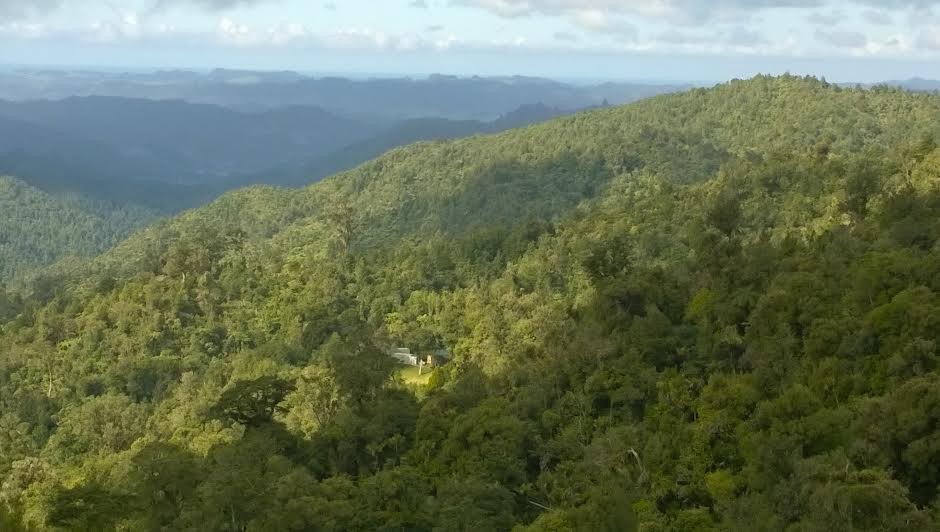
In the forest which surrounds our little house amid the rolling ranges, are reminders that time truly is an ever rolling stream.
The plants and creatures here are older by millions of years than those in Europe which had to recover from the Ice Age 10 million years ago.
Here in this remote country, New Zealand split off from the ancient continent of Gondwana between 80 and 85 million years ago, and some flora and fauna here date back 250 million years.
So when I walk in our forest, I’m conscious I’m in touch with life forms that have survived since primeval times in this isolated place, and what recent arrivals on this planet my species and I are..
Mankind didn’t arrive on these islands until around 1000 years ago. They found it inhabited by peculiar flightless birds, giant invertebrates, and plants – some having survived more or less unchanged since Gondwanan times. These unique trusting creatures which had never seen human beings before were easily hunted to extinction.
Roughly 64 endemic species—including at least 51 birds, 3 frogs, 3 lizards, a freshwater fish, and a bat—died out thanks to hunting, and introduced animals like pigs and goats, possums and rabbits..
The amazing giant bird, the moa, disappeared in two hundred years, and then the Haast’s eagle, known as ‘the biggest, baddest, most magnificent eagle ever to have existed in the world’ died out as it had fed on the moa.
So sadly, these once isolated islands are now part of the 6th Mass Extinction, in which scientists warn that by 2050, up to 30% to 50% of all Earth’s plant and animal species could face extinction due to climate change, habitat loss, and human activity.
The forest appears empty, apart from the birds, compared with European woods and forest alive with squirrels and rabbits, foxes and deer, and so many other fascinating creatures, there are no indigenous mammals here except bats, but we host other primeval treasures.
And we wage a constant battle against the animals introduced by man in the last thousand years, as they eat these native creatures and destroy their habitats.
So we treasure rare species like our frogs, the Archey’s frogs whose ancient evolutionary lineage stretches back roughly 150 to 200 million years, making them living fossils that coexisted with dinosaurs.. They are only found these days in our forest and two other places in New Zealand.
These tiny delicious creatures, only an inch and a half, live on land and their minute tadpoles hatch on their father’s back, and live there until they are old enough to cope on their own. The froglets often stay with their dad for several years, and they can live up to forty years. One night I saw one the size of a fingernail.
Their cousins the Hochstetter’s frogs, also ancient and endangered, live here too, and they both are our pride and joy, as is the butterfly extinct in the rest of the world, and only found in our forest – Helm’s butterfly, the forest ringlet, so rare and special that scientists come here to study it, even some of David Attrenborough’s researchers.
And then there are our lizards, known as striped geckos. They are described as ‘rare and stealthy reptiles’. They were first discovered in the 1990s when one turned up in a home nearby.. Now we have teams of scientists turning up here to discover and map these beautiful little creatures hiding in the ferns and trees..
But besides these rare species, I’m conscious as I walk in the forest that there are others, just as precious, but so plentiful that we take them for granted. There are 170 different sorts of worms in this country, including the beautiful glow worms… I’ve learned that they, like all other living beings, have their own secret life, communicating with each other through touch and taste and ground vibrations. Being hermaphrodites, after they have mated they can both produce offspring.
We all know now how vital their lives are to the health of the soil, and that modern farming methods, fertilisers etc, are death to these invaluable forms of life – which are also food for many birds and reptiles. As long ago as 1881 Charles Darwin wrote: “It may be doubted whether there are many other animals which have played so important a part in the history of the world, as have these lowly organized creatures.”
I used to think that spiders were just a nuisance, but have now discovered that they have a massive and vital use in nature. They act as Earth’s natural pest control by eating billions of insects like flies, mosquitoes, and crop-destroying bugs, keeping the balance of the ecosystem. Their exquisite webs are their form of communication, which they can read, knowing what fly or other insect is invading their web, and spinning and retracting and playing its strands like a guitar.
The amazing NZ snails are cherished too, there are over a thousand different species in this country, and after learning how intelligent and maternal they are from Elizabeth Tova Bailey’s wonderful book, ‘The Sound of a Wild Snail Eating,’ and reading about dozens of French snails lifting the lid of a basket taking them to market in a concerted effort and scattering, I have a great fondness for them. I’ve watched two snails crawl up the water bowl in my garden, and drink together, and then crawl back out and away, and I’ve read of a snail making his way over a garden wall and finding more food in that garden, and coming back to bring his wilting companion to a better place. Snails are more than petunia devouring pests !
We also have a very long centipede with a painful bite – not my favourite life form, but I was fascinated to discover that their pairs of legs are a different length so they don’t trip themselves up!
Birds, butterflies, moths and bees, so many forms of life which we so often take for granted, but when their lives are decoded, turn out to have intelligent, intricate rituals and systems which support not only them, but the planet.
Insects, which are fast disappearing, are the tiny workers that keep nature alive. They pollinate three-quarters of our food crops, feed countless birds and fish, and clean up dead waste to enrich the soil. It’s estimated that without them, our global food and natural systems would completely break down. Yet the total extinction rates for insects are happening up to eight times faster than for mammals, birds, or reptiles.
It turns out that our world could not exist without them, and since they lived for aeons before we latecomers trampled across the planet, they could probably manage without us for many aeons, world without end.
So I try to tread softly in this forest among its ancient creatures, and marvel at the silent secret lives of the senior partners in our life here. While I grapple with technology and use electricity, gas, oil and other resources of the earth, invisible primeval lives continue to support the planet as they have done for more millions of years than I can imagine.
Food for Threadbare Gourmets
When I’m really up against it for time or energy, there’s nothing like that packet of pasta and tin of tomatoes always lined up in the pantry. My favourite pasta is angel hair and my husband loves macaroni, so I do both, it’s so easy.
Thanks to Nigella Lawson, I no longer bother with boiling water, but just use cold water, and cook until the pasta is done.
With long pasta like angel hair ( capellini) I use a big frying pan and plonk the strands in the cold water with some salt.
The tin of tomatoes is embellished with garlic and chopped onion ( cooked for five minutes in the microwave) and a big dollop of butter, maybe a slurp of soy sauce for the umami flavour. Gently simmer for ten minutes or so, and tip over the drained pasta. Freshly grated parmesan is a must…I sometimes stir some cream into the tomatoes too.
Food for Thought
We say ‘I have done nothing today.’ What! have you not lived? That is not only the fundamental, but the most noble of your occupations.”
French philosopher Michel Montaigne

