Tag: love

  • The Long and winding road

    A hundred and twelve years ago, Mr Bill Topp obtained a license from the Post Office to carry the mail once a week across a precipitous muddy track from one tiny settlement to another, using one horse. It took him three hours and nine minutes to traverse the fourteen miles of steep hairpin bends rising to 1,410 feet, and thus, over time the rough track acquired the name The 309 Road.

    There are just under 300 of these steep hairpin bends. A river winds fifty feet below, and in the years since we moved here, the increasingly violent storms have made it an increasingly dangerous drive, with steep slips into the river below, making it narrower and narrower, as we negotiate what is left of the road. It is still unpaved, dusty in summer, muddy in winter.

    We live halfway along it, at the very top of the range, in our protected forest. When we reach the high wrought iron gates and the civilized paved road inside, which leads to our little home another mile and a half further on, we heave a sigh of relief. Home safely !

    The 309 is famous in these parts for its horrors. We have a joke whenever we see a spanking new clean car creeping around the bends ( often on the wrong side of the road because they think it’s safer) we call them TT’s – Terrified Tourists. They are a menace to our safety, as are the tradies’ cars, tearing around the bends often on the wrong side too.

    If we turn left when we drive out of our gates, we head down to an old gold mining town, still full of Victorian settler charm, with a population of 2,000, and reliant on summer tourism with its beautiful harbour, enticing little shops and cafes, and famous potters. On the drive down, there are waterfalls and forest glades with giant kauri trees where tourists visit, and  a farm which is bisected by the road. Here until two years ago, dozens of wild black pigs roamed around the farm, and across the road with their tiny black piglets. 

    Tourists used to stop to pet them and talk to the gentle, eccentric, white haired old man who cherished them until one day just before Christmas, when he unwittingly became a murderer. A rustler described by his mother as ‘a loveable ratbag’, descended on the farm yet again, to help himself to a free Christmas ham. The frantic old farmer chased after him, beside himself from guarding the pigs night and day from thieves. He heard the terrible screams of his pet pig being butchered, snapped, and shot the man. He is now in his eighties, awaiting trial. Everyone, including the police, sympathise with him, and money was raised to pay an animal charity five hundred miles away, to round up the 60 beloved and abandoned pigs and re-home them in a sanctuary

    When we turn right out of the gate, we head downhill to a holiday destination which was once a tiny fishing village with a magnificent harbour. Nearby, Captain Cook first set foot in this land which is now called New Zealand. I often visualise the Endeavour sailing into these empty, glistening waters, edged by scarlet, flowering pohutukawa trees, no sound but the singing birds, and the creaking of the sails and rigging of the battered sailing ship.. 

    Back when Mr Bill Topp began his post office service, there were just a few hundred people living here, mostly reliant on the felling of the kauri trees for their living.

    These wonderful straight trees were ideal for ships masts as well as for building the settler cottages and Victorian villas.

    Driving down the road this side, with the steep cliffs one side, and the steep drop to the river the other, we cross a water splash, with its tiny waterfall splashing into a mossy grotto on one side, before crossing the road to fall into the river below. We pass a field near the bottom where a black steer known as Houdini used to live – we were just two of those who rescued him from his escapes. Past the quarry and we emerge onto flat farmland and into the now bustling little sea-side town.

     It’s now the second largest town in distant Coromandel peninsula, with 6,000 people revelling in the glorious, miles long, empty beach edged with royal palms. The beach is called after HMS Buffalo, a ship which sank here in July 1840 in a fierce storm. It went down only fifty metres from the shore, and the remains can sometimes be seen at low tide. 

    Locals shop in the one main street, perhaps a quarter of a mile long. A friend visiting from England marvelled at the tree lined streets and immaculate mown grass verges, with not a piece of litter to be seen – it’s a trim tidy little town, more like a village, where everyone knows each other and we’re greeted by our Christian names in every shop. 

    In the hardware shop, the women wanted to send me flowers when I had cancer, only deterred by the fact that my husband told them I was coming out of hospital the next day.

     In the cafe, the owners did send me flowers, at the chemist the gentle Iraqi pharmacist greets us by name, and at the timber store where my husband is a regular, we’re always warmly welcomed.  

    As we sat in the cafe the other day, I looked around and said to my husband – there’s a microcosm of society sitting here today… the two youngsters with their dog sitting outside by the dog’s drinking bowl, inside an elderly gay couple I often see here. In the corner, two well dressed middle class couples with elegant haircuts and soft voices. At the table next to us, a couple of archetypal residents in this place famous for the eccentricity of its settlers – potters and painters – a man whose white beard spread down his chest, and white hair reaching his shoulder, talking to a woman whose long grey hair billowed around her face and down her back.

    Yes, a microcosm of the gentle, unhurried people who share this remote peninsula with us.

    We thank our lucky stars every day that we live in this peaceful, beautiful place, with the sea and the trees, the wind and the stars… far from the strife and struggles of the world, and it seems to us like heaven on earth. 

    Food for Threadbare Gourmets

    When I want to cheer up a pedestrian meal, I make some soup, usually tomato or lentil.

    Tomato soup is the easiest and quickest.

     A chopped onion softened up for five minutes in the microwave with a sprinkle of olive oil, joins a tin of tomatoes in the pot. A bay leaf, a garlic clove, a generous squeeze of tomato puree and a big knob of butter all go in together with about two cups of chicken stock. Simmer for twenty minutes or so, whizz with the blender, and when it’s smooth, stir in some milk, or preferably cream. Easy and delicious, and tons better than a tin of tomato soup.

    Food for Thought

    We must fight against the spirit of unconscious cruelty with which we treat the animals. Animals suffer as much as we do. True humanity does not allow us to impose such sufferings on them. It is our duty to make the whole world recognize it. Until we extend our circle of compassion to all living things, humanity will not find peace.

       Albert Schweitzer (1875-1965) was a musician, philosopher, theologian and founded a hospital in Africa.
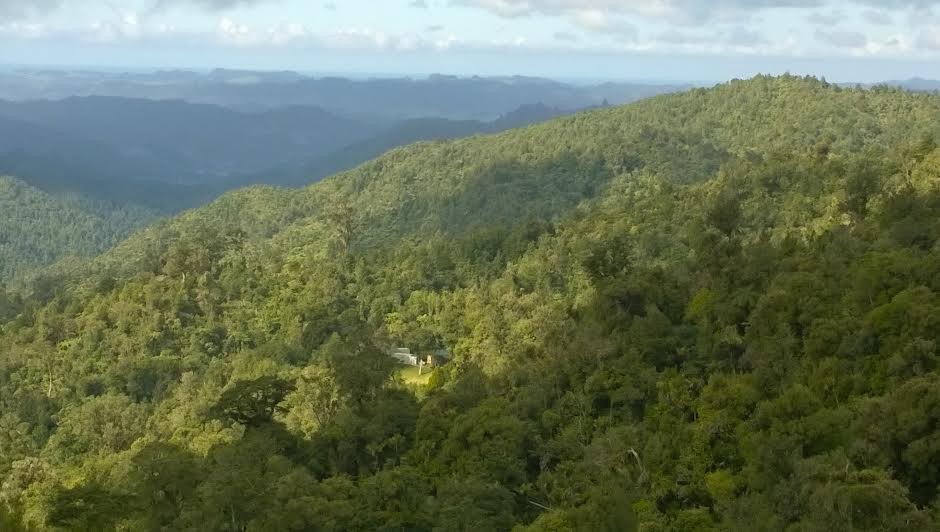
  • The House in the Forest

    The house in the middle of the forest, among the endless ranges stretching as far as the eye can see in the picture above, is ours.

    There are a few neighbours hidden around us in the thick canopy.

    We’ve lived here for almost eleven years now, since my husband left his far off home to join me in this remote little country of just over five million people. I was in my late seventies, he in his sixties.

    It was a leap of faith for us both, and since we had no money between us after leaving our previous lives, a tough start.

    He had left his ranch, and I left my beautiful clifftop cottage in a little fishing village.

    He found this place on the internet – a tiny wooden cabin surrounded by trees, gazing across to an amphitheatre of hills and forest.

    We joke that we own a quarter of a mountain.

    We used to gaze at the ad on the website every night for a year before he arrived on these shores, causing the estate agent to believe that there was massive interest in this remote cabin with no running water, no electricity, and no amenities.

    The forest is hidden from the winding dirt road with 298 hairpin bends by huge wrought iron gates, and is a protected area, so that it cannot be spoiled, developed or changed in any way..

    The dirt road, we discovered, was notorious for its difficulty, danger and beauty. The river which runs alongside it far below has its source on our forty acres of land.

    When my husband- to- be landed in this country, we packed up my beautiful possessions, walls of books, French antiques, china, lamps, pictures and rugs, in two 20foot containers, and arrived here on a sunny day just before Christmas. One loving friend had given us a Christmas wreath to hang on the door, and a tree one foot high equipped with tiny Christmas lights. I brought a stock of beeswax candles to light the cabin at night.

    We’d packed the bed last in the crammed container, along with candle sticks, a French mirror, a small table and lace tablecloth, and when I’d scrubbed and cleaned the inside of the cabin, we installed the bed, made it up with beautiful linen sheets and French counterpane, hung the mirror above the bed, arranged the tall candlesticks on the table under the window, and felt we had a home !

     Also to hand was a tiny gas camp stove, a frying pan and some plates and cutlery, and I cooked all our meals on a picnic table at the side of the house. It didn’t rain at all for the first few weeks, and we were able to unpack one container into a hastily erected garden pavilion so we could turn the now empty container into a minuscule kitchen and sitting room. We had bought a ranch slider from a demolition yard in a town an hour and a half away, carried home on top of the car, and installed at the end.

    Undeterred by our primitive conditions I persuaded my helpful new partner to hang up a big gilt Victorian mirror and several very large pictures in antique gold frames, we unpacked several bookcases and books to line the rest of the walls with books,

     furnished it with a sofa and two antique French armchairs, an oriental rug, and screened it from the kitchen with a weathered old grey French shutter.

    When our neighbours came to call, they were enchanted – one called it ‘petit Versailles’, another brought her mahjong group for afternoon tea to view it, and another, his daughter and then his sister out from England to view this extraordinary ‘room’ in the

     middle of the forest.

    Our neighbours were a fascinating group of people drawn here by the environment and the opportunity to help preserve both the trees, as well as some of the rare and endangered species which dwell here.

    Among the twenty so, are a well known architect, and a professor of aeronautics, who when he retired, went back to University to obtain a degree in zoology, and is now one of the foremost authorities on lepidoptera ( moths and butterflies ) in the country. He has discovered over three hundred new species of moth on the estate in the last ten years. 

    Our nearest neighbour is a Dutch cello player, and further away lives one of the country’s most renowned landscape architects and botanist wife, while further up the road, is a Dutch restaurateur and his artist wife. Nearby are a couple, one of whom is Swiss, who run a bungee jumping company in various parts of the world, an engineer, who’d retired from running African gold mines, and his Russian wife, and other fascinating characters.

    My husband is one of these fascinating characters, having started life in the US Navy as a highly trained nuclear specialist in a nuclear submarine, and when he left Hawaii to join me, was working at a famous observatory on top of one of the highest mountains in the world. He’s not only creative, designing and building our house, using a skateboard to create a sliding door and other ingenious devices, making concrete spheres and series of waterfalls for the garden and creating a thirty foot tree of lights at Christmas,  but he’s also the best informed person I’ve ever met, whether we’re talking about space and the stars, or how the body works, or the waves behave, or the theory of magnetism, gravity or Hadley Cells, or Leonardo da Vinci.

    We don’t have a television – instead every night after supper, we read to each other, a ritual we wouldn’t miss. 

    So we live in a world within a world, making expeditions down the long winding road to the nearest town for supplies, which include all the wood, doors and windows, which have been transported up the mountain to build our house on the sturdy roof rack of our loyal station wagon.

    My husband has built the house around us and as the years have gone by we have lived in warmth and comfort and beauty.

     I’ve planted a garden, and learned what flowers and plants the roaming bands of quail will spare when foraging for their salad course. 

    So this is the story of our adventure – the story of the forest and fauna and its rare and precious creatures is yet to be told.

    Food for Threadbare Gourmets

    Apple tart was a staple of our diet, growing up, nearly always eaten after Sunday lunch of roast beef and Yorkshire pudding.

    But these days I can’t be doing with all the faffing of pie-making and instead make a quick, easy French galette.

    While the oven is heating to 200 degrees, I grease a flat oven proof dish, and place in it a sheet of frozen sweet shortcrust pastry to melt.

    Three or four eating apples, peeled and thinly sliced, are fried in butter. By the time they’re ready, the pastry has sunk into the dish and the apples are then piled in the middle. Then sprinkle with sugar and cinnamon, fold the corners of the pastry over the apple, making a square… sprinkle with more sugar and cook for roughly thirty minutes.

    Leaves apple tart for dead !

    Food for Thought

    We will be held accountable for all the permitted pleasures we failed to enjoy .

    Hebrew Haggada

  • Beauty that connects