Tag: writing

  • Art and Soul

    Yesterday we set off on a long journey along the coast to the tip of the peninsula where we live.

    The road was a succession of hairpin bends winding past big empty beaches and bays, and among hills and streams and fields with sheep, a spectacular drive.

    At the end of this odyssey was a tiny settlement of between a hundred and thirty and a hundred and fifty villagers.

    The village consisted of a grocery store which also sold petrol, a farm shop, with delectable homemade jams and pickles as well as a wide assortment of meats, sausages, pickled and preserved goodies, and which served coffee on a terrace.

    We came away with a jar of my favourite quince jelly. There was a Himalayan centre – of all places – selling wonderful hippie artifacts, and a fire station and a village hall.

    There was also a smaller War Memorial Hall, commemorating the thirty men from this place who fought in the First World war, and the four who remained on the battlefield, and the twenty-three men who travelled across the world to the Second World War, one of whom also did not return. 

    How the departure of these contingents of brave men who crossed the oceans to fight for peace must have affected the farms and homes in this remote place is hard to imagine. Most of the men were gone for four and six years… who was left to fix the fences, milk the cows, shear the sheep, dig the potatoes, stop up a leaking roof, or father the children?

    It wasn’t just the men who went to war and came home traumatised who were the heroes.

    The War Memorial Hall was our destination. It’s a wooden building with wonderful acoustics, we had come to listen to an accomplished musician play the six Bach Suites for Solo Cello. We sat there for four hours, an audience of nearly thirty, silent and awed by the glory of the throbbing and thrilling notes, the vibrating chords and soaring ecstasies of  Bach’s glorious music, composed over three hundred years ago.

    The musician, who performs around the world, had come to live here recently, and gave this gift to his little community, and they responded with deep appreciation.

    As we drove away, still glorying in the harmonies and trajectories of soaring sound, I thought about the unexpectedness of such high art in such remote human settlements. 

    In the next small town with two thousand inhabitants, there is a concert in two weeks being held at a famous potter’s gallery. Milton’s Paradise Lost will be recited accompanied by a trumpet, and then a baroque concert will be performed. I expect there will be a full house.

    In the remote fishing village where I previously lived was a retired ballet dancer. 

    She’d won a scholarship to the famed New York City ballet as a seven year old, and now in retirement she had created her own modern dance company, aided by an Arts Council grant. Her pupils performed the ballets she’d envisioned in the village hall, and it was always packed with enthusiastic supporters. They seemed to think it mattered.

    “Life beats down and crushes the soul, and art reminds you that you have one”, wrote Stella Adler, actress and drama teacher. It also gives the soul the courage to reach the depths and find the strength and power to live life at the depth of our being. 

    I felt the truth of these words one day when I received an emotional blow so devastating, that the room turned black as I read the letter. Later, packing to go home in my bedroom, I saw the rose I’d picked on my dressing table, and as I gazed at it, feeling deeply its beauty and living energy, it gave me the hope and the courage to feel that somehow life could go on

    (I was all of twenty -two !).

    When resistance worker in war-time France, Odette Churchill, was asked how she kept her secrets under torture from the Gestapo, she said they sat her on a chair in front of a window. She could see green trees billowing in the sunshine and as her torturers ripped her fingernails out, she concentrated on the trees and their life and beauty.

    And later when she was being returned to her underground cellar in solitary confinement, the skeleton of a leaf blew in the door with her. She seized it, and its beauty and the promise of life sustained her. Even after she was burned with a red hot poker, she was able to hold on to her sanity and integrity.

    The rest of us are never tested to such a horrendous degree, but art and beauty can sustain even lives of hardship or drudgery. 

    The Scottish philosopher Henry Drummond wrote:

    “Ask the working-man’s wife, and she will tell you there is a moral effect even in a clean table-cloth.” 

    And in my experience, even a handsome tray laid with a crisp tray cloth and pretty cup and saucer lifts the spirit.

    So off to put the kettle on, fill the milk jug, and spoon the lapsang souchong into the pot. Music, art and beauty and a good cup of tea are an unbeatable recipe for a good life to me!

    Food for Threadbare Gourmets

    Back from the concert, I had little appetite for cooking supper. Luckily I had some cold chicken in the fridge, and some cooked rice in the deep freeze. Remembering Coronation chicken devised by Constance Spry and others for Queen Elizabeth’s crowning, I did a quick simplified version. The chopped chicken was mixed into mayonnaise, golden syrup, curry powder and cream to taste. The rice was defrosted in the microwave, and a handful of almonds toasted as in the previous blog. Couldn’t be bothered with the peas and sultanas in the classic recipe, just stirred vinaigrette dressing through the rice, sprinkled the almonds through and piled the chicken mixture on top. Quick and easy…

    Food for Thought

    Don’t cry for me, for I go where music was born. J.S.Bach on his deathbed
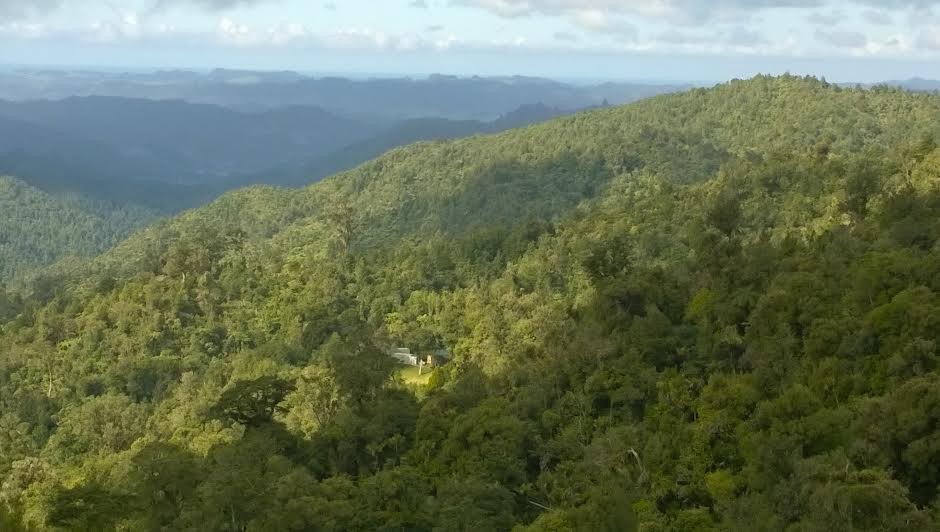
  • The House in the Forest

    The house in the middle of the forest, among the endless ranges stretching as far as the eye can see in the picture above, is ours.

    There are a few neighbours hidden around us in the thick canopy.

    We’ve lived here for almost eleven years now, since my husband left his far off home to join me in this remote little country of just over five million people. I was in my late seventies, he in his sixties.

    It was a leap of faith for us both, and since we had no money between us after leaving our previous lives, a tough start.

    He had left his ranch, and I left my beautiful clifftop cottage in a little fishing village.

    He found this place on the internet – a tiny wooden cabin surrounded by trees, gazing across to an amphitheatre of hills and forest.

    We joke that we own a quarter of a mountain.

    We used to gaze at the ad on the website every night for a year before he arrived on these shores, causing the estate agent to believe that there was massive interest in this remote cabin with no running water, no electricity, and no amenities.

    The forest is hidden from the winding dirt road with 298 hairpin bends by huge wrought iron gates, and is a protected area, so that it cannot be spoiled, developed or changed in any way..

    The dirt road, we discovered, was notorious for its difficulty, danger and beauty. The river which runs alongside it far below has its source on our forty acres of land.

    When my husband- to- be landed in this country, we packed up my beautiful possessions, walls of books, French antiques, china, lamps, pictures and rugs, in two 20foot containers, and arrived here on a sunny day just before Christmas. One loving friend had given us a Christmas wreath to hang on the door, and a tree one foot high equipped with tiny Christmas lights. I brought a stock of beeswax candles to light the cabin at night.

    We’d packed the bed last in the crammed container, along with candle sticks, a French mirror, a small table and lace tablecloth, and when I’d scrubbed and cleaned the inside of the cabin, we installed the bed, made it up with beautiful linen sheets and French counterpane, hung the mirror above the bed, arranged the tall candlesticks on the table under the window, and felt we had a home !

     Also to hand was a tiny gas camp stove, a frying pan and some plates and cutlery, and I cooked all our meals on a picnic table at the side of the house. It didn’t rain at all for the first few weeks, and we were able to unpack one container into a hastily erected garden pavilion so we could turn the now empty container into a minuscule kitchen and sitting room. We had bought a ranch slider from a demolition yard in a town an hour and a half away, carried home on top of the car, and installed at the end.

    Undeterred by our primitive conditions I persuaded my helpful new partner to hang up a big gilt Victorian mirror and several very large pictures in antique gold frames, we unpacked several bookcases and books to line the rest of the walls with books,

     furnished it with a sofa and two antique French armchairs, an oriental rug, and screened it from the kitchen with a weathered old grey French shutter.

    When our neighbours came to call, they were enchanted – one called it ‘petit Versailles’, another brought her mahjong group for afternoon tea to view it, and another, his daughter and then his sister out from England to view this extraordinary ‘room’ in the

     middle of the forest.

    Our neighbours were a fascinating group of people drawn here by the environment and the opportunity to help preserve both the trees, as well as some of the rare and endangered species which dwell here.

    Among the twenty so, are a well known architect, and a professor of aeronautics, who when he retired, went back to University to obtain a degree in zoology, and is now one of the foremost authorities on lepidoptera ( moths and butterflies ) in the country. He has discovered over three hundred new species of moth on the estate in the last ten years. 

    Our nearest neighbour is a Dutch cello player, and further away lives one of the country’s most renowned landscape architects and botanist wife, while further up the road, is a Dutch restaurateur and his artist wife. Nearby are a couple, one of whom is Swiss, who run a bungee jumping company in various parts of the world, an engineer, who’d retired from running African gold mines, and his Russian wife, and other fascinating characters.

    My husband is one of these fascinating characters, having started life in the US Navy as a highly trained nuclear specialist in a nuclear submarine, and when he left Hawaii to join me, was working at a famous observatory on top of one of the highest mountains in the world. He’s not only creative, designing and building our house, using a skateboard to create a sliding door and other ingenious devices, making concrete spheres and series of waterfalls for the garden and creating a thirty foot tree of lights at Christmas,  but he’s also the best informed person I’ve ever met, whether we’re talking about space and the stars, or how the body works, or the waves behave, or the theory of magnetism, gravity or Hadley Cells, or Leonardo da Vinci.

    We don’t have a television – instead every night after supper, we read to each other, a ritual we wouldn’t miss. 

    So we live in a world within a world, making expeditions down the long winding road to the nearest town for supplies, which include all the wood, doors and windows, which have been transported up the mountain to build our house on the sturdy roof rack of our loyal station wagon.

    My husband has built the house around us and as the years have gone by we have lived in warmth and comfort and beauty.

     I’ve planted a garden, and learned what flowers and plants the roaming bands of quail will spare when foraging for their salad course. 

    So this is the story of our adventure – the story of the forest and fauna and its rare and precious creatures is yet to be told.

    Food for Threadbare Gourmets

    Apple tart was a staple of our diet, growing up, nearly always eaten after Sunday lunch of roast beef and Yorkshire pudding.

    But these days I can’t be doing with all the faffing of pie-making and instead make a quick, easy French galette.

    While the oven is heating to 200 degrees, I grease a flat oven proof dish, and place in it a sheet of frozen sweet shortcrust pastry to melt.

    Three or four eating apples, peeled and thinly sliced, are fried in butter. By the time they’re ready, the pastry has sunk into the dish and the apples are then piled in the middle. Then sprinkle with sugar and cinnamon, fold the corners of the pastry over the apple, making a square… sprinkle with more sugar and cook for roughly thirty minutes.

    Leaves apple tart for dead !

    Food for Thought

    We will be held accountable for all the permitted pleasures we failed to enjoy .

    Hebrew Haggada

  • Beauty that connects