Author: Valerie Davies NZ

  • The preciousness of people

    Illustration from the post “The preciousness of people”

    A knock on the door revealed a stranger holding a white enamel colander full of strawberries. We had moved into this house in town the day before, and he introduced himself as a neighbour.

    That was a very meagre description of what he was, he was a glorious eccentric who I watched every day cycle slowly past on a very high old fashioned bike with a basket on the front, which gave the impression of being far too big for his small skinny frame, and liable to go out of control at any minute. He was on his way to the docks where he was a dock worker – a somewhat unconventional one I imagine.

    Again a meagre description of this blue- eyed, wildly bearded, elderly Irishman, who revealed to us that he was a sort of remittance man, exiled from Ireland by his despairing family to make his somewhat erratic way in the antipodes.

    He was a poet, he told us. I believed him though I never saw any of his work. His life was a poem. We went to his house, which was a poky little state house. Inside it gave the impression of being a miniature stately home, along the lines of an Irish demesne… a few good but battered antiques, the odd oil painting and large old-fashioned sofa and chairs covered in old fashioned country house flowered linens.

    This splendid impression of stateliness continued into the garden, which was quite big, being on a corner. He had transformed this rocky site into a miniature paradise, grass walks edged with pleached fruit trees, a vegetable patch, a strawberry bed, a tiny terrace and lawn, and best of all, a deep pond edged with large rocks, which he had created by levering the huge rocks day after day over a period of six months, until a deep hole had been carved out of the stony ground.

    He was an eccentric, one of the many who, when I look back, have enriched our lives and given us fun and pleasure. There was Mr Macdonald, a direct descendant of Beatrix Potter’s Mr Mcgregor, who was our neighbour in the country, another Irishman. He only wore a pink woollen vest with long sleeves and braces, all summer and winter, except on Sundays when he looked quite unnatural, shaved and spruced up in a short sleeved shirt in which he looked very ill at ease. Every spring he would arrive at my door in his pink vest, braces and hob-nailed boots, bearing a huge bunch of sweet-smelling narcissi which I had once told him reminded me of spring in England. He never missed a year thereafter.

    There was Alf, an Englishman who served in the Malayan Police, and every three years when his leave was due, not having any family he wished to return to, he would sail to the bottom of the Arabian Peninsula. There he would buy a large flock of goats, and then proceed to drive them through the desert, using the goats as food and currency, until he reached Port Said. There he would get a boat to Liverpool, make a quick visit to his sister there, and then return to his tropical home in Kota Bahru.

    Here too, lived Mammy, a giant White Russian, over six feet tall, wearing thick pebble specs for her short sighted grey eyes, and wearing the first caftans I ‘d seen over her enormous frame, all in brilliant colours and garish patterns . Mammy ran the local hotel where everyone gathered in Kota Bahru, and was a local joke too. As a seventeen year old I didn’t think she was such a joke. She and her husband had escaped the revolution in Russia, and made it safely to Shanghai like so many other White Russians.

    They had survived the rigours of Japanese occupation and then fled Mao’s Communist takeover, ending up in Singapore. There, one afternoon, Mammy’s husband had walked down the road to buy an evening newspaper, and had never returned. No-one knew whether he had run away or was the victim of some crime. And Mammy was now surviving in this rather heartless superficial society in the remotest part of Malaya but creating laughter and fun all around her – actually rather more than a survivor.

    Another neighbour was our Dutch friend Andrea, who had an antique shop full of the most exquisite items of a particular sensitivity, many of which I still posses. She was as nutty about animals as I, and far more lawless, striding into a bikie house to steal/rescue weeping puppies with no tails. I revelled in her poetic garden and laughed to see her huge magenta magnolia blossoms each wrapped in a plastic bag to protest them from the wind… not a good look actually!

    Her house was beautiful in that glorious Dutch interior way of Pieter de Hooch and Vermeer, her pottery made you want to hold it and stroke it – and I have some – and her paintings were romantic and exquisite, and I have some of them too. I could actually write a book about her…

    These memories were prompted by a conversation with a neighbour on my walk this morning. Since some of them read my blog, I cannot reveal what we talked of, or his glorious quirks of personality, but he reminded me of the joy of being with people who allow their personalities to flower, with no thought of what anyone else may think. Eccentricity is simply individuality, unself- consciousness, and the courage to be and do what feels right. When we are in the company of such people it feels as though ‘the waters of life’ are flowing, there are no limitations, and all things are possible.

    Martin Buber, the great Jewish philosopher wrote that: ‘Everyone has in him something precious that is in no one else. But this precious something in a man is revealed to him only if he truly perceives his strongest feeling, his central wish, that in him which stirs his inmost being.’

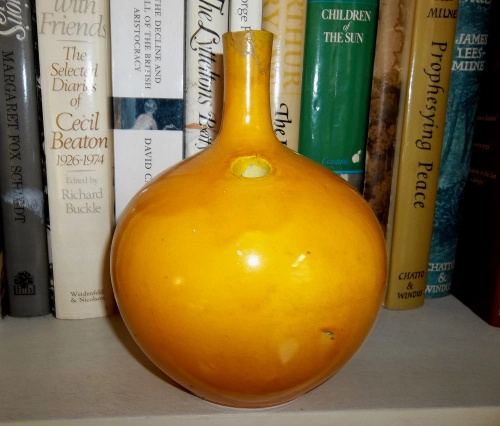
    P.S. The picture is of an antique English drinking jar given me by my friend Andrea.

    Food for threadbare gourmets

    A faithful follower e-mailed me yesterday and asked if I had a recipe for Simnel cake. This is the light fruit cake that’s traditional at Easter, so I told her I’d blog it today. I use Nigella Lawson’s recipe with my own adaptations.

    When I make it, I prepare the tin as usual, and then cream 175 g of soft unsalted butter with 175 g of caster sugar. Then mix 225 g of SR flour with half a teasp of cinnamon, a quarter of a teasp of ginger and 25 g of ground almonds. Add one egg with some of the flour mixture to the butter mixture, and mix two more eggs into the rest of the mix in the same way, before adding two tblsp of milk. Finally, fold in 500g of mixed dried fruit, plus some chopped glace cherries if you like them.

    At this stage I put half the cake mix in the tin, roll out about 400g of marzipan, cut into a cake sized circle and place on the cake mix, then cover with the rest of the cake. Bake for an hour at 170 C, then turn it down to 150C and cook for another hour and a half. It’s cooked when it’s risen and firm. Let it cool completely on a rack before taking it from the tin.

    When cool, paint the top with apricot jam, and roll out another 400g of marzipan and stick it on. With 200g of marzipan, make balls representing the eleven apostles – Judas surplus to requirements here – and stick them on using an egg white – beaten to just frothy. Some people quickly put it under the grill to make it look slightly toasted.

  • When is right wrong?

    Illustration from the post “When is right wrong?”

    It’s always been quite easy to be a pacifist in New Zealand for the last fifty years. Vietnam seemed indefensible to many, and our nuclear free policy made it feasible to take the moral high ground and declare that war is wrong.

    I was forced to think about this on reading of the First World War project at Paddington Station in London, where a magnificent and moving statue of an unknown warrior stands. In full battle kit and helmet, he is reading a letter. As part of the commemorations marking the start of World War One, writers have been invited to write a letter to him, and Stephen Fry, wit, comedian and actor was amongst the first to write his, and it caused a sensation.

    He wrote it as from a pacifist brother. Though he got historic details wrong – a pacifist would not be sitting at home then, he’d either be in prison or working on a farm, his letter moved many people. I’ve always been firmly behind conscientious objectors – (I like the moral high ground!) but this letter made me think hard about what was the right thing to do then, and how the right thing could very easily seem to be the wrong thing.

    I thought about the horrific killings at schools and other places in the last few years, where deranged gun-owners shot numbers of their fellows, and if they didn’t end up shooting themselves, were shot, in order to stop them killing any more innocent victims. These incidents made me think when is it wrong to kill another human being, if there is no other way to stop them killing others. As pacifists do we stand and watch while others are killed, or do we intervene in whatever way we can, to protect the innocent?

    This was actually the dilemma in the World Wars. Revisionist historians have said that there was no need for Britain to go to war in 1914. But Britain had informally agreed to support France if she was attacked in order to keep the balance of peace and power in Europe. More importantly, she had signed a pact in 1839 with four other countries of Europe, including Germany, to protect Belgium and allow this war-torn corner of Europe to enjoy being a neutral country, safe for the first time in history from being fought over. It was known as the cock-pit of Europe. It took the British Foreign Secretary, Lord Palmerston, nine years of diplomacy and negotiations to get the five signatories to agree to preserve Belgium, and they included France, Russia and England, and also Germany and Austria.

    But Belgium was doomed as soon as the Prussian General Schlieffen began planning a war for German supremacy, because his plans for invading France, took in Belgium first. By then, under Bismarck’s influence, the German nation had become a military one. Invading Belgium didn’t bother them, though it did the honest German ambassador in London, Prince Lichnowsky, whose anguished telegrams begging the Kaiser not to invade, I have read.

    In Belgium the Germans did what they did at Lidice in Hungary and Oradour in France in the Second World War, when they blamed the Nazis for these unspeakable atrocities. No Nazis around in the first war, but they still burned villages, hanged one man in ten and sometimes one man in two, and shot women, children and babies, the youngest three weeks old – at Dinant – as reprisals against any Belgians who had attempted to resist. Before the war was four weeks old, towns and villages had been sacked and burned, their people shot, and Louvain, and its ancient library reduced to cinders. So the choice for many Englishmen was clear – stand by and watch as a pacifist, or try to stop what seemed like a barbarian host?

    The British soldiers who went to war then, were part of the history of England which had always tried to stop one power dominating and enslaving all of Europe, from Louis the Fourteenth of France to Napoleon. To go to war seemed to many who joined up then, to be a heroic attempt to save civilisation, and even more so in the Second World War, when Hitler was enslaving the civilised world.

    The tragedy of resisting a violent and merciless enemy is that too often all the combatants find themselves using the same methods as the aggressor… war. But can we stand by and hang onto our principles of not killing, when all those we love will be destroyed, and not just those we love – our society, our country, and our whole civilisation. This was the choice which thinking people faced in both world wars.

    When World War One was declared, England’s army was smaller than Serbia’s – the tiny country where the match had been lit at Sarajevo. So England’s armies were citizen armies, in both wars, made up of peace-loving men called up to defend their country. There’s a lot of research to show that many soldiers when they fired their rifles at the advancing enemy, didn’t actually shoot at the enemy, but aimed to miss, and that even more didn’t shoot at all. They too faced choices on the battle field which are impossible for us to imagine, when like me, we are living in a safe, peace-loving democracy.

    So though I believe in peace, and have always supposed I was a pacifist, and attended Quaker meeting, where everyone was a declared pacifist, do I still believe it is possible to be one when the chips are down? I don’t know any more … Aggression turns easy choices upside down, when right – not killing – seems wrong, and wrong – fighting – seems right.

    The wonderful story of the American colonel in Iraq, surrounded by an angry mob intent on violence, calling his armed troop to a halt, ordering them to kneel and point their guns to the sky, immediately defused the threat of violence on that occasion. So how do we defuse the violence of would- be psychopathic conquerors who believe that might is right? Maybe only people power can do that – and that can happen – as it did at the Berlin Wall.

    Maybe it just needs enough of us to say: “They shall not pass…” Food for threadbare gourmets

    Something to eat with a glass of wine is one of our specialities in this village – among my friends anyway. It’s so easy to share a glass of wine and a nibble on a Friday night, without all the hassle of a dinner party. The latest craze is kumara skins – kumara are the Maori sweet potato that Kiwis pine for when they leave this country, but even ordinary potatoes are good this way.

    Boil scrubbed orange and golden kumara until soft, and then cut them into thin wedges, leaving about a cm of flesh. Heat hot oil until it’s just smoking. Dust the kumara with seasoned flour and fry until golden. Drain and sprinkle with sea salt. Eat the skins with sour cream sauce – half a cup of sour cream mixed with a tbsp on mustard, fresh herbs and lemon juice.

    Food for thought

    There is something that can be found in one place. It is a great treasure, which may be called the fulfilment of existence. The place where this treasure can be found is the place on which one stands.

    Martin Buber 1878- 1965 Jewish philosopher

  • Dancing to the music of time

    Illustration from the post “Dancing to the music of time”

    I climbed up the rusty fire escape smothered in trails of blue flowering morning glory and stepped onto the veranda of a very big two- storied, shabby white house built on the side of a volcano. The morning glory swung from trees, twisted up the fire escape, and swathed both house and garden in carpets of greenery and purple trumpet shaped flowers. With pillars, porticoes, verandas and banisters all festooned in drooping creeper, it looked like a romantic, deserted Southern mansion.

    Once on the veranda I peered through the windows, and beckoned to my slightly reluctant partner in crime to join me. It was obviously the home of students or alternative life stylers on this floor, the only unusual thing about their chaotic living arrangements being the live rabbits who were hopping about the grubby carpets. Downstairs a motor bike gang who seemed to have wrecked the place, had their bikes parked inside the entrance hall.

    Reader – to quote Charlotte Bronte – we bought the house. It took time to track down the owner and persuade him to sell, but we did. The room where the rabbits had bred was forever known as the rabbit room during our years in the house. The occupants moved out, but that was all. It was up to us to break down partitions, rip up revolting carpets, clean, scrub, paint and restore – including dozens of missing banisters – used no doubt for firewood. The bikies had left behind more than indescribable squalor but awful energy as well. But for the first time since its original owner the house had become a family home again, not a collection of shabby flats.

    The house had been built in 1875 by a French architect for himself, described on the title as Jean le Bailly Hervei, gentleman. The first thing we did was to rip out a partition and remove a door and two huge cupboards. This revealed Jean’s conception of a huge central hall, twelve feet high, thirty feet long and ten feet wide, stretching down the centre of the house, and looking out over the harbour and then to distant hills beyond. When I stood at the huge French doors and watched the flaming sunsets or the black clouds scudding in from the hills so that I knew what the weather would be like in half an hour, I felt close to Jean le Bailly Hervei.

    He designed this splendid roomy house with every French window and door opening towards the sun and these magnificent views, and each room led off from the airy hall on both the top and the bottom floors. The floor of the top hall I painted a rich pumpkin colour which picked up the shades of pumpkin and rose and purple and cream in a long Kelim rug which fitted the space. The bottom hall which matched the top, I painted white, including the floor, and blue and white curtains and matching table cloth over a round table obliterated traces of the former tenants and their bikes. My son painted his bedroom floor lime green to go with his colour scheme.

    The children and the little frolicking dogs brought life and fun into the house, and music rang through all the spacious rooms – the children played the piano and their flute and clarinet – me – the stereo – mostly Bach’s Brandenburg concertos, Beatles, Joan Baez and Cat Stevens.

    One day while clearing the garden of morning glory, I found a three foot high, concrete garden gnome hidden under the greenery. We dragged him inside, and since we had friends staying and my birthday feast that night, I invited the gnome to dinner too. He presided in a chair at the head of the table and we had lots of laughter at his expense.

    When we moved on, children gone, the psychiatrist who bought the house from us, an hour after it went on the market, asked me six months later at a party, what we had done to remove the brutal vibrations of drugs, alcohol, violence and fear which we had inherited. I was fascinated that a conventional medicine man should acknowledge that old energy, and that he had thought about it.

    We brought colour and energy into the house, I said, along with all the books and precious things we’d loved and collected, including tapestry and patchwork cushions and crocheted bedspreads I’d made. We had bowls of pot-pourri and flowers, and often used candle- light. But the two things that must have made the real difference, I told him, were that we all meditated, and there was always music being played. I think more than anything, it was the meditation and the music, I said.

    These memories came back to me today when I was reading that world-renowned neuro-scientist Oliver Sacks says that music affects the brain more than any other discipline. It is, he says, the only discipline that actually changes the physical appearance of the brain. We are designed for music, for ‘its complex sonic pattern woven in time, its logic, its momentum, and its unbreakable sequences’

    In Australia in a school where they have a Music Excellence programme the students spend many hours playing rehearsing and having music lessons. At prize-givings, eighty percent of the top students receiving awards for academic excellence were also music students.

    They mostly spend more than ten hours a week involved in their music and have almost no behaviour problems or any upsetting emotional or social issues even though they come from both rich and poor homes, single parent homes and every the other variation on backgrounds which could spell problems for children.

    Do we know whether the music acts as a stress release, or whether it builds such emotional equilibrium and peace of mind that its practitioners can weather all sorts of stresses without problems? Maybe it doesn’t matter. What does matter to us is that we recognise the value of music, and allow ourselves to receive and enjoy its healing and strengthening properties. Some research has shown that people who learn a musical instrument are less likely to suffer from Alzheimer’s.

    Music is supposed to teach basic skills such as concentration, counting, listening, and cooperation, help with understanding of language, improve memory, and help learning in all other areas. But actually, it doesn’t matter what the benefits are, it’s the sheer joy of music that enriches our lives. Perhaps it should be compulsory in schools, and be ranked along with writing and arithmetic as one of the necessities of life.

    And what I find amazing is that music healed a house. Once it had dissolved the top layers of fear and anger and violence, it seemed to penetrate to other layers of energy and atmosphere… reaching through levels of sadness and regret and loss, until finally the sweetness of the music uncovered all the layers of time, and we reached the gentleness and joy of Jean the Bailly Hervei .

    It was a voyage of discovery travelling back into the past and becoming aware of the lives of so many who had lived there before us. Music gathered together threads of sweet feelings from the past, and stitched them into the tapestry of life that we were adding our colours to. And it was the invisible vibrations of music which conducted us gently through those layers of time and feeling so we were able to hand on to the next owners the intangible beauty of a well-loved house. .

    Food for threadbare gourmets

    For these hot, dry, sunny days of Indian summer, sitting on the veranda, cicadas clattering, I like to make a spinach and salmon quiche which is good hot or cold. After lining a quiche dish or similar with thin short crust pastry – though I have used filo too, I simply pour the filling in and bake in a moderate oven for 40 minutes or until gently firm. For the filling I use 150 gm of chopped smoked salmon, a packet of frozen chopped spinach, defrosted and squeezed dry, 300 to 400mls of thick cream, three large eggs, salt and pepper. Mix everything together, adding the spinach and salmon last, and either a little grated nutmeg or a little parmesan cheese if you fancy, and pour into the partly cooked pastry case. Good with salad of course…

    Food for thought

    I think the sages are the growing tip of the secret impulse of evolution… I think they embody the very drive of the Kosmos towards greater depths and expanding consciousness. I think they are riding the edge of a light beam, racing towards a rendezvous with God.

    From ‘ A Brief History of Everything’, by Ken Wilber, Influential American writer and philosopher.

  • Can bloggers change the world?

    Illustration from the post “Can bloggers change the world?”

    I’ve been in a situation for the last few weeks where I haven’t seen or read a newspaper, watched TV or listened to the radio. The only newspaper I’ve seen is the hundred year old front page of The Auckland Star, a now defunct newspaper, and this page was a facsimile, framed, and hanging in odd places in our various homes over the years.

    It was dated 11 February 1913. Two thirds of the page was filled with the main story which had shocked the Empire (there was only one empire back then, and it was British!). The rest of the space was taken up with smaller items, an African revolt in Mozambique, quelled by the Portuguese, the terrible fighting between Serbs and Turks with high casualties, another item in which the Turkish commander of Adrianople on hearing of the proposed neutralisation of the fortress promised ” to take care to put the 40,000 Bulgarians who live here out of the way. I shall confide the women and children to the foreign consuls, turn the guns on all the Bulgarians and then convert Adrianople to a giant rubbish heap”.

    Beneath this was a story about the Turkish Red Cross addressing European sovereigns asking them to recall the law of Christ to stop Christian forces committing the most ghastly outrages and assassinations on Turks witnessed in Europe in modern times. Under this item was the English response to the Australian Cricket Association’s investigation into the behaviour of the team in England, followed by a report from Melbourne on the arrest of two Chinese involved in an enterprise with Hong Kong Chinese to smuggle ‘Chinese persons’ into the Commonwealth.

    A political crisis in Japan had provoked rioting which was put down by the army, and the English House of Lords debated compulsory physical training and elementary military skills to: “lay a foundation … on which a scheme of national defence could be based if unforeseen dangers menaced the country”. At the bottom of the page, an unforeseen menace, the Kaiser, was reported as having unexpectedly addressed the university centenary celebration, and “delivered a fiery panegyric upon German military virtues”.

    And Suffragettes had a smashing time in London, where they broke the windows of the Reform, Carlton, Junior Carlton, Oxford and Cambridge Clubs, and Prince Christian’s house ( what had he done?). “The missiles were of “lead and fireclay balls”.

    The only other news of women was the report of the Kaiser’s daughter’s betrothal to Prince Ernst of Cumberland. Nothing very different there. Serbs killing, refugees being driven from their homes and ‘confided to the care of foreign consuls’, cricketing misdemeanours, African riots, Japanese politics, boat people trying to get into Australia, suffragettes protesting, reports on princelings, are still the stuff of the news today. Substitute Syrians for Serbs, feminists for suffragettes, and it could just as easily be the front page of any newspaper today.

    What made this day in history different was the story which filled the rest of the page and which has grabbed the imagination of the world ever since – the story of a man who failed. First, he failed to achieve his objective, and then he failed to get back safely.

    The main headline reads: “Scott Party Perish”, followed by the next headline: “Five Who Made The Final Dash”, and then another headline: “Lost In A Blizzard.” And then another headline (they made the most of headlines in 1913): “After Reaching The South Pole”. Below, yet another headline: ” A World Wide Sensation”, followed at last by the main story, two sentences, the first saying they’d reached the South Pole on January 18, and perished in a blizzard, the second, listing the five who perished.

    And this story is the only clue to how things really have changed in the last hundred years, even though they may seem to look much the same. Scott and his men would not have died now – they would have had the latest dietary discoveries to sustain them, they could have gone on tractors or skis, or any of several different ways, and kept in touch with the media and their families with all the different forms of communication we now have at our disposal … they might even have been able to keep us up to date on Facebook, and Twittered their families regularly.

    The marvels of modern communication are what really are changing the world … so that maybe – just maybe – that page of news items may seem very dated in another hundred years. But the other thing which has changed since that day in 1913 is what we’ve done to our planet in the last hundred years, destruction on a scale that actually threatens the survival of the human race, and prompts some to wonder if it has a future.

    Maybe the biggest change since that day of news in 1913 is the change in our mind-set… we have a United Nations now, which is supposed to help bring peace to troubled hot-spots… at least the intention is there. We have governments who talk about the happiness levels of their people, and maybe best of all, we have the internet to unite us to change things.

    We all know that riots, revolutions and parties can be created with a few text messages, but there’s something deeper and more important happening in the world that we bloggers inhabit. That is the growth of groups and individuals who use this medium to change things for the better.

    The biggest and most successful so far is the group known as Avaaz, which now has millions of members world-wide who create and follow up petitions to governments to rescue women about to be stoned for having been raped, petitions to stop destruction of ancient tribal lands and forests, to tackle Monsanto and their environmental damage, to lobby European countries to stop using pesticides to save our bees.

    Their range of concerns cover all the issues of our small world and the more of us who can support them the more likely we are to change this precious world for the better. So far they’ve achieved their aims on many issues both great and small, and saved a few women. And yes – that’s a commercial … and Avaaz is the name!

    Food for Threadbare Gourmets At last we have some rain, and the autumn mist now hanging over us makes me hope that perhaps we will get some mushrooms springing up in the grass outside our house… some years we do, some we don’t, and I never know why. If we do, and we only have a few, they will go with bacon for my husband. But if we have plenty I’ll cook them in butter with some chopped garlic, add chopped parsley and then some thick cream to bubble up. Poured over toasted sour dough bread, they are tasty and delicious.

    Food for thought

    When we do dote upon the perfections and beauties of some one creature, we do not love that too much, but all other things too little. Never was anything in this world loved too much, but many things have been loved in a false way; and all in too short a measure.

    Thomas Traherne 1636 -1674 English metaphysical poet who remained unpublished for two hundred years.

  • Heaven’s scent

    Illustration from the post “Heaven’s scent”

    The first time I smelt it was at sea. One of my dearest friends had drowned there a few days before with her baby and two small children. Her husband’s ship, trading between New Zealand and the Islands, had caught fire in a heavy storm just off the coast not far from here, and they had had to take to the life-boats. Their mayday signal was never picked up, and the life-rafts, which are reputed to be safer near the coast, had broken away. So my friend and her children didn’t survive the mountainous waves.

    Her heroic and tragic story before this happened, is too long to tell here, but her partner, a French sea captain, did survive. He came to stay with us for the next few days until the body of one child was washed ashore.

    We all trekked up to Northland, and after the heart-wrenching funeral, Jean asked us to take all the flowers to a nearby bay. There, a police launch was waiting, and with a few close friends we loaded the flowers into the cabin – then thankfully shut the door on the overpowering scent of freesias, jasmine and other spring flowers, and took off for the bay where my beautiful friend had died.

    When we reached the spot where she had slipped from his grasp, Jean stopped the launch, and then, in an old Breton custom, went to toss the flowers into the sea. As the launch stopped, the sun was shining, the blue sea was calm, and the line of golden sand on the shore, still guarded by a watching policeman, lay ahead. Only another mile from here, but a mile too far for my friend. We sat silently and breathed in the heavenly fragrance wafting around us. Exquisite. Then the door to the cabin was opened and the scent of the flowers inside was entirely different.

    When we talked about this to a friend, he told us about the writer Rosamund Lehman, whose daughter had died suddenly – of polio, I think – in Indonesia. A heavenly fragrance permeated the hall outside Rosamund’s flat. People didn’t believe it until they went to visit her, and then were overwhelmed by the perfume.

    A few years later, we began to experience the same wafts of flowery perfume in our sitting room. I searched for the source, but it came from none of the flowers in the room. The scent cut through the smell of the coal fire, and every other momentary odour. In the end, we gave up, and just accepted, as a friend said, that we had angels there. After a week of this, one of our cavalier King Charles spaniels was diagnosed with an untreatable disease. We gave ourselves five agonising last days with him, and then took him to the vet for the last time.

    When I got back home my nine year old daughter was waiting on the veranda, home with flu. She couldn’t wait to tell me. “The flowers came from that patch on the floor where Sheba used to lie to get cool,” she cried. (Sheba was an afghan who’d died the previous year) “She was warning us about Benedick.”

    When we went inside, the fragrance had gone, but later, as I sat by the fire crocheting and wiping stray tears, I suddenly smelt a strong scent of lavender. Knowing well that I hadn’t got any, I still searched my knitting basket for a bottle of lavender. I called through to my daughter in bed – ‘have you spilt some lavender water?’

    Then we realised that my son had picked a bunch of lavender and camellias to go with Benedick on his last journey… the scent was a last message from his little dog.

    Since then we’ve heard of other instances of these heavenly perfumes. In her beautiful account of a year living in the Blue Mountains, Australian poet Kate Llewellyn, describes sitting next to two nuns on a train, and their gentle simple conversation with her. After they had left, she felt that she could smell violets… “the odour of sanctity,” she called it.

    The Catholic Church calls it the ‘odor of sanctity’, but always associates it with the bodies of saints who have died. But these heavenly scents are like a gift sent from who knows where, and have nothing to do with sanctity. Rather, they are like gifts from a benevolent and loving source who for some reason allows these emanations of beauty to visit and to comfort. No-one has to be holy or to deserve them, they are simply a manifestation of another order of beauty and wholeness that we may be conscious of, but can never see or grasp.

    They are the moments that we can hold onto in a world where man can create so much pain and misery. Beyond this world created by man is this other level of love. And how exquisite that it’s the fragrance of flowers that delivers this message of hope – that the world doesn’t have to be the way we make it – that there are other worlds of truth and beauty and peace that these fragrances remind us exist.

    Rabindranath Tagore talked of the air filling with the perfume of promise… sometimes I wonder if that is what these flowery messages are – both a consolation and a promise.

    Food for threadbare gourmets

    With a family of gluten free addicts, I’m always looking for recipes without wheat. This is a lovely chocolatey treat. I melt 125 g of butter and 150 of dark cooking chocolate gently in a large saucepan. Stir in half a cup of sugar and a teasp of vanilla. Next, stir in three egg yolks and a cup of ground almonds. Beat the egg whites until peaks form and then beat in two tablsp of sugar. Using a slotted spoon, gently fold the whites into the chocolate mixture. Line a 20 cm cake tin with a base of cooking paper, and bake at 180 degrees for 25 minutes. The cake will come out soft, and will sink and firm when cool. It’s very rich, so a sprinkling of icing sugar on top is all it needs.

    Food for thought

    In a rich moonlit garden, flowers open beneath the eyes of entire nations terrified to acknowledge the simplicity of the beauty of peace…

    Aberjhani, American historian, novelist, poet and blogger

  • Ordeal by wardrobe

    Illustration from the post “Ordeal by wardrobe”

    There will not be many people wearing soft fuchsia coloured leather gloves in the North Island of New Zealand this winter, but I will be one of them.

    They were a gift from my daughter last Christmas. She brought forward the present giving ceremony, and insisted that I open my presents first before anyone else opened theirs, because she wanted to see the look on my face when I saw them. She’d brought them back from London months before. I hoped my face showed everything she hoped when I unwrapped them. I can’t put them away. They sit on my dressing table – a symbol – of many things.

    But her solicitude for my wardrobe doesn’t stop at leather gloves. This weekend she pounced, and said that the following day we were going to go through my clothes, and I was going to sort everything into keep, store and throw away! I had a friend who had also undergone this ordeal by wardrobe, when her daughters dismissed all her lovely clothes as ‘tragic,” so I knew what I was in for.

    I had to agree that something had to be done, as I was always losing things in the muddle of too many hangars on the rail. As the morning wore away, it got easier and easier to let go.

    “You’ve got too many white T-shirts.” was the first pronouncement. “There are five days in the week, how many do you think you can wear?” Resisting the temptation to correct her arithmetic I feebly tried to think why I would want more than a dozen white T- shirts, but nothing came to mind…

    “No more brown, or dull sludgy colours” was the next diktat. “They don’t suit you. You need bright clear colours.” No arguing with the considered opinion of an expert… so out went two thirds of my wardrobe.

    I tried to salvage a few comfortable jumpers and slide them into the store –and- second- thoughts pile. “No,” said the arbiter – “how long is it since you bought that? – fifteen years? – Well it may have looked nice then, but it’s hopelessly out of date now – anyway, it’s got moth holes”…

    No, that’s worn, no, that’s got pilling, no, that’s the wrong colour … gradually the wardrobe emptied, and the to-keep pile was pitifully small. The throw- out pile (for the womens’ refuge) was huge.

    “No, you have to give up labels”, she pronounced. “But I always cut mine out,” I protested… “Yes, but look – you just said ‘but that’s a Jaeger, ‘when I tried to throw away that jumper.”

    “Okay, I get it”, I sighed. “I can’t believe you’d have bought this,” she exclaimed, holding up a black and gold embroidered evening coat.” “No, I can’t either,” I agreed, “so I’ve never worn it”. “Right, Trademe”, she said. “Anything with tags you haven’t worn we can sell and just think, even if you only get five dollars each for all this stuff you’ve never worn, it’s all money towards a new wardrobe!”

    By now she’d found various un-worn shirts I had had made that had never worked.“I hope by the time I’m your age, I’m not making these sort of mistakes,” she muttered…“What are these?” she cried, holding up a pair of well tailored tartan pyjamas beautifully piped in red. “What on earth have you got these for? How long have you had them?”

    “Exactly nineteen years,” I replied truthfully. “I saw a picture in a magazine of a model wearing pyjamas like these, cuddled up in front of a log fire with a cup of hot chocolate, looking so cosy and glamorous.” She looked at me disbelievingly. “Have you ever worn them, have you ever done that?”“Not yet”, I admitted, “but I might.” She opened her mouth to say something withering, but then took pity on me –“OK, you can have your dreams,” she said, and dropped the pyjamas on the to-keep pile.

    By now we had descended into the bottom of the wardrobe to the shoe department. While I sat on a small stool scrabbling around in the darkness, she took the opportunity to tweet her friends. “Sorting my mum’s wardrobe” went the message – “keep, store and throw.” Back came a flutter of twitters from people who obviously had time on their hands that morning. The opinion seemed to be unanimous – too hard basket for them… I thought to myself, now at least one third of Auckland knows I’m throwing away my clothes.

    There had been a time when my daughter needed a whole cupboard for her shoe fetish, but no more, it seems. “If I buy a new pair, I gash another pair,” she lectured me… so out went shabby oldies, Moroccan slippers, shoes that pinched, boots that had the wrong sort of heel… the good news was that I found a pair of beautiful black suede indoor shoes that I’d never even worn and had lost about seven years ago. Needless to say a whole harvest of handbags was dissipated. “But you know I’m a bag lady,” I whimpered….

    At the end she shook her head in a tolerant and kindly way. ”I’m proud of you, I never thought you’d do it so quickly and easily – now don’t you feel better?” she coaxed…” A lot lighter?” “Definitely a lot lighter”, I answered, looking at the giant pile destined for the womens’ refuge… a smaller pile that I could have second thoughts about and store, and then the emasculated line of shirts and skirts, trousers and jackets hanging on the rail.

    But as I looked, I had to admit she was right. She’d even hung them so I could see what to wear with what. Best of all, I’d found the three jackets she’d lavished on me last year that I’d forgotten about – one Jaeger and two Ralph Lauren… labels, I said!

    Yes, there is nothing like a daughter… and thankfully, they keep you on your toes, as they can always see room for improvement. I do hope she approves of what I choose to wear with the fuchsia pink leather gloves when winter comes. Maybe I‘d better get her advice – after she‘s finished stacking the three metres of fire-wood sitting in my garage… there really is nothing like a daughter!

    PS. She checked out this story, and said she could add a few more items – what about that lost evening bag you were so thrilled to find under a pile of jumpers? Enough is enough, I said firmly.

    Food for threadbare gourmets

    Our neighbours have a banana tree which is weighed down with small sweet bananas, and they don’t eat them. This largesse comes our way, and I use this recipe when we have too many to eat.

    Mash a cup of bananas, and melt 150gms of butter. Put both in a dish and add two eggs and a cup of sugar… I often use brown for the taste. Mix them together and then add two cups of self raising flour. Dissolve a teasp of baking soda in 3 tablspns of milk, and stir that in too. Beat lightly, before tipping the mixture into a greased 20cm cake tin, the base lined with baking paper. Bake at 180 degrees for 50 to 55 minutes. It’s cooked when the cake springs back when lightly touched. Lovely with thick lemon icing.

    Food for thought

    Comparison is the thief of joy. Anonymous

  • Ant or grasshopper?

    Illustration from the post “Ant or grasshopper?”

    The weather forecasters are calling it an Indian summer. This appals me – sitting here looking out of the French windows, watching butterflies flitting over the hydrangeas, I thought we were still gently making our way through an antipodean summer. Has the time flown so fast that we are in that gap between high summer and early autumn? The din of the cicadas should have warned me, as should the scattered pink blossoms on the plum tree. This bewildered specimen flowers every autumn – fruitlessly – before doing its spring burst of glory.

    Driving along the roads to town, the verges are blooming with the autumn flowering of scarlet mombretia which have spread through the long golden grass. White oxe-eye daisies grow in clumps among the mombretias, and there are still some red- hot pokers and a few roses flowering as I drive past unkempt hedge-rows bright with a heavy harvest of red hawthorn berries.

    If it was the northern hemisphere I would repeat to myself the old country lore that we must be going to have a hard winter, and nature is providing for the hungry birds. But we never have hard winters where I live, so I just savour the bounty with no fear for the future. Instead we long for rain.

    Every year now we have a drought, and it becomes a struggle to keep the garden alive; I use up our precious water to save the white Japanese anenomes for their burst of autumn flowering, and to stop the roses wilting. The purple salvia looks after itself. Glorious scented Jean Ducher, and bright mutabilis keep the cycle of roses going all the year round. And littered around the garden are the shallow plant holders filled with water for thirsty hedgehogs to drink, and where I also see wasps sipping and even a pair of snails making their way together down to the water in a deep bowl.

    When I looked out of the bedroom window this morning at silent dawn, the sea looked like wet aluminium, the curve of bay on the distant horizon was steel grey, and the clouds overhead, silver- grey. But by the time I drove into town for shopping, the sun had come out. The fields are so dry they are burned to a pale gold, and the pennyroyal is now flowering, making a carpet of purple.

    That rich purple carpet always reminds me of when I was in France, staying in an ivy- turreted, moated chateau in deepest Vienne as a twelve year old… my best friend there, Josephine, invited me to go mushrooming with her and her maid, so equipped with baskets we set off to find “champignons”, chattering in fractured French and broken English.

    Two little girls dressed in flowery cotton summer dresses made their way through long wet grass and dewy paths lined on either side with blackberry bushes heavy with fat juicy fruit as big as grapes.

    We walked through early morning mist, and it suddenly cleared. There in the bright sun-shine in front of us, stretched a shimmering field of tiny pale purple-blue flowers, with hundreds of miniature, deep blue butterflies hovering and fluttering above them. That world was alive with birds and butterflies.

    Farmers here are feeding out to the cows already, and I fear for the thirsty birds and hedgehogs. As I drove past the agistement fields outside the village, I saw all eight mares spread out round the field in a circle, with their heads thrust deep into bright red plastic buckets; and by the side of each one, their long-legged foal stood patiently, waiting for mother to finish.

    At lunch with friends was a person I’d never met, who used to be a dressage and eventing rider. She told a fascinating story of when she was part of the NZ team at the Olympics when Mark Todd won his first gold medal. The New Zealand team were in third place when their last rider came on. This person did the round without a fault, but so slowly that the team lost forty points and slipped right down the order. Mark Todd, beside himself, strode up to the rider, and exploded; “Why did you do it?”

    “I was saving the horse,” was the reply, to which Todd cried despairingly: “What for?” I have used this thought constantly since, so every time I go to save something, I ask myself, what for, and mentally come back to the present, and seize the day!

    On my own the other day, I decided to lay my lunch on a tray and take it out to the veranda where I look down to the sea through the gnarled branches of spreading pohutakawa trees. It’s shaded from the mid-day sun by dappled light filtered through leaves of the white wisteria. Suddenly I thought – why not use my precious antique green French plates – and green wine glasses – and the best silver – what am I saving them for? This is not seizing the day, I chided myself.

    This thought has spread into other parts of my consciousness… I’m raiding my store-cupboard – if not now – when ? Why not eat these goodies now? Time to start emptying the deep freeze – what am I saving all this food for? Those pretty shoes – why not wear them today, even if I’m not going anywhere?

    Maybe I’m becoming a grasshopper – singing the summer through, taking no heed for the morrow – and the prudent ant in me is having a hard job trying to make itself heard. But being a grasshopper seems to mean feeling much satisfaction, joy and being right here in the present. If not now – when? Saving it – what for? Two phrases which are life-changing, ring with truth, and which mean that other cliché – seize the day. So I’ve come to terms with the Indian summer, and revel in these days of softer sun and autumn flowers and golden trees.

    Food for threadbare gourmets

    It’s the time of year for the apple harvest. One of my favourite ways to use them for pudding when we have friends is to allow one apple per person. Take out the cores, and fill the hollow with brown sugar and sultanas, or as I usually do, with left-over Christmas mincemeat.

    Put them either in an enamel dish or other oven-proof dish, but I love the homely look of an old-fashioned enamel dish for this. Pour cream and whisky over them to come up to about half an inch in the dish. Cover and bake until soft. They’re delicious served on their own or with a crisp biscuit, or for something filling, with a creamy rice pudding.

    Food for thought

    “If we do not contest the violation of the fundamental right of free people to be left unmolested in their thoughts, associations, and communications–to be free from suspicion without cause–we will have lost the foundation of our thinking society. The defence of this fundamental freedom is the challenge of our generation,”

    Edward Snowden NSA whistleblower and hero.

  • Our best friends

    Illustration from the post “Our best friends”
    Illustration from the post “Our best friends”

    This magnificent creature was making the most of the water in the dog’s bowl at my gate. He could have been Captain Scott’s dog Osman, the wonderful husky who saved so many dog’s lives when the team fell into a deep icy crevasse. Gallant Osman hung on at the brink, taking the whole weight of the dogs and the sleds until they were rescued. This hero survived Scott’s disastrous Antarctic expedition, and ended his days here in New Zealand.

    If I’m reading history, it isn’t the dates and the battles that stick in my mind but the children and the animals, and I hate to read in the news that a head of state has donated two Russian wolf-hounds, or a splendid race horse on a state visit. The poor creatures are torn away from their homes and given to uninterested strangers speaking a foreign language.

    To this day, I sorrow for Mary, Queen of Scots’ little Skye terrier who came with her to the block, hidden in her long skirts. When the Queen’s head had been severed, the faithful creature rushed out and stood howling between the body and the head. Nothing would entice the little dog away from the remains of the person she was devoted to. Finally, when the Queen’s body was removed the little dog was repeatedly washed by her grieving ladies to remove the blood and the smell, but she refused to eat, and died shortly after of a broken heart.

    Marie Antoinette’s pet- dog who shared her solitary confinement, was left behind when the white-haired, dignified Queen was hustled out to the guillotine, and was adopted by the prison governor – we don’t know for how long that little dog pined.

    And Joy, the Russian Tsarevich’s spaniel, was found in the deserted house in Ekaterinberg, eight days after the massacre of the Russian Royal family, when an army of White Russians took the city and a group of officers rushed to the Ipatiev house where the family had been imprisoned. The little dog was starving and wandering around looking for his master. History does not put my mind at rest as to the fate of this little dog. (It also seems to suggest that being the beloved of royalty is a dangerous destiny.)

    But just as bad was the fate of Joseph Banks’ dogs. Banks was the naturalist who sailed with Captain Cook on his first great voyage in 1768. Besides cluttering up the tiny ship with four servants, Banks also brought his two pet greyhounds with him.

    After two years voyaging, still at sea, the Endeavour called at Savu Island, and after a drunken night dining with the local Rajah who wanted an English sheep and an English dog, Cook gave him the last sheep on board, and Banks gave him one of his greyhounds. What the sensitive greyhound went through pining and parted from his life-time companion, and the men who he knew and loved, to be abandoned on a tropical island among people who had no idea of what a dog or a sheep was, doesn’t bear thinking of – not by me at any rate.

    And at Matavai Bay, Tahiti, ten years later, the captain of another English ship, the Mercury, reported that an English pointer left behind by a previous ship: “singled them out, showing its joy by every action the poor animal was capable of.” Which tells us that the dog was capable of distinguishing between races, and was homesick, and was probably hoping to go back to its old familiar home across the sea when it recognised the sailors. I wish I knew that the sailors had taken it back home, but I fear they didn’t.

    Then there was Mackenzie, from New Zealand’s South Canterbury, a cattle rustler. His dog was brought into Lyttleton court as a witness. She slipped her chain and ran over to the dock, scratching and whining, trying to get in and join her master. The red- bearded rustler, who’d refused to speak a word until then, began to weep. He begged to keep the dog and take any punishment the court meted out.

    “I ‘ll make your roads, I’ll break your stones… only let me keep her.” They didn’t let him keep her of course, being men of stone themselves, and the little black dog was sold to a farmer who she refused to work for, only knowing commands in Gaelic. We don’t know the end of either her or her master.

    But what we do know is that too often it’s only their owners who care about their dogs. Once the person who loved them is no longer there, a dog’s life is an uncertain one. Which is why I love the wonderful people – and many of them are bloggers – who rescue and adopt the dogs who have been left behind. And in my experience there is no dog as devoted as one who has been rescued. I used to have three at a time, and wherever I walked, from kitchen to garden, from bedroom to study, fourteen feet moved

    The gratitude of a rescued dog never ends. They know that all their happiness is the gift of love from a stranger who becomes their beloved.Last year, when his mistress died, Lochi, a rescued German shepherd, a beautiful silvery creature, went to mass every day at the church of San Donaci in Italy as soon as he heard the bells ringing. He sat where his owner last lay in her coffin. He died two months after her of a broken heart. (wonderfully, so as not to disturb him, the local priest served mass down in the church instead of at the altar.)

    If only people had hearts as big and loving as dogs we wouldn’t have places like Syria and Palestine, Ukraine and Afghanistan and all the other broken hearts in the world. There is a mantra : let only love prevail…

    Food for threadbare gourmets

    Still lotus-eating at the end of the long dry summer, I sat in a bower in my dearest friend’s green garden, enjoying a long talk and a simple lunch with her. Just a delicious glass of chilled rose, a slice of salmon on a bed of brown rice with goodies in it, and a salad of green leaves, translucent slices of ripe pear, and parmesan flakes mixed through with the vinaigrette, followed by coffee and a chocolate truffle… what more could one desire… love and lotus –eating !

    The brown rice had been cooked and then marinated in soya sauce. Sun flowers seeds, sultanas soaked until plump, chopped apricots, spring onions, and walnuts then mixed through. Delicious with the salmon, but just as good with warm lamb or chicken I suspect…

    Food for thought

    You might quiet the whole world for a second if you pray. And if you love, if you really love, our guns will wilt.

    St John of the Cross, translated by Daniel Ladinsky

  • Pooh Bear has the answers

    Illustration from the post “Pooh Bear has the answers”

    I’ve only been on one teddy bear’s picnic. There were lots of teddy bears, crammed into a little dolls pram, my three year old grand- daughter and me. We solemnly walked the pram to a tree in the park in Melbourne next to the house where they lived.

    There, on a cold, slightly misty winter’s afternoon, we carefully propped a huddle of teddies of different sizes and varying shades from honey to dark brown, around the base of a tree. After careful discussion as to what teddy bears might eat, we had plumped for very small brown bread and honey sandwiches – we thought that arbiter of bear behaviour, Pooh Bear, would have approved, and that was all we needed to know really. We thought bears would probably only have wanted to drink water, so that was easily solved….

    I was thrilled that she still remembers this occasion now she’s old enough to be at university. And she remembers too, jumping on our shadows the year before, and learning to sing ‘Kumbaya, my Lord’ when she was even smaller (in an English accent!). These memories may be more precious to me than to my grand-daughter, and most grand-parents will understand just how precious they are.

    When I look back to my memories with my grandmother, I marvel at what I learned from her, much more, I suspect than today’s grand children learn from theirs. She taught me to knit and sew and do French knitting, and embroider dozens of stitches I’d forgotten till leafing through an old Mrs Beaton cook book recently – daisy stitch, herringbone stitch, blanket stitch, chain stitch, back stitch, buttonhole stitch, cross stitch. She told me the names of flowers and saints and cousins I’d never seen, the stories of dead great uncles in the war. She taught me prayers and proverbs and songs.

    But somehow, once the days of reading aloud Pooh Bear and Dr Seuss and Dear Dinosaur had passed, all my grand-children were so engrossed in their play stations and favourite, regular afternoon TV programmes, that there was rarely a space for the sort of boredom or blank days we used to have in my childhood; those times when for lack of something better to do, we mastered a new skill and learned to knit, or read a book considered too hard or too boring before, and which was now discovered to be a treasure.

    It was on those long empty days that I discovered the joys of rambling alone with the dog, or daring to cross the weir by the mill with friends, or digging around the Roman mines, hoping after two thousand years to find a Roman coin; it was when we picked primroses in the woods, and carried catkins and pussy willow home as spring announced itself … As we grew older we made egg sandwiches and took a bottle of ginger pop to picnic on empty beaches with names like Man o’ War Bay and Arish Mell Gap, coming home tired and sunburned.

    But my grand-children have done it differently. Today they’re not free to roam alone as we were – instead, they went on exciting holidays, in the tropics or to fishing lodges, or learned to sail or ski. But then they’d come to stay with me, and do ordinary and yet totally absorbing things. Leaving their play stations, they’d feed the eels in the river at the bottom of the garden, spend days making boats out of flax leaves, and floating them down the waterfall, building dams, playing Pooh Sticks.

    They could spend an afternoon totally absorbed in throwing stones down into another river, far below, and listening for the plop. Another morning in the city when I took all four of them to a secret spot above the harbour, where old oak trees spread, they spent a whole morning searching for acorns and throwing them down into the water. Not aimlessly, but aiming.

    And not a question of little things please little minds, but being ‘in the zone’, alive and present. Blowing bubbles from my veranda and seeing who could make the biggest one that drifted furthest and lasted longest; or the ritual playing of hunt the thimble with the same silver thimble every time, seemed to give them more fun and shrieks of laughter than watching their Japanese TV serials and videos or war games on the computer. And grandparents have time for long conversations about the size of universe and whether ice-cream is good for you, and what dogs are dreaming about – and about important things – like ethics – which even small children understand in terms of right and wrong, or better still, kind or unkind …

    Sometimes I think that this is one of the few gifts we can give our grand-children in this busy technological age when our grandchildren know more than their grandparents, and learn to teach us, instead of us teaching them. We can give them the time and the space to savour the little things. We can listen to them uncritically. We can give them unconditional love, because we don’t have to make sure they eat up all their vegetables. And the utter bliss of it is that they give us the same unconditional love too. “I’ve got to, but I’ll still be your darling”, said one when I asked him not to grow up!

    It’s that ubiquitous bear, Pooh, that ‘bear of very little brain’, who puts into words what I would say to my precious ones in the future. He says so memorably and so truly: “If ever there is tomorrow when we’re not together… there is something you must always remember. You are braver than you believe, stronger than you seem, and smarter than you think. But the most important thing is, even if we’re apart… I’ll always be with you.”

    Food for threadbare gourmets

    It’s that wonderful time of year for both birds and people – when the figs are ripe. A friend made the most delicious salad the other day using real lettuce – not mixtures of baby leaves – and tossed them with chopped- not sliced – cucumber, fresh peas, and thinly sliced figs, with a vinaigrette sauce. The sweetness of the figs with the crunchiness of the cucumber and the crispness of the lettuce was delicious with cold lamb and couscous.

    Food for thought

    …’It often takes great courage to follow intuition. It takes a Viking, who is unafraid to sail in unknown seas…. to live intuitively is to live fourth-dimensionally’… Florence Scovel Shinn, 1871 – 1940 New Thought writer who influenced Louise Hay.

  • Very gallant gentlemen

    Illustration from the post “Very gallant gentlemen”

    It was like a large black diamond, about two inches across and each of its seven or eight facets had been carved and smoothed by aeons of icy wind and weather. It looked and felt like a precious stone. It was. It had been smuggled out from the Antartic, where no one is allowed to take anything from that pristine wilderness.

    A friend had brought it out for us. For years I carried it from house to house, and on the last move it disappeared. I regret it more than anything else that I’ve ever lost or broken or damaged. Eight years later, I still feel sad to no longer have that irreplaceable, potent black stone sitting on my table among other treasures. It was the treasure of treasures.

    But I still have my shelves of books on that mysterious continent, and the extraordinary men who couldn’t stay away from it. Captain Scott’s expedition is the one that still reverberates among the English… a bit like Dunkirk, his heroic failure somehow thrilled them more than if he had achieved his goal of getting to the South Pole first. Poor Amundsen who did, is hardly rated by Scott afficionadoes. He made it look easy, while Scott and his men laboured mightily.

    Yet men who were quite ordinary have become legends since their snowy deaths back then – men like Captain Oates stepping outside the tent into a blizzard with his :’ I am just going outside and may be some time’, and heading off to die… his portrait entitled: “A very gallant gentleman” still proudly hangs in his old cavalry regiment’s mess. He knew his frostbitten feet were going to make the difference between Scott and the other two getting back to safety, or being held up by him and never making it. But it was too late by then anyway, with the unexpectedly terrible weather making impossible the last few miles of the journey to safety.

    Oates, who in spite of being taciturn, was a potent presence and a penetrating observer, was unimpressed by Captain Scott, and spent a great deal of his time before the expedition started, trying to cosset his Mongolian ponies, crouching with them in their freezing stalls, coaxing them to eat their in-edible rations, or rescuing harness, headstalls and any other object which the bored and ravenous animals were tempted to devour.

    His cronies who shared one side of the cramped hut which was their home while wintering at Cape Evans, consisted of Bowers, Cherry-Garrard, Atkinson and Meares, who were known as The Tenement Dwellers, anti-feminist, anti-scientist, conservative and spartan – and, one has to add, narrow-minded and philistine.

    The other side of the twenty-five foot wide hut were the scientists, who made a dainty attempt at home-making, mocked by Oates who called their space The Opium Den. They draped a curtain, scrounged from photographer Ponting, across their bunks to give themselves privacy. One added a branch acetylene light, another stained everything stainable with Condy’s fluid, making it a uniform red brown, the Norwegian, Gran, put red borders made from photographers’ material on their shelves, and another adorned his bunk with a piece of dark blue material which had started life as part of a Sunday altar cloth.

    Yet all sixteen men relied on each other for company and comfort, succour and safety. They knew that their survival depended on each other, and perhaps in this way discovered for themselves the truth of the ideal society in which all life and all things and all men are connected to each other. No-one is separate from the whole, a truth which our civilisation as a whole, seems to have forgotten.

    Writing of the expedition to Cape Crozier he made with Bowers and Wilson on their ‘worst journey in the world’, (the title of his book) Cherry Garrard said: ‘ And we DID stick it… we did not forget the Please and Thank you, which mean much in such circumstances, and all the little links with decent civilisation which we could still keep going. I’ll swear there was still a grace about us as we staggered in. And we kept our tempers – even with God.’ A bond of mysticism carried these three men through.

    Tactful Dr Bill Wilson, secret disciple of St Francis, and known as Uncle Bill, was the advisor, peace-maker and comforter in this tiny society. Birdie Bowers, bachelor, tiger for punishment, endlessly strong and tireless long after everyone else was fainting with exhaustion, was the other closet mystic in the party – ” The purpose of life,” he wrote “… is to make a great decision – to choose between the material and the spiritual, and if we choose the spiritual we must work out our choice, and then it will run like a silver thread through the material… nothing that happens to our bodies really matters.”

    And it’s this which is what makes Scott’s expedition so continuously fascinating, that they were people, who at the extremity of their strength, dying of starvation, continued to be kind and considerate to each other, and never did forget the pleases and thank you’s, the courtesies and the deeper meanings of civilisation. Because they cared about their animals they didn’t kill and eat their dogs like Amundsen did, and Scott also refused to eat the ponies on their journey, which ultimately sealed their fate.

    So though they failed to achieve their purpose, they remain inspirational. They were ordinary men stretched to the limits of their endurance, and they never lost their decency, and goodness and humanity. This is why their story is so enduring. They were true to themselves and to their code of honour. They remind me that simple human decencies are actually what make men and women great and that these qualities are the bedrock of our civilisation.

    Food for Threadbare Gourmets

    A weekend lunch party at a friend’s house, seated on her veranda overlooking a turquoise sea, and embellished with sunshine, laughter, lots of rose to drink and delicious food, ending with summer pudding – what else on a perfect summer’s day? Here’s how to make this delicious and easy classic English pudding.

    You need about two pounds of a mix of summer fruit and berries. Keep strawberries separate from the rest. In a pan melt 175 gms of sugar with three tblspns of water. Then add the prepared fruit except the strawberries. Gently cook for a few minutes to soften. Line a pudding bowl with thinly cut slices of bread, no crusts, all fitted and slotted into each other so there are no cracks.

    Pour the fruit into a sieve to strain off the juice. Fill the bowl with the fruit, adding the strawberries if you have them, in different layers. Soak slices of bread in some of the juice, and fit them over the top. Weight the top with a plate and some heavy tins, and leave in the fridge overnight for at least six to seven hours. Turn out this wonderful looking pink pudding, and serve with lots of cream to eight delighted people.

    Food for Thought

    Always do your best: Your best is going to change from moment to moment; it will be different when you are healthy as opposed to sick. Under any circumstances, simply do your best, and you will avoid self-judgement, self-abuse, and regret.

    Don Miguel Ruiz. ‘The Four Agreements’