Category: Art, Film & Music

  • Gossip and gaiety – a Kaleidoscope of Extraordinary Lives

    When my husband and I became an item he told his friends to look me up on the internet.

    One of them said to me that she’d never known anyone who figured on the internet before, and this prompted me to search my memory for people I knew who were described on the internet.

    It turned out there were an awful lot – thanks partly to a career in journalism when I’d interviewed some amazing people..

    Leaving aside the privilege of interviewing celebrities who were masters in their field, like Dr Spock and Dr Seuss, wonderful ballet dancer Robert Helpman, and David McTaggart, founder of Greenpeace, who I interviewed in Auckland harbour as he set sail on his first protest voyage to the French nuclear tests in the Pacific-  the first story about Greenpeace – there were other categories .

    There were the fascinating interviews with people like the Maori Queen, novelist Iris Murdoch and Aborigine tennis champion, Yvonne Goolagong.

    There were the’ encounters’  – connecting through a best friend, with eccentric author, Barbara Cartland who wrote 723 books,  chatting with Sir Edmund Hillary at a fundraising lunch for his local surf  club, and watching as all eyes were riveted on the tall figure of Raine Spencer, Barbara Cartland’s daughter, and later Princess Diana’s reviled and then beloved stepmother, as she walked across the dining room at the Eagle’s Nest in the Hilton in Hongkong to talk to me. She had huge blue eyes, a complexion like porcelain, and oozed beauty and charm. 

    There was a conversation with Princess Alexandra, the Queen’s cousin at Government house, when  she asked me how I coped as a solo mother and a full time journalist.

    Prince Phillip joked about working above the shop, ( Buckingham Palace) when I told him I worked from home, and then on board Britannia there was the Queen, another woman with big blue eyes, and porcelain complexion.

     She was asked by a fellow journalist when we were talking, what Kava, the Fijian drink she’d just sipped in the Islands, was like.

    She was about to tell us, when she suddenly realised she would offend the people of Fiji, so she quickly quipped – ‘like a nice cup of tea.’

    And then there were the friends, and when I looked them up on Google, I realised what amazing lives so many of them had lived.

    Nicholas Groves – Raines was a lanky school mate when I knew him in the early fifties, famous at school in the Cameron Highlands in Malaya  for catching numbers of what were known as buzz bombs. Big sticky beetles with large clicking wings which made a piercing buzzing sound as they flew. After storing them in matchboxes, he released them one morning during assembly, and we all shrieked and ducked and covered our heads with our hymn books to avoid the weirdly buzzing panic stricken creatures blundering around, getting tangled in our hair. 

    His google entry describes this mischievous youth as

     ‘an acclaimed Scottish architect and conservationist renowned for rescuing and restoring ruined and neglected historic buildings across Scotland.  He has been celebrated for saving more significant historic listed buildings in Scotland than any other private individual. In 2017, he was awarded the Lifetime Achievement Award by the Royal Incorporation of Architects in Scotland.

    Then there was John Blashford – Snell, a young officer cadet, who one lunch time took me punting on the lake at Sandhurst, and when the ancient craft began to sink midlake had to ignominiously tow me back to shore in his now soaking khaki uniform.

    His Google entry describes him as a ‘renowned British explorer, former Royal Engineers officer, and author who has led over 100 expeditions worldwide. Famous for combining adventure with scientific research and humanitarian aid, he founded the Scientific Exploration Society and is the creator of the youth initiative Operation Drake/Operation Raleigh.  

    ‘He led the first successful descent of the Blue Nile in Ethiopia,  mapping the dangerous river and essentially pioneering modern whitewater rafting. He headed the British Trans-Americas Expedition, completing the first-ever vehicular crossing of the notoriously impenetrable Darién Gap swamp and jungle in Panama, and directed the first major scientific navigation of the  Zaire /Congo River, focusing on medical research regarding river blindness.

     The last I heard of him a few years ago in his eighties, he was looking for a medical officer to join him on an expedition to Mongolia!

    Footie was my next famous friend, our lecturer in constitutional history at officer cadet school. Footie’s real name was Edgar Feuchtwanger, but generations of irreverent officer cadets had called him Footie for short. Later he and I became good friends and I loved him.

     His Google entry among other things says Edgar, was a:

    ‘German-born British historian, who died at 100 year old  at his home. As a Jewish child in 1930’s Munich, Feuchtwanger had an intimate view of the rise of the Nazi Party through the daily life of one of his closest neighbors, Adolf Hitler, and wrote the bestseller  “I was Htler’s Neighbour” amongst many other books – ahistorian who was a vocal critic of Hitler and the Nazis.

    A few years later, as a gay giddy twenty year old, John Gouriet swam into my consciousness. 

    He was my best friend’s boyfriend, a captain in the 15/19th hussars, and we had a fun foursome with my cavalry boyfriend. Later when we had all married other people, John became famous “as a right-wing political activist who campaigned relentlessly in the 1970s against what he saw as the abuse of power by trade “…one of these campaigns was known as Operation Pony Express when John organised the delivery of the post when Post Office workers went on strike.        

    In later years, John Adair was the man I wished I had plumped for instead of the other man I was seeing at the time. John’s Google entry describes him as  a British academic who was a leadership theorist and author of more than 40 books (translated into 18 languages) on business, military and other leadership. I knew him when he was a lecturer at Sandhurst, and I was a lecturer at WRAC cadet school, and he was witty and kind and clever and a lovely dancer at summer balls.

    David and Elspeth were friends in Hong Kong when as young marrieds we made a foursome, who since we had amahs to baby-sit enjoyed an interlude of partying, dancing in night clubs and having fun before my marriage broke down, and I lost so many friends. David’s very long Google entry reads in part:

     ‘Sir David Robert Ford, KBE, LVO  was the fifth and the last non-ethnic Chinese Chief Secretary of Hong Kong and Deputy Governor of Hong Kong from 1986 to 1993 and was Hong Kong Commissioner in London until 1997  He was also very briefly Governor before Hong Kong was handed over to the Chinese.’

    Andrew Grima’s Google entry said among other things that he was the most influential jewellery designer of the post-war period, widely regarded as the father of modern jewellery. Prince Phillip commissioned him to make lovely brooches and earrings for the Queen and Princess Anne.

    I interviewed him when he came to buy pearls in Hong Kong, and we became good friends. He introduced me to high society and suddenly I was enjoying witty lunches at the home on the peak of Hong Kong’s then Chief Secretary, and dancing at balls in marble halls. 

    He was a big gentle dark haired man who had started life as an engineer, and on joining his father in law’s firm as an accountant segued into designing beautiful avant garde jewellery which set the tone for modern jewellery, snapped up by high society, pop stars, and everyone in between.

    Too many other distinguished people passed  through my life in Hong Kong to write about – French couturiers, singers, artists, musicians, dancers, writers, even a good, kind and talented diplomat who ended up being lynched on Shanghai station and then imprisoned in the besieged embassy in Peking, and who later became an eminent MP and knight of the realm . In the 60’s Hong Kong was a glamorous and stimulating place. 

     I finally ended up in New Zealand with my two children. Again, this life turned out to be full of fascinating people, among them a woman who became a close friend, Babette Hayes. She was French Syrian and after the war grew up in France and London, before emigrating to Australia. There she electrified Sydney with both her French gourmet cooking and cookbooks, and even more spectacularly  as a pioneer of beautiful creative interior design.

     One of her Google entries describes heras Australia’s first stylist,  recognised for her ground breaking work in magazine styling and her committment to raising standards of interior design and decoration… She loved my house, and photographed it for the Australian magazine Belle.

    Life in NZ was dramatic and traumatic in many ways, and among the extraordinary persons I became close to was probably this country’s blackest sheep, though, when I first knew him, I like everyone else was deceived by his persona- erudite, upright, art connoisseur, statesman, humanitarian. 

    In the end Bill Sutch was discovered to be a Russian spy, and though tried and exonerated in the 70’s, after his death and the crumbling of the USSR and opening the files, it was found that he’d been recruited in New York in the 50’s, when working at the UN at the height of the Cold War. 

    But perhaps the most colourful and incredible life I encountered was an admiral from the First World War. His Google entry merely records his distinguished military service, ending on a mission to Sydney in 1919, but that doesn’t even cover a fraction of his extraordinary life. After his first wife died, he roistered around the world on his yacht until anchoring in the harbour at Monte Carlo in the mid thirties when he was 68. 

    One night a 24 year old blonde socialite slipped off the deck of the yacht moored alongside, and joined the Admiral. Off they sailed, and had four children, besides the two from the Admiral’s first marriage. They rubbed shoulders with the likes of Noel Coward, and the Windsors and Barbara Hutton in the South of France, and after the war, when Monaco  became too expensive, moved to a rambling villa by the sea in a remote fishing village in Spain. They took with them the speed boat given to Clementina, the youngest daughter, after she’d rescued Barbara Hutton’s son from a hideous water skiing accident in the harbour at Monte Carlo.

    When I encountered them the Admiral was 92, Dora, his wife, 54, the two younger children nineteen and eighteen, and their tutor Mark, a fair haired handsome Canadian of 34. He was Dora’s lover, and looked after everyone, and also the wistaria shrouded villa. It was built around a courtyard, with lots of geraniums in big pots and a fountain, and they were all dependent on the ancient Admirals’ dwindled pension.

    The following year everything had changed. 

    The Admiral had died, Dora was in London, and Mark was dead from polio.

    After a delicious affair with one of the James Bonds – Shaun Connery –  beautiful blue-eyed Clementina with waist length fair hair – married a Polish Prince. The eldest son was sailing yachts in the Mediterranean for millionaires, and the youngest son turned the charming villa into an exclusive Mediterranean getaway for aristocratic friends and contacts. Even now it still flourishes as a luxury hide away for the exclusive few. 

    The Admiral’s son by his first wife had died in a Nazi concentration camp after being captured and tortured as an SOE agent, and decorated for valour, while the eldest daughter had married a Spanish nobleman who was shot by Republicans as he opened the front door. She ended up in South America married to a millionaire. The lives of this intrepid family spanned both the world and history..

    As Mae West once said,  “You only live once, but if you do it right, once is enough.” 

    Looking back through my life, I’m amazed at these extraordinary lives. Poet Rupert Brooke wrote a poem ‘These I have loved’… I can’t say I loved all the people in this list of friends, acquaintances and oddities, but I have relished them. 

    And in another poem he says – “happiness crowned the room when you were there and you and you”… and again, I feel that these lives, though I haven’t loved all the owners of them,  have added such fun and fascination and crowned mine. I feel, like Helen Keller ” that so long as the memory of certain beloved friends lives in my heart, I shall say that life is good.”

    Food for threadbare gourmets

    Only sausages in the fridge last night, so I fell back on a postwar childhood recipe.

    It went down a treat.

    Fry pieces of chopped bacon with onion and garlic. Add a tin of tomato baked beans and cooked sausages  chopped into bite sized pieces. I added some tomato puree for extra taste and a little water to lubricate the mixture and served it with mashed potato creamed with lashings of butter and a little cream.

    I had some cooked puy lentils from the night before, so I separated the onion bacon mixture and used the lentils instead of the baked beans for me – very good.

    Food for thought

    “The purpose of our lives is to be happy.” — Dalai Lama

    #lives #history #famous people

  • A composer, a journalist and an activist

    A composer, a journalist and an activist. One of the great boons of technology is the ability to find about people I’m curious about, have known in the past, or want to know about now!.

    Illustration from the post “A composer, a journalist and an activist”

    I was looking up on Google to find out more about the Polish priest, Jerzy Popieluszko, hideously martyred during the struggle for Solidarity in Poland. In the text I found the name of Andrzej Panufnik, who had written a piece of music commemorating Popieluszko, so I followed this up, discovering that he was a much more interesting person than the rather weary, elegant, middle-aged composer I had met on Christmas evening at Twickenham Vicarage, my in-law’s house, back in 1964.

    He had refused a Christmas mince pie then, thinking that we crude Anglo-Saxons were eating beef mince pies, after all the previous Christmas feasting earlier in the day. I felt he had not been entirely convinced even after having it explained in very simple English.” Too much food, too much food”, he kept murmuring. (My problem on meeting him was that I was young, unhappy, ignorant and probably crass).

    His life, surviving in war-time Warsaw, composing and playing music at cafes – the only way Poles could hear live music since the Germans had forbidden public meetings – and then escaping with his mother just before the Warsaw Uprising, sounded harrowing in the extreme. When he returned to bury his brother and collect his music manuscripts, he found they had all been destroyed, including his ‘Songs for the Underground Resistance’. It got worse. Under Communism, he was required to reflect in his music ‘the realities of socialist life’, and even his symphonies for peace were considered politically unsafe, while his links with other great, but suspect composers, like Shostakovich and Khatchaturian in Russia, were also unhelpful. He was criticised for ‘Formalism’!

    In the end he managed to defect. Visiting Switzerland in 1954 to conduct a specially arranged concert, organised so that he could defect, he ended up in a chase in a Zurich taxi, escaping from the pursuing Polish Secret Police. Reaching England, he was supported by other sympathetic composers, including Vaughan Williams, until he established himself. At the same time he was declared a traitor and a non-person by the Communists after his much-publicised flight from Poland.

    Eventually he married his second wife, Camilla, an heiress, photographer, and efficient organiser, who lived in a beautiful old house on the banks of the Thames, near my in-laws. From then on he pursued a tranquil and distinguished career, composing and conducting, and was knighted by the Queen. Yehudi Menuhin commissioned a violin concerto from him and Rostropovich, a cello concerto. Compositions streamed out of him, including a ‘Paean” written for the Queen Mother’s eightieth birthday. England, happy marriage, prosperity and professional success, must have seemed like heaven after the perils and dangers of Poland, during and after the war. His obituaries described him as one of the most ‘potent voices in music in the twentieth century’.

    Still playing on Google, I found Welles Hangen, head of the NBC Bureau in Hong Kong when I was there. He had disappeared in Cambodia in 1970. I had lost touch with Pat, his wife, one of my close friends when I first came here. I felt she had no energy for anything but the search for Welles. I had spent the last day in Hong Kong with her, the children playing together for the last time. She gave me some delicate dark green jade earrings, with a gold setting in Chinese characters meaning happiness and good fortune, to take with me on my terrifying expedition into the unknown – New Zealand. Welles had given them to her.

    In the stories about Welles on Google, I found an account of the Christmas party I went to in their palatial white house with walls of windows, looking down over the harbour from the Peak. A woman who was a war-correspondent, just arrived in Vietnam, had written it. Her description of the fabled party was totally unlike my perception of it. I saw no glamorous Chinese courtesans in exotic cheongsams, circling the room looking for “foreign devils” to subsidise them, nor even any CIA agents, or any other conspirators.

    I just saw a sea of middle-aged Yankees – many of whose stout, slightly boring wives I had met at the American Women’s Association lunches, talks and fairs that Pat always took me to. And I was stuck at one of the little round tables with a handful of them, eating dinner with a group of people talking their own private language of acquaintances and domestic doings, which I could hardly hear anyway, above the din of conversation all round. I left early.

    When I arrived, wearing an Edwardian-style turquoise crepe blouse, and a quilted silk, darker turquoise ankle-length skirt, my long dark hair piled up into a Japanese geisha chignon, I climbed the steps to the terrace behind Robert Elegant, the English writer and correspondent and his wife, who had had a reputation as a beauty. Welles greeted them at the top of the steps, and then turned to me, took my hands in his, and paid me a glowing compliment. Mrs Elegant swung round and glared at me. For the first time I understood the chagrin of growing older, when I saw it written in her face.

    The next morning, party over, Welles left at five am to return to the chaos in Cambodia. Pat, their adopted children, a son, four year old Dana, and Claire, the plump little blue- eyed blonde toddler they’d brought back from the States the previous year, celebrated Christmas without him. A few weeks later, Pat showed me the elegant writing desk she had had designed by an architect, to give to Welles for his 40 birthday when he returned. It was waiting in his study, standing on one of the oriental rugs he’d brought home, literally loaded over his shoulders, when they lived in the Middle East. The desk was simply two elegant rosewood trestles and a sheet of black glass suspended over them.

    Welles never saw it. The last news Pat had of him was that he and his camera-man had been captured. She went into a frenzy of effort, ringing and writing, and answering the phones endlessly, and even – in this night-mare – collaborating with “the underground”. Actually, Quakers, who were equipping a ship with medical supplies to sail to the stricken North Vietnam. Previously scornful of pacifists, now, if helping the enemy would help Welles, Pat would help them. She bought up stocks of bandages, quinine, and everything else she thought could be useful from all the chemists in Hong Kong, hoping that somehow a good deed to the North Vietnamese would ricochet into better treatment for Welles, wherever he was.

    Later, and shortly after I arrived in New Zealand, I had a dream of Welles. He came to me and asked me to tell Pat that he was alive, but that he was also dead. He was very insistent that I let her know this, so she would stop waiting for him. But in the cold light of morning I didn’t dare write such a letter to Pat, to rob her of the hope which was her equilibrium. Hope was what was keeping her going, and capable of continuing to mother the children, a role which never came easily to her, much as she loved them.

    She was the most unhandy and clueless mother I ever knew. She had collected Dana from the New York orphanage the night of the huge power black-out in New York, and had been stuck in a strange unlit house with a hungry crying baby she didn’t even know how to feed. She was in her forties, and had a busy life, so Dana, and then Claire, spent much time with a rather bored, unprepossessing Chinese amah. Which was why Pat loved my children coming to play with hers. I always felt I had let Welles down by not doing as he asked.

    I learned from Google that Pat and the children stayed on in Hong Kong for another two and a half years, before returning to family in San Francisco. And there too, was the story of Welles’s end, and the discovery of his remains, in 1993, when the Americans were finally allowed back into Cambodia to investigate, twenty-three years after his disappearance. According to a local peasant, Welles and the others had been captured by the Viet Cong and Khymer Rouge, taken to a hut, kept for a few days, then marched to the riverbed and beaten to death.

    Investigations revealed the four bodies, which were identified, and then Pat attended a ceremony at Arlington National Cemetery, where Welles’ ashes were interred. Two years later Pat was laid to rest beside him. Earlier, at Arlington Cemetery, she had said she would have preferred to go on hoping, but at least now she had finality.

    th And then there was Cheryl. I didn’t need to google her, she was a friend and back from her world-wide conference in Melbourne. She told me of a woman from a remote community in the Arctic Circle. The woman lives in a village of two-hundred-and- seventy-eight souls, and they depend on fish and caribou for their food. The fish, they know are now contaminated by the poisons we flush into the world’s oceans. So this year, conscious of dwindling fish stocks world-wide, and in the interests of responsible conservation, they agreed to limit themselves to catching two-hundred-and-twenty fish this season. They caught eight.

    And because the summer had been so warm, the snow had melted on the caribou’s feeding grounds. When winter came the tundra froze over, and the caribou cannot break through the ice with their hooves to get to their food below the surface. So the caribou were starving.

    Cheryl is an interesting person. I know she is highly distinguished, and even has a papal knighthood, but when she talked of her Journey at a meeting of souls, I couldn’t fathom where this exceptionality was hidden in her. But the more I have met her, the more I see what deep wisdom she has. She must have – she understands the concepts I’m talking of, when no-one else does!!! At each encounter, she says something that illuminates, and I think about it for days.

    This time, after her story about the Inuit village, we were talking of summer, and how we have both planted queen of the night for its scent. She mentioned how she listens for that moment during each day, when the rasping of the cicadas turns into the clicking of the crickets. I was fascinated, and realised that I had never even thought about it. I shall now. And I shall listen. Among many of her activities, she seeks out and shows films about the planet and global warming to her community, and has started a local chapter of the Red Hat Society (that is a story in itself))

    These are some of the rare people I treasure having encountered, or having loved in my life… yes, there are so many more, because every person is so unique – a uniqueness that shines through in every blog I read. So vive all our differences and specialness and uniqueness… there is no-one else like us and never will be – everyone who reads these words is not just unusual but a one-off – what a thought!

    Food for threadbare gourmets

    I needed a quick, quick meal – we were starving. Chopped mushrooms and chopped bacon quickly fried. At the same time a packet each of instant noodles was soaking in boiling water. Salt, pepper and some cream tipped into the mushroom mixture and boiled up to reduce slightly. Noodles drained, mixture tipped over, and a sprinkling of grated parmesan from the deep freeze. Supper ready in five minutes!

    Food for thought

    Those who do not have power over the story that dominates their lives, power to re-tell it, to re-think it, deconstruct it, joke about it, and change it as times change, truly are powerless, because they cannot think new thoughts. Salman Rushdie, novelist.

  • Aliens, Narnia and our dog, Murphy

    Image result for image of world from space

    My latest devouring passion (perhaps passions keep you alive and hungry for the fascination and excitement of life!) is for films about aliens… I especially love the ones with encounters between them and us… those with peace and a desire to communicate.

    The film ‘Arrival’ sparked this unlikely interest, and I’ve watched it several times, and have been working backward from ‘The Day The Earth Stood Still’, in which Keanu Reeves played the solemn and idealistic alien, ‘ET’ of course, and my favourite, ‘Close Encounters of the Third Kind’. At the end of any film I’ve watched, I then go into a frenzy Googling the cast, reviews, and interviews with directors and any other interesting facts, etc.

    When watching ‘Close Encounters…’ again last night, I registered for the first time the dead decoy carcases of sheep and cattle. I noticed too, the tortured dog entrapped in a crude home-made gas mask by his owner, who was trying to sell animal gas masks at the crowded railway station crammed with evacuees. I put aside my disquiet at the killing of the sheep and cattle in order to immerse myself in the mystical, magical encounter with the space-ship and its aliens.

    But in my researches afterwards, my misgivings returned. Reading Spielberg explaining that before disguising a group of local school children as the child aliens he had tried to use an orang-utan encased in a silver lycra suit and roller skates strapped to his feet upset me dreadfully. The poor creature undid the skates and crawled back to its owner, so Spielberg had to switch to using children.

    As usual, my heart turned over at the idea of using an animal for the purposes of entertainment and causing it distress and discomfort. Not as bad as bull fighting obviously, or as bad as the experience of the tiger in ‘The Life of Pi’. This glorious creature became the victim of the very people who were supposed to be looking after him, and nearly drowned because his keepers were so pre-occupied with the affair they were enjoying.

    I’m been suspicious of the use of animals in films ever since the makers of Narnia had wanted to use our magnificent bull mastiff. We had taken Murphy – a rescue dog – to the vet, who was impressed with his splendid mastiff good looks. The vet told us that the makers of the film Narnia were on the look- out for big, handsome bull mastiffs like this. They needed six apparently.

    We thought about it, desultorily, and finally asked what it would involve. It would have meant gentle, devoted Murphy – who’d cried with relief all the way home from a ‘Club Med for Critters’ where we’d left him for a weekend once – going away for training for six weeks. And what would the training be, we asked. He would learn to snarl and growl and spring upon people on demand, we learned.

    We were absolutely horrified. While he would be pining, and wondering why he had been taken away from us, Murphy’s gentle, friendly nature would have been warped for the purposes of film makers who obviously would not have his best interests at heart. How would they teach a friendly courteous animal to snarl and growl and attack, I wondered, appalled.

    Since learning about this, I’ve been very conscious of the way film-makers seem to lack a conscience about how animals are used on set. I no longer believe those PC disclaimers: ‘No animal has suffered any cruelty in the making of this film.’ Certainly, the carnage, when over a hundred horses were killed in the making of Ben Hur, would not be tolerated today, but what constitutes cruelty is entirely subjective…

    I cried my heart out over Old Yeller, like most of my generation, my best friend and I mopping up our blotched mascara in the ladies cloakroom after the film… but I sometimes wonder now, after our experience with Narnia , how Old Yeller was trained when he had to snarl and growl before rabies set in…

    Lassie is another story, with his waving tail and cheerful demeanour. The most fascinating thing about him is that his character is based on a true story, and on the heroism of a real Lassie.

    Wikipedia tells us that writer Nigel Clarke in the “Shipwreck Guide to Dorset and South Devon”, gives the original Lassie story. Half collie, Lassie was owned by the landlord of the Pilot Boat, a pub in the little sea-side town of Lyme Regis. On New Year’s Day in 1915, the battleship “HMS Formidable” was torpedoed by a German submarine off Start Point in South Devon, with the loss of more than 500 men. In a storm that followed, a life raft containing bodies was blown along the coast to Lyme Regis. The owner of the Pilot Boat offered his cellar as a morgue.

    When the bodies had been laid out on the stone floor, Lassie found her way down amongst them, and began to lick the face of one of the victims, Able Seaman John Cowan. She stayed beside him for more than half an hour, nuzzling him and keeping him warm with her fur. To everyone’s astonishment, Cowan eventually stirred. He was taken to hospital and went on to make a full recovery. He visited Lassie again when he returned to thank all those who had saved his life.

    The sinking of the ship was a severe blow and when RN officers heard the story of Lassie, and what she did to rescue Cowan, they told the story again and again to anyone who would listen, as it was so inspirational and heart-warming. The story travelled to Hollywood and Lassie and the generations of Lassies who followed her, became one of the immortals. Hers is a feel-good story, as also was the real- life filming of Babe.

    In this film, there were six trainers acting as department heads, supervised by an American trainer, and assisted by over fifty- seven animal handlers from the United States, Australia and New Zealand. It took a year and a half of training, and six months of filming to make the film. Wherever there was any violence or an incident in which an animal might suffer discomfort, animatronic models were used; and the pigs were so clever that animatronic models were hardly used in their scenes.

    The filming of Babe was a triumph for the humane treatment of other creatures. Interestingly, James Cromwell, who played Farmer Hogget, who was already a vegetarian, became a vegan after making it. Many children, including my granddaughter, stopped eating bacon after seeing this film… And when we remember how often the word ‘pig’ is used in such derogatory ways, it was beautiful and heart- warming that pigs were portrayed at last as the intelligent and loveable creatures that they are.

    I’ve strayed a long way from aliens, but I like to think that the noble alien in ‘The Day The World Stood Still’, who came to save the planet, but not the undeserving people, would approve of this film, realising that humans are changing, that they can cherish all life, and not just our own species. (They can even give up eating bacon!)

    Technology update. I discovered that my extraordinary overload of e-mails was a file I didn’t know existed, and it contained every blog I have ever received, plus every like, comment, follower, since May 2012. There were nearly ninety thousand, and I’m down to just under seventy- three thousand, deleting them in chunks of fifty which is the best ‘they’ will let me do.

    Four fascinating bloggers used to send between five and twenty blogs a day each, which was one reason for the huge back-log… but now at least I know what I’m up against and try to clear between five hundred and a thousand every day … time consuming especially when a title leaps out at me, and I simply have to stop and read it. I’m back as far as December 2015, so you can imagine what a task I still face…this may explain my tardiness in sometimes getting back to you… but nil desperandum.

    Food for threadbare gourmets

    Not much in the fridge, except the makings of courgette and feta fritters, a favourite for us both. First, grate two large courgettes and put them to drain on kitchen paper. I’m using leeks at the moment instead of onions, so cut half a leek in four lengthways and chop it. Gently fry the leek in olive oil. In a large bowl mix the leeks, grated courgettes, two beaten eggs, a crumbled packet of feta (about 225 gr) two tablespoons of flour, lots of salt and pepper, and plenty of chopped parsley and fresh thyme. Drop tablespoonfuls into hot olive oil, and slightly flatten, turn when brown on one side, and then drain on kitchen paper while you cook the rest.

    Sometimes I use coriander instead of parsley and thyme, sometimes nutmeg. We eat the fritters with chilli jelly or sweet chilli sauce, or beetroot relish, with salad – and hot buttered rolls for hungry people. This amount of fritters is enough for three greedy people or four reasonable people!

    Food for thought

    You may choose to look the other way but you can never say again that you did not know. William Wilberforce who campaigned against slavery and cruelty to animals.

  • Kintsugi, art and life

    I wrote a column about my collection of cracked and chipped blue and white china thirty years ago. Some people received the idea of a collection of cracked china with derision and laughter… something cracked or chipped had lost its value, usefulness and good looks was the unspoken message, or I must be too poor to have such a pointless collection instead of perfect objects.

    Undeterred, in the years since, I’ve saved shattered fragments of blue and white china when I’ve dropped or broken something, intending to stick them all together in a splendid mould and make a bird bath. I still have all the bits … but though the spirit has been willing, the body has been weak, alas.

    So when a few weeks ago a possum knocked a precious piece of pottery off the bird table I was heart-broken. It was a large platter given to me by its maker, a potter of some renown, whose pieces now on sale in the national museum cost more than I could ever have dreamed.

    But my platter came into my hands over thirty years ago when I used to take my daughter for piano lessons with a beautiful woman who played the cello in the city orchestra and taught the piano. While my daughter tackled the music of civilisation’s finest composers, I whiled away the time chatting to her teacher’s husband, the potter, admiring his work which was all around and even then, out of my reach to afford.

    They lived in an enchanting house he had built himself, and where in the romantic rambling garden black and white speckly bantam hens roamed, kicking up the flower beds with their stubby tufted legs and fearsome claws. One day the potter gave me one of his platters and a few months later by chance, another came into my hands.

    I’ve always treasured them, and since I love using beautiful things for mundane purposes have always used them as bird baths. Now in our forest, I use them as bird tables for bird seed, balanced on pedestals made from other treasured ceramics. A possum must have clambered up and knocked the platter off. It had broken into three pieces. I found it when I awoke and got up to fill it with bird seed and scatter seed on the ground for our visiting quails.

    Going back to bed with my early morning tea I brooded over this unexpected event, and idly let my mind roam over the five hundred-year-old Japanese art of kintsugi, when cracks or breaks in a piece of pottery or porcelain are pieced together again with glue and gold… the name means golden repairs. They become so beautiful that some pieces have been broken deliberately in order to restore them with veins of gold.

    Mentioning this to my love, he immediately Googled, and over the weeks he mastered the technique, and the platter was returned to me on Christmas Day with beautiful veins of gold now holding the broken pieces together… the platter is even more beautiful than before… which is the idea … this exquisite art form has developed to become part of the Japanese philosophy of life… where respecting the past with ‘awe and reverence’ adds to the beauty of the object. It is not seen as flawed or broken, but as re-stored… not to wholeness, but to a beauty reflecting life, its impermanence and poignancy.

    Since discovering the concept of kintsugi I’ve thought how though it is an old instinct brought to perfection by Japanese craftsmen, it’s also been used by so many others for so many centuries … I thought of the ancient ruined monasteries scattered around England, dissolved by Henry VIII in the 1530’s in order to enrich himself and turfing out the monks, leaving them homeless and destitute.

    Local people were the ones who ruined those abandoned monasteries, dismantling exquisite abbeys, priories and friaries, and using the stones to build or enrich their own homes. Even in this day and age, I have stopped the car in a muddy lane in Cumberland to exclaim over a carved Gothic window blocked up to make part of the wall in a rough stone barn – relic of a local monastery.

    I used to walk in a Devon village where the red post box was set into the thick wall of a house rising straight out of the street, which would once have been a cart-track, and next to it in the wall was a small beautifully carved blocked up window from another medieval building. These small architectural gems ennobled the old stone walls they were set in – another Japanese concept – ‘wabi sabi ‘– finding beauty in old or broken things

    Shakespeare found beauty in old things, and using the principles of kintsugi, rewrote the ancient legends he had learned in his classical education at Stratford Grammar School, re-creating and transforming the stories of Anthony and Cleopatra, Julius Caesar or Troilus and Cressida – to name a few – into enduring works of art.

    Not sublime works of art, but definitely kintsugi, are the pre-loved clothes – as they’re sometimes called – which a friend finds. By changing the buttons, adding a trimming, altering the neckline, edging hemlines or cuffs with contrasting fabric she turns each found item into an enviable work of art as well as a desirable item of clothing.

    And there’s something touching and very sweet about the darns or patches in a piece of old linen, or a carefully repaired scrap of precious old lace. I love the chips and worn places on old painted furniture and the scratches on the polished wood of an antique table, or the kicked legs of a well-used chair.

    These are the scars of a life well lived, and to iron them out, re-paint, sand them away and restore them to what is so often wrongly called ‘their former glory,’ chills my heart. I know this means their honourable scars have been destroyed, and their character obliterated. In trying to make things look as good as new we are not honouring their past… the spirit of kintsugi.

    When we were told on our personal growth courses to turn sour milk into yogurt, this was the same thing, re-creating and restoring the broken, cracked or scratched parts of our lives, and using them to teach us strength, compassion, insight. Acknowledging the hard places and tough times we had come through, and the buried pain, we were able then to see how they had shaped us.

    We learned to face these times with ‘awe and reverence’, and with gratitude too, since without these scars, we would not be the people we had become. Our lives regained both magic and poignancy as we learned to see the mysterious patterns of events which we had endured and previously dismissed or de-valued.

    Patterns of pain, loss, anger or despair, once recognised, became our golden repairs, our kintsugi, which enriched us and gave us a sense of the beauty of our lives. The cracks of character and kindness round our mouths, the lines of laughter softening our eyes, the deep furrows of thought and intellect above our brows became testimony to strength of character, to acceptance of the challenges faced, and rejection of bitterness or resistance.

    Maybe this is why I find the faces of celebrities who have had a face lift or a botox injection rather sad… they are not honouring the medals earned by a well-lived life.

    The most precious example of kintsugi in this place where we live is a diver’s rusty old tank, found while we scoured a demolition yard for re-cycled goodies. It was brought joyfully home, carefully cut in two, sanded, gently polished and re-painted, so it is a dull antique grey, with a few antique coins stuck to the circumference.

    It’s mounted at the bottom of our drive with a striker made from an old fishing weight attached to a handle of weathered wood sitting by it. When visitors arrive, they ring the bell to tell us they’re here. Every day at dawn, and in the gloaming we ring our bell in gratitude. It reminds us that life is precious. And so we honour life.

    Food for threadbare gourmets

    We always used to have goose at Christmas when I was a child, but on the one occasion we had turkey I remember my father saying he wasn’t going to eat cold turkey or turkey sandwiches for the next week. So he devised a rechauffe of turkey eaten on rice.

    Faced with lots of left-over turkey this year, I decided to follow his example. I had saved all the turkey juices, so after frying mushrooms and chopped bacon in butter, I stirred in a table spoon of flour to thicken the mixture and added the turkey juices. When this had thickened, I added chopped turkey and a little cream, salt and pepper, nutmeg to taste, and a small chicken bouillon cube.

    Served on boiled rice, with peas, chopped parsley and butter stirred through, it was much better than cold turkey sandwiches!

    Food for Thought

    The self-actualising person is not a normal person with something added, but a normal person with nothing taken away. Abraham Maslow

  • Dancing to the music of time

    Illustration from the post “Dancing to the music of time”

    I climbed up the rusty fire escape smothered in trails of blue flowering morning glory and stepped onto the veranda of a very big two- storied, shabby white house built on the side of a volcano. The morning glory swung from trees, twisted up the fire escape, and swathed both house and garden in carpets of greenery and purple trumpet shaped flowers. With pillars, porticoes, verandas and banisters all festooned in drooping creeper, it looked like a romantic, deserted Southern mansion.

    Once on the veranda I peered through the windows, and beckoned to my slightly reluctant partner in crime to join me. It was obviously the home of students or alternative life stylers on this floor, the only unusual thing about their chaotic living arrangements being the live rabbits who were hopping about the grubby carpets. Downstairs a motor bike gang who seemed to have wrecked the place, had their bikes parked inside the entrance hall.

    Reader – to quote Charlotte Bronte – we bought the house. It took time to track down the owner and persuade him to sell, but we did. The room where the rabbits had bred was forever known as the rabbit room during our years in the house. The occupants moved out, but that was all. It was up to us to break down partitions, rip up revolting carpets, clean, scrub, paint and restore – including dozens of missing banisters – used no doubt for firewood. The bikies had left behind more than indescribable squalor but awful energy as well. But for the first time since its original owner the house had become a family home again, not a collection of shabby flats.

    The house had been built in 1875 by a French architect for himself, described on the title as Jean le Bailly Hervei, gentleman. The first thing we did was to rip out a partition and remove a door and two huge cupboards. This revealed Jean’s conception of a huge central hall, twelve feet high, thirty feet long and ten feet wide, stretching down the centre of the house, and looking out over the harbour and then to distant hills beyond. When I stood at the huge French doors and watched the flaming sunsets or the black clouds scudding in from the hills so that I knew what the weather would be like in half an hour, I felt close to Jean le Bailly Hervei.

    He designed this splendid roomy house with every French window and door opening towards the sun and these magnificent views, and each room led off from the airy hall on both the top and the bottom floors. The floor of the top hall I painted a rich pumpkin colour which picked up the shades of pumpkin and rose and purple and cream in a long Kelim rug which fitted the space. The bottom hall which matched the top, I painted white, including the floor, and blue and white curtains and matching table cloth over a round table obliterated traces of the former tenants and their bikes. My son painted his bedroom floor lime green to go with his colour scheme.

    The children and the little frolicking dogs brought life and fun into the house, and music rang through all the spacious rooms – the children played the piano and their flute and clarinet – me – the stereo – mostly Bach’s Brandenburg concertos, Beatles, Joan Baez and Cat Stevens.

    One day while clearing the garden of morning glory, I found a three foot high, concrete garden gnome hidden under the greenery. We dragged him inside, and since we had friends staying and my birthday feast that night, I invited the gnome to dinner too. He presided in a chair at the head of the table and we had lots of laughter at his expense.

    When we moved on, children gone, the psychiatrist who bought the house from us, an hour after it went on the market, asked me six months later at a party, what we had done to remove the brutal vibrations of drugs, alcohol, violence and fear which we had inherited. I was fascinated that a conventional medicine man should acknowledge that old energy, and that he had thought about it.

    We brought colour and energy into the house, I said, along with all the books and precious things we’d loved and collected, including tapestry and patchwork cushions and crocheted bedspreads I’d made. We had bowls of pot-pourri and flowers, and often used candle- light. But the two things that must have made the real difference, I told him, were that we all meditated, and there was always music being played. I think more than anything, it was the meditation and the music, I said.

    These memories came back to me today when I was reading that world-renowned neuro-scientist Oliver Sacks says that music affects the brain more than any other discipline. It is, he says, the only discipline that actually changes the physical appearance of the brain. We are designed for music, for ‘its complex sonic pattern woven in time, its logic, its momentum, and its unbreakable sequences’

    In Australia in a school where they have a Music Excellence programme the students spend many hours playing rehearsing and having music lessons. At prize-givings, eighty percent of the top students receiving awards for academic excellence were also music students.

    They mostly spend more than ten hours a week involved in their music and have almost no behaviour problems or any upsetting emotional or social issues even though they come from both rich and poor homes, single parent homes and every the other variation on backgrounds which could spell problems for children.

    Do we know whether the music acts as a stress release, or whether it builds such emotional equilibrium and peace of mind that its practitioners can weather all sorts of stresses without problems? Maybe it doesn’t matter. What does matter to us is that we recognise the value of music, and allow ourselves to receive and enjoy its healing and strengthening properties. Some research has shown that people who learn a musical instrument are less likely to suffer from Alzheimer’s.

    Music is supposed to teach basic skills such as concentration, counting, listening, and cooperation, help with understanding of language, improve memory, and help learning in all other areas. But actually, it doesn’t matter what the benefits are, it’s the sheer joy of music that enriches our lives. Perhaps it should be compulsory in schools, and be ranked along with writing and arithmetic as one of the necessities of life.

    And what I find amazing is that music healed a house. Once it had dissolved the top layers of fear and anger and violence, it seemed to penetrate to other layers of energy and atmosphere… reaching through levels of sadness and regret and loss, until finally the sweetness of the music uncovered all the layers of time, and we reached the gentleness and joy of Jean the Bailly Hervei .

    It was a voyage of discovery travelling back into the past and becoming aware of the lives of so many who had lived there before us. Music gathered together threads of sweet feelings from the past, and stitched them into the tapestry of life that we were adding our colours to. And it was the invisible vibrations of music which conducted us gently through those layers of time and feeling so we were able to hand on to the next owners the intangible beauty of a well-loved house. .

    Food for threadbare gourmets

    For these hot, dry, sunny days of Indian summer, sitting on the veranda, cicadas clattering, I like to make a spinach and salmon quiche which is good hot or cold. After lining a quiche dish or similar with thin short crust pastry – though I have used filo too, I simply pour the filling in and bake in a moderate oven for 40 minutes or until gently firm. For the filling I use 150 gm of chopped smoked salmon, a packet of frozen chopped spinach, defrosted and squeezed dry, 300 to 400mls of thick cream, three large eggs, salt and pepper. Mix everything together, adding the spinach and salmon last, and either a little grated nutmeg or a little parmesan cheese if you fancy, and pour into the partly cooked pastry case. Good with salad of course…

    Food for thought

    I think the sages are the growing tip of the secret impulse of evolution… I think they embody the very drive of the Kosmos towards greater depths and expanding consciousness. I think they are riding the edge of a light beam, racing towards a rendezvous with God.

    From ‘ A Brief History of Everything’, by Ken Wilber, Influential American writer and philosopher.

  • Seize the day!

    Illustration from the post “Seize the day!”

    Today was not one of those days, but One of Those Days. Yesterday, as I watched the tiny, greenery- yallery birds we call silver- eyes in the trees, hunting for insects and the like, I thought how I hadn’t seen the cock pheasant for months. He must have found another home, I thought.

    When I awoke this morning I jumped out of bed and looked out of the open window to the sea as usual. There, right below my window, was the pheasant, in the garden bed with the bromeliads. He slowly pecked and ambled his way down through the vegetable beds to the petanque court, and then sauntereded off down the path into the wild patch. A moment earlier or later, and I would have missed him. Do I believe in coincidences, or did the pheasant pick up my wave-length?

    It was one of those glorious late summer days. The colours bright, the air sparkling. In the morning I rendezvoused with two old friends at an art gallery in the next village, to see an exhibition in a barn in the orchard. The gnarled branches of the old fruit trees were blanketed in fluffy celadon-green lichen, and hung with knobbly green quinces and pink and yellow apples. The barn was full of pottery, paintings, sculpture and furniture.

    Robin knew one of the painters, who told us a dealer had wanted to see her work, so the painter had suggested that the dealer come to the exhibition. The artist led the dealer into the barn, and before she could show off her vividly coloured abstract flower paintings, the poor painter told us with some chagrin, that the dealer had instead pounced on a set of black and brown geometrical abstracts, and said she’d buy the lot. These black and brown works of art were composed of cow dung, clay and other mixtures, and smelt richly of a farm yard!

    After a cup of coffee by the river, and a whip round the gallery there, we drove on to Tawharanui National Park, and the “Exhibition in a Woolshed”. Never has the sea looked so blue, the islands so green and purple, and the sands so white. The rolling hills were burnt gold in the flaming sun, and the gum trees which lined the last stretches of the dusty, winding gravel road gave us grateful dappled shade.

    At the National Park we enjoyed the pungent smell of a real woolshed, and savoured the integrity of the wooden slats and fences, smoothed and polished by the hands of generations of sheep shearers – hands – no doubt, impregnated with oil from the fleeces. Another collection of absorbing paintings, pottery and sculpture, and then a walk around the sculpture park edging the turquoise sea.

    The day flowed from one treat to another. Late in the afternoon we arrived at another cafe for lunch, exhausted with art and walking in the midday sun. We sat outside in the shade of the trees, where we could see the waterfall. We go back through twenty nine years of gruelling growth courses, endless lunches, regular birthday parties, shared experiences and watching our children grow up, marry, have their children, break-up, divorce and struggle on, in sickness and in health…

    Two of the paintings in the woolshed were accompanied by poems by Fernando Pessoa. They were numbered and called “The Keeper of the Sheep”…. my favourite lines from number 11 were: “The world wasn’t made for us to think about it… But to look at it and to be in agreement”.

    And then, number XXX1X: “… the only hidden meanings of things Is that they have no hidden meaning. … things are really what they seem to be And there’s nothing to understand.”

    Words which were a wonderful antidote to artistic pretension and cow dung! As we left the woolshed, outside in the sheep pen there was a battered old farm noticeboard which read:

    ‘Cows: bulls, steers, heifers, calves.’

    Sheep: rams, wethers, ewes, hoggets lambs.’ The names were as evocative as a poem, a hymn to a rural past that few people now remember or experience.

    Sheep seem to be in my consciousness at the moment. Last night, I’d been reading an artist’s account of her decision to find a lamb to photograph while she was painting Jesus, so she’d get it right. She went to a local market, but saw only a sorry collection of scraggly mixed breeds – no lambs. She was about to turn away when a sparkling white ewe emerged from the flock and approached her. She was pregnant.

    The artist decided to buy her, and the dealer told her the sheep’s breed was a ‘mouflon’. On the way home, she was suddenly struck by the fear that the sheep might be some sort of new hybrid which had not existed when Jesus had been on earth, since she had never seen a sheep like her, in spite of growing up on a ranch.

    After establishing the sheep in her new home, the artist set off for the library, where she found that the mouflon was the oldest domesticated breed of sheep in Europe, and had been herded in the Middle East two thousand years ago. Since they were living in the US, it was an amazing synchronicity to find the exact type of sheep she needed, especially since she hadn’t known that she did need it!

    The perfection of the interlocking factors in this story reflect a little of how I feel today. It’s as though I know in my heart, and not just in my mind, that all is well, and that if we let go trying to make the right thing happen, the perfect thing happens. And it may not be what we planned or thought we wanted. This means a sense of peace, a calm, and a certainty. There is no need to keep striving, because when we surrender, life falls into place anyway.

    And I’m learning to let go the distinction between the earthly and the spiritual. There is no distinction. Everything is sacred. So the laughter of today has the same value as this morning’s early meditation. As I hummed the pop song: “Take my heart to higher ground’, a la Streisand, I felt it was as sacred as a Bach cantata. Feeling that every moment has a hidden significance, means the days are lived at a particular level of commitment

    Making the most of each day, and knowing that the sum of these days add up to life well lived, is its own reward, and so in the words of that old Jewish saying, we can go on our way stringing pearls for heaven. And maybe try for heaven on earth… and carpe diem.

    Food for Threadbare Gourmets

    Browsing through Sally’s latest blog at mybeautifulthings@wordpress.com , I saw her picture of lunch at Falmouth – salmon fishcakes, spinach, poached egg and Hollandaise sauce. My taste buds sizzled, and I thought this is what we’re going to have for supper. I actually had some salmon, plenty of Agria potatoes – best for mashing, and all the trimmings – fresh eggs, spinach in the deep freeze, and a recipe for a quick hollandaise sauce.

    Here’s my recipe for the quick hollandaise sauce. Blend the juice and zest of two lemons, four egg yolks and two teasps of mild mustard. Melt the butter, and keeping the motor running, pour the butter into the eggs in a slow stream. Process until just thickened and no more. Season to taste, and keep at room temperature until using it. This makes two cups. Extravagant and delicious!

    I used fresh smoked salmon and dill in the fish cakes and rolled them in flour before frying them in a mix of butter and oil. I think if I was feeling threadbare, a tin of red salmon, or even pink salmon jazzed up with plenty of herbs would work.

    Food for Thought I am done with great things and big plans, great institutions and big success. I am for those tiny, invisible loving human forces that work from individual to individual, creeping through the crannies of the world like so many rootlets…

    William James 1842 -1910 Sometimes called the father of American psychology, and also best known for his book ‘The Varieties of Religious Experience.’

  • Hollywood, Ruined Reputations and Truth

    Illustration from the post “Hollywood, Ruined Reputations and Truth”

    In the New Zealand Parliament this week the leader of one of the parties put up a motion congratulating the New Zealand Ambassador and his second secretary for “their courageous and commendable” role in offering refuge and “significant help” in 1979, at their Tehran embassy during the US hostage crisis in Iran.

    He termed the film ‘Argo’ a “grave misrepresentation” of the part the NZ diplomats had played, which had placed both themselves, and their country’s policies and trade at risk.

    The motion was passed unanimously. Ben Affleck has admitted in a press conference that he had been unjust both to the British and to the New Zealanders, who’d both risked themselves and their countries by helping the US hostages. But he said it was a better story if he falsified the facts.

    I can’t imagine how it must feel to be held up as a coward to the whole world, when you’ve actually acted generously and courageously. But such thoughtless arrogance is nothing new. Hollywood has been falsifying history and making heroic war films about Americans using the exploits of British servicemen for years.

    And this is why I prefer facts to fiction. The story I tell now is true, and is such a perfectly rounded story with a neat plot and unexpected ending that if it was fiction it would be said to be too neat, and therefore improbable.

    It’s about my father who belonged to a distinguished cavalry regiment, and had fought in tanks throughout the war. After the war, playing a leading role in a huge military exercise, the last of its kind ever held in England, he was concerned about the lack of proper treatment of the real accidentally wounded, as opposed to the dummy wounded, and he became a whistleblower.

    We all know that whistleblowers are not popular, and like many another whistleblower, he had ruined his career. So he left his regiment in which he now had no future, and volunteered to go to Malaya as an infantryman, to serve where communist Chinese guerrillas were terrorising the local populations and killing British rubber planters and the like. The conflict in Malaya was called an Emergency at the request of the planters, as otherwise the insurance companies wouldn’t cover them for losses, if it was a war!

    The Chinese guerillas called themselves a Liberation Army, and received their orders from Moscow. Their leader was a Chinese called Chin Peng, who had trained in guerrilla warfare against the invading Japanese during the war. These guerrilla “freedom” fighters were ruthless and brutal in their methods of intimidation.

    Vulnerable and frightened Malays and Chinese labourers living on the edges of the jungle were re-settled in safe New Villages, where they had better conditions and pay than ever before – and after British pressure, were allowed to buy land and have the vote – so they didn’t need to support the ‘bandits’ as everyone else called them. Measures were put in place to stop the bandits getting food from the terrified local populations, and since the bandits also extorted food from the Sakai’s – the aborigines – in the jungle, the Sakai’s hated them too.

    This meant that in the end the bandits could be starved out of their hideouts. A lot of thought went into winkling them out of the dense jungle, while not antagonising the local populations. Troops, who consisted of some British and Ghurka regiments, and some Malay regiments, tracked them down in the jungle. My father was in a Malay regiment, and small detachments were dropped into the jungle at the end of a rope by helicopter, to spend six weeks tracking, hoping to find bandit camps, disband them and send the demoralised and hungry bandits to rehabilitation camps. Inevitably there was shooting. But while the British authorities offered surrender, no Britons who were captured by the bandits ever survived. The military operation was called ‘Winning Hearts and Minds”….

    We lived in a tiny military camp in the middle of the jungle in Pahang, central Malaya. I came home for school holidays with a large armoured car escort, in case of ambush. On this day, we had gone to the nearest village where the only grocery shop for hundreds of square miles was to be found. The shop was owned by a magnificent old Chinese trader, known as Mr Tek Seng, and when shopping there we all had to go into his back room and drink tea while our groceries were packed up.

    As we left Tek Seng’s, my father, who we thought was still in the jungle, raced up to the entrance in an army jeep, and called out to my stepmother to get some oranges and hurry, hurry. When she returned with a box a few minutes later, he was half carrying an emaciated Chinese man in ragged clothes, and putting him into the back seat of our car. He sat the man down, and sat on the seat beside him, peeling an orange. He then gave the man segments to eat. When he’d finished one orange, my father indicated to the man to go on eating them, and help himself from the box. We then drove home with him.

    Back at camp, the man was taken to the guardroom, and I heard later that as soon as he began eating the oranges, he began to recover. He was at death’s door with starvation and scurvy when my father had found him in the jungle. (Early Renaissance explorers lost two thirds of their crews from scurvy, as did all the navies until the 18 century) But as soon as a person gets some vitamin C into them, they start to recover. And that was that with the bandit, I thought.

    We returned to England after Merdeka – self government – was declared in Malaya in 1956, and got on with our lives. Chin Peng, meanwhile, the Communist leader, eventually retired to live in Beijing since there was nothing to fight for since Malaya achieved peaceful independence without him!

    A few years later, my father retired too, and took a job in Whitehall, central London. Some seven years after the bandit had been captured and rescued from the jungle, a soldier from the Royal Signals Corps came to my father’s office, and asked to see him. It was the bandit.

    He had emerged from rehabilitation camp a changed man, and had joined the British Army. He was now stationed with his unit in Gibraltar, and he came to London to seek out my father and to give him a watch. To thank him.

    I love this story for its humanity and decency.

    Food for Threadbare Gourmets

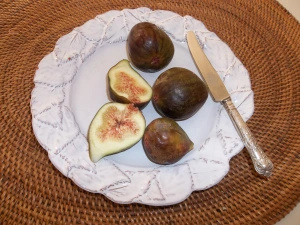
    The threadbare gourmets in this house feasted rather well today. Friends had brought us some fresh fillets of fish which they had caught this morning. We ate them with buttered new potatoes bought from a stall on the road home, and local tomatoes also bought from a road-side stall. And afterwards we had fragrant ripe figs, from another friend’s garden. They were beautiful to look at, stained with dark purple and green on the outside, and inside, pale pink and translucent green.

    I cooked the fish quickly in butter and with chopped dill. I also cooked the soft little tomatoes with them so the juices would flavour the cream. When both were not quite cooked, I tipped a tblsp of brandy in the pan and let it bubble up, then added salt and pepper and thick cream and let it bubble and thicken a bit more. We ate it immediately with the new potatoes and parsley, and some green beans.

    Food for Thought

    If you lose touch with nature you lose touch with humanity. If there’s no relationship with nature then you become a killer; then you kill baby seals, whales, dolphins, and man either for gain, for sport, for food, or for knowledge. Then nature is frightened of you, withdrawing its beauty. You may take long walks in the woods or camp in lovely places but you are a killer and so lose their friendship. You probably are not related to anything but to your wife or your husband…

    Jiddhu Krishnamurti 1895 – 1986 Teacher, philosopher

    th

  • Art and soul – do they matter?

    Illustration from the post “Art and soul – do they matter?”

    On Sunday I discovered that I am a member of a tiny minority. I belong to a group of around three million people world- wide who watch the live performances of opera filmed from the New York Metropolitan Opera House! And when I watched film of the Met audience, I decided that I must also belong to an even more select group, a blogger who watches opera. I don’t know what a blogger actually looks like, but to my mind, this collection of elegant, groomed rich people didn’t look like bloggers- would they have the time to sit over a computer? Not did my home audience of mostly elderly people look like bloggers either!

    It was a Mozart opera, ‘La Clemenza di Tito‘. Then on Tuesday I spent ages poring over Clanmother’s beautiful blog with Renoir’s pictures. On Wednesday I went back to see the opera again, unable to resist it, and on Friday I rushed in to see the film ‘Anna Karenina’ before it went off. A week you could say, of culture and art. The theme of the opera was goodness and mercy, though it took even worse liberties with history than Hollywood does. This didn’t matter.

    The music was sublime, the costumes and scenery a feast for the eyes, and the voices were among the best in the world. Two of the parts were what are known in opera as trouser roles – that is they were written for women’s voices, but the characters were men. Anyone who saw singer Susan Graham all in white as the long legged elegant Rosenkavalier will know just how ravishing women dressed up as men are, and these two were delectable.

    Opera singers are born, not made, but to achieve the mastery needed to sing opera well takes years of voice training, learning music theory and music history, if possible mastering an instrument, learning French, German and Italian since most operas are written in these languages, learning drama, acting skills, and sometimes ballet, and for men, sword fighting skills. For the rest of their lives, opera singers have to continue to practise and train their voices to sing different sorts of opera. Mozart’s music is the most testing and the finest training according to singers. And many have to work at day jobs to make a living.

    This opera was written in the last three months of Mozart’s life, when he was travelling around the music capitals of Europe looking for a post to support his family in 1791. It appeared in the first week in September; a week later he produced another great opera,’ The Magic Flute‘, and then some cantatas, a clarinet concerto, a piano concerto, and finally his great Requiem before dying on the 6 December. What inspired creativity in the last three months of his life, and typical of his lifelong astonishing output, having begun composing when he was five .

    The pictures of Renoir throb with joie de vivre and utter beauty. Each exquisite picture, whether flowers, dancers, portraits or landscape are radiant with life and light. To see one is exciting, to see a collection of them is breath-taking … In spite of acute arthritis in his hands, Renoir went on painting into extreme old age, and the joyousness and celebration of beauty are always there.

    ‘Anna Karenina’ is considered to be one of the greatest novels in western literature… though some beg to differ, myself among them. At the end of this sumptuous production, with jewels and dresses to die for, I felt a distaste at having watched a collection of worldly people with no self awareness make a hash of their lives! This novel, along with ‘War and Peace’ are Tolstoy’s masterpieces, for he spent most of his later adult life trying unsuccessfully to reform his errant ways, and then trying to reform the world, gaining a controversial reputation as a reformer. He preached peace and inspired both Ghandi and Martin Luther King.

    So in one week I had had a feast of some of the world’s great artists. Beverley Sills, the American soprano once said that: “arts are the signature of civilisation”, and it worries me sometimes that this signature is getting more and more illegible. In a film on Beethoven a couple of years ago, I heard a magnificent German bass agonising over what he called the dumbing down of our culture – referring amongst other things to cheap music, Facebook communication, and the shallow snippets of sensational news on radio and TV – he was comparing them with the profundity of Beethoven .

    I would also have added to his list new Bible translations which are no longer literature, but banal religious tracts, and the sort of art that wins prizes these days – someone’s unmade bed adorned with stubbed out fag-ends and grubby sheets, or a skull covered in diamonds. Both the perpetrators of these masterpieces are now rich and famous on the strength of them…

    Taoist philosophy suggests that art awakens a response in the mind and soul and it is important that it should evoke the higher not the lower nature. And that is what the art that I revelled in this week did for me. It lifted me above the daily round and common task, the disappointments and frustrations of a rather difficult week, and reminded me of actress Stella Adler’s words: ‘Life beats down and crushes the soul, and art reminds you that you have one.’ Yes, I think art matters…

    Food for Threadbare Gourmets

    Frangipane is the delicious almond base in many fruit tarts. It’s easy as…you just need four oz of butter and four oz of sugar, two eggs, one oz flour, 5 oz ground almonds, one teasp vanilla essence, and half a teasp of almond essence. Just beat them all together, and spread on top of the pastry. Then press down in it the fruit of your choice. This is only one of many recipes, some use more eggs, others use more almonds. I keep my ground almonds in the deep freeze so that they are fresh and don’t go rancid.

    Food for Thought

    Oh great Creator, grant us one more hour to perform our art and perfect our lives. Jim Morrison 194 – 1971 Poet and songwriter who died unexpectedly in Paris at 27

  • Rambling through Youtube

    I had the haunting Irish tune of ‘Down By The Salley Gardens’ on my mind and turned to lovely Youtube. I did the rounds, Kathleen Ferrier- sublime, Orla Fallon – beautiful, Marianne Faithful – shallow, and Clannad, performing authentically in an Irish pub – haunting, wistful, and satisfying. And as I flitted from one version to the next, I stumbled on William Butler Yeats himself, reading his poem (though it was based on an old Irish folk song).

    It was magic listening to the real voice of the poet, and reminded me what a gift recording is. I never had much time for Yeats in his monocle and black cloak, who left Wilfred Owen out of the Oxford Book of English Verse because he suspected Owen of pacifist sympathies. Yeats, in his fifties, didn’t fight in the war, but Owen was in the trenches for the whole four years, writing the finest war poetry, and dying in an attack across a canal in the last week of the war. So Yeats, born in 1865, doesn’t do it for me, but to hear his voice, echoing across historic centuries was still a thrill.

    On the sidebar, there was Virginia Woolf reading on the BBC in 1939, a year before she walked into the river, and never came back. It’s the only recording we have of her. I clicked – of course – and listened to this wonderful voice reading her thoughts on words, entranced as her imagination soared and she opened new worlds of ideas. Her beautiful diction and resonant tones gave an idea of the layers of meaning and perception that she applied to life and art.

    Then Alan Rickman showed up at the side, reading Shakespeare’s sonnets. Hearing that mellifluous voice, reading the cadences of Shakespeare’s phrases and innermost thoughts was so moving. But since Harry Potter is never far from us these days, there was Rickman also in his role as Severus Snape. And once hooked into the world of Harry Potter, I couldn’t go past Emma Thompson as Sybil Trelawny in a scene which has never been shown, as it was cut. Shame. I laughed till the tears ran down my face as she tried to eat her meal in a state of total panic and confusion – doesn’t sound funny, I know, but you haven’t seen it.

    I was watching, of course, a master, as were Rickman, Woolf and Yeats. Watching or hearing a master is an experience which stirs the soul. Sitting at a concert of Joan Sutherland , every time she came on stage and that glorious sound rang out, the tears just rolled down my cheeks. Listening to Yehudi Menuhin was like entering a mysterious world of spirit, and sitting motionless, holding my breath, as Kathleen Battle, in black with a cyclamen pink stole about fifteen feet long, sang to a packed hall of spellbound concertgoers is one of my treasured memories.

    Masters reveal a world of universal connections, and seeing a Leonardo or a Michelangelo takes us into that same world of universal values of beauty and truth. But one of the favourite books on my shelf is a collection of sonnets to the woman he loved, by Michelangelo, and I love them precisely because he was n’t a great poet, as he was a great artist. In his poetry he shows the side of him that struggles with the same ordinariness – or perhaps I mean common humanity – as the rest of us. As an amateur poet, he is exposed in these poems, while in the mastery of his art, it’s his greatness that we see.

    So while I am awed by, and grateful for mastery, there is something very beautiful about amateurishness. Many years ago, on New Year’s Eve at a party in Somerset, I had struggled all evening to look as though I was having fun with a group of people I didn’t know, and had nothing in common with. I was staying with friends, who had taken me with them. As midnight approached, we all gathered in the main hall of the castle, and a man asked if there was anyone who could accompany him on the piano. With no takers, he said he’d sing anyway. I cringed, wondering if he would embarass himself.

    And so began one of the loveliest moments of my life. He sang ‘My love is like a red, red rose’. Not professionally, but honestly and lovingly. All our egos which had jostled and struggled to keep their ends up all evening stood transfixed. A long silence followed the ending of the song, and there was a softness in the room and on the faces of everyone. The evening changed. His courage in exposing himself to us all had somehow broken the barriers that separated us. Warmth and kindness showed in every face.

    I’ve heard another song sung like that in a voice that had no training, and nothing to recommend it except sweetness of tone, and sweetness of character. And it was just as moving. So while mastery is a sublime experience, the love and honesty that we lesser mortals have to offer, is just as precious in its own way.

    Food for Threadbare Gourmets If we’re having something ordinary to eat, and I need to give it a bit of a lift, I make our family favourite, culled years ago, from the pages of Elizabeth David. I only used to make it at Christmas, for the adults, but one memorable year, the grandchildren discovered it, and gobbled it up under the affronted and greedy gaze of all the grownups. So now I make about three dishes of it, and there is a great big potato peeling bee on Christmas Eve, and some of the children eschew the turkey, plumping for the potatoes, and only moving on to the rest of the feast later. If there’s any left over, they eat them for breakfast! So I always make it now when the family come, and often for dressy meals with friends.

    All you need are potatoes, garlic and lashings of cream. I use Agria potatoes, which mash well, and also in this dish, absorb the cream. Slice the potatoes thinly into rounds, and pat them dry. Butter a shallowish baking dish, and layer the potatoes in, every now and then anointing the layers with salt and pepper, chopped garlic and a few knobs of butter. When the dish is nearly filled, dot the top with butter and pour in as much cream as you need to nearly cover the potatoes. Bake for an hour or more in a moderate oven. If the cream has dried up by the end, I pour more into the crevices, and put back in the oven for a few minutes. It can be cooked the day before and re-heated, but give it plenty of time. It’s delicious with any meal, and with a few vegetables is also a lovely vegetarian meal.

    Food for Thought

    Ad on Trademe: One toothpick with a FREE son included ( I’m sure there is some law which forbids me trafficking in humans, hence the toothpick)…being a teenager he requires large amounts of food (meat and candy mostly, despite the fridge being full of fruit and veg.) Uses power enough to run a small town ( computer, TV, PlayStation and assorted electrical gadgets as well as always leaving the fridge door open) Unfortunately he is short-sighted and unable to see unwashed dishes, grime, towels on the floor or skid marks. Requires 14 hours of sleep per day. Needs a soundproof room as he either slaughters pigs in there or plays heavy metal (sounds the same to me)

    Don’t suppose he managed to get rid of him… there’s a glut of teenage boys like this, I suspect.

  • I’m Crazy for Power

    Yesterday afternoon I was thrown out of the cinema. Friend and I had gone to see our favourite film before it went off. Quarter of an hour into the familiar dialogue, chuckling at the jokes we’d laughed at before, the film disappeared and a weak little light appeared at the top of the stairs. We waited for them to fix the tape, but instead a girl appeared and said it was a power cut. Great gnashing of teeth. I was thankful for the feeble light by the stairs, imagining what it would have been like to have been plunged into total darkness, and a stampede for the only exit at the bottom of the stairs.

    Sitting around outside, they finally told us to go home. Couldn’t give us a refund, because the till wouldn’t open without electricity. So they gave us another ticket.

    Before going home, I said I’d just get some tomatoes for my husband’s supper – cold – since I was going to Tai Chi. The grocery was in flat panic. Dark, with no lights, blinds down over the open chilled shelves. I asked to give them some money for the tomatoes, but they had to go to the back and find the key to manually open the till. Then they didn’t know how much they were, because the price would have come up on the till… so off they went to the office to find the list of stock prices, and finally I managed to buy the tomatoes. Thank heavens I didn’t need any petrol. The whole little town was buzzing in despair and panic, no-one could even go to the loo.

    Back home, I thought about The Great Storm of four years ago. Most of the country had been blacked out, but power was restored over a few days. In our neck of the woods however, where concrete power poles had been crumbled all over the road like biscuit crumbs, and a tree had come down over the generator across the road from us, we were powerless for five days.

    A different world opens up. We catch rainwater on the roof, store it in a huge tank, and pump it into the house. But no electricity equals no pump, equals no water. No water for drinking, washing, washing clothes, washing dishes, flushing the loo. No power meant no cooking, no lighting, and no TV or stereo. Luckily we could open our garage manually, but some friends had no other way of getting into their garages, and were marooned with their car behind the immoveable garage door.

    So I boiled water on a camp fire and on the wood burning heater, fried eggs and bacon, and boiled soup. Didn’t dare open the deep freeze for fear of losing the still frozen contents, and resented opening the fridge for butter, milk and the like. The village store was in darkness, their fridges going on a generator, the garage was closed. No help at the fish and chip shop. Unwashed dishes piled up. Unwashed clothes accumulated. We had to get used to unwashed bodies. Some people cooked on their barbecues, some people had no form of heating except electricity, and froze.

    After a couple of days we began to gingerly adjust. I drove to a nearby town which had the power on, and bought water and lots of extra pairs of underpants and panties. My husband thought of using buckets of water from the swimming pool next door – my daughter’s holiday home – to flush the loo. I never got used to not having my electric blanket, but at least we had a hot water bottle. Candles made the house look and feel beautiful, but the light wasn’t good enough to read by at night. Some neighbours used miners’ lamps, clipping them round their heads to go to bed and read. It worked apart from the large circle in the middle of their foreheads from the pressure.

    I read today that the Blessed Bill Gates has offered a prize for a loo that works without water, electricity or a septic tank – all components of our system here – a loo that costs only five cents a day to run, preferably captures energy, and discharges no pollutants. A number of brilliant solutions have been invented. And the idea is to provide safe sanitation for the 2.5 billion people around the world who don’t have it.

    I think we should all be able to buy these loos. Our over-crowded world desperately needs sustainable solutions like these for everything. We need alternatives to electricity, oil and coal … we need a dozen more Bill Gates’s to find solutions that involve the sun’s sustainable energy, the wind, the waves. For a few days, we in our village experienced a few temporary discomforts when power was unavailable, but were able to get outside help from places that did have power.

    But there will surely come a time when there won’t be enough of anything. The world’s population is estimated to grow to between nine and ten billion within forty years – the lifetime of our grand-children. Two hundred years ago the population of England and Wales was eight million, compared with 56 million now, and it’s the same sort of increase all over the world. So we urgently need more solutions like Bill Gates’s loos.

    This is not cause for despair, for all is not lost. Mankind is brilliant at creating marvellous inventions, and resolving problems when it wants to. I’m reading a book called ‘The Great Disruption’ by Paul Gilding about how you and I can do something to help resolve these problems. Watch this space – I’ll let you know!

    Food for Threadbare Gourmets

    Having had lunch with a friend in her bay window overlooking a long, white, empty beach nearby, and then afternoon tea with a couple of friends to swap books, I hadn’t really thought about what to feed us in the evening. Something quick was wanted, so I fell back on my old standby, my un-orthodox version of kedgeree, made with a tin of salmon – cheap too.

    A cup of long grain rice on the boil, two eggs on the boil, half a cup each of sultanas and frozen peas soaking in boiling water, and I was ready to begin. After gently frying a chopped onion in oil until soft, I added a couple of cloves of garlic and a chopped up knob of fresh ginger (you can always use powdered, but fresh is nicer).

    When the garlic is soft, sprinkle a teaspoon of powdered cumin, turmeric and a bit less of coriander into the pan, and let them cook gently. I sometimes also use some made up curry powder as well, and vary the amounts of the spices depending on how hot I want it. Better to start with less, and increase it, than find it’s burning the roof off your mouth (I have been known to add some brown sugar to take the edge off a too hot curry).

    Now open the tin of salmon and drain, and add it to the mix in the frying pan. Drain the peas and sultanas and stir them in. Add a knob of butter if it needs lubricating. Drain the rice, and add this, gently stirring with lots of chopped parsley. I always find that adding another generous knob of butter improves the taste. Pile onto the plates and chop a hardboiled egg over each helping. Usual caveat – serves two greedy people generously, and three to four well-behaved people – add an egg for each person.

    Food for Thought

    Lead me from death to life, from falsehood to truth.

    Lead me from despair to hope, from fear to trust.

    Lead me from hate to love, from war to peace.

    Let peace fill our hearts, our world, our universe.

    No, not the prayer of St Francis of Assisi, but a translation from the Upanishads by Satish Kumar Born 1937. Jain monk, nuclear disarmament campaigner, founder of Schumacher College, in Devon, England which teaches green values and sustainability, and present editor of Resurgence magazine