
Not a picture of hear no evil, see no evil and speak no evil, but a picture of the three fat wood pigeons sitting on the power line outside our house yesterday.
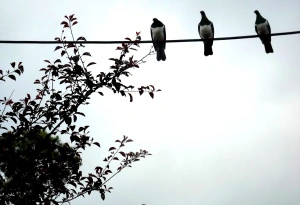
They used to be plentiful, but between the Maoris and the settlers they nearly became extinct. They’re now protected, and their numbers are increasing. The Maoris call them kereru, we call them wood pigeons, and they are big, heavy, iridescent green and bronze, with a white bib, and they crash around the trees, so we can hear them coming.
This morning, waiting for the kettle to boil while I made a cup of tea to take back to bed, I stood at the bench looking out of the kitchen window, and watched one of these pigeons in the guava tree, gobbling up the tiny yellow fruit.
I was fascinated to see how this big heavy unwieldy bird kept his balance on the thin frail branches. He moved from fruit to fruit, gobbling them up, without ever looking or checking to see where he was putting his feet. He knew instinctively how to move, whether the branch was strong enough for him, and how to keep his balance without thinking. I watched him for a long time, in awe of his skill and his knowing.
I took the tea-tray back to bed, and lay back on the pillows looking out of the window on the other side of the house. The loquat tree, just beyond the window, which is covered in blossom, was alive with movement, and I saw the tui, another native bird, also feeding on the flowers. He too, moved from twig to twig, hanging upside down, sideways, whichever way suited him, to reach the blossoms and the nectar.
As I watched this bird, with his bright white bobble of feathers jiggling at his throat, which caused the early settlers to call him the parson – bird, I felt I was watching something familiar, and then realised that this was the same knowing and instinct that I’d just been watching in the wood pigeon.
During the nightas I turned over in my sleep, I heard a morepork, the New Zealand owl calling, very close; later, the huffing
of a possum in the loquat tree, which sounds like the hissing of a python and what I feared were rats rustling in the roof above. I hoped the hedgehogs were still busy hoovering up the snails and slugs in the garden.
When I drove through the little hamlet at the edge of the sea on my way to shop the other day, I slowed down when I saw a couple of ducks crossing the road ahead. They had a purpose. They were making for a drive-way where a mulberry tree hung over the fence, and the ripe fruit had fallen on the ground.
The ducks were feasting… how did they know the fruit was there, that this drive was the only way to get at it, and that this is the time of year for fruit? And how did they know how to cross the road, and get out of the way of cars?
And on the way home I dodged a quail family scuttling along the side of the road with half a dozen speckled brown babies. In our last house, I once looked out of the window to see a quail family sitting in a row on a fence, all six babies snuggled up against their parents. It was a picture of such love and content, and one that stayed in my mind, so that whenever I remember it, I re-live the feeling of joy in the sight.
Henry Beston wrote in ‘The Outermost House’: ‘We patronise them for their incompleteness, for their tragic fate in having taken form so far below ourselves. And therein do we err. For the animal shall not be measured by man. In a world older and more complete than ours, they move finished and complete, gifted with the extension of the senses we have lost or never attained, living by voices we shall never hear. They are not brethren, they are not underlings: they are other nations, caught with ourselves in the net of life and time, fellow prisoners of the splendour and travail of the earth.’
This wonderful passage says it all… the mystery of other lives, other consciousness, and the sacredness of all life. I love the phrase: ‘they are other nations’. It gives them dignity and mana, and no longer are they lesser beings on whom we can practise our cruelty and our indifference.
Long ago, when I was a young reporter, I was sent to interview a woman who had a black cat. When she called it, this cat came bounding towards her, running like a dog. She told me it had never learned to purr, and it never miaowed. And it thought it was a dog, because it had been reared by a dog.
The dog was a black cocker spaniel, whose puppies had died. She was so unhappy that they got a black kitten for her, and she reared it as her own, teaching it to run like a dog. The kitten watched her mother, and copied her behaviour, but she didn’t know she was a cat, since her mother didn’t know she was a cat either. So how do we know when animals and birds know instinctively what to do and when they know it from copying?
Living in the country, I feel we are on the fringes of these other nations, catching glimpses of their mysterious lives, and hearing their calls to each other. Sometimes I sit in the garden and hear one bird calling in a tree, and another answering in a tree in the distance. Where a hawk is hovering, the tiny birds set up a warning, and the ducks quack in fear on the pond as it drifts overhead.
I love the sound of the birds calling in the middle of the night, in that dark stillness. In the morning the songs of the birds are different – full of pleasure at the coming of a new day. I love watching the sparrows and the finches bathing in the little bird bath in the vegetable garden, and the way they flock down to the wheat I scatter on the lawn.
It’s hard to describe the pleasure of just being with these other beings, other nations. And when I see the black backed gulls, hovering, wheeling, gliding on the wind currents above the cliffs, dazzling white against the deep blue sea, I feel a wild wonder and joy at their beauty and their freedom. So many nations, so many mysteries.
Food for Threadbare Gourmets
I had some silver beet – or chard – to use up. So I chopped up an onion, and softened it in butter and oil, added a chopped up rasher of bacon, and then the chopped up chard. When it was all wilted, I added a handful of raisins, some pine nuts, and salt and pepper. It’s so good, and would make a good vegetarian meal with the bacon left out, and served with rice.
Food for Thought
It is the very nature of Grace to fill spaces that have been empty.
Goethe 1749 -1832 Poet, novelist, playwright, scientist, statesman, theatre director, critic and amateur artist
 ThesoundofwaterNZ
Leave a comment