Category: Life & Reflections

  • Simple pleasures- they may not be what you think !

    For some it’s a nice hot bath, for others it’s sitting in front of a roaring log fire – surely one of the most primeval pleasures – so what are your simple pleasures? One of mine is a hot croissant eaten with unsalted butter, good apricot jam, accompanied by a pot of freshly made coffee, and delivered to me in bed… perhaps not so simple, given the various components required to deliver this perfection!
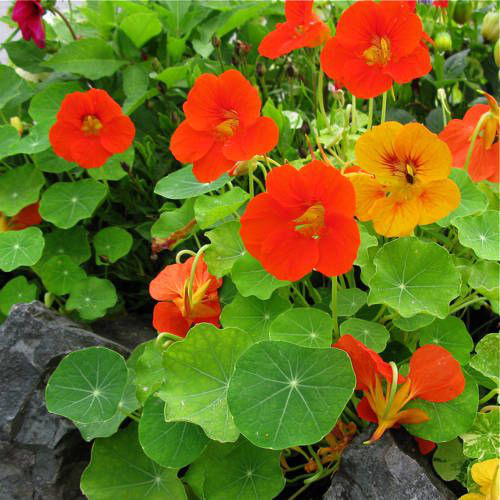
    Illustration from the post “Simple pleasures- they may not be what you think !”

    Then there is the simple pleasure of sitting in the sun on the garden bench by the profusion of rambling nasturtiums, and gently feeling beneath the round flat leaves to find the clusters of green ribbed seeds left by the flowers that have bloomed… my harvest to sow for next year’s pleasure.

    These thoughts were prompted by browsing through one of my favourite books which positively encourages hedonism, though hedonism of the sweetest, simplest kind… most of these simple pleasures cost nothing. It’s an anthology by sixty fine writers, and they’ve given their thoughts and services to the National Trust, the body which maintains and protects historic sites and buildings in England.

    In the introduction, Dr James le Fanu, after discussing how our genomes are virtually inter-changeable with either a mouse or a primate, goes on to write: ‘It is remarkable the difference it makes to acknowledge that we no longer know… the nature of those genetic instructions. Suddenly the sheer extraordinariness of that rich diversity of shape and form jostling for attention on the fishmonger’s counter – and the florist’s and the greengrocer’s and the whole glorious panoply of nature – is infused with a deep sense of wonder of ‘how can these things be?’

    So since one of the simple pleasures of reading an anthology is flicking back and forth, sampling the joys and wonders it holds, I dive into a page which reads: …’and as you take the long single track road snaking down the shady side of Inkpen Beacon, it’s as though you feel the centuries fall away behind you.

    ‘You pass the ramparts of an Iron Age fort, and then the gibbet on the Beacon, a reminder of the eighteenth century. You twist between hawthorne and wild brambles, and now you’re in Civil War Britain. Pass the old church, and you’re back in Norman times. Then in the village itself, there are flinty tracks and beech hedges, and what Orwell in exasperation called the deep, deep sleep of the English countryside … an unspoilt, timeless view of fields, safely grazing sheep and the sound of rooks chattering contentiously in the beech trees overhanging the lane …old Wessex, Alfred’s ancient kingdom…. Watership Down just over the hill…King Charles fought the battle of Newbury in nearby fields’ … this from Robert McCrum who has written a book on P.G.Wodehouse amongst others.

    And then to a delicious essay by Sally Muir, knitting designer…’I was taught by Mother Mary Joseph… it was the sort of thing you did in a convent in the 1960’s. It wasn’t all Carnaby Street and The Beatles for most of us. I think the nuns were working on ‘the devil makes work for idle hands ‘principle, and in a way they were right. One great advantage of an evening spent knitting is that you can’t easily smoke, play video games, buy things from Amazon, or inject drugs at the same time. In fact there are all sorts of things you can’t do, as both hands are fully occupied….’

    I dip into ‘Grooming the dog’, and ’In love with the clarinet’, savour ‘Collecting the eggs’, and ‘Picking up litter’, and the arcane discussion of the best litter-picking-up devices, and relish ‘In praise of zoos’, much as I hate them. Philosopher Alain de Botton writes: ‘A zoo unsettles in simultaneously making animals seem more human and humans more animal… in May 1842 Queen Victoria visited Regents Park zoo, and in her diary, noted of the new orang-utan from Calcutta: ‘He is wonderful, preparing and drinking his tea, but he is painfully and disagreeably human.’ (reading this, I imagine being captured and placed in a cage like a room in a Holiday Inn, with three meals a day passed through a hatch, and nothing to do other than watch TV – while a crowd of giraffes look on at me, giggling and videoing, licking giant ice-creams, while saying what a short neck I have.)’

    Alain de Botton, I learn, having enjoyed many of his books, is also the founder of two organisations, Living Architecture and The School of Life, the first dedicated to promoting beauty, and the second to wisdom – oh Yes !!!

    As I flick the pages of this tiny book – five inches by three and a half – Christmas stocking size, which I bought six copies of to give to friends, I can’t resist ‘Gossip’, written by journalist Sarah Sands. She discovers by chance that historian Simon Schama is ’an A-grade gossip’. ‘How exciting that a man of such an elevated mind is happy to trade in gossip as well as ideas… Gossip is what makes a great historian a delightful dinner companion… the bond of intimacy. One shares gossip as one should share good wine. It is an act of pleasure.

    ‘There is an art to gossip, which is really a moment of memoir. Philosophers of the human heart… or heartless but comic diarists …, tell us more about social history, politics and humanity than autobiographies of public record… I always learn more from a gossip than a prig. Life is a comedy, it is not Hansard.’ (Hansard is the English Parliamentary record)

    The two most thought-provoking of these simple pleasures come at the end of this delicious little book. Historian Anthony Seldon was the headmaster of Wellington College when he wrote his essay. Wellington College is one of the tougher English private schools. I wonder if he changed that reputation, for he writes of the joys of meditation and yoga.

    He ends by saying: ‘Most exciting of all is the sense I have that the happiness and joy I experience are only the tip of the iceberg. They cost nothing, harm nobody and I feel connected to life in all its fullness. The future promise is that the joy will only get deeper year by year, and the fear of crossing that divide from dry land into the water, from life into death, fades into utter inconsequence.’

    Sue Crewe has edited the splendid magazine English House and Garden with zest and skill since 1994 – not the sort of person I would have expected to write the exquisite little gem that ends this book. Over the years I’ve followed from afar her career, and noted that she had had what she bravely describes as a ‘period of turbulence’, and which I knew had been full of heartbreak.

    She describes how a friend gave her a little book in which she had to write five things she was grateful for, every day. A simple practice which over the years has grown into what she describes as ‘several feet of bookshelves’. She tells how for the first five years she kept to the five one-liners, and how at first she groped for entries, and fell back on being grateful for her warm bed, or being well fed. Then she felt brave enough to branch out into what she calls ‘free-range gratitude diary-keeping’ and expanded her thoughts.

    Now she writes: ‘Almost imperceptibly, free-floating anxiety and feelings of discontent with myself and the world were replaced by contentment and a clearer understanding of what I found acceptable and unacceptable about my own and other people’s behaviour…. It did and does help me keep things in perspective…

    ‘But the most transformative revelation is the power of gratitude itself: it takes up so much room that everything corrosive and depressing is squeezed to the margins. It seems to push out resentment, fear, envy, self-pity and all the other ugly sentiments that bring you down, leaving room for serenity, contentment, and optimism to take up residence.’

    On this glorious note, one of my favourite books ends… full of such simple pleasures, those which don’t just add joy to life, but also enlightenment. I feel nothing but gratitude to all these writers when I re-read this little book yet again… and gratitude too, for the reminder of the power of words. The right words can transform our own thoughts and lives, and this reminder of the power of words, reminds me too, of the power of our blogs – each one mostly written with pleasure, and with words from the heart, to reach other hearts in that extraordinary network of friends and souls around the world.

    Simple Pleasures – Little things that make life worth living. Published by Random House.

    Food for threadbare gourmets

    Made a pile of ham sandwiches for lunch, and some were left over. My thrifty soul decided to wrap them tightly in silver foil and store them in the fridge to have for supper that night. But I forgot, and several days later found this anonymous packet of foil on a shelf with butter and yogurt. Cautiously opening it, I discovered the now somewhat stale ham sandwiches. Undeterred, I decided it was ham sandwiches for me that night. I dunked them in egg like French toast and fried them in a little olive oil and butter. They were absolutely delicious – the best way to have ham sandwiches!!!

    Food for thought

    ‘The world will never starve for want of wonders, but only for want of wonder.’ G.K.Chesterton
  • Helicopters, hallucinations and hospital

    .It only took two seconds. But since the consequences of those two seconds have dominated my life for the last six months, and promise to do so for some months yet, I feel faintly justified in sharing them.

    Stepping blithely onto the back of the sofa to put a book back on the highest shelf, I lost my balance and fell backwards. Lying on the floor in a strange position, I knew without even looking that I had broken my leg and announced this to my love as he came to help me. Luckily the sofa is seven feet long, so he was able to get me onto it so I could lie there in unbelievable agony.

    Even in that short time when I looked at my knee it was about ten inches across. I foolishly thought this was just swelling.

    Abandoning the idea of driving to our nearest hospital an hour and a half away along a winding, precipitous road above the sea, we rang 111 instead. In half an hour the blessed ambulance arrived, with two angels who pumped me full of morphine, got me onto a special stretcher which didn’t entail lifting me, and decided I had to go by helicopter to the big area hospital.

    After the interminable drive down the long winding gravel road during which time they stopped regularly to allow me to be sick, we reached the air strip and the waiting helicopter.

    The last words I heard before I even had time to say goodbye to Himself, were: “I’m giving you ketamine for the pain. Some people get hallucinations.” I did.

    Suddenly I was hurtling through outer space – tumbling into a vortex between intricate patterns of gold and black, and being sucked into the centre into the black hole. It seemed to go on endlessly. Eventually I said if I’m dying, I’m ready to die, but this didn’t stop the tumbling through space, the diving into the black hole again and again, and the patterns closing in around me. Then suddenly, I was back in the real world, unable to move a limb, totally paralysed, with the blazing sun beating down on my face through the glass about a foot away.

    Unable to move or attract attention, I somehow survived this ordeal by sunburn, and arriving on terra firma was immediately surrounded by helpful, efficient people and wheeled away into a white tunnel which is what seems to pass for an X-ray these days apparently.

    Then up to the operating theatre, and more blissful unconsciousness while they put on a plaster from thigh to toes, which had to last until the specialist could operate five days later. They told me the top bone was jammed down on the bottom bone, shattering it – a very nasty injury they assured me… not sure what happened to the knee in between, and I never got to ask…

    Wheeled into a ward, addled with drugs and shock, I got used to the other drug-crazed, injured people around me! There were six of us and they included a secret smoker in one corner, and a young Maori woman who wore dark glasses all the time so she didn’t have to speak to any of us. The one time she was roused into vehement speech was on my behalf on the third day.

    I had drawn what I called the Short Straw, a nurse who was looking after me that day who was so stout, it was a real effort I felt, to keep on her feet all those hours, and deaf too, so I wasn’t sure whether she was a bit dim or whether she just hadn’t heard me. Her ministrations were slow and reluctant, and when I told her I felt sick and she ignored me, I wasn’t sure whether she didn’t think it was worth taking any notice of me, or whether she just hadn’t heard. Seconds later, I called urgently for a receptacle and then filled three large ones with blood. “I wonder what caused that?” she kept saying in a helpless, puzzled way.

    Apparently enraged, the Maori girl sat up in bed, took off her dark glasses, and using the odd four letter word, said words to the effect: “what do you expect when you fill her full of F… tramadol. Of course it’s tramadol doing it, you dimwit.” I trust the Short Straw only heard some of this.

    The doctors decided it was the infamous drug tramadol too, combined with the rest of my cocktail, so I was downgraded to morphine and daily injections, instead of taking anti-coagulants. The result of this was that I had damaged my stomach, but didn’t know what to eat, so ate nothing but yogurt or mashed potato for some time, since otherwise I felt so ill that the pain of my leg paled into insignificance.

    The operation duly took place and I wore a heavy black lycra and metal brace from thigh to foot for the next two months, unable to set foot to the ground. The operation also left me with a numb foot and shin, which I still have, accompanied by nerve pain which means I still enjoy/consume a full cocktail of painkilling drugs, and which makes it hard to walk.

    The months were passed in a little cottage hospital where thirty-five of us were all coping with long-term injuries. In our little ward with four of us, we sympathised with each other, listened to each other’s life stories, gossiped about our favourite nurses, and moaned about the rigours of trips by ambulance back to base hospital to see the specialists at regular intervals.

    I was humbled by the dedication and commitment of the staff, none of whom ever dawdled but who were on the run all day, scurrying down long corridors of an old style building, walking between ten and twelve miles a day.

    I set myself to be a low maintenance patient, but many of the patients needed help even in getting out of bed, (depending on the injury this was an art in itself), into a shower, dressing or eating, and no nurse ever be-grudged the time they spent with anyone. Two patients died unexpectedly while I was there, and red-eyed nurses showed me how much they cared.

    The doctor who visited several times a week knew everyone’s names, joshed us all, and usually ended his visits in the big sitting room, where he sat at the piano and played old favourites for anyone who wanted to listen. One of my favourite nurses was a delicious and beautiful Indian who brought her children and nephews to do Indian dancing for us… exquisite…others brought their dogs, and one jumped straight up on my bed, and cuddled into me – bliss…

    Most people were old, and alone at home so they couldn’t manage, and were sheltered safely here until they were ready to cope. I was a rarity with my leg stuck out in front of me in a wheel chair. But what I learned as I observed the others was that I was one of the only lucky ones there.

    Though I was older than many, I was almost the only man or woman there with my own teeth, who didn’t have a hearing aid, who didn’t have dementia in some form, and who was strong and active, healthy and able to do yoga and all the other things that kept me young(ish) and flexible. In other words, I had been lucky enough to afford to go to the dentist, to be educated about a healthy diet and life-style, could afford them both, and had enjoyed a life fairly unencumbered and unstressed by money worries.

    These frail people brought home to me as never before how life expectancy and/or the enjoyment of good health depends on income, which dictates education, health care, mental health, housing, and everything else we need for a good life.

    I listened to the life stories of my companions in pain, and heard how one woman brought up her six children when her husband died when her youngest was five, working at sewing factory uniforms at home from dawn to dusk to make a living and look after the children, and helping in the local shop when she had any spare hours; the lady in the bed across from me who had had two children and adopted two more, shared the trials of coping with deeply disturbed children and then their adult problems; the beautiful, feisty woman in the next bed was going home to look after an alcoholic and bloody-minded, middle-aged son she’d brought up alone, and the severely mentally handicapped sister she also cared for.

    And then there were the incidental friendships. A visiting son who had raised thousands of dollars to rescue, doctor and re-home over six thousand feral cats. When he ran out of money and still had thirty-six cats to re-home, he sold his house and he and his wife moved into the country into a smaller house with land where rescued dogs, ducks, ponies, goats, pigeons and every other needy creature came to live with him and be loved. All the cats came and were named and loved until they died. This lovely man worked at night driving a bull-dozer to make enough money, and he also did a lovely tango across the ward to amuse his mother! It was my enthusiastic applause which connected us !

    A young woman came with her dog to visit an old neighbour, and she told me she and her sister and her mother, rescue and re- home more dogs than the local animal charity, who often turn to them for help. They used up every penny they earned caring for desperate creatures.

    Listening to these stories, and the life-stories of my fellow patients, I felt humble and so grateful for the life I had been able to lead. Even having the time to write and to blog, and to own a computer is something only the fortunate can do.

    Breaking my leg, and now hobbling around with my stick, waiting for everything to heal has been a blessing. It has opened my eyes to how so many good, kind women live their whole lives coping with inescapable burdens. That son reminded me of how much hidden goodness there is in the community, and I was shown how much beauty, compassion and dedication so many women pour into their lives and their careers in the hospitals where they work. I was reminded that women are wonderful.

    And I left this wonderful place with a full complement of much needed pain-killers, a walking frame, crutches, stool for the bathroom and a high stool to sit on in the kitchen. I was offered care at home, plus someone to clean, and free physio for as long as I needed it. I will never grumble about paying taxes again! I give thanks for being fortunate enough to live in a western society where care and compassion for those who need it, is a way of life.

    Food for threadbare gourmets This is the first year of my adult life that I haven’t made my own Christmas mince pies – for obvious reasons (see above !!!). But I found some decent bought ones, prized off their lids and spooned oodles more good mince- meat into them, replacing the lids, and heating them up as required. Before serving I sprinkle them with caster sugar … this IS Christmas isn’t it??

    I also like to serve them with a dollop of brandy butter – why keep anything so delicious just for Christmas pudding? I make it by ear as it were, using two ounces of softened butter – preferably unsalted, but not necessarily… and adding icing sugar and brandy… I go on beating with a fork, or a beater, and adding butter and icing sugar and brandy until it tastes the way I want it, and is the right soft consistency. I also add a few drops of vanilla. Once tasted, no mince pie is complete without it… though cream is also good… A Merry Christmas… to threadbare gourmets and to all those who are neither gourmets nor threadbare !

    Food for thought

    Lord, forgive us that we feast while others starve. Grace before a banquet, said by John Fisher, Bishop of Rochester in the reign of Henry VIII. Just as appropriate now as then…

  • My drug of choice

    Illustration from the post “My drug of choice”

    “I thought I’d make a cup of tea”, were the last murmured words of the mother of Janet Frame, NZ writer, as she died in her husband’s arms in the kitchen. They could well be mine… tea for me marks waking up and going to bed, a break mid-morning and that indispensable cup in the afternoon, the cup that cheers when a friend calls, or the one that sustains after a shock or a long day’s retail therapy.

    I felt the would-be murderess Mrs McWilliams who shot her enemy Mrs Dick in the Tudor Tea Rooms in Christchurch NZ was a kindred spirit. When she was disarmed after her pot- shot she retorted: “Oh, give me a cup of tea, that’s what I came here for.” When told that her victim was not dead or even much hurt the redoubtable Mrs McWilliams replied, “Oh isn’t she, what a pity.” (She got seven years jail for her failed attempt to eliminate her enemy)

    We can sheet back this country’s addiction to tea to our discoverer Captain Cook, who concocted the first brews from leaves of the manuka tree, which he called, and many still do, the tea tree. He experimented with it in 1769, brewing the leaves in the hope of preventing scurvy, and wrote in his journal ( men write journals – women are downgraded to writing diaries): “The leaves were used by many of us as tea which has a very agreeable bitter scent and flavour when they are recent…. when the infusion was made strong it proved emetic to some in the same manner as green tea.”

    In some ways, tea was the answer to coffee… men had gathered to gossip in coffee houses in London and elsewhere, for several centuries, while women had nowhere acceptable to congregate. The first tea-rooms opened in Glasgow in the 1870’s and tea- rooms quickly became as important to women as coffee houses to men in previous centuries.

    Afternoon tea at home also became an institution… it was a relaxed time when women took off their corsets before changing into finery for dinner, and wore soft floating tea gowns. The great French food philosopher Brillat-Savarin called afternoon tea: “an extraordinary meal … in that, being offered to persons that have already dined well, it supposes neither appetite nor thirst, and has no object but distraction, no basis but delicate enjoyment…”

    I’ll say – and not just for tea but for chocolate cake and shortbread, meringues and cucumber sandwiches. I used to think tea was an occasion just for ladies to enjoy… I couldn’t imagine inviting a man to tea… but then I remembered the delicate courtships conducted over silver tea- pots by the fireside in Edwardian times, and realised what pleasures we have forfeited in our nine to five world. I also wondered if this was the raison d’etre for those loose floating tea gowns… easier for making love?

    Portly philanderer, Edward the Seventh used to visit his lady loves for afternoon tea, arriving in an elegant black carriage with his coat of arms on the door. Inside, his inamoratas awaited him. They could be the ravishing Lily Langtry, the Jersey Lily, as famous for her beauty which adorned postcards, as Kim Kardashian is today; or others, like Winston Churchill’s gorgeous mother Jennie, or even Camilla Parker Bowles’, (aka Prince Charles’ second wife) great-grandmother, Mrs Alice Keppel. She was Edward’s mistress for twelve years and was invited to his death-bed by his generous wife, Queen Alexandra.

    Afternoon tea for me has never been graced by the presence of king, prince, or even lover… my most un-forgettable afternoon tea was at a Catholic convent in Ipoh, Malaya. The Chinese nuns in this little convent had been accredited to examine children taking GCE, the Cambridge University secondary schools exam, in oral French. So accordingly, I and nine classmates, embarked on the day- long journey in stifling armoured vehicles (to protect us from lurking Chinese bandits) and then by train, from the Cameron Highlands down to Ipoh.

    Arriving in the early evening after travelling all day, we went to sleep in a dormitory with other Chinese teenagers who all, to our amazement, managed to get undressed and shower without showing an inch of flesh. This proved quite a challenge to us less inhibited girls trying to do in Rome as the Romans did. The next day we hung around until afternoon in the steamy convent grounds, and then I was first in alphabetical order for the exam.

    I was shown into a little room, where a bowing, smiling, gentle little Chinese nun in heavy black horn-rimmed spectacles and starched veil awaited me. It would have been bad enough trying to understand a Chinese person’s French, spoken by someone who had never been to France or met a French person, but worse was to come. She made a cup of tea and offered me a cake, baked especially for us all, she explained in broken English.

    So there we were, an Asian nun, performing, not the tea ceremony of her culture, but an adulterated version of a western ritual, and speaking a foreign language to a person who couldn’t make out a word she was saying, and who knew that shortly an even greater ordeal awaited, in which two people who already couldn’t understand each other, were about to embark on a conversation in a language foreign to them both.

    But it was the preliminary that almost silenced me. I bit into the cake, and discovered with horror that the nuns knew no more about baking English cakes than they did about speaking French. They had obviously used sawdust held together, not with butter and eggs, but with some sort of inedible glue. With the first bite drying out my mouth and clogging my throat, I realised that now I had to struggle through the whole of this un-eatable culinary disaster, as well as bluff my way through the exam. Each bite nearly choked me, and I still had to look as though it was delicious.

    Somehow I got to end of this terrible experience, and there seemed to be an unspoken agreement that if I ate the cake, she would find my school girl French understandable and acceptable to her Chinese ears. I left with us both bowing and smiling, with great good humour, and walked into my classmate waiting to go in. She raised her eye-brows questioningly, and I smiled maliciously, which she optimistically took for re-assurance… later our profane school- girlish post mortems and accusations would have curled the ears of these innocent kindly nuns.

    Other teas, with silver teapots, even a white-capped maid, tiers of scrumptious cakes, and lace napkins have never blotted out the memory of this ordeal. And now, a law unto myself, I break all the rules of the English ritual afternoon tea, which is a very different thing to tea ceremonies in parts of the world where tea drinking originated. My most daring break with convention is to put the milk in first, considered so vulgar by generations of tea drinking aficionados.

    And having discovered that tea tastes much nicer when the milk goes in first, I have now also discovered that science supports my taste buds. According to research carried out by the Royal Society of Chemistry in 2003,”… if milk is poured into hot tea, individual drops separate from the bulk of the milk and come into contact with the high temperatures of the tea for enough time for significant denaturation or degradation of the milk to occur.” There you go, as they say in this country…

    I have n’t space to touch on one of the most thrilling aspects of drinking tea, which used to be illegal in this country, and provoked fiery debate by male Members of Parliament; and now since 1981, it’s become illegal again ( MEN !!!). I refer to the innocent pastime of reading the tea leaves… but that is too vast and esoteric a subject for this little blog to tackle!

    Food for threadbare gourmets

    Cucumber sandwiches are de rigueur for the ritual English afternoon tea, and very dull they can be too. These I served for a friend’s birthday party, and we gobbled them up… with relish…. Apart from white bread sliced as thinly as possible – even supermarket sliced does the job… you need peeled and thinly sliced cucumber, eight ounces of softened cream cheese, quarter of a cup of mayonnaise, a good sprinkling of onion powder, garlic powder and a pinch of lemon pepper if you have it. Mix everything except the bread and cucumber, spread the mix on the bread, and arrange the cucumber on top. Cover with another slice of bread also spread with the mixture. Press down firmly, and cut into dainty bite-sized sandwiches. Irresistible.

    Food for thought

    By experts in poverty I do not mean sociologists, but poor men. GK Chesterton

  • A tearful (sob) tale !

    If I’m going to cry I want it to be when I’m laughing. I think that may be one of my favourite pleasures, to laugh till I cry… but it’s not something that can be planned… such moments seize us out of the blue, and swoop down without any warning. And then it’s bliss…I love it – having laughed my way not just to good health but to aching sides and streaming eyes.

    Illustration from the post “A tearful (sob) tale !”

    Tears come more easily to some than others… my tear ducts are the sort that let me down and embarrass me constantly… it was about the only thing I had in common with Princess Diana, being neither blonde, rich, thin, Royal or any of the other things she was…. but she cried easily… she cried waving goodbye to her fiancée when he flew off to NZ for a couple of weeks, she cried, bless her, when the band played God Bless the Prince of Wales on her honeymoon, and she cried among other times, when she was complimented on her work on the day her separation was announced. By contrast her sister-in-law Princess Anne has only gone on record crying once… when she waved farewell to any more cruises on the royal yacht Britannia as it was de-commissioned.

    The tough and the strong are sometimes tempted to despise we weaker vessels, and that’s when tears are so humiliating, if we forget that some of the sweetest moments in life, and the most memorable, are those which move us to tears. Tears are one of the things that make us human beings – though I have watched that heart-breaking video when an elephant who had been starved and beaten for fifty years was finally freed, and he wept – rivers of tears slowly trickling down his wrinkled old grey cheeks -and I wept too.

    So yes, tears reveal us as feeling human beings… and though times of hormonal change… those teenage years, pregnancy, post- natal months, menopause, depression, even the wrong medical drugs can cause unexpected floods of tears, nevertheless, tears should not be sniffed at. A baby’s tears are his only means of showing his hunger, hurt, fear, anger, discomfort, insecurity and other problems…. but as we grow older and find less direct forms of communication, tears assume a different place in our lives.

    They still mark emotions like fear, misery, anger, grief, hurt, but as we grow older – joy too. So why does our culture sneer at tears and try to train children not to cry, with the jeer: ‘cry baby’ or ‘softie’ being an allowed insult in the playground or even worse: ‘don’t be such a girl’.

    When I landed in New Zealand in the middle of winter many years ago, my luggage two small children, tears of fright flowed behind my huge black sunglasses in spite of all my efforts at control. And there have been many other moments since when tears marked unforgettable moments of joy and sorrow… including watching first my children, and then my grand-children’s nativity plays… I cried when I watched my tall, skinny thirteen year old son walking away from his childhood into ‘big’ school, head and shoulders above the others his age… at my daughter’s wedding, and my grandchild’s christening… a perfect watering can.

    ‘Don’t cry when you say goodbye to us’, my eight year old daughter had said before they took off across the world to see their father. So I smiled and waved, and tried to pretend tears weren’t coursing down my cheeks in great rivers. Later, the exquisite voice of Joan Sutherland singing in concert brought tears to my eyes and to many others. Few of us could define what these involuntary tears were triggered by but they were precious, and the moments memorable. I’ve heard other great singers in person including the incomparable Kathleen Battle, but none of them drew that spontaneous tribute.

    When my first baby was born the midwife who delivered her did so in floods of tears… she said she always cried when a baby was born. Now, tenderised by life, I know what she means. I only have to see a new born to feel those tears start gushing. It’s hard not feel embarrassed or humiliated by these ever-ready tear ducts.

    I am famous in the family for beginning to cry in the cinema at the beginning of a film. As the credits went up on the film ‘The Young Winston’… the traditional ride of the Adjutant on his white horse, up the flight of steps to the library at the end of the Passing- Out Parade at Sandhurst filled me with such nostalgia for my military childhood that I was lost at the first frame.

    And I remember lingering in the cinema loo mopping my eyes with my best friend as we tottered out after Disney’s ‘Old Yeller’ (about a Labrador) had ended, ravaged with tears and nearly blinded with clogged mascara. I can go to a funeral of someone I hardly know, as a courtesy to a family member, and become a tearful wreck… not quite sure whether I’m crying in sympathy with those who are really mourning, whether tears are contagious like yawns, or whether I’m touching into old and forgotten griefs.

    In the end it’s animals who really pull the heart-strings and have provoked so many gallons of tears I could fill buckets with them … I was ten when I wept over the shooting of the ponies in the film ‘Scott of the Antarctic’… blow the men dying heroically in the snow, it was the ponies I cried over. The deaths of our fifteen or more rescued dogs and a cat was always a tear- streaked nightmare over the years, and it isn’t just me who’s reduced to an emotional wreck by animals.

    On one particular personal growth course, a man who had remained unmoved by harrowing moments supposed to break down our innermost defences, went home one night to find his precious bull terrier fighting for her life, and losing it in child birth. The next day, as he told us all about his beloved ‘Maggie’, he dissolved into heart- broken sobs, as did all the women and most of the strong men in the room. Loved animals in distress can make even the toughest weep.

    Broken with grief, this man was then able to do the inner work he had come for, the tears had dissolved his emotional barriers, and he became a softer, kinder, warmer person overnight. So in spite of the superiority of those who have well controlled tear ducts, it does seem that weeping is good for the soul, even though it’s terrible for the complexion. Doesn’t seem to matter whether we’re weeping from laughter or weeping from grief, or weeping from any other emotion, tears seem to loosen us up.

    Yet mostly, tears don’t seem to come in the moments of great crisis… then the mind is focussed. Shock and intense attention keep us icy cold, functioning unhampered by anguish or emotion… so maybe tears are a bit like Wordsworth’s definition of poetry: emotion recollected in tranquillity, but in the case of tears: emotion when there’s time for it. I rather treasure the words of Kahlil Gibran, who puts tears and laughter into perspective, as ever… that they are both – in the pompous self-mocking phrase of a friend – part of ‘life’s rich pageant’!

    Gibran says: “I would not exchange the laughter of my heart for the fortunes of the multitudes; nor would I be content with converting my tears, invited by my agonized self, into calm. It is my fervent hope that my whole life on this earth will ever be tears and laughter.”

    So weepers of the world – unite! Hang onto your sodden tissues, and leave off your mascara. Don’t feel intimidated by the stiff upper lips or cold embarrassment of stronger mortals, our ability to cry at the drop of a hat means that we’re living, breathing, sentient beings, Yours tearfully…

    Food for threadbare gourmets

    A friend for supper on a cold winter’s night meant that I wanted to spoil her with comfort food, and what more comforting than blackberry and apple crumble?

    I had the apples, and a tin of blackberries, though I prefer fresh or frozen, and also often use boysenberries instead. I tipped the cold, cooked sliced apples and the blackberries into a pie dish, with plenty of juice, and sugar to taste; then the crumble was spread on top, baked in a moderate oven for forty minutes, tested with a knitting needle to make sure the crumble was cooked, and served with cream… delicious and she loved it. The trick is the crumble… eight ounces of flour, four ounces of cold butter, grated and mixed with the flour, six ounces of brown sugar, the grated rind of a lemon, and two ounces of ground almonds. Mixed altogether, it only takes a few minutes to prepare, and not much more to eat!

    Food for thought All children long for recognition and acceptance of their essence – secretly so do most adults. The insistent question inside all of us is: do you see me, not only my body, but my essence; the gifts, potential, needs, wounds, character and quality of soul that shape me individually? Professor Richard Whitfield

  • That two -letter word

    Illustration from the post “That two -letter word”

    Over the years I’ve worked hard to banish some words from my thoughts and vocabulary, words like must and mustn’t, ought to and oughtn’t, should and shouldn’t… learning to ignore the inner voice that has bullied me from childhood. I’ve also worked even harder to introduce a two letter word into my voice and into my life. That wonderful little word ‘no.

    Granted I heard plenty of it as a child but it wasn’t a word I often used myself. Brought up to be a good girl and do as I was told, it would never have occurred to me to say ‘no’ to just about anything. And now, it’s a freeing experience to say no, and not follow it up with excuses and reasons why I’m not being ‘nice’ or ‘good’. I might sometimes add: ‘I don’t think so,’ to take away a little of the baldness of a straight’ no’. But there it is, a neat little addition to my tools for living, a power tool you could say.

    But there’s another two- letter word that bothers me, that I try not to use, and which always bothers me too when I hear others using it. It’s when some- one refers to ‘My’ people,’ my’ church, ‘my party, ‘my god’, ‘my’ country…. I even used to object to the man in my life saying ‘my lawns’ or ‘my car’… ‘they’re the lawns, or it’s the car’, I’d say… and it was always the children, not ‘my’ children.

    As soon as the word ‘my’ is uttered, those who are not mine, are other – different, on the other side. When someone says my country, my people, my party, they are implying loyalty to those groups, and loyalty often leads to division, hostility, and sometimes war, it seems to me. The great spiritual teacher Krishnamurti was once asked how we could stop wars. And he replied that we should not join anything – a political party, a religion, any group, implying that as soon as we are committed to a set of beliefs that commit us to sticking with them, defending that point of view closes our minds to other possibilities and ideas.

    ‘My’ country right or wrong used to have a fine ring to it… but now that we are a global village and after the shock of 9/11 which contributed to that understanding, we can’t afford to indulge in that mindless patriotism. We now know we are all so interlinked, that when Japan suffers an earthquake, a tsunami and a nuclear disaster, it affects the ocean, and thus the whole world. When Russia’ s nuclear meltdown at Chernobyl happened, it affected farmers and their sheep as far away as Wales, and poisoned the whole crop of camomile right across Europe for starters…. so it’s getting harder to just be a patriot, now that we are citizens of the world.

    ‘My people,’ whether it’s a Maori elder, or a Catholic priest speaking, refers only to those who can claim to be part of that tribe or religion. The implication always seems to be that the others are less, different, not worth as much as those who are ‘mine’. We only have to look at the despair in the Middle East to see what happens when we belong to a group or a country or a religion.

    Israel feels comfortable oppressing people who are not Jewish, and now, like Muslims is discriminating against women, Sunni Muslims despise and exterminate Shia Muslims and vice versa… Kurds or Yazidis, Druze or Maronite, Christians or Ba’hai are in constant danger – whenever anyone belongs to a sect or nationality it exposes them to hate or oppression by those who belong to a different religion, creed or nationality. And I haven’t even mentioned different genders…

    And ‘my’ is the word that breaks up families and small communities even in so called peaceful places. Disputes between neighbours over a right- of way which runs over ‘my land’, or the rows about fishing on ‘my river’, are so often caused by that little two- letter pronoun ‘my’, while the word ‘my’ in front of money is often the reason for not sharing with those who have none… and the excuse by giant corporations for exploiting both people and oceans, wildernesses, forests and rivers.

    My dog, my children, my family… as soon as we use that description, so often it becomes the unspoken reason for not caring about other children, other dogs, all families.

    I sometimes feel that ‘my’ is a word that blocks love… if we thought of our children, our dog, our world, our dying oceans, our disappearing elephants, perhaps we would be able to change our mind set and work with each other to save lives, share happiness, and even save our world from the sixth great extinction which scientists fear is imminent.

    The Pope’s call to act to rescue our planet from impending disaster actually means giving up the word ‘my’ and beginning to think in terms of us and our. It could even mean giving up loyalty to deeply held beliefs, letting go our loyalties to race or colour or creed, and opening our hearts to other minds and other ideas. We might even discover that no-one is right, no-one is wrong, that we are all coming Buddhas, and that that little two -letter word ‘my’ was irrelevant. That would be a world on track towards a great leap in consciousness…’we are the world’…

    Food for threadbare gourmets

    This is the first recipe I shared in my first blog back in 2012. There may be readers who would like it now, so here it is, comfort food with just three ingredients – a simple potato hotpot: Peel and slice some potatoes, chop some onions, and chop up some bacon – the more you can afford, the better. Make plenty of white sauce, using butter and if you add a little cream, all the better. Then layer the potatoes, onions and bacon in a casserole or oven-proof dish, finishing with a layer of potatoes.

    Pour the white sauce over it, letting it seep down through the layers. Cook in a moderate oven for one and a half to two hours, testing to see the potatoes are soft. Eat with some green vegetables or a green salad. Cheap as, delicious, and filling. Adding anything like cheese utterly spoils the taste… it’s one of those simple things that is perfect without any so-called improvements.

    Food for thought

    I allow myself to say ‘my’ birthday! A friend sent me this prayer for my birthday yesterday. May I have the courage today To live the life that I would love to postpone my dream no longer but to do at last what I came here for and waste my heart on fear no more ! John O’Donohue

  • Searching for me

    Illustration from the post “Searching for me”

    My horoscope today told me: ‘it may feel strange to feel sad or melancholic since you’re so light hearted by nature …’ Really ? Know thyself the Greek oracle said… but that’s easier said than done…. they also said – or maybe it was just Socrates, who said that the inner and the outer man should be one. Again, easier said than done… and maybe not for the faint-hearted.

    I always found that the enjoyment of palmistry, astrology, even tarot cards, had less to do with curiosity about the future and more to do with curiosity about that unknown quantity – me. I pursued astrology for years driven by hope for better things – the Gemini sign which was mine infuriated me.

    Yes, I hoped I really was adaptable, versatile, intellectual, witty and logical, busy, lively, talkative and amusing, having a flair for writing and language, youthful and up to date in outlook an appearance. But no, I was not prepared to accept that I was changeable, restless, cunning, inquisitive, inconsistent and two-faced, as some perceptive people in the past, perceiving that I am Gemini, have charged. Nor am I prepared to admit that I’m unable to control my nervous energy – and I refuse to answer to being called superficial and a gossip.

    Yes, I am delighted to agree that I’m a wonderful parent whose own wide interests will foster the waking interests of my children ( and grandchildren now ) but no, I am not prepared to concede that I’m a flirt and emotionally superficial.

    My old copy of Webster’s Dictionary gave me this information, believe it or not, so I felt considerably mollified when I went to a ‘real’ astrologer, whatever that may mean, and he informed me I also had a streak of Pisces, hence my ready tears – Aquarius and Sagittarius. So when I’m accused of all the negative Gemini traits I now claim dispensation by latching onto the positive aspects of Pisces, Aquarius and Sagittarius.

    So I thought I’d got myself neatly labelled and was getting to know myself, until I stumbled on a book called ‘Colour in your world’ and found a whole new world of code signs with which to read the personality. Colour is one of my passions so I was sure to discover a bit more psychological know- how I thought. We began with red… yes, I liked to flatter myself that I was ‘vital and outward’, a person with an appetite to live life fully… yes, I hoped, I was integrated and oriented which the book told me meant I am impulsive and quick to release my feelings and emotions. I ignored the bit about manic depressives liking red… and anyway only my dressing gown, a coat and a handful of jumpers, and underwear is red… and my kitchen was painted red only once.

    So I moved on to orange. I had one house where just the hall and the bathroom and bedroom were orange – or pumpkin as I liked to call it… the bedroom toned down with blue. This revealed that we oranges were generally good-natured, likeable, sociable, have an easy smile and – no I don’t have a remarkable talent for small talk, it’s one of my fiercest hates.

    Yes, I can accept if I am an orange, that I care profoundly for people and that they will care for me in return … if only the world was peopled with oranges… but hell no, I don’t ‘lack grand passion and may never marry’ – so far I’ve married twice … no – orange is out… definitely not an orange. So I moved on to the next colour… Yellow goes with high-mindedness… ah yes, that must be me – I’ve always had yellow rooms… yes, I’m sure I have a superior mind and enjoy using it… Oh blow Van Gogh, who loved yellow and was morbid and deeply disturbed. Yellow cannot possibly be me.

    The one colour I could say definitely was not me was green, I hate parties, my social standing and financial position aren’t important, and I am rarely prudent. No, there is not even a soupcon of green in this house. By the time I’d worked through blue-green, blue, purple, brown, white , grey, black and pink I was more muddled than ever, and farther off knowing myself that I was in the beginning.

    But then, back in the day, I had a break-through. It was an innocent enough sounding book called ‘Sleep positions’, the night language of the body. I read it at one sitting – or lying, I should say, as I waited for my significant other to come home later that night.

    By the time he had arrived I had worked out what my present sleep position revealed, what my recent sleep position revealed, and what my childhood sleep position was saying. I learned what my other half was trying to tell me by the way he slept, and I had reviewed our relationship and assessed the chances of working our way through to old age on the strength of a chapter called: ‘ sleep love and sleep hate’.

    I expounded the early warning signs and sleep-position analysis, and when asked how I had slept the next morning, replied with an analysis of our sleep positions that night and how upset I now felt by his sleep position. As the nights went by and I continued to review our sleep positions every morning the poor man began to fear for the stability of the relationship too.

    “It’s all that expletive- deleted book,” he exploded one morning. It’s a funny thing – he had endured dissertations on the Coburg and Hohenzollern family trees spread across the bed, explanations of the Arian heresy and the origin of the Gospel of St Mark, even put up with me reading TS Eliot aloud, but he just couldn’t seem to handle sleep analysis.

    Ah well, as TS Eliot once wrote, ‘humankind cannot take too much reality.’ I have long since given up worrying about other people’s sleep positions and begun puzzling over mine. My most recent change of position seems to be telling me that I am trying to retain control over my life.

    That would be right… and since those long-ago days of astrology and palmistry, colour and sleep positions, the Enneagram, a product of Sufi and Gurdjieff thinking, as well as other forms of character analysis, has given me many happy hours of cogitation– am I a tragic romantic or a perfectionist or a boss or a devil’s advocate, and why those near and dear to me respond the way they do, and whether I cope with aggression or depression… or tears! The riddles of character sometimes seem unsolvable – to me anyway.

    In my beginning is my end, as TS Eliot also said, and Webster’s Dictionary has my interests at heart. It warns me that as a Gemini I am always doing more than one thing at a time, (isn’t it called multi-tasking these days?) and living on my nerves, and should be careful not to overstrain my sensitive and highly strung system which will break down under pressure. I think this must mean I should coddle myself – quite the nicest advice I’ve had for a long time…

    So as I have long suspected, it is more helpful to read the dictionary than any other form of the printed word. None of this has given me any reliable clues to that Greek ideal of knowing myself, but maybe I won’t be able to stand too much reality either. Do I really want to know myself as well as everyone else does? ‘O would some power gie us the giftie to see ourselves as others see us’ … wrote Burns… but I think that’s taking a big risk, so perhaps not. Ignorance may be bliss after all.

    Food for threadbare gourmets I love dressings and marinades. This is a tasty little mixture that gives a bit of zing to a stir-fry, or a plain bowl of noodles, and is also a delicious marinade for chicken or fish, especially salmon. Just mix a quarter of a cup of sesame oil with an eighth of a cup of rice wine vinegar, one deseeded and chopped chilli, some garlic cloves to taste, and chopped ginger, a splash of fish sauce, a squeeze of lime, and some chopped coriander… (I often just use ground coriander and ground ginger) It’s a useful little standby.

    Food for thought I don’t want to get rid of poverty just to ensure that prosperity is maintained: I want to get rid of poverty because it is bad, it is wrong, it is immoral, it is un-ethical, it is un-Christian, it is unfair and it is unjust and it is everything that is bad. I mean involuntary poverty – where a man is told that his hands are not wanted, and his wife and his youngsters will be deprived of the necessary things for health. Walter Nash, NZ Prime Minister, speaking in Philadelphia at the International Labour Conference in 1944

  • A hiatus

    Illustration from the post “A hiatus”

    Dear friends and fellow bloggers, the writing gods have withdrawn their inspiration from me, and have made it clear that this is a moment for Hestia, the goddess of peace and replenishment, solitude and silence to make her entrance.

    So for now, it is a hiatus – an interruption. I shall follow you all from afar, knowing that you too will come and go in the rhythms of life; and lacking all inspiration myself at the moment, I will share and sign off with words from an inspirational poet, Rabindranath Tagore. It is our golden autumn here in the southern hemisphere, and this is how it was in Bengal a hundred years ago when Tagore was writing:

    Autumn Today the peace of autumn pervades the world. In the radiant noon, silent and motionless, the wide stillness rests like a tired bird spreading over the deserted fields to all horizons its wings of golden green. Today the thin thread of the river flows without song, leaving no mark on its sandy banks. The many distant villages bask in the sun with eyes closed in idle and languid slumber. In the stillness I hear every blade of grass, in every speck of dust, in every part of my own body, in the visible and invisible worlds, in the planets, the sun, and the stars, the joyous dance of the atoms through endless time – the myriad murmuring waves of Rhythm surrounding Thy throne.

  • Souvenirs of life

    Illustration from the post “Souvenirs of life”

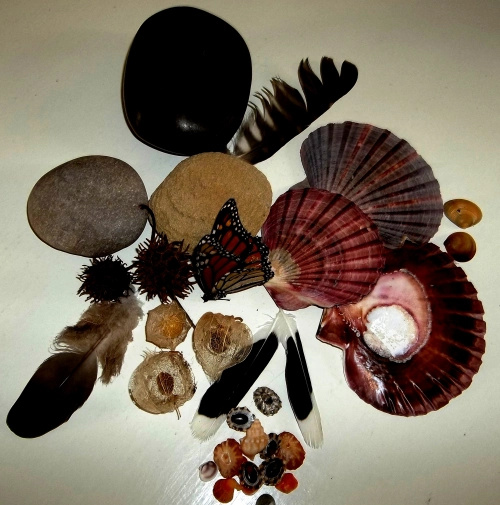
    These stones and feathers and shells can tell the story of my life in the last few decades… shells collected with the children on a Northland beach, a black and white feather lying outside the door when I opened it on our first day in a new house – greeting from a tui… the brown and cream morepork feather found on a long walk around the harbour with the thoughts and dreams of that afternoon threaded through its fronds.

    An ancient stone from a river bed in the Blue Mountains of Australia was picked up after a day spent abseiling in abject terror, another from a cold pebbled beach in Devon, the chill of the Atlantic breakers still embedded in it after all these years, while the polished brown stone came from an underground cave in the central North Island where glow-worms illuminated the roof, and a river flowed through. These things are the stuff of my life… as they are of every life in which they are valued.

    As I looked at them I thought of how other collections can also tell the story of a life. When I renewed my passport recently I found all my old ones, going back to when I was twelve and going to France on my own to learn French. In that passport photo two frightened brown eyes gazed out at the world. I had been so appalled at this picture that I promptly destroyed the evidence.

    Which left the rest – a twenty one year old about to go on holiday to Spain, well- groomed hair, immaculate lipstick, and veiled blank eyes… the next, an exhausted mother of two toddlers about to go to Hong Kong, badly cut hair, eyes sad and resigned. And then, a picture of a thirty five year old woman, lots of dark hair piled up confidently, smiling eyes, relaxed smile. Life to be lived now, not endured. In the decades since, the hair has got shorter and then faded, and the last photo was so awful I hoped to be un- recognisable, but the story of a life is told in those passport photos.

    Another can tell the story of their life in their jewellery, the coral necklace given at a christening, the charm bracelet for a little girl, pearls for a twenty-first, the engagement ring and the gold band… a gift to mark the first child, a clumsy pottery brooch made at school and proudly presented to a beloved mother… the ring inherited from a grandmother, the eternity ring at a silver wedding… such precious collections can mark out the steps of a life quite as well as a photograph album.

    I wonder if there is even a market these days for photograph albums now all our photos are taken on phones and I-pads. I was never much of a photographer, so that the photos of my honeymoon were on the same roll of film as the pictures of my first baby. But I did have a memory.

    I remember one summer’s afternoon when the children were three and four as they tumbled around on the grass, one wearing a sun-suit in glorious colours of pink and orange and red, the other in matching shirt and orange shorts. As I looked at them, revelling in their laughter, their shining hair, and sparkling eyes, pearly teeth and glowing sun-tanned faces, I thought to myself, I’m going to remember this moment forever.

    It was a turning point, because I found I did never forget that moment. So now, I know I can fasten those moments I want to remember with that little intention, and our minds are so obedient that they obey the instructions, and can call up the images whenever they are wanted. On the other hand, I wonder if the ease of communication, the instant photos, the selfies sent from Rome or Khatmandu which reach every member of the family all over the world the same day, make it easy to forget. We don’t have to remember, because it’s all there, on Facebook or in the picture file on the computer.

    But for how long? Until the internet crashes? Or some other disaster hits the net? The computer is stolen? Few people will be able to pick up old albums in the future and leaf through them re-living their own lives, or discover the lives of their ancestors. And how will biographers fare in the future? In the past we’ve had portraits and miniatures in pre-photography days; then the wonderful stilted posed photos of the early days of photography, with the expert’s head hidden under a black cloth over a tripod while he captured forever the people and that moment in their time.

    Then came the brownie box camera and all the other simple do- it- yourself cameras, and families recorded their events and special moments themselves. Biographies of the famous from the twenties until the sixties are full of revealing snaps, but what will there be for future writers and historians wanting to illustrate their books about the powerful and famous? Not much, I suspect.

    In the past, many anonymous photos turned out to be records of history – impromptu black and white snaps of Battle of Britain pilots ‘scrambling’, shots of families crouched in air –raid shelters from London to Leningrad, soldiers in Africa or Italy taking grainy pictures of each other to send back home… joyful hugs and kisses of victory – all these spontaneous pictures of humanity enduring both the ordeals and the pleasures of the twentieth century, captured in black and white film, are the stuff of history.

    But I wonder what history is being preserved today in our somewhat ephemeral records? Will collections of jewellery or stones, in the end be the things to jog people’s memories in the future? Maybe the photos in passports and on driving licenses will the best concrete records we will have… time to get a decent picture taken for these official documents perhaps !

    Food for threadbare gourmets

    Summer salads don’t always mean lettuce for me… One of my favourites is grated cauliflower, mixed with chopped hard- boiled egg, some chopped Medjuel dates, toasted slivered almonds, and lots of chopped parsley. Then stir in enough good mayonnaise to the consistency you like. Chopped apple or banana is a variation, but actually anything can be added, and it still tastes good. But it can’t sit around, or it turns watery. I eat it on its own, but it’s also good with cold chicken.

    Food for thought

    And a poet said, Speak to us of Beauty. And he answered: Where shall you seek beauty, and how shall you find her unless she herself be your way and your guide? Beauty is not a need but an ecstasy. It is… a heart inflamed and a soul enchanted … a garden forever in bloom and a flock of angels in flight.

    ‘The Prophet’ by Kahlil Gibran, Lebanese poet, 1883 -1931. ‘The Prophet’ has never been out of print since it was published in 1923.

  • The eternal search – for the perfect coffee

    Illustration from the post “The eternal search – for the perfect coffee”

    I lost my wallet the other day. Going to pay for the dry cleaning, I found my big red Guy Laroche wallet given to me by my generous daughter had disappeared. Panic. The last place I’d had it was at the garden centre a mile away. And since I’d paid for the plants, the wallet must still be sitting in the trolley. More panic.

    I ran through the things that mattered in my mind… credit cards … but ‘they’ wouldn’t know my pin number. Pain to have to cancel… forget them for now. Money? Who cared. But oh, my photographs of the grandchildren and moments caught in time that I wanted to remember… they were irreplaceable… and the two little love letters with terrible spelling and seven year old scrawls from them … one which I had found written in the diary they always used to keep when they came to stay with me… on this occasion they had decided that they would stay permanently and be home-schooled by me:

    ‘Five time a week I have fun. It can be so wonderful. I will like to say that I am writing this because it came from my hart and I kodn’t get it out of my hed….I hope that we can stay heer for homeschool it will be so fun and it will asol be fun because I love my granny so much it can be fun every day but I love staying heer and I like feeding the eels’… how could I replace a letter like that? My heart curled over at the thought of such a loss…

    What else? Oh … my collection of coffee cards. Each one stamped for every coffee I’d had, and nearly ready for a free coffee. The restaurant down by the river, the cafe in the garden where they make pottery, the lovely place where they also make hand-made chocolates, my stopping off place in town…

    Zipping up my stiff upper lip I hurried back to the garden centre, and there was the red wallet, waiting for me at the office. (gardeners are good people!) “It was my coffee cards I was worried about,” I explained when I picked it up, and everyone laughed because they knew how I felt.

    I have travelled the length and breadth of one country, which shall remain nameless for fear of hurting millions of people’s feelings, looking for a decent cup of coffee. I finally found one in a far-flung cathedral crypt cafe. I will drive for miles for the sake of that elusive perfect cup.

    I know as soon as it’s put in front of me if it’s going to be a good one. The cream will be thick and won’t just dwindle into a thin froth when stirred. It will be smooth and not too creamy and not too strong. The most memorable coffee I’ve ever had was in an Italian restaurant in Melbourne.

    Creating this ambrosia obviously came naturally to the maker… and in that search for the perfect cup, I’ve discovered that the maker actually matters. Yes, I know the machine has to be properly cleaned so the coffee doesn’t taste bitter, and the milk the right temperature, but there’s more to it than that. And the deciding factor in the quality of a cup of coffee for me, seems to be the person.

    Everyone makes the coffee the same way on the same sort of machines I’m assured, but it doesn’t work out like that. Every barista is different and so is their coffee. A grumpy barista does not produce a good cup of coffee. A good cup of coffee is hand- crafted and a work of love, so I know if it’s going to be delicious by the quality of the barista’s smile. A nice person makes great coffee! They even do lovely patterns in the froth, like a Christmas tree at Christmas time, or a flower or smiley face at other times!

    And what despair and thwarted desire when I arrive at a favourite coffee place to find a new member of staff, or the nice coffee person has taken off overseas, and we have to start all over again, with a learner driver as it were! Or the tantalising times when the best coffee maker is busy cutting cake or sorting spoons, and not at her post, and I have to make do with a cup which I know won’t be as good as hers. C’est la vie, but coffee is so much more than beans, milk and water!

    And when the perfect coffee arrives, what sybaritic pleasure – the delicate sinking of the spoon into the froth, and a gentle stirring. Sometimes a fragrant teaspoon of coffee crystals for the sheer pleasure of stirring and dissolving them in the glorious liquid. And then a sip, and a contented settling into satisfaction as I slowly savour one of civilisation’s minor works of art.

    Sadly the second cup never reaches the same level of pleasure as the first. And I’ve even read that scientific research has proved this to be true. No wonder it matters that that first cup is as good as it can get!

    Food for Threadbare Gourmets

    One of my favourite coffee places serves gingerbread with their coffee. I love it. To make it myself, I use two eggs, a cup of sugar, a cup of milk and a cup of golden syrup (the cup rinsed out with oil before measuring the syrup). Beat them together. Melt 225g butter. Mix two cups SR flour, two teasp or more of ground ginger, a teasp each of mixed spice and of cinnamon, and a teasp of baking soda into the egg mixture and then stir in the melted butter.

    Pour into a loaf tin with the base lined with baking paper. Bake at 180 degrees for an hour. If you’re using a fan-bake oven test after 45 minutes. Let it cool in the tin for 30 minutes before turning out. You can ice it, but I like it cut into slices and spread with a little butter.

    Food for Thought

    “The artist’s task is to save the soul of mankind; and anything less is a dithering while Rome burns. If artists cannot find the way, then the way cannot be found.” Terence McKenna (1946 – 2000) was an American philosopher, ethnobotanist, lecturer, writer and author of several books.. He was also the creator of a mathematical theory of time based on patterns found in the I Ching which he termed novelty theory.

  • The necessity of beauty

    Illustration from the post “The necessity of beauty”

    Pamela was my lodger. She was living in the third bedroom in my flat for the same reasons that Mr Micawber pronounced the immortal words:”Annual income twenty pounds, annual expenditure nineteen pounds nineteen and six, result happiness. Annual income twenty pounds, annual expenditure twenty pounds nought and six, result misery.”

    I’d tried to fill the gap between my meagre salary (women were paid far less than men in the Hongkong I lived in ) and my expenditure, by doing TV quiz shows, radio programmes, using the children as photographic models and even doing PR for the Anglican church until I could stand being hypocritical no longer. So Pamela was my next attempt at solvency. While she lived with me my life was filled with her dramas, love affairs, crises and disasters.

    She arrived with one fiancée, dressed demurely in twinset and pearls, tweed skirt and silk head –scarf. Soon she found a more exciting prospect, and changed her style to newly fashionable jeans, her hair swung up into dashing styles and lots of makeup. The new fiancée lent her his new VW while he went back to England to sort out his divorce, and hereby hangs the tale. Pamela rolled the car her first night in possession of it, and I was awakened in the middle of the night by a Chinese policeman who couldn’t speak English.

    I pieced together that Pamela had had an accident, and was in a Chinese hospital since she had no insurance to cover her for a European one. The next morning the children, four and five years old, and I, packed up a few things for Pamela and made an expedition to the enormous building which housed some thousands of sick and penniless Chinese.

    We found our way through a maze of corridors to Pamela’s ward, and by the time I reached her bed I was deeply shocked. The ward held eighty women. They were all dressed in faded brown cotton shifts including Pamela. The noise was horrendous. Cantonese is the noisiest language on earth. To hear our amah chatting to another outside the kitchen was deafening. To hear seventy- nine women chatting in a confined space was probably higher than the safe decibel level.

    Pamela was bruised and shocked but not injured. After doing our duty, and promising to return that afternoon with more things she wanted, the children and I went home, leaving her with a little bunch of camellias I’d picked. Only six blossoms because that was all that were flowering.

    When we returned in the afternoon, something had changed. There was a hush in the ward and a sense of peace, and all eyes were on the gwailo (long- nose) and her children. Being watched was something one accepted as part of life then, but this felt different. And the hush was a sort of reverence. Pamela whispered to me what had happened after I left.

    When we walked out of the ward, the women came crowding round her to see the flowers and smell the fragrance. They were ecstatic at this exquisite beauty in their harsh unfriendly environment. Deprived as the women were, of all colour and texture and smell and beauty, the flowers brought something like heaven into their lives.

    They didn’t speak English, and Pamela didn’t speak Cantonese, but with the aid of the ward sister’s few words of English, they worked out a roster for the flowers. Each woman would have one camellia by her bed-side in a glass for three hours in every twenty-four. Pamela had one all the time, and the sixth flower which had fallen off its stem, the ward sisters had in their office, floating in a saucer.

    Back at the office the next day I rang the dean of the cathedral and several hotels and they agreed to send their flowers to the hospital whenever they changed them. I wonder if they still do.

    The great Catholic thinker Monsignor Hildebrand wrote that: ‘the poor need not only bread. The poor also need beauty’. But it’s not just the poor. We all need beauty.

    It’s strange to me that Abraham Maslow in his hierarchy of needs didn’t include beauty. Sometimes beauty is the the only thing that keeps us going. As Resistance fighter Odette Churchill was being locked back in her cell after a bout of torture by the Gestapo, she snatched up the skeleton of a leaf being blown in the door with her. The beauty of that leaf sustained her and gave her hope and courage and a belief in goodness that carried her through her dreadful ordeal.

    Quaker writer, Caroline Graveson wrote that: ‘ there is a daily round for beauty as well as for goodness, a world of flowers and books and cinemas and clothes and manners as well as mountains and masterpieces.’ She talked of beauty: ‘not only in the natural beauty of the earth and sky, but in all fitness of language and rhythm, whether it describe a heavenly vision or a street fight, a Hamlet or a Falstaff, a philosophy or a joke: in all fitness of line and colour and shade, whether seen in the Sistine Madonna or a child’s knitted frock…’

    The sad thing is that those deprived Chinese women in that joyless hospital ward, came from a culture, which before the blight of industrialisation and the tyranny of plastic, was incapable of producing anything that wasn’t beautiful – from their baskets to their bowls, to their porcelain and their poetry. And there was something very beautiful about buying a kati of vegetables in the markets and watching them being skilfully wrapped in a beautifully folded sheet of re-cycled Chinese newspaper, or a large leaf, and tied with a knotted reed.

    Perhaps their own sage should have the last word, Confucius said that everything is beautiful, to those who can see it….

    Food for Threadbare Gourmets

    Salady food feels right in the Antipodean Christmas season.This is one of my favourites. Boil new potatoes for the number of people you have, plus hardboiled eggs. Chop them and mix them with sliced artichoke hearts fresh from the delicatessen or from a jar. Gently toss in a good vinaigrette dressing, and sprinkle with capers if desired. Delicious on its own with crusty rolls, or with cold chicken or cold salmon.