Category: Memoir & Family

  • Nuns, nice habits and strange foibles

    A life – This is the ninth instalment of an autobiographical series before I revert to my normal blogs
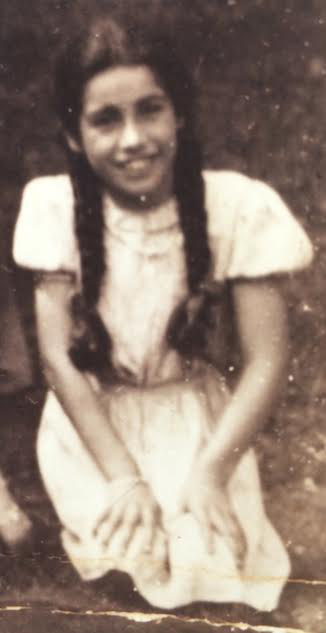
    Illustration from the post “Nuns, nice habits and strange foibles”

    I never had any trouble remembering the date of my baby brother’s birth, because when we arrived back in England from Belsen, we were sent to school at a convent in Yorkshire. It was with the sisters of the Assumption of the Virgin Mary, a Belgian teaching order. My brother’s birthday was the Feast of Our Lady of Lourdes, one of many feast days when we were sent home, presumably so the nuns could pay due reverence to the day, unhampered by their fee- paying pupils, and causing my parents to grumble that they spent all this money in order for us to stay home.

    Sometimes, as at Corpus Christi, we were required to attend in order to parade and go to Mass, and draw holy pictures. This was a time of severe mortification for me, because not being Catholic, our parents refused to buy us white dresses and veils to wear on feast days.

    On the other hand, thanks to the books I had read with my grandmother, I was bigotedly anti-Catholic, and had no qualms about being different. The nuns themselves were mostly gentle and sophisticated women, many of them French or Belgian, others English. My form teacher, who was also the maths teacher, was the most avidly religious person at the convent and not a nun at all. Rather, she was an Irish Catholic, and, as I discovered later in New Zealand, she embraced a very different brand of Catholicism. ‘

    Not to put too fine a point on it, she rammed religion and her devotion down our throats, exhorting us amongst other things, to bring old clothes to her to dispense to the needy. As she gathered them in from everyone except me, she would regularly intone, ” Ah, gurrells, it’s boi moi gude deeds to the puir that I hope to go to heaven.” She would interrupt long division to make us all stand up and say The Angelus, and we would then pray for the parents of all the unfortunate girls who had one Protestant parent. Since both my parents were Protestant, this was a prayer I obstinately refused to join in, as I had no regrets about their situation.

    One day, her propaganda about “puir St Thomas Moore”, wicked Protestants and suffering Catholics enraged me so much, that having just finished one of my father’s books, a history of the Borgia family, I had enough ammunition, I felt, with the Inquisition and the scandal of the Avignon Popes, to take her on. I never got beyond the Borgia Pope and a quick mention of the Inquisition, before she clapped her hands over her ears, and drowned me out by shouting: “What a pack of Protestant lies.” No- one liked me very much after that, and I would always be left to last when they were picking teams for netball and rounders.

    One person who did like me, perhaps a little too much, was Mother Michael, a rather coarse -looking Englishwoman compared with the refined foreign nuns. She was not a teacher so much as our house- mother, and she was obsessed with long hair. My long, almost black, thick plaits were meat and drink to her. Every lunch hour I was dragged off to the big, sunny cloakroom-cum ante-room, and had my plaits ceremoniously undone, and brushed out.

    The brushing went on all through play-time, and I never got to play with anyone. As the time for the bell drew near, she’d plait the blessed things up again, refusing to let me do them. She dragged the hair round my face quite differently to the way I scraped my hair back myself, and I’d get home every day, looking quite unlike the school girl who had set out in the morning.

    Every day my stepmother would ask what was going on, and when I told her about the brushing and the plaiting, she’d say “It’s got to stop”. But I didn’t know how to stop it, so it went on until Mother Michael fell in love with another girl with long plaits.

    The nuns wore elegant, plum- red gaberdine habits, with a long swinging pleated skirt, and a thick, beautiful cord with long tassels round their waist. Their rosaries also hung from this fat cord, and they had long, soft white wool veils which swung in the wind when they borrowed our roller skates and took a turn round the rink in the evenings when everyone was inside, doing their homework. The garden beside the skating rink plunged down towards Our Lady’s grotto, and then to the River Tees.

    I would gaze out of the classroom window in our annexe called The Hermitage, in winter, and see the black, lacy boughs of the empty trees, the black running water of the river, white snow, and sometimes a flame- coloured squirrel silhouetted in the trees against the pale winter sky. The main convent building was grim, grey, Victorian Gothic, with long, shiny, lino-floored corridors where feet and voices echoed. It smelt of incense and wax candles, lino polish, and nearer the kitchens, carbolic soda and grease. In alcoves at regular intervals along the echoing corridors, painted statues of saints draped with rosaries presided. I glared at them like a latter-day Oliver Cromwell as our crocodile straggled to chapel for prayers every day after lunch.

    I always enjoyed Retreat, three or four days of silence when we spent most of our time drawing and painting holy pictures, instead of wrestling with fractions, and going to chapel for mass, as well as the regular after- lunch prayers, and then Benediction. I hated the priest who came to the convent for the occasion, and whom all the nuns fluttered around and flattered and fawned upon. To the cynical ten-year-old looking coldly on, he looked like a very boring, not very bright man, who relished in an unspiritual fashion, the entirely undeserved attention he received.

    I was happy to go to chapel as often as we did during Retreat, as I had figured out that God was everywhere so it didn’t matter where you were beating his ear. I had no idea why we were doing all this, but then, a lot of things puzzled me… so I loved the reverent silence of the whole day, including the silent meals with severe, beautiful Mother John standing at her lectern, reading from the lives of saints. During these meals we ate Assumption Tart, known to us all as Sumpies.

    The story of the three fashionable Belgian Victorian women who decided to found the Order was read aloud as we ate the tart. None of them knew how to cook, clean, or sew, and so in the first week, the lady nun assigned to cooking duties threw together some ingredients in a panic and produced the hard, yellow crust of almost inedible pastry on which jam was smeared and which we still ate. We all welcomed Sumpies on the menu, as at least the jam was sweet, the only ingredient which had any taste. The convent food was still obviously flung together by nuns who could not cook.

    During Retreat, our class was visited by both Reverend Mother, and Mother Superior, causing an outbreak of curtsying and crossing ourselves. Since no-one ever explained anything to children in those days, I couldn’t work out why a young Reverend Mother seemed more important than a Mother Superior. Reverend Mother was Polish, about twenty-eight, very young to have reached such rank, and had an indefinable air of holiness about her. She also had an amazing complexion, pale skin and brilliant red cheeks. She received total devotion from everyone, and she fascinated me. Sometimes she wasn’t well enough to come to our weekly audience with her, so Mother Adelaide, Mother Superior, came instead.

    My father adored Mother Adelaide. She was just the sort of woman he loved, witty and wise, French, sophisticated, clever and rather beautiful. Long after, when I heard that Reverend Mother had died the following year of TB, I realised that Mother Adelaide had left her duties as superior of the order, to come over from Belgium to keep things going with as little disturbance to everyone, including the beloved young nun.

    After a while, it was decided that my sister would do better at school on her own. So I agreed to ” sit the scholarship” in order to go to the local grammar school. My stepmother was then summoned for an interview with the county education authorities. She told me that they informed her that my maths was so abysmal there was no way I could qualify for higher education. But my English and general knowledge were so far ahead of my age, that there was no way they could not give me a scholarship. Nothing much has changed since then, my maths are still abysmal.

    To be continued

    Food for threadbare gourmets

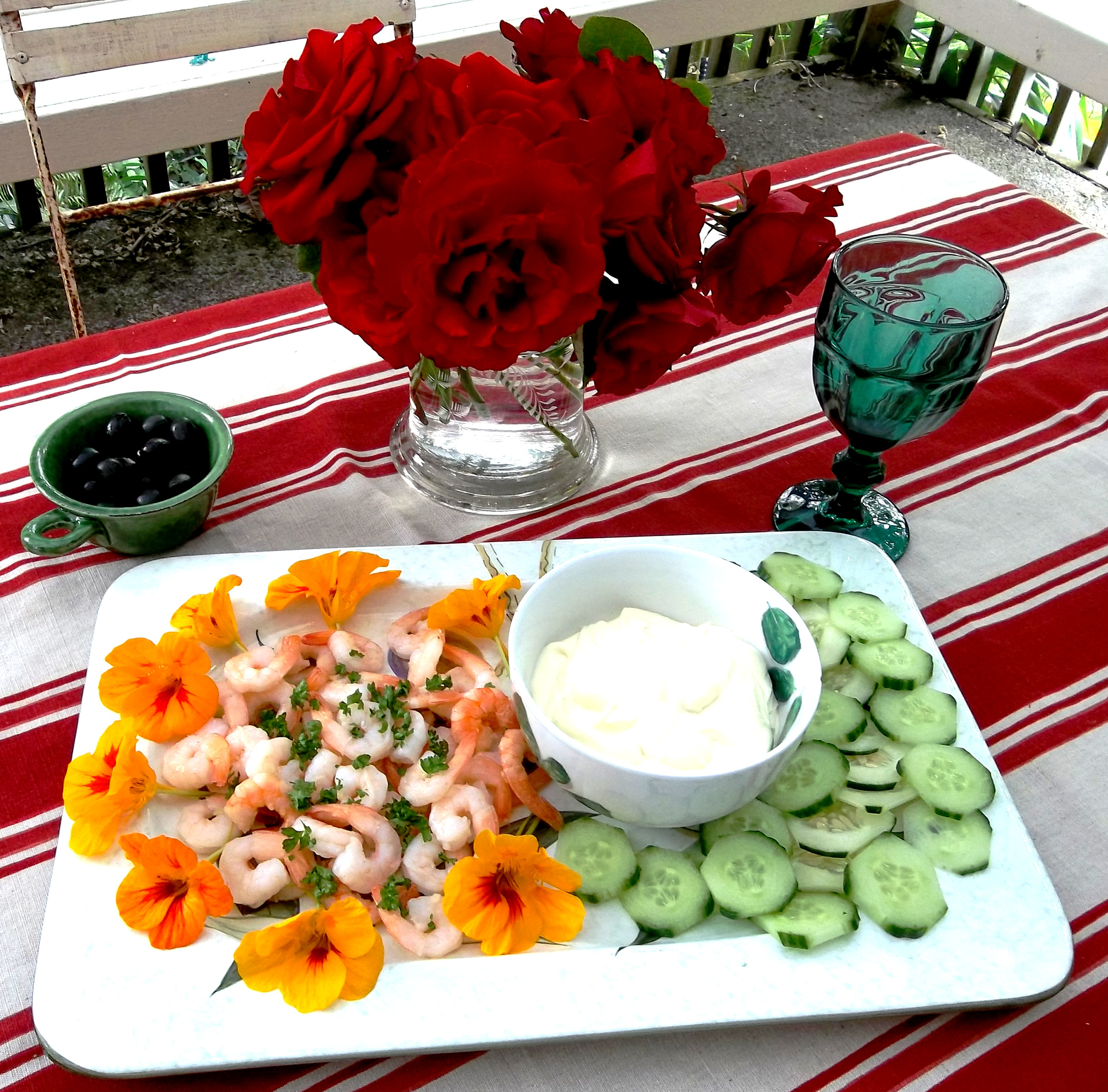
    I had some wonderful coloured -peppers, red, yellow and orange, and instead of cooking them in my usual way, I tried a Jamie Oliver recipe – with adaptations! I chopped the three peppers and added them to a chopped onion, plenty of garlic and olive oil to sweat them until cooked. When soft I added a good glug of balsamic vinegar and boiled it all together, and then salt and pepper to taste.

    This is where Jamie Oliver comes in. He recommended tossing in a generous handful of parmesan cheese and some table spoons of mascapone or cream cheese. Stir it all together until everything is melted and amalgamated. He served it with pasta and I served it with steak and mushrooms, and it was delicious.. It may have been better with pasta but I won’t be using the cream cheese again.

    Food for thought

    If you truly get in touch with a piece of carrot, you get in touch with the soil, the rain, the sunshine. You get in touch with Mother Earth and eating in such a way, you feel in touch with true life, your roots, and that is meditation. If we chew every morsel of our food in that way we become grateful and when you are grateful, you are happy. Thich Nhat Hanh. Vietnamese Buddhist teacher

  • Flowers, beauty, architecture and antiquity

    Illustration from the post “Flowers, beauty, architecture and antiquity”

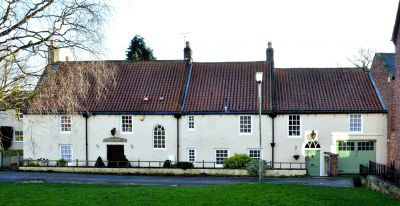
    The Old Parsonage A life – Part six After a few weeks in London we packed up again and travelled north. I remember the cooing of wood pigeons and the enchantment of high summer in unspoiled country on the borders of Durham and Yorkshire, where my parents had found a house belonging to a friend of the family. It was in a village by the River Tees, described in the guide books as a ‘late medieval house, with studded front door with affixed carved oak female head, under ogee-shaped lintel (door said to have come from a demolished Saxon chapel).

    ‘The date on the lintel above the door is c1450, the reign of Henry VI. The house had been through many hands since then, had been extended in the 17 century, altered in the 18 and equipped with modern comforts in the 20th. Fashionable pantiles from the Low Countries were used to re-roof the house in the 17 century. Today it’s been altered again, and one wing converted into another dwelling.’

    It was set in a high walled garden at the end of the village, and we spent most of our time in the sitting room, a wood panelled room with huge Tudor fireplace and inglenook. If I stood on the head of the tiger on the striped tiger-skin rug, I could just reach the chamfered 17 century beams as a nine- year- old. The casement windows looked onto the garden, and beyond the garden walls, hills and woods stretched to the sky-line.

    We children were rarely allowed into the drawing room, and then, only if we knocked on the door beforehand. Mostly we stood at the door with whatever it was we wanted to say, but were allowed to sit there when guests came or when we had our lessons. I hankered to spend time in that room, a Georgian addition with French windows into the garden. It was simply furnished with soft flowered chintz, but it had a different atmosphere to the rest of the house – a refined, gentle energy compared with the robust Tudor architecture elsewhere.

    I loved the slightly faded thirties linen prints on the loose covers on the sofas and chairs, and the black and white tiled hall with its antique chests and barometer. I developed a love of interior decoration and from then on felt uncomfortable in rooms that were ugly or tasteless, and was hungry for beauty when it was absent.

    My new stepmother, who was lonely, and needed someone to talk to, unconsciously educated me too, looking through the pages of Vogue with me, and discussing the famous and controversial New Look by Dior. She wore clothes that I could appreciate, well- cut grey flannel trousers with a red jacket, elegant suits, nifty little hats with a bit of veil, perched at an angle, incredibly high navy suede court shoes, and severe beautifully cut evening dresses.

    Everything was new and interesting, the stones in her jewellery, discussing menus, the intriguing friends who dropped in on their return from overseas, learning to distinguish crystal from glass, china from pottery. We didn’t always see eye-to eye. I was deeply upset when the revolving Victorian summer house with stained glass windows, a pointed pitched roof, and a circular table like a wheel which turned the house in the direction of the sun, was demolished, and the circle of soil now exposed, planted with grass. It seemed barbaric to smash this thing of beauty. My stepmother condemned it as Victorian. Anything Victorian was despised by both my parents.

    This rambling house was a splendid place to curl up in and bury myself in a book. They were in short supply here. The owner had put hers away, and ours were all packed up. My stepmother gave me her textbooks on ancient history, so I learned about Pericles

    th th th

    th and Alexander, Carthage and Hannibal, there was Tanglewood Tales’, a book on Greek legends by Nathanial Hawthorne, and ‘ Black Beauty’, that animal classic which has influenced me more than any other for the rest of my life, I suspect.

    Whatever the curse of the motor car, I am glad horses are no longer ill-used, neglected and exploited every day on the streets and in the country-side. “Little Women’, also among my stepmother’s books, had the same potent moral influence on me, as on so many other girls before and after. Interesting that the Quaker background of Anna Sewell, and the Transcendentalism of Louisa M. Alcott should have influenced so many generations of children.

    I grazed through Palgrave’s ‘Golden Treasury’, which our stepmother used for our lessons. She was not strong on child psychology, but we learned a lot of poetry from the Golden Treasury, including: “Breathes there the man with soul so dead,” from Walter Scott, and Elizabeth Barrett Browning’s ” What was he doing, the great God Pan, down in the reeds by the river?” I can still declaim them both in the overblown elocution class style required of us. Longfellow’s Hiawatha was another favourite of my stepmother, and we learned to recite long passages of this too.

    My sister got very ratty if she didn’t do the same things as me, so she tried to learn them as well. But she never mastered the esoteric spelling my stepmother required of a nine- year- old and an eight- year -old. The words included phlegm and haemorrhage, diaphragm, delphinium and rhododendron. By now, my father had long since departed for his next army posting and we were alone with our new stepmother, who was struggling with early pregnancy as well as the malaria she’d picked up in Egypt, though we were unaware of either. Sixty years later, she confided over an affectionate dinner together that:” You never played me up – you could have, but you never did.”

    We didn’t go to the village school, and never knew anyone from the village except the gardener, Mr Appleby. He took a fancy to me and taught me the names of his flowers in the garden. He certainly behaved as though they were his. His deep red, rich pink, and white peonies were his greatest joy, and had a beauty all their own, as I picked them for my stepmother’s crystal vases. They were as lovely as roses, dripping with dew on their bright green leaves, and droplets nestled in the big flower heads layered with petals like an old-fashioned rose.

    Since we had our lessons in the afternoon, it was my job in the morning to re-fill and refresh all the flower vases in every room in the house. This was perfect. It got me away from the parents who I was very nervous with – never sure of what was required of me and possible disgrace – and I could spend as much time in the garden as I wanted. Mr Appleby let me pick the best pink and red peonies, there were fat, pink, peppermint-scented pinks, sweet- scented roses, multi-coloured wallflowers and purple penstemons, fragrant white stocks, spiky blue delphiniums and stocky lupins. Snow- in- summer and blue campanula sprawled in crevices on the terrace by the house.

    He started bringing me treats from his own garden, huge, juicy, golden Williams pears, the fattest, hairiest, rosiest gooseberries I’d ever seen, juicy purple plums with golden flesh. My sister was furious that he never brought her any treats. Then he offered to take me for walks around the surrounding country-side.

    The first walks were magic. Mr Appleby was probably in his sixties, a wiry little man with red apple cheeks and black stubble, who wore a grubby shirt with no collar and shabby black jackets and worn trousers that would be described as ‘rusty’. He had lived here all his life and knew every path and stream and hill and dale for miles around. He showed me mice nests slung between corn stalks, rubbed the ears off barley for me to taste, showed me the flowers that grew in bean fields and corn fields, where bird’s nests were, and where fish jumped in the pools which gathered between great slabs of flat rock in the river.

    He explained who owned this field and that great house, he took me by shallow streams he called becks, and up steep cliffs he called scars. The walks extended from five miles at the beginning, to over eight miles one afternoon, up hills and along narrow paths, when I was so tired I thought I’d never take another step. I was always exhausted at the end of these marathons.

    And then one day he said something I didn’t believe I’d heard. So he said it louder. ” Give us a kiss, then.” How could I be ungrateful after all the things he’d done to give me pleasure. I dabbed a quick peck on his horrid unshaven cheek. He did the same on the next walk. I avoided him in the garden as much as I could. I felt so sick the following week when he came for the Tuesday afternoon expedition that I hid in the top of the pear tree.

    My stepmother called and called, until my sister revealed my hiding place, and I was sent on my way with admonitions not to be so rude. I dragged behind him for most of the way for the rest of those walks, but there was always a point when at some place he asked for the unwilling kiss. Once, I tried to tell my stepmother about it, but she stared at me disbelievingly, which effectively closed the conversation, and now I look back sadly, and see an achingly lonely and love-starved old man.

    I loved that country-side. I remember walking by myself to the next village on an errand for my stepmother, dawdling past the long, grey stone wall of an estate, with dark, shiny rhododendron bushes reaching over the top, and hearing the cooing of wood pigeons. There was a clear blue sky, the empty, cobbled village street, no sounds of traffic, nothing but bird song, sunshine, the church clock chiming, shady trees and the perfect happiness of being on my own with nothing to do but walk in this perfect place.

    A Shell guidebook in the 70’s described our village as consisting of one street 3/4 mile long. ” One side of the road is a wide green behind which extremely attractive 18th and early 19th century houses face equally good houses behind a narrow green on the other side of the road. The village is sited on a ridge immediately above the bank of the Tees, and the river and rich farmland beyond can be glimpsed between the trees and houses. It is remarkably unspoilt… New houses are discreetly sited, so that they do not detract from the atmosphere of a more gracious age than our own. It is a village of many greens, sundials, river views, trees, and attractive door-casings, and its centre has changed very little since Jane Austen’s day.”

    In 1947, it had changed even less, and there were no new houses, rather, it resembled the very village scenes observed by Emma… “her eyes fell only on the butcher with his tray, a tidy old woman travelling homewards from the shop with her full basket, two curs quarrelling over a dirty bone, and a string of dawdling children round the baker’s little bow-window eyeing the gingerbread…”

    The only difference between 1815, when Jane Austen wrote these words at the end of one European war, and 1947 at the end of another European war, was the lack of horses and ginger bread. Food rationing was still as stringent as ever, with Europe on the verge of starvation, while lack of petrol meant no cars spoiled the peace of this north country village.

    And all this was about to change as we sailed from Harwich to the Hook of Holland on our journey to join my father at Belsen, the notorious concentration camp in the heart of hungry, war-ravaged Germany.

    To be continued

    Food for threadbare gourmets

    My tomato plants are flourishing, so I have a glorious glut of tomatoes. This was my solution the other day. Fry the chopped tomatoes gently in olive oil… the skins come off easily as they cook. When soft, pour in lots of cream, and as it boils to thicken, stir in a small lump of Dijon mustard, salt and pepper, and let them all meld together.

    Two- minute noodles were a quick answer to some padding for the tomatoes which were poured over them. With fresh parmesan grated over the tomatoes it was a fragrant, delicious light lunch. A small glass of red or white wine is a great enhancement!

    Food for Thought

    The people who are compelled to write down what they feel are the ones who feel it hardest… Briana Wiest

    I discovered this quote and much more on a beautiful wordpress blog at: Deborah J. Brasket Living on the Edge of the Wild

  • Was I a snowflake?

    Illustration from the post “Was I a snowflake?”

    A life – part four

    When we occasionally walked past what was known as the elementary school in those days, I used to shudder. The grim Victorian building, the concrete playground and iron railings, the noise and roughness of it horrified me. I was so grateful, even as a small child, that I went to my sheltered little school.

    Unlike most prep schools one reads about in that period my private school was neither cruel, sadistic or frightening – perhaps because it was owned by a woman and all our teachers were women, except for the wonderful history teacher.

    Miss MacFarlane-Watts, owner and head mistress, was a tall commanding woman with thick, grey hair cut almost as short as a man’s. She wore white shirts with a tie, heavy pleated skirts, tweed jackets, thick stockings and flat lace- up shoes. Without ever having heard the word lesbian or even a discussion about genders, I knew she was different… and we all accepted her as such. School was a large Edwardian house set in tree- ringed grounds and lawns, not far from where we lived.

    As a fashionista even at that age, I rather enjoyed our school uniform… white blouses and navy blue pleated tunics with a braid belt for the girls, and grey shorts and jumpers for the boys. Our hats were my real pride and joy, a big brimmed, deep crowned navy- blue, thick, velour hat for winter with a striped ribbon with the school colours, and a wide-brimmed Panama hat for summer – they were so big that we little girls must have looked like mushrooms beneath them, and it was amazing that items of such quality were still available at this point in the war. We kept these expensive hats from flying off in a wind with a piece of elastic which went under our chins. Even our gabardine macintoshes were the finest quality.

    Clothes had always figured largely in my life even as a toddler, when I remember the broiderie anglais edging my white petticoat, and relished my delicate little smocked ninon dresses, one in pink, the other in blue… does anyone even know what ninon is today … a fine net covered in tiny balls of fluff is my recollection.

    My grandmother inevitably had somewhat old- fashioned ideas about clothes, one of which was to kit us out in liberty bodices… a sort of cotton layer worn on top of a vest and under a jumper, with buttons round the waist to hook a skirt on. They weren’t too bad, but I shrivelled with embarrassment when she sent me to school in antique leather gaiters to keep warm. They stretched the length of my leg, and the tiny buttons running that whole length had to be prized open with a button hook to get them off… this experiment was abandoned when I couldn’t cope with getting them off for physical education!

    The day we arrived at this school, the infant mistress – who seemed enormous to me – swung my tiny blonde sister up in the air, looked into her big blue eyes fringed with impossibly long black lashes, and said “Oh, what a little Topsy!” She didn’t take to me… children always know… and a few days later, she said to my bewildered little sister: “If your sister put her head in a bucket of water, you would too, wouldn’t you?” To which my sister baldly replied “Yes”.

    It was a kind environment. A few years later, when I was eight and one of the big girls, my brother started school. He was so frightened by the experience that he was sent up to my classroom, and was allowed to sit by my side at my desk for days until he was ready to cope on his own.

    Lessons were archaic. We learned to write copperplate, often using badly crossed nibs to write rows of letters over and over again until we got the right angle and shape of each letter. On handwriting days, the ink monitor – (never me – I was such an introvert that no-one even knew if I could cope with such responsibility, and I was happy to be overlooked) brought the tray of inkwells in, and they were passed along the rows of desks… then the pens… inevitably there would be spills – usually by a hapless boy.

    Each day began with chanting boring times tables, while we sat with our arms folded, and I sometimes think the ritual may have been a calming meditative exercise too, for we never had any rowdiness or fuss to disturb the quiet orderliness of the classroom.

    Art lessons nearly broke my heart. I was so excited when it was announced that we were now old enough to begin art lessons. But it was a huge let-down. We had to learn to draw a straight line, making short feathery strokes with our pencils. After a couple of lessons when we had mastered this arcane skill, we graduated to drawing a rectangular box and tackling perspective. With this accomplishment behind us we were now ready to be introduced to colour ! Hurray! We were instructed to bring a laurel leaf with red berry attached to the stalk to school the next day. Alas, our laurel hedge had no berries, so no lovely red for me, just boring green and yellow spotted leaves.

    No computers then, so we competed with pencil cases, and collections of hard-to- come- by coloured pencils. We marked our pencils by slicing off a sliver of wood to make a flat surface at the top and then inked our name on it. Indelible pencils were much sought after… you licked the lead, and this made the writing indelible… as for rubbers (erasers if you’re American) – if you lost one, or broke it in half by using it too strenuously, war-time replacements were scarce… whispers criss-crossed the classroom – “can I borrow your rubber”, “can you lend me your red pencil?”

    At Christmas we were all dragooned into the Nativity play. I had no idea what it was we were doing… which was not unusual… I spent so much time dreaming that I often missed important information. On this occasion, we all trooped down to the hall nearby, and I found I was an angel along with the other small girls. I was given a triangle to ching on at various not very obvious intervals to me.

    The boys seemed to have all the best parts as wise men, wicked kings, shepherds – and of course, Joseph. They also had all the best musical instruments – tambourines, and trumpets, drums and the rest- this was the moment I realised somewhat bitterly that boys/ men had advantages that we girls did not seem to have. And while we stood around in our angel nightgowns in the freezing hall, the teachers seemed to endlessly move rows of chairs around. It was all a complete enigma to me then.

    The next year we passed on the nativity play as we’d lost the use of the hall to the American soldiers who used it as their dining hall. They seemed noisy and enormous – wore fur-trimmed jackets – air crew I learned later – and since our back garden abutted onto the back of this hall, showered us with chewing gum, wrapped cubes of sugar – much prized – and sometimes bars of chocolate.

    My grandmother gave us three pence pocket money every week, and with this I bought a bar of chocolate every Friday from Mr Duscherer, the German grocer just up the road on the corner. Everyone knew he was German, but I never once heard a word of disparagement about him. He was a big kindly man and I used to watch with pleasure as he prized a wire through a big round of cheese when you ordered a quarter of a pound or whatever the ration was then.

    He had a huge machine that cut bacon the way you wanted it – smoky, thick or thin, streaky or back… he would weigh half a pound of biscuits out from big Peak and Frean biscuit tins into brown paper bags – did biscuits not get soggy then, I’ve often wondered, as I try to break into thick layers of cellophane to get into a biscuit packet these days. He sold stamps, posted parcels – usually wrapped in scarce and re-used brown paper, tied with re-used string and sealed with red sealing wax- no ubiquitous cellotape then, and he also stocked Sunny Stories, Enid Blyton’s weekly magazine for children with the long running serial The Faraway Tree in it.

    Life seemed simple and safe and satisfying, especially after my grandmother bought me a little blue bicycle, and I no longer needed to make sure that all my dolls were safely tucked up in their cot and had been kissed good night, a ritual which I needed to do when my mother was still with us, and I now recognise as psychological transference.

    And with the end of the war it was all about to change dramatically.

    To be continued.

    Food for threadbare gourmets

    Today, I had one duck leg left over after a little feast yesterday, using a tin my son had given me, so I made a duck risotto. It was delicious. Did the usual, onions, cooked half a dozen finely chopped mushrooms, fried the rice in butter, threw in a glass of good white wine to evaporate, and then added hot stock and a good pinch of dried thyme. When it was nearly cooked, added a generous dollop of cream, some green peas, and the duck meat which shredded beautifully. And then, with duck and orange in mind, added the grated rind of an orange and the orange juice.

    When ready, I covered it for ten minutes to sit and mature, then stirred in a big knob of butter and some parmesan. Served with more parmesan, green salad and glass of chilled Riesling, it was rather good.

    Food for thought

    It is never too late to be what you might have been. George Eliot, great Victorian woman novelist

  • The passing of an era

    Image result for victorian interiors A life – part three

    My grandmother was my favourite person. Whereas I had always felt responsible for my baby brother and younger sister, when she came to look after us when my mother left, I felt I could hand over the burden.

    When she moved in to pick up the reins, she brought all her Victorian past with her. Up went the heavy, red velvet curtains in the bay window in the front room where my sister and I had watched the big girls playing on their roller skates across the road, peering through the brown sticky paper, taped across the windows in diamond shapes, to stop the glass shattering in a bombing raid.

    I loved the texture and the colour and richness of the velvet. I loved the shiny brass rods with the rings that clanked when the curtains were pulled, and the big brass knobs at each end. I loved the aspidistra in its brass pot standing on its tall, spindly, three -legged table. On the other hand, I hated the Staffordshire figures which were her great pride. I thought them ugly and clumsy – and still do, for that matter, though I did like her Meissen angels.

    Upstairs in the bedrooms, our little utility divans were replaced with deep feather mattresses into which we sank in blissful security. The dark mahogany and rosewood wardrobes and dressing tables filled my senses with deep satisfaction. The sheen, the grain, and their generous size were comforting and solid in a world which in my experience had been bleak and insecure, able to be blown away by a bomb in the red sky of night.

    I remember the pleasure of sitting at the oak dining table as I dreamily chewed my bread and jam, and gazing at her knick- knacks on the oak sideboard the other side of the room – deep, blue Wedgwood biscuit barrel for chocolate biscuits, silver- bound oak biscuit barrel for plain Vienna biscuits, and the silver stag standing at bay on a writing tray which held all her letters and bills. Brass candle sticks stood each side of the biscuit barrels. The tall, wooden, barley-sugar twisted ones on the kitchen mantelpiece over the coal range now stand on my dining table.

    She boiled the kettle for afternoon tea in winter on a little cast-iron stand which hooked onto the side of the grate in the dining room fire. And there was the bliss of making toast over that fire with a long brass toasting fork. It tended to taste of flames and soot, but was warm and crisp and a great treat. The thick red and blue patterned turkey rug in front of that fire was my favourite place. Kneeling with my elbows on the rug I would bury myself in a book while I was supposed to be watching the butter soften by the fireside.

    Deep in my book and oblivious to butter, duty or anything else, I would be discovered crouched by the saucer of swimming, melted, precious, rationed butter. But if I was reading I was excused. No-one ever got into trouble for reading in her house. Until the day she died she was encouraging her great-grandchildren to read, as she had always encouraged me.

    Not that I needed it. I longed passionately to be able to read grownup books. My mother had already taught me to read when I finally started school at five and a half, having stayed home to keep my sister company until she was old enough to start school with me. I was forever bored as the class limped along the wall friezes which said things like ‘A for apple, ‘B’ for bat’. The teacher didn’t know I could read, and it never occurred to me to tell her. I was so shy I rarely spoke at all. I read every textbook as soon as they gave it to us, a habit I took into secondary school, so I already knew all the answers in class.

    Books for children were scarce, presumably because few were printed during the war. So, when my grandmother arrived with her box loads of books, it seemed like treasure. The children’s books were my father’s First World War and Edwardian boys’ books, the plots mostly centred on some pious crisis of conscience, but which I read nonetheless. I was particularly fond of my grandmother’s bound volumes of Victorian ladies’ journals, rows of red leather binding and gold tooling, with pictures as well as stories inside.

    They tended to be about Evangelical but highborn young men who possessed crisp, fair curls, and wore boaters and striped blazers, and often went punting, and they also featured swooning young women, often orphaned, but in truth, of noble blood!! I learned a lot about mourning from these tomes, and the fact that ladies wore lots of black crepe – whatever that was – and black jet jewellery for such occasions. Not that I had the faintest idea what mourning was, except that it made people cry.

    My grandmother also pressed on me her books from her Victorian childhood. ‘Froggie’s Little Brother’ was the most memorably painful, about a family living and dying in various stages of starvation and violence in the East End of London (my brother and I laughed years later that we were probably the last two people in the world to read this grim novel). There were The Wide Wide World’, ‘The Lamplighter’ and ‘Behind the Scenes’, all tales about orphans. I wept buckets over them. When I had surfaced from these agonies, there was’ A Crown of Thorns’, a suitable tale for a seven -year -old about Dutch Protestants being buried alive by the Spanish Inquisition during the time of Elizabeth 1.

    I baulked at ‘Pilgrim’s Progress’. My grandmother’s big volume with the original illustrations, with Christian stuck in the Slough of Despond, and the depravities of Vanity Fair and all the rest, depressed me more than any of her other books which included ‘Foxe’s Book of Martyrs’…

    Editions of Mallory and tales of Arthur, Merlin and Morgan Ie Fay in Arts and Crafts bindings, and Pre-Raphaelite illustrations with art nouveau drawings educated my eye as well as my mind. I laboriously read Defoe’s ‘Robinson Crusoe’ in one of the original editions – which my grandmother collected – another large leather-bound tome with engravings protected by tissue paper, like ‘Pilgrim’s Progress ‘and Foxe’s ‘Martyrs.’ I still remember the terrible shock when Crusoe and I found Man Friday’s footsteps on the beach!

    And I read Swift’s account of ‘Gulliver’s Travels’, and later found the children’s watered-down version pallid and boring. My favourite book then is still one of my favourites, ‘John Halifax, Gentleman’. When I re- read it as an adult, I recognised many of the ethical imperatives in the novel as having influenced my thinking ever since, while ‘Uncle Tom’s Cabin’ introduced me to the concept of slavery and abolition.

    Later when I unguardedly revealed to my recently returned father and his new wife that I enjoyed ‘Little Lord Fauntleroy,’ and they laughed themselves silly over its Victorian sentiment, I feared the rest of my reading was also material for mockery, and buried its existence in the back of my mind. And since my new parents did not want to be bored with tales of our past, I never discussed these books, and much else, so was never able to put them in context.

    Even the green and gold Tate and Lyle golden syrup tin which sat on the table at breakfast to use instead of rationed sugar, was worth reading and squinting at as I spooned the treacle over my porridge…’ out of the strength cometh forth sweetness’ it proclaimed. My grandmother was very pleased with me for taking her injunctions about reading so literally, and boasted to her friends about it. So whenever I was due for a present they dug into their shelves for a book suitable for a seven- year- old bookworm, with the result that I had more copies of Aesop’s fables than any other child in history, I would imagine.

    She introduced me to gardening. She gave us a small plot of our own, and we went to the news-agent where they sold seeds as well as sweets, newspapers and bread, and chose the seeds we wanted to grow. I loved the name Love-in-a-mist, and since they were also blue, my favourite colour, I took several packets. Every day for the next three weeks I rushed outside in the morning to peer at my little plot of earth until the glorious dawn when I detected a faint green haze – the first sign of the green mist through which the blue flowers were going to emerge.

    Like many gardeners, my grandmother couldn’t resist breaking off twigs and cuttings wherever she was, if the opportunity presented itself with dignity. But once her scruples were nearly undone by a hidden fern we passed regularly when we all walked down to the beach with my brother in his push chair. Every time my grandmother passed this wire fence with the little fern nestling there, unloved, and unseen by the people whose garden it was, she fantasised about bringing a trowel one day, and leaning over to dig it up. Finally, she couldn’t trust herself any more, and to my great relief removed herself from temptation, by going the long way round.

    She was deeply religious and never missed a Sunday at the Salvation Army, which she had joined in its early days when she was a girl at the turn of the century. She told me tales of marching through the squalor of the East End being pelted with tomatoes, and trying to give the ‘War Cry ‘ to drunks outside pubs. Because the rest of the family disapproved of her ties to the Salvation Army, she sent us to a church Sunday School near us, and made sure we were as regular as she was. Consequently, I became immersed in religion. She and I were never ones to skim over a thing lightly, so I read more Bibles and Bible stories than most children of my generation.

    She was obviously a highly intelligent woman who had been frustrated for most of her life – clever, feisty, quick-tempered and even in her eighties – a rebel. She could add a column of figures faster than anyone else, and her memory was phenomenal. I inherited the memory, somewhat watered down, but not the ability with figures. While her elder sister Lizzie, who was famous for being bossy, trained as a nurse, became matron of a hospital in Leeds, and shockingly for those times, lived happily with a married man, Mabel, my grandmother, married young, and unhappily. With her religious beliefs, it was a great shame to her that she was divorced.

    Her memories of her late Victorian childhood fascinated me and stretched my imagination. Most important of all her stories was not her grandfather captaining the first paddle steamer up the Thames and receiving the Freedom of London when he stepped ashore, but her description of the night Woolwich Arsenal blew up.

    She and her sister Jessica were in their bedroom and the windows blew out, the dressing table mirror was shattered, and the sky was red and filled with flames.’We threw ourselves down on the floor and prayed’, she said ‘We thought the end of the world had come’.

    Not having the faintest idea what Woolwich Arsenal was, I was instead riveted by the phrase ‘the end of the world’. The possibility had never occurred to me, and it teased my mind with the same horror as the Victorian bogeyman she threatened to call on, who apparently had a similar facility for descending chimneys as Father Christmas.

    She taught me to knit and sew and do French knitting, and embroider dozens of stitches I’d forgotten till leafing through an old Mrs Beaton cook book recently – daisy stitch, herringbone stitch, blanket stitch, chain stitch, back stitch, buttonhole stitch, cross stitch. She told me the names of flowers and saints and cousins I’d never seen, the stories of dead great uncles, of people who lived in our street – like the woman detective who went to meet the SS Montrose when it docked – to arrest the famous murderer, Dr Crippen and his mistress Ethel le Neve, who was disguised as a boy. She gave me a wealth of information and taught me prayers and proverbs and family history. Her love for me and mine for her was one of the rocks at the base of my life.

    I never really knew my grandfather, her husband, and met him only a few times. He had loved another woman for seven years before my grandmother finally gave in, and they settled for divorce. The other woman’s husband was so incensed that he threw acid in her face, disfiguring her for life. My one memory of her as a four- year- old was a gentle woman with a pink blob for a face, which I had to kiss. My grandfather loved her till the day she died, some years before he did.

    And since he had willed their house to her, thinking she would outlast him by years, she unwittingly made him homeless when a distant nephew inherited the house from her and turned the old man out.

    To be continued.

    Food for threadbare gourmets

    It’s too hot to cook a meal at midday, so we’re having salady wraps instead. He has wholemeal and I have spinach, and I spread them with either mayonnaise or Caesar salad dressing. Torn crunchy iceberg lettuce leaves are spread over this, and then chopped ham, grated cheese and green peppers for him are arranged, and the whole thing rolled up and held in place with tooth- picks. I have hard- boiled egg moistened with a little vinaigrette dressing, and then chopped tomato, and grated carrot along with the lettuce and tooth-picks… filling and refreshing on a hot day. We’ll have chicken tomorrow, pastrami for him and an assortment of vegetables including cucumber, avocadoes and thinly sliced red onion…

    Food for thought

    When we re-examine what we really want, we realize that everything that happens in our lives – every misfortune, every slight, every loss, and also every joy, every surprise, every happy accident – is a teacher, and life is a giant classroom. Arianna Huffington

  • Bombs and a baby

    Illustration from the post “Bombs and a baby”

    A Life – Part two We are familie-e-e-e-ee

    I was staying with my grandmother when I was three. She must have had her hands full, looking after me, nursing her sister Jessie who was dying from kidney disease in the big bedroom, and coping with her maverick younger son, who was staying with her before embarking for the Western desert, to join the maverick Long Range Desert Group – a match made in heaven!

    My uncle, who was unmarried, childless, and in his early twenties, spoiled me the way everyone did since I was the eldest of only two grandchildren. So now he said he would take me with him when he went to say his last goodbyes to the other side of the family. It would be an opportunity for me to meet my great-grandmother for the first time too.

    We crossed London by double decker bus, and arrived at a house filled, it seemed to me, with lots of old people in dreary black and dark clothes. I was made to kiss all these tall elderly people towering over me (they were probably not more than forty!) and then we sat down to tea round a big oval table laden with cake-stands on the lace table-cloth.

    The grownups got on with their conversation, and my great-grandmother, a fearsome little lady, grey and wizened, but sharp as a button, leaned down from the head of the table with a plate of small cakes, and offered me one. I reached out to take one, then drew back, realising they had currants in them. “No thank you,” I said politely.

    “Why don’t you want one?” My ancient relative asked sharply.

    “I don’t like currants,” I replied.

    “You’ll have one,” she snapped, “I made them myself.”

    So I took one obediently, and sat quietly picking out the currants so I could eat the cake parts, while the conversation flowed around me.

    Suddenly a stick landed hard on my knuckles, and I cried out in pain. My great-grandmother was leaning down the tea table and had hit me with her walking stick. I pushed back my chair, slid off it, and fled into the kitchen where I buried my head in some- one’s lap (a maid?) who was sitting there, and cried my heart out. Before long, my uncle came in and I was hustled out of the house in disgrace.

    When we caught the bus, with my uncle still be-rating me for my naughtiness, I was so upset, I jumped off the open double decker, and rolled into the road. I wasn’t hurt, but everyone on the bus seemed to be very angry with my poor uncle for upsetting a little girl so much that she did something so drastic to get away from him!

    Back at my grandmother’s, the poor young man related the whole sorry saga to my disbelieving grandparent. “But she’s always so good”, she kept repeating as he tried to get her to understand how unfortunate the afternoon had been. My grandmother just cuddled me, and he was miffed.

    Later she came to stay with us in Dorset, and I repaid her kindness by flinging myself into her lap to give her a hug, and knocking her spectacles off her nose, and smashing them. It was difficult to get anything repaired with everyone concentrated on the war effort, but she returned a few months later, and stepped down from the train smiling, wearing her repaired specs. I leapt rapturously into her arms, and knocked them off again. They lay shattered on the station paving. And she forgave me again.

    When I stayed with her in London, while my brother was born back in Dorset, she taught me proverbs and rhymes and skipping games. I learned to skip down in the disused cobbled stable-yard, happily singing and chanting these traditional rhymes to myself. But I hurried inside from the garden in the dusk, fearful that Germans might be hiding behind the laurel bushes.

    They might get me if I strayed too far from the big Edwardian house in which she had a flat, and I never lingered near the head- stones and graves for dead dogs, because there were so many places where the Germans might be hiding. When she visited her friends and took me with her, I overheard their conversations about where the bombs had been falling and realised that the world was a very dangerous place.

    I was just four when my father came to stay before returning to North Africa after being commissioned. But then he and my mother had a row, and he packed his suitcase and strode out of the door. My mother stood weeping in the doorway, watching him go, and then she sent me after him. I ran down the lane, and he stopped, put down his suitcase, kissed me, and came home. But then it happened all over again, and this time when my mother stood in the doorway weeping, and sent me after him, he was angry, and sent me back crying.

    I stood in the door with my mother and watched him go back to the war, and my heart was like a stone. I cried because he hadn’t loved me enough to come back, and I cried because I had failed my mother. There were other memories. The songs my mother sang me. She loved singing. She sang ‘Cherry ripe’, and ‘ Where the bee sucks, there suck I, and ‘One fine day’, from Madame Butterfly as lullabies…

    Nine months after my father had disappeared back to the war, my baby brother was born, and we moved to a red brick villa on the outskirts of Weymouth. She used to sing the words of a pop-song then: ” You are my sunshine, my only sunshine, you make me happy when skies are grey…” It was many years before I heard those songs again, and nearly fifty years before I could bear to hear ‘you are my sunshine.’ My mother disappeared a little over a year after we moved to Weymouth. The skies had often seemed grey before she left.

    After the baby was born she seemed to have lost interest in us. She had always been somewhat erratic even to a small watching child, but now she would read a book at meal-times so we couldn’t talk to her. She was often out, and we would be so hungry with no food in the house, and I felt so despairing, that I used to look for comfort at a picture in a hymnbook my grandmother had given me. It was a painting of Jesus floating on a cloud, and underneath were the words from a hymn: ‘There’s a friend for little children above the bright blue sky’.

    I learned to mash Farley’s rusks with milk to feed the baby, and can remember when we had been away for the weekend with our mother, rushing in to rescue the abandoned baby in his cot, change his nappy, and make scrambled egg for the starving child. When I stood on a chair at the ironing board to iron our school uniform for the expensive private school we attended, she laughed, and said, “you’re my little slave, aren’t you – but don’t tell anyone I said that”.

    The worst times were at night. If I woke I would creep along to her bedroom and very quietly open the door to see if she was there. If she was, she smacked me hard, but I didn’t mind, because she was home. If she was out, when the air raid siren screamed, I had to get my younger sister and the baby downstairs and into the air raid shelter. One night as we lay on a mattress in the shelter, my nose began to bleed heavily. I couldn’t stop it, and finally must have slipped into unconsciousness, because the next thing I knew, I was wrapped in a blanket, with my mother holding me and fire blazing in the hearth.

    The worst night of all was when I lay awake for hours frozen with fear, hearing planes flying over endlessly, and certain that this was Hitler come to get us. It was only recently that I realised that this was the night of D-Day, when people all over the South of England were standing outside in their night clothes watching this great armada flying to the invasion. It was round about this time that my mother disappeared, and my grandmother left her home and friends to come and care for us – a six- year- old, a five-year- old and a traumatised fourteen- month-old baby. The next few years were the good ones.

    To be continued

    Food for threadbare gourmets

    Having read a blog about not wasting food I felt challenged… I don’t think I do, but to be on the safe side, I used up left-overs today. I had a good serving of cooked rice, so decided to make kedgeree. Did my normal thing now of cooking the onion in the microwave before adding it to the frying pan, sprinkled a heaped teaspoon of curry powder, half a teasp each of cumin, coriander and turmeric, plenty of garlic and let them cook with the onion for a few minutes.

    Having soaked half a cup of frozen peas and sultanas in boiling water, I added them to the mix to absorb the curry flavours, and then stirred in the cold cooked long grain rice. I had no smoked salmon left after making blinis endlessly for all the celebrations we’ve been attending, so opened a tin of shrimps, and stirred them in. Tasting it, I added some more curry powder, and salt. I didn’t have any fresh parsley to chop, but with a chopped hard- boiled egg each, it was a good lunch.

    Food for thought

    Intuition, not intellect, is the ‘open sesame’ of yourself. Albert Einstein

  • Time, like an ever-rolling stream

    a traditional Cotswold village hotel, England, UK

    Illustration from the post “Time, like an ever-rolling stream”

    A life – Part one

    Diarist Frances Partridge wrote”… I have a passionate desire to describe what I’ve felt, thought or experienced, for its own sake – to express, communicate or both? And I can hardly bear not to pin down the fleeting moments.”

    This year is when I turn eighty, the sort of birthday one can never imagine will happen to oneself, and I still have that: ‘passionate desire to describe what I’ve felt, thought or experienced, for its own sake – to express. communicate…’ and above all, to savour and revel in the joy of everything – love, food, family, friends, ideas, music, books, the sea and the wind, the birds and the flowers… infinite treasures and gifts.

    My years seem to have been packed with incident and tragedy, drama and amazement, travel and wonder. I look back at the people I’ve known and loved, and also to the people, who to my puzzlement and sadness have hated me and sabotaged me, and I know that each one has given me gifts of love and insight, and in the case of my enemies, strength and tolerance… I can’t say that I ’love them that hate’ me in Jesus’s words, but I try to see the point of their presence in my life, and to let them go… forgiveness is not a word I use… I’d rather come to terms with the past and the sadness of knowing that others are hostile, and then release them from my life.

    What I have learned from the hostility and jealousy of those people who do actually hate me – and they are family rather than strangers- is that their words reflect who they are, rather than telling me anything about myself.

    One of the wonderful things about living the years that I have, is that Time has taught me so much about myself. In doing so, Time and opportunity have set me free to be the essence of who I really am, rather than the person who has been beset by the grief of bereavement, abandonment, divorce, poverty, pain and rejection. The insights that Time has allowed me to gather, have set me free from those profound and painful experiences to be joyful, fearless, and – I hope -loving…

    And like Frances Partridge, I have this urge to write about the fleeting moments, even if no-one reads them… just writing the story of time past will be satisfying, fulfilling, and, I suspect, will give me fresh insights with which to live the rest of life, however long it may be. My intention is also to go forth on the next journey, singing and dancing, heading off joyfully into that other plane of existence which awaits us all.

    Maybe writing my story will seem self-indulgent to some readers, but to those who stick around and find it interesting, I thank you in advance.

    Most of us were touched by history in the 20th century, and many of our lives touched too. Sometimes, the connections are obvious, sometimes they remain hidden. And sometimes history, events or people have reached out from other centuries and other segments of time and beckoned for attention. The past is always with us – our own and the pasts of other people and other times. Consciousness of these peoples and these pasts enrich the experience of our present.

    And, oh, the pleasure of acquaintance with personalities then and now, their quirks and foibles and wonderful, mystifying uniqueness. And there is too, the indefinable uniqueness of the places around the planet where human beings have settled and, in the taming of the place, evolved their own particular culture.

    Skyscrapers and fast food chains may try to obliterate the personality of modern megalopolises, but rock and sand, climate and sea still exert their shaping influence. Rock and sea hem in the millions who cluster upon Hongkong, and mould their lives as they push and punch for space, while among the mountains and islands, volcanoes and lakes of New Zealand, people have obliterated forests and swamps and become a pastoral people.

    For a while I lived on the rock that is Hongkong, and among the mountains, lakes and plains that are New Zealand; I shared the hardships of survivors in dis-membered Germany and battered Britain, grew up in Malayan jungles and attended school set among tea plantations in the highlands.

    The story that I write is like the story of us all, in that it’s my interpretation of the past, my remembrance and re-living and reworking of the segments of time inherited from my forbears and family.

    Begin at the beginning, commanded Alice, but, like most of us, my own stories only begin halfway though. Glints of sunlight and moments of beauty remain embedded in the dull, grey mass of unremembered early years. That pink dress with tiny tucks and frills, a blue balloon sailing away in the wind, the taste of a warm cherry pulled from a drooping branch, the honey scent of golden gorse flowers, these are my beginnings. But where did they lead and where am I still travelling?

    Dorset in 1940 was a different world. It was my world. With no pylons or pollution, undefiled by progress, it still lay dreaming in that deep content described by Thomas Hardy. Once known as Summerlands, it seemed always to be summer in my two and three- year- old’s memory. Hardy’s description: ” The languid perfume of the summer fruits, the mists, the hay, the flowers, formed therein a vast pool of odour which at this hour seemed to make the animals, the very bees and butterflies drowsy…” was how it was for me.

    The skies were clear and blue, and the bright sun blindingly gold. Dragonflies darting and dipping over the water seemed one moment emerald-green, the next, electric blue. Wisps of freshly- gathered hay lay in long horizontal strips high up on hawthorn hedges, where the heavily laden dray, hauled by a huge, patient cart horse had swayed and creaked down the narrow lane past our home in the dusk. The scent of honeysuckle and the taste of pink and yellow cherries warmed by the sun still transports me back to those times.

    My twenty-three -year- old mother had fled the Blitz and was living in great discomfort in a tiny farm cottage. It had no electricity, which was not unusual then, and she walked regularly to the village shop to replenish the oil for the lamps she used at night. I dragged along holding the handle of the pushchair while my baby sister sat in it. We passed the grey stone manor, scene of Tess of the D’Urberville’s honeymoon, and plodded over the ancient Elizabethan bridge to a shop before the level crossing. The dark little shop had fly papers hanging in it with dying flies buzzing. Their misery appalled me.

    Sometimes, I lay on my stomach and pushed my head between the struts of the small bridge nearby to watch the currents of the stream. Other times I stood on tiptoes high enough to peer over the lichen-encrusted stone of the big bridge over the river, and gazed into the shiny water flowing below, and at the sharp emerald- green of the long strands of water-weed forever rippling with the current. If I forgot time, I discovered that my mother seemed miles away with the push-chair, and ran in panic to catch up.

    The only thing which shattered the silence of those quiet days, was the terrible tanks which ground ear-splittingly along the road from the nearby military camp. Once, as we crossed the grey bridge over the Frome, a column of tanks caught us halfway across. We sheltered in one of the mossy alcoves for pedestrians trapped in former ages by farm carts, horses and carriages. The caterpillar tracks, which seemed to smash into fragments the very air we breathed, were higher than my ears. Their noise felt like hearing the sound of hell. No-one told me this was the sound of war

    At two I had few words, but I understood what the adults were saying, and they often puzzled me. The biggest puzzle of all was when they gathered in a little knot of excitement, and looked up to those clear, blue skies, saying: ” There’s another dog-fight”. Hard though I squinted up into the cloudless blue sky, I could see no dogs, only tiny white crosses, and white puffs following the crosses, diving across the sky. Now I know this was the Battle of Britain.

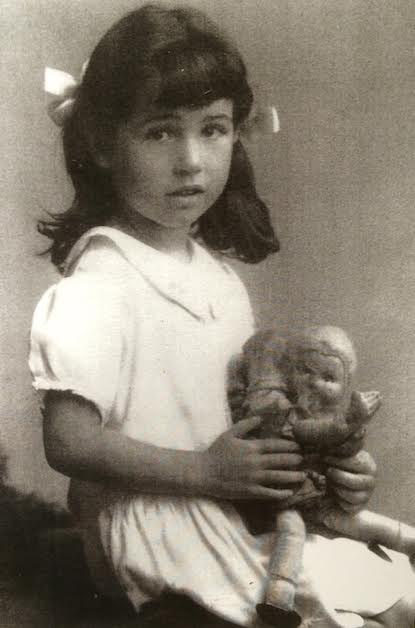
    There was a framed photograph of me on the kitchen wall. Thick dark hair cut straight across my forehead, dark eyes, my neck and shoulders fading away. I looked at it often, wondering when my arms and the rest of me grew. And there were other memories too, like snapshots in colour, with no knowledge of what happened before or after.

    Pulling on my Wellingtons and staggering outside, very proud to have managed it un- aided, and the pain at the burst of laughter when the adults saw the boots were on the wrong feet. The grass snake in the puddle. Putting my arms round a huge, hairy, grey and white dog called Mollie. The perfect happiness of the day I was big enough to fit the blue, pink and yellow flowered sun-suit, when the big children from the farm let me join them, and we ran up a hill where sunshine streamed between the trunks of pine trees in golden columns of light.

    These older girls taught me their country games, dances and songs, some harking back to the eighteenth century: ‘Poor Jennie is a-weeping on a fine summer’s day’, a haunting tune that has stayed with me all my life, and: ‘I sent a letter to my love and on the way, I dropped it. One of you has picked it up and put it in your pocket…’

    These are some of the fleeting moments that reach back to that past more than seventy- seven years ago … ‘Time, like an ever- rolling stream, Bears all its sons away, They fly forgotten, as a dream Dies at the opening day.’

    To be continued

    Food for threadbare gourmets

    After all that rich Christmas food we needed something to re-set our digestive juices ! I craved curry, wanted something quick and easy, and also wanted to use up scraps. I only had half an onion, plenty of mushrooms, the green top of a leek, and tomatoes. Giving the chopped onion a quick zap in the microwave, I added it to the frying pan with olive oil, sliced mushrooms, the leek chopped very finely, and a couple of chopped tomatoes.

    When they were soft, feeling lazy, I stirred in a generous teaspoon of prepared garlic from a jar, a teasp of ginger from a jar, a good sprinkling of ground cumin, coriander and even more of turmeric to taste, plus a teasp of mild curry powder for good measure. When the spices had cooked for a few minutes in the oil, I added water, and let the mix boil … after tasting, I added a generous dollop – a heaped tablespoon – of ginger marmalade to take the sharpness off the curry and a good squirt of tomato paste from a tube. After letting all this gently simmer, I added some cream before serving, but another time would try yogurt.

    We ate it with dahl – lentils – and a hard- boiled egg each. I couldn’t be bothered to cook rice as well, but the lentils soaked the curry up instead. This quick simple economical vegetarian curry was even better when it had mellowed the next day, when we had it again…

    Food for thought

    The dedicated life is the life worth living. You must give with your whole heart.

    Annie Dillard – American writer and mystic

  • Let them eat ( Christmas ) cake!

    Image result for christmas cake images free Poor Marie Antoinette. She never said it. But she’s suffered from that blighting propaganda ever since. What she needed, and still needs, is a good spin doctor to right her dreadful wrongs, but until she gets one, her name is indelibly associated with cake. (She was actually a devoted and intelligent mother, and I think I’d have gone mad if I’d been her, and known of the barbaric treatment the revolutionaries meted out to her eight- year -old son after she was beheaded during The Terror. Her son died two years later, by then completely mute, disease-ridden, covered in scars from beatings, and unable to walk. The past was sometimes as cruel as the present…)

    But to return to the subject of cake. In the days when a woman’s place was in the home, and preferably in the kitchen, cake was part of that equation. I grew up in the fifties when women were still supposed to be there, and watched my stepmother struggle with the expectations around cake in those days. Her steak and kidney puddings had to be tasted to be believed, her steak pies with perfect pastry were sumptuous, as were her heavenly steamed ginger puddings and apple pies, but cakes were not her thing.

    The pinnacle of cake-makings skills back then was the Victoria sponge. A pretty boring version of cake, and now long out of favour, but back then, the classic Victoria sponge was a firm cake cooked in two tins, and glued together with raspberry jam, the top sprinkled with icing sugar. Simple, but like all simple things, more difficult than it looks.

    I would come home from school in the afternoon, and find my stepmother had had another go at a sponge, and was pretty down in the mouth, because as usual, it had sunk in the middle. As much as we were allowed to do, I fell on these failures, and revelled in the sunken, soggy, sweet middle – the best part of the cake, I thought. Sadly, years later, I discovered that my stepmother thought I was sending her up when I enthused about how delicious it was.

    A few years later, living in Malaya, she was rescued from the kitchen by an amah who certainly didn’t bake cakes. Instead, like every other amah, she delivered a tea tray with rich tea biscuits and tiny Malayan bananas to the bedroom every day at four o’clock, to wake the dozing memsahibs from their afternoon rest in the tropical heat. With the pressure to produce the perfect sponge lifted from her shoulders, my stepmother began to be more interested in cake, and one holiday I came home from boarding school and was invited to experiment with making something called a boiled fruit cake – no creaming and beating, just a bit of mixing and boiling before baking.

    So began the process of producing a cake in the tropics in the fifties. First the flour had to be sieved to get the weevils out. Every egg had to be broken into a separate cup to make sure none of them were bad, as indeed, many of them were. The rest of the makings came out of the food safe, which was a primitive cupboard made with wire mesh to ensure some movement of air in the sticky heat. It stood on legs two feet off the floor. The legs were placed in used sardine tins or similar, which were kept filled with water, to deter ants from invading the food.

    The cake was simply a mix of all the ingredients and then baked. It wasn’t just soggy and sweet in the middle, it was soggy and sweet all through – just my sort of cake.

    When I had my own kitchen, my ambition to eat cake was permanently at war with my determination never to get bogged down with the hard labour of creaming and beating that seemed to be involved in making a cake. But I found a temporary solution in the first months of my marriage – a cake that didn’t even have to be cooked – it was made from mostly crushed biscuit crumbs, melted butter and chocolate and finished off in the fridge. It was even a success with an old school friend who’d mastered the whole baking thing, and could even do a crème brulee.

    But the real break-through came when reading the old Manchester Guardian, as it was called back then. Highbrow though the women’s pages were, Guardian women were not too cerebral to eat cake. And hidden away one day in a sensible article on cakes – nothing frivolous, just egalitarian, down to earth, common sense advice – I found the answer to cake-making. Instead of creaming the butter, or beating it with the eggs or the sugar, all we had to do was MELT the butter and stir it in.

    This simple technique I applied to chocolate cakes, lemon cakes, you- name- it cakes. It‘s carried me through a life-time of eating cake and I’ve never even considered making a Victoria sponge.

    But now I have another triumphant addition to my cake making repertoire – just in time for Christmas too. The NZ genius known as Annabel Langbien, who invented the three ingredient scones I wrote about, has also invented the three ingredient Christmas cake. This of course, is meat and drink to me, though being the over-the top person I am, (if half is delicious – twice as much must be twice as delicious!) I did actually embellish this gloriously simple recipe.

    1kg mixed dried fruit, 2½ cups (600ml) milk or almond milk, 2¾ cups self-raising flour , 1 tbsp sherry, rum or whiskey, to brush (optional)

    icing sugar, to dust (optional)

    Place dried fruit in a bowl, cover with milk and leave to soak overnight in the fridge.

    The next day, preheat oven to 160°C and line a medium (23cm diameter) springform cake tin with baking paper.

    Stir flour into fruit mixture until evenly combined and smooth into prepared tin. Bake until it is risen, set and golden and a skewer inserted into the centre comes out clean (check after about 1¼ hours and return to oven for a little longer if needed). Remove from oven and, while still hot, brush with sherry, rum or whisky, if using. Cool in the tin before turning out. Stored in an airtight container, it will keep for 3-4 weeks.

    My embellishments included soaking the fruit in brandy and lapsang souchong cold tea, using a cup of almond meal and one and a half cups of flour…plus a cup of melted butter, cup of brown sugar and three beaten eggs…then I couldn’t resist adding a teasp of vanilla essence, plus two teasp mixed together of nutmeg, cinnamon and mixed spice – and then a good table spoon of golden syrup… (still simple, No creaming beating etc – just all mixed together and utterly delicious).

    I ‘m also thinking of going the whole hog when I unwrap it to eat, and layering on apricot jam to hold some marzipan, and icing on top of that. Otherwise I would arrange crystallised ginger on the top before baking.

    I also cooked the cake very slowly, for far longer than Annabel suggests – wrapping the tin in layers of thick brown paper.

    I wrote the first half of this blog on 5 June 2012… but thought I must share the updated version with this blindingly simple recipe for Christmas cake.

    Food for thought

    Thought control is the highest form of prayer. Therefore think only on good things, and righteous. Dwell not in negativity and darkness.

    And even in those moments when things look bleak – especially in those moments – see only perfection, express only gratefulness, and then imagine only what manifestation of perfection you choose next.

    In this formula is found tranquillity. In this process is found peace. In this awareness is found joy.

    Donald Neale Walsch Conversations with God Book 3

  • The present needs the past

    Illustration from the post “The present needs the past”

    I began sorting through drawer loads of recipes collected since the early sixties. I’ve dragged them around more twenty- six homes and three countries, and frequently can’t find the one I want; and though I try to keep my favourites altogether, they still stray into other collections of ‘intending to try’, and ‘must try’. After hours spent sorting them into piles, and several rubbish bags filled with the unwanted trimmings of yellowing newsprint and magazine borders, I realised that this truly was what is called a back-breaking job. I hadn’t even handled a quarter of the clippings.

    Method: sort through the whole lot, putting them into cake, pudding, pasta, rice, chicken, fish piles, soups, salads, suppers, savouries, sauces and so on. Then sort the piles, throw out the duplicates, and trim yet again, to fit into scrapbooks, and stick them in. The cake book was huge, almond, fruit, lemon, plum, rhubarb, apple, madeira, chocolate, coffee, the whole nine yards. It has taken me days to get this far.

    The interesting thing is that I recognise most of the recipes, know where we were living then, and even remember with many of them, how and when I tore or cut them out, right back to 1964, when we were living in a country house called Newney Hall in the hidden country-side of Essex.

    I can remember many of the dinner parties and the people who were there and the menus. Crocenbouche in the height of a Hongkong summer, with no air-conditioning in the kitchen, dripping with sweat, as I baked choux pastry balls, whipped up cream with cointreau, and made the caramel to dribble over the pyramid of puff pastry balls. Biskotten torte, a Danish coffee and walnut confection which could be made a week beforehand, given to me when I was engaged, by my stepmother’s best friend, staying with them in Shrewsbury; vol-au-vent, one of my father’s favourites, and mint and orange salad, a Robert Carrier special from the then new Sunday Times colour supplement.

    Then there were the handwritten ones, salmon slice from Jenny, fruit cake from some people who read my columns, and who delivered a cake personally – then a recipe which the children still hanker after – a vegetarian meat loaf, made principally from pea-nuts, garlic, carrots and herbs, this sent by a reader in Tauranga, after a column on vegetarianism – Marianne’s beetroot relish, Frances’s apple cake, Evelyn’s strawberry jam. So the whole exercise raked over old memories, stretching back for fifty years. Many of the favourites had greasy or jammy finger-marks all over them, splotches of grease, or wine-stains!

    I now have three thick scrapbooks catalogued into easily discovered sections, and decorated with beautiful pictures of food, fruit or vegetables cut out from magazines, and when I need a new idea for a meal, I go to leaf through them, and find something to inspire me.

    In another day and age, I would have bequeathed them to my daughter, and they would have become family heirlooms like the treasured notebooks in browning spidery hand-writing of previous generations. But alas, already, even I now go to the internet for a quick fix on how to cook asparagus in the micro wave, and when I asked my daughter for a recipe for hot cheese scones we’d had for lunch, she sent me the internet reference.

    I have shelves of cookbooks I used to love reading, but which I rarely ever open these days… apart from Elizabeth Luard’s book on family life which includes a number of my favourite recipes, and I can’t cut them out and ruin the book, so there they stay.

    So it seems to me that my recipe scrapbooks are as obsolete as the family photograph albums. As with cookbooks, I have a shelf groaning with photograph albums. Not many from my early years, I have to admit – not much photographing went on in our family during the war, with my father overseas for seven years at the war, and my mother gone. But some from schooldays as a teenager, a precious few of previous generations – when taking a photo was serious stuff – and dozens and dozens of pictures of my children and grand- children. They and I used to pore over them when they were little, and reminisce about their childhoods. Maybe one day they would have been interested, not just in the records of their childhoods, but in the older family photos too, the records as it were, of their ancestors.

    But it’s been many years since I received any up to date physical photos of my family to insert into an album. Lots yes, on the internet, but will they still be there in twenty years? Will this generation and succeeding ones have any of the family records that we, and previous generations have had since the camera was invented by Frenchman Louis Daguerre in1838 and Englishman William Fox- Talbot in 1839? Even before then, portraits, miniatures, sketches, silhouettes provided some family records.

    But today, we seem to have lost something precious, something perhaps that we only appreciate as we get older. Young people are too busy taking their selfies, and posting on Facebook and all the other social media outlets to realise that the impermanence of this new technology has its drawbacks.

    Then, I think to myself, is it just me that sees it this way? And then another inner voice stoutly proclaims that honouring the past, recognising the lives and achievements of our ancestors matters; knowing where we come from gives us a standard to live by, a knowledge that our forbears have faced and overcome great challenges in their lives, and therefore, so can we.

    Even the trivial recognitions as we peer at good-looking Great-Aunt Jessie and recognise our nose, our eyes, and realise that we are part of a long chain of lives and family, gives us a sense of rootedness, and a feeling of permanence. Seeing faded pictures of poor Great – Uncle Arthur and remembering that he died on HMS Vanguard which un-explainedly exploded in Scapa Flow in 1917 taking him and another 799 sailors to the bottom, puts us in touch with history; learning about valiant Great-Aunt Violet who overcame childhood polio, lived with painful irons on her legs all her life with no complaint, and brought up a happy family, can inspire us to believe that we too have profound inner strengths with which to face the challenges of our own lives.

    So yes, in some ways, as I look at my proud achievement of those gathered recipes into thick scrapbooks, I feel sad, as they symbolize so many other facets of life absent in this brave new world of convenience and technology. And yes, I know too, that there is no turning back, so that like my ancestors I must make the best of it, suspecting that my descendants have no idea of what they might have lost!

    As wave is driven by wave And each, pursued, pursues the wave ahead, So time flies on and follows, flies, and follows, Always, for ever and new. What was before Is left behind; what never was is now; And every passing moment is renewed.” Ovid wrote this sometime before the birth of Christ… he also wrote that everything changes and nothing perishes – his words are my conundrum, my lesson and my answer.

    Food for threadbare gourmets

    My daughter gave me delicious hot cheese and bacon scones when I dropped in at lunch time. “Only three ingredients,” she boasted, “apart from the bacon which I added”. I couldn’t wait to try them myself! Annabel Langbein, a NZ cookery writer invented them: two and a half cups of SR flour, two and a half cups of grated cheddar cheese, and two cups of Greek yogurt, plus salt and pepper. Mix them all together, drop spoon-fuls onto a greased tray, and cook in a moderate oven for ten to fifteen minutes. Mine took a bit longer than the stated time to cook because I simply put the whole lot on the tray in one piece and cut it into triangular segments. But they were good. Next time I’ll add some chopped cooked bacon, and might add some Parmesan too.

    PS I experimented with last week’s recipe for broad beans etc, and found that by leaving out the garlic, and using nutmeg instead, it was subtler and to my taste, more delicious…

    Food for thought

    The more faithfully you listen to the voice within you, the better you will hear what is happening outside. And only she who listens can speak.

    Dag Hammarskjold Swedish Secretary-General of the UN for eight years. He died in a mysterious plane crash in Africa in 1961 at the age of forty-seven, and JFK described him as one of the greatest statesmen of our time.

  • Tour de France

    Illustration from the post “Tour de France”

    France in 1950 was unspoilt by either holidaymakers or tourists. I was there to spend a month with friends, and improve my French.

    Alex, the son of the friends, came to stay with us first, a sophisticated fourteen- year -old who bullied me, took shameless advantage of my literal interpretation of my father’s instructions to be a good hostess, and used me as dogsbody, maid and batman all in one. After one of our regular rows he came downstairs from his room and his dictionary, and in front of my parents announced to me: ” You are ‘aughty, arrogant and proud.”

    Coming from a quiet Yorkshire country town, Paris seemed a massive city of radiant light and celebration. Looking down from the family home in the heart of the city, I watched rainbows of light rolling along the wide roads, as hundreds of cars sped round the boulevards.

    Having a bath that night was an ordeal in which I seemed to be accompanied by a crowd as my reflection followed me round a huge, mirrored bathroom. The flat was empty except for a resident maid and the chauffeur who was to drive us down to the chateau. It was huge and overwhelming and Alex was more arrogant than ever. It seemed that his father hadn’t briefed him on being a good host.

    However, the next day, he and the chauffeur took me on a whirl around Paris – Notre Dame, cavernous and crowded and Catholic. I was disappointed. I had expected the sacred silence of empty Anglican cathedrals, but this was bustling with chattering people treating the place like their home, and selling souvenirs at stalls by the door. Twelve-year old-righteousness remembered stalls being overturned in another temple.

    Today, of course, every Anglican cathedral in England bustles with tourists too, the whispers and commentaries coiling up the perpendicular arches, and bouncing off the roof and coming back down magnified a million times. But in Notre Dame that day they managed to pray amidst the din.

    From the steps of the cathedral we drove past the Louvre, circled the Arc de Triomphe and ended up at the Eiffel Tower – which turned out to be closed on Sundays. It didn’t matter – Paris in summer, nearly seventy years ago, was a beautiful, fragrant city, where people lounged outside on the pavements beneath the trees, and where, when we walked beside the Seine in the sun-shine, it was uncrowded and peaceful.

    After lunch, I persuaded Alex to show me how to get out of the flat, and wandered onto the streets, looking for a bookstall. A terrible thought had suddenly wriggled into my consciousness. I had nothing to read! The worst thing that could happen to me! At a corner shop, my eyes raced over the shelves as the full horror of my situation became clear. Everything was literally a closed book- it was all in French. I came out with the only two English language publications in the shop- a copy of Life magazine, which was mostly pictures, and the August 1950 copy of Reader’s Digest, a magazine I’d never seen before.

    Though I soon became bored with its banal, monotonous, uniform prose, I read it regularly for the next month, until I knew most of it by heart. I read ad nauseam about some chap called Billy Graham and how he had met and married his sweetheart, ‘The Most Unforgettable Character I’ve Met’ finally palled, the jokes got worse as the month went by, but ‘How To Improve Your Word Power’ was a winner, I got a hundred per cent before the month was out.

    The first reading got me through the evening in Paris, and the next morning we set off for Vienne. Our destination at the chateau was everything that a romantic, unformed imagination could have visualised. We approached it down a long avenue of ancient trees. Those which had succumbed to old age had been chopped down to a height of three feet, hollowed out, and planted with foaming pink geraniums spilling out over the stumps.

    The chateau was a moated, ivy-covered, turreted, thirteenth century family home. The moat had been filled in with sand, where the smaller children played. Where the drawbridge had once been, there was now a wide bridge leading to the iron- studded front door which was always open. From the high, dark hall hung with family portraits and armour and weapons, one door led to the dining room, a very solemn place, and the other to the salon, a light, airy room furnished with a variety of gilt sofas and chairs of different periods, mirrors, and objets d’art, while at the end of the hall, a staircase rose to the family quarters.

    All seven brothers and sisters returned every summer with their families for the shooting, and they all had their own family accommodation. Alex and his family had a self-contained flat at the other end of the chateau but I was placed in one of the spare bedrooms of the main chateau, a beautiful room hung with toile de jouy in pale green with its own bathroom. The elegant, shuttered windows were hung around with more ivy, and from it would emerge huge, black, long-legged spiders, bigger and hairier than any English variety that had terrorised me in the bath at home, and which perched themselves on the mouldings in corners of the ceiling.

    The ceiling was far too high to reach with a broom and a chair, so Alex and his cousins would troop in every evening with their pop guns and have great sport shooting the hairy beasts. I went to bed every night in this gorgeous room, wondering if I would wake and find another monster had somehow insinuated itself through the shutters and into the hangings round my bed.

    Breakfast was taken en famille, and was the one meal of the day I enjoyed, though I didn’t do as they all did, and dip my buttered toast into my bowl of coffee. The bread was freshly baked and brought from the village by one of the maids when she came on duty before breakfast. In the afternoon, another delivery of fresh bread was made by a boy on a bike, and we would eat it for gouter at about three o’clock, we children standing around in the kitchen, illegally eating great slices of this heavenly bread, spread with runny home- made confiture which I called jam.

    Those were the good times. Lunch and dinner in the stately main dining room, with at least thirty of us round the enormous, oval table was a long drawn- out ordeal. No allowance was made for an Anglo-Saxon barbarian who was accustomed to eat with a knife and fork. Every course was eaten with a fork only and I fought a losing battle with pastry and delicate vegetable dishes served whole, or legs of chicken and partridge.

    My appetite would go before we began these marathon meals, so it was with no pangs that my half-eaten courses were taken away, after I had given up the struggle to keep the food on the plate while I chased it round with the fork. But then a solicitous adult, or maid serving the next course would enquire if I hadn’t enjoyed it, or try to coax me to eat a little more. Neither could I stomach the richness of it all after a life-time of grim war-time English rations.

    Every lunch time began with a slice of orange melon. In the beginning, I loved it, but by the end I could scarcely bear the smell of it when the maid placed it in front of me. No-one ever skipped or left a course, so neither could I. The melon was followed by vegetable courses or soup, and then the meat course. I hated the meat on its own without the vegetables, it tasted too rich for my austere war-time palate. After cheese and fruit, we would have what everyone else considered a great delicacy. It was called fromage blanc. It looked like whipped meringue, and we could sprinkle a little sugar on it to mask the sourness. I could barely swallow it without retching.

    Dinner was a variation on lunch, but whereas after lunch the adults retired to snooze in the hot afternoon, after dinner, we all trooped into the salon. Coffee was served in exquisite little coffee cups, and the children had to sit and make polite conversation until we younger ones were sent to bed.

    I had a particular friend, one of the cousins, the same age as me. She spelt her surname for me and wrote it down with pride, telling me she had a very proud surname. She was right and it was only years later that I recognised it as one of the great names in French history. Josephine and I had very little of each other’s language but we made it work for us.

    She took me with her maid to pick champignons one misty morning, and as the sun rose, the mist rolled away, and revealed a field of tiny, blue flowers shimmering with hosts of tiny, iridescent blue butterflies the same blue as the flowers. The dusty, country lanes were festooned with sweet, juicy bunches of blackberries as big as grapes, and everywhere there were shrines and crucifixes.

    We played tennis together on the court set a little way back from the chateau. In the afternoon when the adults and toddlers were resting, we were roped in for deadly games of croquet on a long lawn well away from the shuttered windows where dozing parents wouldn’t hear the vicious battles and bullying of the victors, and tears and tantrums of the defeated. The girls were mostly the defeated. I tried desperately to hold back my tears as my ball disappeared regularly into the rhododendrons. They were all such terrible sports I felt it my duty to try to maintain the Anglican tradition of good sportsmanship, but my sang froid crumbled very easily.

    Other days, we were lined up for the partridge shooting, and issued with white rags on sticks. We then had to advance in line across the vine yards and fields, driving the birds in front of us in the cruel time- honoured method. I did it without a pang, because I had no idea what we were doing, since the instructions were in rapid French. It wouldn’t have made any difference if I had understood, I was too handicapped by trying to be a good guest to voice any objections.

    It was fun of course. We grabbed bunches of purple grapes to stuff into our mouths as we advanced slowly, and then dropped them as we came upon a bigger and better bunch a few yards on. When the shoot was over, we children were transported to the chateau whose land we were shooting over. There were four or five other chateaus within a few miles of our village, several which I could see on the sky-line – romantic and elegant eighteenth century pavilions.

    On one day after tumbling around and sliding down the hay in the barns, frightening the hens, we were taken to clean up, and then ushered into the salon for afternoon tea. I was fascinated, for not only was our hostess beautiful, but so was the room. Whereas the salon at Persac was a higgledy-piggledy mixture of French furniture of different styles which had simply accumulated over the centuries in order to seat the family, this was a room with great style and elegance, even to my ignorant eyes.

    The colours were clear, pale pastels, with gleaming gilt or pale, painted furniture. The portraits were not heavy oils, and sturdy worthies, like Persac, but delicate, gilt- framed frivolous likenesses, and translucent miniatures. The chairs and sofas and gilt tables were arranged with a wonderful sense of symmetry. There were flowers everywhere and big windows with the light streaming in – I fell in love with the place. I wanted to ask them how come they hadn’t they been obliterated in the French Revolution and the chateau destroyed? How come you got away with it, I longed to ask, but didn’t dare.

    These people were cousins, as were all the people in the neighbouring chateaux, but they had quite a different atmosphere to the rather provincial heaviness of Persac. I was sad to go back to the ivied, spidered chateau. But it was necessary. I was secretly feeding the farm dog, who slunk around the farm yard some way away from the Chateau, but within the grounds. It was a real French farm yard, with ducks and geese waddling around, a dung heap and a fetid pond, chickens clucking over their new laid eggs in the hay filled barns, and an assortment of cows, pigs and horses.

    Patou, the starving farm dog, seemed the only animal who wasn’t looked after, presumably because he wasn’t intended for eating. The maids in the kitchen let me have a few stale crusts, and I lobbied them every day for more for the poor creature. Patou – which the mads said meant ugly – was the first of many animals who have ruined my holidays.

    One afternoon I was herded with the other children into the narrow grey cobbled streets of the village at the gates of the chateau. The whole village seemed to be standing there, including old ladies dressed entirely in black, and others who leaned out of shuttered windows overlooking us. As I stood there feeling bewildered, a column of bikes suddenly hurtled past us to the cheers and waves of all the spectators. That, I was proudly informed, when they had passed, was the Tour de France. No outriders, no loudhailers, no crowd control, no yellow jerseys – just tanned -looking men on bikes pedalling hell – for- leather.

    Shortly after, I caught an early plane back to London, driving through grey, early morning streets of Paris craning to see elegant ladies of fashion. ” There weren’t any,” I told my parents disgustedly. My stepmother pointed out that they hadn’t even woken at that hour in the morning, and all I had seen was people going to work. This was my tour de France.

    Food for threadbare gourmets I love cake, but if I’m making one myself it has to be easy. So this recipe which I found years ago was perfect. It’s called Hurry-up coffee cake and uses left-over percolator coffee. I particularly love coffee and walnut cake with lashings of coffee icing…

    In a large bowl put one and a half cups of self -raising flour, two table spoons of cornflour, a good cup of brown sugar, 125 grammes of softened butter, half a cup of strong black coffee, two eggs beaten, a few drops of vanilla, and three quarters of a cup of chopped walnuts. Beat all this together until smooth, spoon into a greased cake tin and bake in a moderate oven (180C or 350F) for thirty minutes. When cool, cut in half and spread with coffee icing – a cup of icing sugar, two tablespoons of softened butter and one tablespoon of strong black coffee.

    Food for thought

    “And remember, as it was written, to love another person is to see the face of God.” Les Miserables by Victor Hugo

  • The necessity of beauty

    Image result for images of gardenias Image result for gardenias

    Pamela was my lodger. She was living in the third bedroom in my flat for the same reasons that Mr Micawber pronounced the immortal words:” Annual income twenty pounds, annual expenditure nineteen pounds nineteen and six, result happiness. Annual income twenty pounds, annual expenditure twenty pounds nought and six, result misery.”

    I’d tried to fill the gap between my meagre salary (women were paid far less than men in the Hongkong I lived in ) and my expenditure, by doing TV quiz shows, radio programmes, using the children as photographic models and even doing PR for the Anglican church until I could stand being hypocritical no longer. So Pamela was my next attempt at solvency. While she lived with me my life was filled with her dramas, love affairs, crises and disasters.

    She arrived with one fiancée, dressed demurely in twinset and pearls, tweed skirt and silk head – scarf. Soon she found a more exciting prospect, and changed her style to newly fashionable jeans, her hair swung up into dashing styles and lots of makeup. The new fiancée lent her his new VW while he went back to England to sort out his divorce, and hereby hangs the tale. Pamela rolled the car her first night in possession of it, and I was awakened in the middle of the night by a Chinese policeman who couldn’t speak English.

    I pieced together that Pamela had had an accident, and was in a Chinese hospital since she had no insurance to cover her for a European one. The next morning the children, four and five years old, and I, packed up a few things for Pamela and made an expedition to the enormous building which housed some thousands of sick and penniless Chinese.

    We found our way through a maze of corridors to Pamela’s ward, and by the time I reached her bed I was deeply shocked. The ward held eighty women. They were all dressed in faded brown cotton shifts including Pamela. The noise was horrendous. Cantonese is the noisiest language on earth. To hear our amah chatting to another outside the kitchen was deafening. To hear seventy- nine women chatting in a confined space was probably higher than the safe decibel level.

    Pamela was bruised and shocked but not injured. After doing our duty, and promising to return that afternoon with more things she wanted, the children and I went home, leaving her with a little bunch of gardenias I’d picked. Only six blossoms because that was all that were flowering.

    When we returned in the afternoon, something had changed. There was a hush in the ward and a sense of peace, and all eyes were on the gwailo (long- nose) and her children. Being watched was something one accepted as part of life then, but this felt different. And the hush was a sort of reverence. Pamela whispered to me what had happened after I left.

    When we walked out of the ward, the women came crowding round her to see the flowers and smell the fragrance. They were ecstatic at this exquisite beauty in their harsh unfriendly environment. Deprived as the women were, of all colour and texture and smell and beauty, the flowers brought something like heaven into their lives.

    They didn’t speak English, and Pamela didn’t speak Cantonese, but with the aid of the ward sister’s few words of English, they worked out a roster for the flowers. Each woman would have one gardenia by her bed-side in a glass for three hours in every twenty-four. Pamela had one all the time, and the sixth flower which had fallen off its stem, the ward sisters had in their office, floating in a saucer.

    Back at the office the next day I rang the dean of the cathedral and several hotels and they agreed to send their flowers to the hospital whenever they changed them. I wonder if they still do.

    The great Catholic thinker Monsignor Hildebrand wrote that: ‘the poor need not only bread. The poor also need beauty’. But it’s not just the poor. We all need beauty.

    It’s strange to me that Abraham Maslow in his hierarchy of vital needs didn’t include beauty. Sometimes beauty is the the only thing that keeps us going. As Resistance fighter Odette Churchill was being locked back in her cell after a bout of torture by the Gestapo, she snatched up the skeleton of a leaf being blown in the door with her. The beauty of that leaf sustained her and gave her hope and courage and a belief in goodness that carried her through her dreadful ordeal.

    Quaker writer, Caroline Graveson wrote that: ‘There is a daily round for beauty as well as for goodness, a world of flowers and books and cinemas and clothes and manners as well as mountains and masterpieces.’ She talked of beauty: ‘not only in the natural beauty of the earth and sky, but in all fitness of language and rhythm, whether it describe a heavenly vision or a street fight, a Hamlet or a Falstaff, a philosophy or a joke: in all fitness of line and colour and shade, whether seen in the Sistine Madonna or a child’s knitted frock…’

    The sad thing is that those deprived Chinese women in that joyless hospital ward, came from a culture, which before the blight of industrialisation and the tyranny of plastic, was incapable of producing anything that wasn’t beautiful – from their baskets to their bowls, to their porcelain and their poetry. And there was something very beautiful about buying a kati of vegetables in the markets and watching them being skilfully wrapped in a beautifully folded sheet of re-cycled Chinese newspaper, or a large leaf, and tied with a knotted reed.

    Perhaps their own sage should have the last word, Confucius said that everything is beautiful, to those who can see it….

    I published this post nearly four years ago … it’s one of my favourites and many readers will have forgotten it, or never seen it….

    Food for Threadbare Gourmets

    I needed a quick pudding for unexpected guests, so I took out of the deep freeze a couple of brioche I’d stored for such an occasion. Once thawed, I gently fried them in butter, then made a sauce with rum and brown sugar, and poured it over the brioche. I served them hot with whipped cream, and though not rum babas, they tasted almost as good.

    Food for Thought

    People travel to wonder at the height of mountains, at the huge waves of the sea, at the long courses of rivers, at the vast compass of the ocean, at the circular motion of the stars; and they pass by themselves without wondering. St Augustine 199 AD