Category: Memoir & Family

  • The gifts that keep on giving

    Illustration from the post “The gifts that keep on giving”

    I’m always slightly envious when people reminisce lovingly about their mothers, since mine disappeared when I was six, not to be found again until I was in my fifties when it was too late to rebuild bridges.

    But when I look back over my memories of the gifts that different people gave me, I realise that my rather erratic mother gave me a gift that is still valuable today. My earliest memories of her are the songs she sang as I went to sleep. I didn’t hear them again for years, but recognised them as soon as the notes rang out…among them, ‘Where the bee sucks, there suck I’, and ‘One fine day,’ from the opera Madame Butterfly, and even: ‘You are my sunshine,’ a pop song from the forties that moved me to tears when I heard it again in middle age.

    That gift – a love of good music – has been my pleasure and companion ever since, so I was ripe for Beethoven and Bach, Handel and Purcell as soon as I heard them when growing up, while opera became a passion, which I learned when I met her again, had also been a passion with my mother.

    As I mused about this gift she gave me, I remembered all the other gifts that so many other people gave me. When my grandmother came to look after us, she brought with her, her collection of precious Meissen and Staffordshire china, and I learned to love china, a love which anyone visiting my house would recognise.

    She also collected books, and many of them were illustrated and designed with prints and patterns from William Morris and fine artists like Aubrey Beardsley and Arthur Rackham, so that from the age of six, my eye was educated by their exquisite artistry.

    This discrimination meant that when I was introduced to Walt Disney – staple children’s fare – I found the cartoons crude, and the lack of light and shade and detail bored me.

    The other gift my grandmother gave me was the love of reading, and for lack of children’s books, I devoured classics like ‘John Halifax, Gentleman’, ‘Robinson Crusoe’ in an original edition, a huge heavy book with engravings protected by flimsy tissue paper, the dreadful ‘Foxe’s Martyrs’, ‘Pilgrim’s Progress,’ ‘Gulliver’s Travels’ – all these in magnificent antique quarto versions, apart from many other history books and even the Bible.

    A man gave me my next gift, a dry, elderly, retired history teacher who had taught in boy’s prep schools all his life, and who came to help out at my little private school during a war-time dearth of teachers. At seven, he introduced me to history, and I soaked up every period he ran through with us, from the Beaker people and the Stone Age, to Julius Caesar and the Romans, Boadicea and Caracticus, Pope Gregory on captured Anglo-Saxon children with blonde hair and blue eyes, dragged through Rome in triumphal marches, saying, ‘Not Angles but angels,’ Alfred the Great, and Aethelred the Unready, Harold and the Conqueror, the Black Prince and English archers, and all the march of history up to Agincourt and Henry V.

    Living in Yorkshire when the war was over, our gardener, Mr Appleby, took a fancy to me, and spent much time teaching me the names of all the flowers…hearts-ease and snow-in-summer in crevices amongst paving stones, the herbaceous borders crammed with red hollyhocks, blue delphiniums and pastel pink and blue lupins, ravishing red peonies and pastel coloured grannie’s bonnets, multi-coloured snapdragons and delicious sweet smelling pinks, the rose Dorothy Perkins scrambling over the trellis hiding the dust-bins … I revelled in this knowledge and his gift to me.

    We didn’t go to school while we were in Yorkshire, and had lessons at home in the afternoon. My new stepmother, who was a physiotherapist and had no idea of how to teach children – or how to bring them up for that matter – gave me an extraordinary gift, apart from teaching me social skills, and that was how to spell. She demanded that at nine I could spell words like phlegm and diarrhoea, rhododendron and diaphragm. This is a gift that keeps on giving, like all the gifts that these adults gave me.

    My father returned from the war in ’47, when I was nine, and his gift was to give me all the books he had enjoyed, so I went from a diet of Lord Lytton and books like ‘Harold’ (killed at Hastings) to Kingsley’s ‘Hypatia’, and ‘The Last Days of Pompei’, to Walter Scott’s ‘Ivanhoe’ and ‘Guy Mannering’ ( “go thy ways Ellangowen, go thy ways”… cursed the gypsy) and Napier’s history of the Peninsula Wars with Wellington, to CS Forester’s riveting: ‘The General’, about the First World War, and many more. Enid Blyton and Rupert the Bear were banned !

    When I was ten and eleven years old I was put in a train from Yorkshire to Kings Cross, to spend a couple of weeks of the summer holidays with my step-grandparents. My grandfather took me walking around London nearly every day. We explored places like Threadneedle Street and the City, tramped down Constitutional Hill and through Hyde Park Corner, passing No I Piccadilly – Apsley House – the Iron Duke’s home, as well as the King’s home – Buckingham Palace (still George VI then).

    We spent blissful hours loitering in front of Duccio, da Vinci and Van Gogh in the National Gallery, and wondering over the Turners in the Tate, gazing at all the statues of historic figures, from beautiful Nurse Edith Cavell at Charing Cross, to tragic Charles I, examined the famous poets and painter’s monuments in Westminster Abbey, and climbed around inside the dome of St Pauls. London was still the bombed, shabby city of the Blitz, with rose bay willow herb flourishing on empty desolate sites. But I know that great and ancient city more intimately than any other. And I have known my way around it ever since.

    The following year I went on another solitary journey via Air France to spend the summer with French friends in their chateau in Vienne. There, the gift was an insight into French food and French architecture… while my first mother-in-law, a fearsome lady, was a talented amateur interior decorator. From her, I absorbed a knowledge of antiques, a love of colour, fabric and design and have enjoyed restoring and decorating houses ever since.

    As I look back at all these gifts, which have enriched the fabric of my life, expanded my mind, and given me pleasures that never fade, I realise how blessed I’ve been. I’ve had many vicissitudes, bitter sorrows, painful partings, terrible decisions to take, and terrifying leaps off that metaphorical cliff in my life. But I’ve also had some sweet joys and learned how to be happy. And the music, the books, the flowers, the history, the beautiful china are all extra gifts that have made life rich and bearable in the bad times.

    I wonder what gifts I’ve been able to pass on to those both near and dear, and even just to those casually encountered. We all have such rich gifts to share with others, and sometimes we do it knowingly, and other times, unconsciously. This is how our civilisation endures, and is handed down from every generation.

    And maybe it’s more important than we know… the handing on and handing down of simple pleasures, facts and names, skills and events… these things are the handing on of our past, the hard-won experience and knowledge of our ancestors, and even of the fabric and treasures of our civilisation. That civilisation is changing fast, but it could go into future shock unless we value the past as well as the future. The gifts we can share may be more valuable than we can ever guess or measure or imagine.

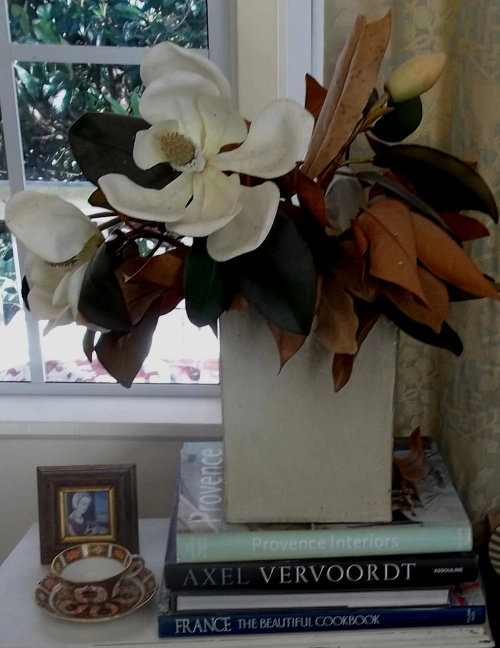
    Footnote. I took this picture for a blog several years ago. It illustrates perfectly different strands of my life.. the flowers are magnolias, the books are on France and French food, Axel Vervoordt is a famous Belgian interior decorator, the china is antique Crown Derby Imari, while the portrait in the tiny frame comes from the medieval Book of Hours.

    Food for threadbare gourmets

    It’s that time of year here in the Antipodes when the delicious Victoria peaches are available. I always snap them up. I don’t bottle any more, I freeze them instead. They have a different texture but are just as good. Being a lazy cook too, I just take out their stalk and then boil them whole, with a syrup made of water, stevia to taste, and a few star anise and a stick of cinnamon. When the peaches are soft I leave them to cool before parcelling them out into various plastic receptacles (I know, I know, sometimes we have to live with parabens!)

    When I want them, I un-freeze them, and gently re-heat them with some brown sugar or maple syrup, and ginger wine, rum or brandy added to the syrup… served with ice-cream or crème fraiche, a whole peach drenched in the unexpected flavours of the syrup is a good easy pudding.

    Food for thought

    “There is divine beauty in learning… To learn means to accept the postulate that life did not begin at my birth. Others have been here before me, and I walk in their footsteps. The books I have read were composed by generations of fathers and sons, mothers and daughters, teachers and disciples. I am the sum total of their experiences, their quests. And so are you.”

    Elie Wiesel, writer, academic, activist, concentration camp survivor and Nobel Laureate

  • Rubbing shoulders with the rich, the famous, and the forgotten

    I wish I could remember what Dr Seuss said when I was interviewing him back in the late sixties. (I’ve never kept clippings of my articles, which I sometimes regret)

    All I can remember at this distance is his shining energy, his charm, good looks, good humour and integrity. I know we talked about his books – my children were young fans of four and five at the time – and how this childless man tried to give a subliminal positive message in many of his stories, like: “trust yourself”, or “be kind to everyone”.

    Then there was the other doctor – Doctor Spock. At a moment’s notice, I was sent out to interview him, along with the newspaper’s star writer … the editor suddenly had a brainstorm and thought he’d like a different angle from a practising mother! No time to do any research. And now, how I wish, thanks to Google, that I had – he was so much more than his famous child- rearing book, a radical and protester at the time of the Vietnam War amongst other things.

    When I had finished my probably rather pallid interview, Dr Spock’s gentle, lady-like wife took me aside, and asked me to interview her, to my amazement. I did, and listened to a hurt, angry woman, who said that her husband’s great reputation was based on her hard work bringing up their sons practically alone, while he picked her brains and dispensed her wisdom/experience from behind his desk. I couldn’t write this, and wasn’t surprised when they divorced a few years later.

    Then there was the inimitable Barbara Cartland, who took me to her bosom when I told her that one of my best friends, John, was her son’s best friend, who she was devoted to. Her son and John had been at Harrow together, and when John married she lent him a cottage at the bottom of her garden. (with no plumbing)

    As she roamed around her hotel bedroom talking animatedly, I decided that her crusade about honey and vitamins must work, she was so lithe and her movements so youthful at seventy-four. She was still writing prolifically her romantic novels, which she told me laughingly had their biggest sales in India.

    When she died at ninety-nine, she had had over seven hundred bodice-rippers published, and left the manuscripts of a hundred and fifty more, which her sons are releasing as e-books every month. She wasn’t just a one trick pony though, one of her interests being gliding, and back in the early thirties she invented the idea of them being towed for long distances which led to troop carrying gliders. Later she was awarded a medal by the flying industry.

    When her daughter, Lady Dartmouth – not yet married to Lord Spencer and so becoming Princess Diana’s stepmother – came to Hongkong, she was just as kind to me as her mother had been. She was a ravishing beauty with the kind of porcelain pink and white complexion and huge blue eyes that actress Valerie Hobson also had. (both utterly charming and beautifully mannered)

    My interview with Raine, Lady Dartmouth, (known as ‘acid -rain’ by Diana and her siblings) was not as predictable as many others. I had some juicy material to work with, like her famous scene at Heathrow airport over dirty tea-cups in the restaurant, her campaign to save Covent Garden, at twenty three being the youngest County Councillor for Westminster, and becoming a member of the United Nations Conference on the Human Environment. A life less ordinary than the traditional fashionable life with ladies who lunch.

    Iris Murdoch, famous author, was another interesting person to interview. I did so where she was staying and met her donnish husband – played so beautifully in the film ‘Iris’, by Jim Broadbent – after she had died of Altzheimers. Being young and crass, I wondered how such a plain woman could have found such a devoted husband, and only later discovered that not only she did have lovers male and female, but that her fierce intelligence was as sexy as a pretty face!

    It was with great trepidation that I approached Robert Helpmann, the famous ballet dancer, producer, and great talent. I had been terrified by him in the famous film: ‘Tales of Hoffman’ as a child, and could never get his Mephistophelian power out of my mind as he flicked his long, black velvet cloak with its long tassel out of the door… even the tassel seemed to convey malice.

    With no Google in 1969, I had no idea that he had started his career in the legendary Anna Pavlova’s company, but at least I knew that in the ballet world he had an enormous reputation. He was a delight – elegant, kind and charming – and even gave me advice about my ballet-mad daughter… don’t let her start until she’s at least eight, and no en point until after fourteen.

    So many fascinating people … from princesses to prime ministers … feminists and activists. Princess Alexandra, the Queen’s cousin, appalled that I was a single mother. “How do you manage? ” she asked… presumably because as well as no husband, I had no chauffeur, nanny, cook, housemaid, butler, or gardener! She was exquisite and elegant in a pale lavender suede coat and matching lavender wide brimmed hat… the Maori Queen, a plain, ordinary woman who grew into a beautiful, wise one; a glamorous, blonde Italian round-the-world yachtswoman, a Polynesian prime minister’s wife; a glorious Indian woman with yard-long black hair that hung loose, vivacious and intelligent, her greatest claim to fame being lover of racing driver Stirling Moss – then a household name – now, like so many of these people – forgotten.

    And yet, of all the people I met and interviewed, the one I treasure most is another forgotten name now, even by the organisation he helped to found. On a cold, wet Sunday afternoon in June 1972, I went down to Westhaven marina in Auckland, at the request of Quaker friends.

    Leaving the children in the car with snacks and books, I threaded my way along the gang-planks to the 38 foot yacht, Vega. On it, I met David McTaggart, one of the founders of Greenpeace, just setting off on his historic journey to Mururoa to protest against the French atomic tests. He was in a great hurry, loading last minute supplies before setting sail, but we did it, and I gloat that that was one of the first stories about Greenpeace to get into print.

    McTaggart was a hero… in spite of their unwanted presence and refusal to be bullied away, the French set off the deadly bomb anyway. The following year when he returned, they beat him so savagely that he lost the sight in one eye for several months. That story went around the world. And yet these days when I am approached outside the supermarkets by eager young enthusiasts to get me to sign up for Greenpeace, they’ve never even heard of David McTaggart.

    Meeting such people was one of the special privileges of being a journalist, but so often, as a single mother I didn’t make the most of such opportunities, being too pre-occupied with how to make ends meet, or if the amah would remember to meet my tiny daughter from the school bus. These were not celebrities in today’s use of the word, but people of character and substance who had carved a niche for themselves, and by their talent or originality become well known.

    I look back to my young, ignorant self and cringe. If only I had known then what I know now. And I also look back and see these people so differently… I understand more about them as I understand more about myself. If only I had had the ability then to really do them justice. This feels familiar – of course – it’s what most parents say about their parenting – if only I had known then what I know now!

    Greater understanding, insight, knowledge – even wisdom – are gifts we acquire if we’re lucky, as we grow older. Yet it’s when we’re young that we have to step up, and so often blunder blindly into the unknown, sometimes realising fearfully that we don’t know, or often, thinking we know better.

    So now, new generations and bright young people are setting off on their own journeys to follow their own dreams, and they will find their own heroes – talented innovators, creators and explorers in their brave new world. Some of their heroes will become rich, some will become famous, and many of them will inevitably be forgotten … and like the heroes of my day – in the words of Ecclesiasticus – they too will have no memorial.

    Food for threadbare gourmets

    An unexpected gathering of the neighbours for drinks the next day, and no time to do a dash into town, half an hour away, to find something to take with me. Remembering an intriguing recipe for sardines I’d used years ago, I rummaged in my store cupboard and found two tins of sardines in olive oil, and then rummaging on the internet for a recipe for sardine pate spread, I found a blog by someone called Manami. I’m grateful to her for digging me out of my hole.

    Picking out the little silver bits and bones, I drained the sardines and mashed them up with two tablespoons of mayonnaise, two teaspoons of finely chopped onion, quarter of a teaspoon of Dijon mustard, a teaspoon of lemon juice and a teaspoon of black pepper.

    Apart from sprinkling it with chopped parsley, that was all there was to it. Served with small cracker biscuits – I used rice crackers, they filled a need.

    Food for thought

    The Highest Thought is always that thought which contains joy. The Clearest Words are those words which contain truth. The Grandest Feeling is that feeling you call love.

    Joy, truth, love.

    These three are interchangeable, and one always leads to the other. It matters not in which order they are placed.

    Neale Donald Walsche. Conversations with God Book I

  • Ode to friendship

    Wherever I look there are the tokens, and maybe calling them tokens is a misuse of the word.

    On the bookcase is a round blue stone, and written on it are the words: ‘ In the bonds of love we meet,’ which are lines from the NZ national Anthem. It was a birthday present from Friend, which is what I Ching calls a person who is in a ‘familial or love relationship’.

    In a fat white jug with all my pens is a sandalwood fan, sitting there at the ready to be used when needed… my Friend brought it to choir practice on a baking hot evening nearly twenty years ago – the sort of evening when we all melted in the airless church hall as we practised our Hallelujahs, or softer Bach anthems. On this day, she produced the fan to keep me cool.

    By the bedside is a long thin delicate bamboo stick with a hand at the end with claws on it – a Chinese back scratcher – in constant use by my love. This is the relic of a Christmas lunch thirty years ago. A gang of us used to meet for Christmas lunch in the park, taking over the beautiful little band rotunda, and bringing lace table-cloths, silver candlesticks, champagne and the works.

    We started a ritual of bringing presents for everyone, and they could cost no more than two dollars… a tiny amount even in NZ currency. All year we subconsciously looked for some delicious little token, and this was Friend’s gift one year, practical and treasured ever since.

    In hospital, an hour and half drive from her home, she and her husband visited me, bringing gifts … a sheepskin to lie on and ease my discomfort, a bag full of miniature bottles of wine – a glass and half to each one – for me to sip with my fairly dreary suppers… an orchid so beautiful that everyone who came by, stopped to admire – it made me many friends… lanolin to rub on my face so my skin wouldn’t dry out in hospital warmth, fluffy red, possum-wool slippers with non-stick soles for my cold feet, vitamin C capsules to aid my healing, and most delicious of all… I had said I wished I had asked my love to try and find my magnifying mirror as I was beginning to look like Freida Kahlo, so a splendid magnifying mirror on a stand came with all the other goodies.

    We have been together at births and funerals, personal growth courses, anniversaries and jolly parties. Best of all have been the long, happy lunches, and the times she and Friend Two have come to stay, armed with bottles of wine donated by helpful husbands. We’ve listened to the latest visiting guru, and then celebrated with riotous dinners, visited massage ladies and spiritual channellers, sat with an aura soma intuitive for a reading, and travelled long distances just to go and commune with a lady who told fortunes reading tea-leaves, or for lunch at a good winery.

    During one famous lunch I happened to mention I’d seen some enormous candlesticks I’d love to get, but feared they might be a bit over the top. We had hardly downed our rose than we all set off to inspect the said candlesticks. The three of us emerged from the store with two pairs each… one to keep as gilt, the other to hand over to Friend Two, an artist, who was going to paint them to look aged and antique and precious. Friend moaned, “K – will kill me for bringing more candlesticks into the house”, but it did not deter her.

    Friend has given me Reiki massages, and I have given her the same. After a severe operation I came to give her one, and after sitting with her for three hours while she slept deeply, I crept away. On Christmas morning we gathered for white-bait fritter brunch at her lovely house, and on birthdays, we three nearly always managed to meet.

    Now, I sit on the sofa, and lean against a deep red taffeta cushion with a large rosette made of dozens of exquisite, hand-stitched, tiny rosettes, made for me by Friend Two. I look up at the beautiful picture she painted for me, and still revel in the painted candle sticks. We laugh because I haven’t bought a lipstick in years- instead she gives me all her mistakes, and they work for me. Guests for lunch exclaim over the beautiful French plates they’re eating from, a gift that both Friends had brought on one of their visits. The memories of their generosity, creativeness, fun and love are all around me.

    I have other friends who are precious too… true friendship is never exclusive, but always inclusive. Somewhere I have read, and forgive me, the lovely person who wrote this – I don’t know who you are… but they wrote: :’ A friend is what the heart needs all the time. True friendship multiplies the good in life and divides its evils. Strive to have friends, for life without friends is like life on a desert island… to find one real friend in a lifetime is good fortune; to keep him is a blessing.’

    In a very difficult life I have had many friends. I also read once that most people only have five close friends… I have many more than that, and they are treasured and beloved. One friend has been my treasured and loyal, loving friend since our school days. Another, just as treasured, just as loyal and loving and supportive, has been there since we were young officers of twenty-one. (She sent me a precious seven-leaved clover she had found, for luck, when I was in hospital.) The roll call of a life-time’s well- loved names is one of my greatest treasures.

    These are the people who have never judged me, but who have seen me and accepted me, in spite of what they saw !!!!. Aristotle said that friendship is a slow ripening fruit… for me friendship has been one of the most precious fruits of my life. And now blogging has added another dimension of friendship bringing fruits and gifts I couldn’t have imagined.

    Some of these friends have not been around for a while, and I know are coping with illness, looking after sick mothers, or a handicapped child, or are just travelling or having fun; but the knowledge of their friendship, the connection of spirit across the globe, the meetings of minds through our blogs and comments, from friends both absent and present, are treasured. Greetings to all these true friends.

    PS This brief TV clip is about my son and his step-daughter. It’s about courage.

    : http://www.newshub.co.nz/home/new-zealand/2017/01/teen-left-tetraplegic-after-horse-accident-determined-to-walk- again.html

    Food for threadbare gourmets

    I un-freezed too many things, not thinking straight. And then I cooked a lovely risotto, forgetting I had the other food waiting to be cooked. The fish wouldn’t last, so I quickly fried it in butter and put it in the fridge. I wondered what to do with cold fish the next day…

    So I cooked some tomatoes in butter, stripping off their skins when cooked, so they melded with the cream I poured over them, (Friend calls me the Queen of Cream) and let them blend together. Then added the cold fish, and gently reheated it, sprinkled lots of dill in … and it was delicious with new potatoes and green beans.

    Food for thought

    Be careful of reading health books. You may die of a misprint.

    Mark Twain 1835 – 1910 (born the year when Halley’s Comet neared earth, died the year it returned)

  • These I have loved

    Illustration from the post “These I have loved”

    Preparing for the next adventure in my life, I look around the house wondering what to keep and what to let go, and I realise there are some things I cannot be parted from. They own me and I am their custodian.

    There’s the pair of wooden corkscrew candlesticks which belonged to my grandmother. They sat on her kitchen mantelpiece above the black range, and since they came into my hands, I have carted them around the world. She was a feisty little red- haired late Victorian lady who converted to the Salvation Army as a girl and went to the East End of London to help save souls and sell the Army’s newspaper, ‘The War Cry’ outside pubs at closing time – and got pelted with rotten fruit for her pains. Another of the stories she told me was about her grandfather, Captain Covell, reputedly the first man to sail a paddle steamer up the Thames in the early years of the nineteenth century, and that when he arrived at the docks he was given the Freedom of the City of London.

    She told me how she was asleep with her sister Jessie in her bedroom in a leafy Kent town the night Woolwich Arsenal blew up in 1907. The sky was red, and the bedroom windows and the glass in her dressing table shattered. “We fell on our knees, and prayed” she told me, “we thought the end of the world had come.” At seven I had never imagined the world could come to an end and was haunted by this terrifying possibility for the rest of my childhood (neither did I know what Woolwich Arsenal was). She always referred to World War One as ‘The Great War’ … her husband had fought in it and her only brother died in it.

    She was a highly intelligent woman, who typically for her period in history, had no outlet for her talents, and my brother once told me he’d never seen anyone add a column of figures faster; while I, during my childhood, was the beneficiary of her large collection of books, including antique early editions of classics like Pilgrim’s Progress, Foxe’s Martyrs, and Robinson Crusoe (which I was driven to read by the time I was eight, for lack of children’s books). My sister inherited her feisty nature, my brother her piercing intelligence, and I, her bent for the spiritual life which never left her, her love of reading, and the candle sticks.

    A treasured brass tray on the pine dresser was hammered out of the top of a shell case by my father’s batman. The batman had etched classic Egyptian figures into the brass, in their classic sideways pose. I don’t know how long they had served together… but my father had been a Desert Rat and escaped from Tobruk, while the alliterative names of his battles rang around my childhood, Sidi Bahrani, and Sidi Rezegh, Bardia and Benghazi… before then he had escaped from France three weeks after Dunkirk, and later, fought his way up Italy before returning to Egypt when the war was over.

    I was a baby when he left, and nearly nine when he returned in 1947, to be posted with the Occupation forces to Belsen two months later. My tenth birthday was the first I ever spent with him, and he was so excited that he gave me my presents the night before… a string of pearls and a black fountain pen with a gold nib and clip… the last presents he ever chose for me himself. He died too young to know his grandchildren and great grandchildren, and before I was mature enough to want to know about him and his war, so the brass tray, the one possession of his that I have, is priceless.

    The egg-shell china antique coffee set, white, blue and gold, was given to me on my wedding day by my step- grandmother who had also received them on her wedding day, and her book –Testament of Youth – she gave me to read when I was seventeen. In spite of Vera Brittain’s rather priggish voice to me, a child of the forties and fifties, I still dissolved into a puddle of anguished tears as I read it. And I understood from it much about this grandmother, who over a hundred years ago now, had waved her fiancee away, rainbow banners billowing in the north- country breeze, flowers flying, trumpets sounding, drums tapping out a triumphant tattoo as the exuberant young men marched through the village in 1914… never to return.

    She was so beautiful that it wasn’t hard for her to find a husband even in a time when there were too few men, and she often reminisced to me about that distant past. She told me about the floating flowered tulle tea gown she wore to a garden party in Shrewsbury in the early thirties when she met the Prince of Wales; of the doctor who set eyes on her, and wanted to marry her, only to see her pushing her pram a few days later… the time her long frilly white petticoat suddenly fell to the pavement from under her long skirt, and how she simply stepped out of it and walked away…. memories that will disappear like gossamer shreds of tulle too, when I no longer remember them.

    I will keep the tiny etching of Ripon Cathedral for a grandchild – it had once belonged his other great-grandfather, a padre who was badly wounded on a beach at D-Day. On the back in faded italic handwriting is its story. It says that when the North Transept of Ripon Cathedral was re-roofed in 1842, the wood from the original roof was used to frame this picture. The Cathedral, a work in progress on the site of three former buildings, was finally roofed in 1156. It takes up to a hundred and fifty years before an oak is ready to use in construction, so the mature oak used for the roof, and now framing the picture, must have been growing well before 1066, that dividing line in English history. So the wood in this frame is over a thousand years old.

    Which makes me think of the span of years that my memories stretch across. Our formidable black-garbed great-grandmother was in her nineties when I met her as a four- year- old in 1942, which means that she was born just before the 1850’s, a hundred and sixty-five years ago now. By the time my eldest grandchild is in his eighties, sixty years from now, the span of generations will be two hundred and twenty five years… not long in the history of the world, but the span of two lifetimes have seen the world move from the age of steam, crinoline and candle-light, to this blog – one of over eighty million on the internet – and to travel in space among the stars… so where will the world be at the end of that third life-time in 2075?

    These facts and figures make me feel that my sentimental memories and guardianship of these little possessions may not have any significance at all. L.P. Hartley wrote: ‘The past is a foreign country’, and for today’s generations this may be only too true. So I now feel that though I‘ll continue to cherish these objects linked to other proud and passionate lives – lives lived through some of the most turbulent times in the history of the world – in the future, these things may not be so precious to anyone else . To a generation who live in the present, preserving the moment in selfies and on Facebook, tweeting and twittering and texting, my past, our ancestors, and the last century must seem as far away as the days of the dinosaurs… ah well, I tell myself, ‘ sic transit gloria mundi ‘- ‘ So passes away earthly glory…’

    Food for threadbare gourmets On a cold wet winter’s day when I read of summer blossoming in blogs all over the northern hemisphere, I think of this salad, which is good in any season in which you can find fresh fennel and hard green apples – preferably grannie smiths. I grind 75 gms of walnuts in the grinder which I use for parmesan cheese, and stir them into a quarter of a cup of good quality mayonnaise, quarter of a cup of plain yogurt and the zest and juice of a lemon to taste. Slice two grannie smiths and a large fennel bulb into thin matchsticks, and then mix with the walnut mixture. A few chopped fennel leaves are good too. If you like ham, it’s good with it, but I just eat it with a hard-boiled egg and crusty rolls for a refreshing lunch.

    Food for thought These I have loved: White plates and cups, clean-gleaming, Ringed with blue lines; and feathery, faery dust; Wet roofs, beneath the lamp-light; the strong crust Of friendly bread; and many-tasting food; Rainbows; and the blue bitter smoke of wood … The first lines from Rupert Brooke’s nostalgic poem The Great Lover

  • Back Again!

    When I read one of my favourite blogs, Cecilia at http://thekitchensgarden.com/2015/04/01/did-you-find-your- voice/#comments I felt the torpor of my hiatus dissolving… So greetings to the friends who have been by my side during this long absence… it’s been one of the wonders of blogging to discover from messages and comments left on my blog, and private letters, that blogging friends care, they don’t forget and they don’t go away. Thank you, lovely friends who’ve sustained me during my absence from our blogging world. And thank you to dear Celi and her Fellowship of the Farmy. Reading their conversation enticed me back, to use my voice again. These were my thoughts yesterday, as I pondered Celi’s words about finding our voices. This is also something of an experiment as I try to find my way round the new systems which have evolved since I last posted!

    BEFORE THERE WAS FEMINISM Sorting through old piles of letters I came on a clipping from the Daily Telegraph – the obituary of one of my dearest friends. We’d been in the army together and known each other since we were nineteen. She died nearly twenty years ago at fifty six. In the beginning, Jackie was a bit of a joke… always a bit harum- scarum when we were required to be constantly immaculate and impeccably punctual… and always bubbling with fun, and deadly serious about saving to buy a car. She’d been saving since she was eight, and even now, every penny she earned went into her car fund, so she missed out on quite a lot of fun with the rest of us. When she was posted to Germany, she found to her ecstatic surprise that by buying a Morris Minor and having it shipped overseas, she didn’t have to pay purchase tax, and she could at last afford her dream. Not long after, she married a man as kind and decent as she. And later I visited her in hospital during her miscarriages, and called in on her during trips back to England, sometimes having to sleep in her absent son’s bed, because her elderly and doting bachelor admirers couldn’t tear themselves away from her warm- hearted home and spare room. She was a generous godmother to my son and a loving friend. Re-reading her obituary I was as awed as I had been on first reading it. Jackie was deliciously dyslexic, leaving big spaces in her letters while she went to look up the dictionary and then forgot and posted the letters anyway. In spite of what could be seen as a handicap, at forty she began writing in ‘Soldier’, the British army’s magazine for soldiers. For the next seventeen years until just before she died, she campaigned for unemployment benefits for army wives serving overseas, maternity benefits for serving women soldiers, fought for the rights of separated and divorced women, and found night shelters for London’s homeless ex- servicemen. She crusaded for compensation for solders injured in training, for anti-Aids packs for British soldiers and their families serving in Africa, and for improvements to married quarters. She worked for better care for soldiers suffering from combat stress, set up the Army Playgroup Associations, and helped start the Federation of Army Wives. This is only a short list of all that she achieved before dying of cancer, not to mention the loving and beautiful home she had created. As I thought about Jackie, I thought of my other friends. My oldest school friend who became a local body politician and the first Labour councillor for the city of Winchester, and who, besides learning to upholster furniture, became a gourmet cook, talented gardener, bee-keeper and honey-maker, and dedicated mother. She also completed a three year diploma in dying, spinning and weaving, before becoming a secretary at the House of Commons, running her MP’s constituency for him! She now writes cookery books. My other army friends included Anne, my dearest friend, who’s still a riding instructor, exquisite interior decorator, and like my school friend, graduated from college as a mature student with a diploma in arcane skills like weaving and soft furnishings, upholstery and other arts. Now in her mid seventies, still caring for her dogs and horses, children and grandchildren, she’s about to walk the El Camino Pilgrim trail in Spain. And then there is Cordelia who started Alcoholics Anonymous in Hongkong – so greatly needed that there are now 17 branches there – and a single mother who supported her children by modelling, doing radio programmes, exquisite sewing, and making sought- after soft furnishings, before becoming a county councillor in local government until recently, and is now a painter … And Perfect Prue – enviably beautiful, clever and talented, tennis champion, fencing champion, darling of all the senior officers to our chagrin. She married the man of her dreams – she’d loved him since her teens – and found jobs for him, and when he walked out on each one she bought a country house and turned it into a Michelin rated restaurant and hotel, while the husband chatted to guests over gin and tonic, and finally disappeared. All these wonderful achieving women came from that generation which notoriously wasn’t trained for anything, and who were expected to stay home and look after their husbands and children… and maybe garden and play bridge. They were never feminists – too busy getting things done in their own lives to even think they were being discriminated against. And they probably were, but they learned to work around the system, and didn’t waste their time repining. The next generation took up the torch of feminism, but these women just accepted Bill Gates’ dictum: ‘life isn’t fair’ – and made the most of it… no grumbles, no sense of victim, just a joyous commitment to making the best of things. They nearly all made their own clothes, some baked their own bread, and Anne still scours hedgerows for hips for rose-hip jelly, elderberries for wine, blackberries for jams. Life often wasn’t easy for them, the war had done dreadful things to their childhoods, but they never looked back in anger or self- pity. They cherished their families and tried to improve the lot of others. They weren’t into saving the world or marching for peace, they just did what needed to be done in the small worlds they lived in. They were gentle and kind and were what would have been called ladies back in their day. All these lives – like all lives – seem like a miracle and a mystery, in which the years have enfolded secret sorrows, public joys, wearying challenges and unworldly wisdom. And now these friends from my youth are devoted grandmothers, back-stops and rocks in tough times, and often indispensable to their families and communities. I treasure them, and yet I sometimes wonder too, how other generations perceive them….tiresome oldies, or beloved matriarchs – or both? … Another of life’s mysteries!

    Food for threadbare gourmets A girl’s dinner and I needed something between nibbles and hors d’oevres to soak up our first glass of champagne. I made a very garlicky aoli, and chopped some cucumber half an hour beforehand, cut out the seeds, and let it sit in some salt and sugar. I patted the chunks dry before arranging them on each plate, and gently fried some fat king prawns in butter and garlic, arranging them on the bed of chopped cucumber, with a big dollop of aoli in the middle. Served with a little napkin and small fork, this went down very nicely with the champagne. I thought it would be rather nice too for a light lunch with some warm crusty rolls.

    Food for thought

    Illustration from the post “Back Again!”

    You say grace before meals. All right. But I say grace before the concert and the opera, and grace before the play and pantomime, and grace before I open a book, and grace before sketching, painting, swimming, fencing, boxing, walking, playing, dancing and grace before I dip the pen in the ink. G.K. Chesterton

  • The preciousness of people

    Illustration from the post “The preciousness of people”

    A knock on the door revealed a stranger holding a white enamel colander full of strawberries. We had moved into this house in town the day before, and he introduced himself as a neighbour.

    That was a very meagre description of what he was, he was a glorious eccentric who I watched every day cycle slowly past on a very high old fashioned bike with a basket on the front, which gave the impression of being far too big for his small skinny frame, and liable to go out of control at any minute. He was on his way to the docks where he was a dock worker – a somewhat unconventional one I imagine.

    Again a meagre description of this blue- eyed, wildly bearded, elderly Irishman, who revealed to us that he was a sort of remittance man, exiled from Ireland by his despairing family to make his somewhat erratic way in the antipodes.

    He was a poet, he told us. I believed him though I never saw any of his work. His life was a poem. We went to his house, which was a poky little state house. Inside it gave the impression of being a miniature stately home, along the lines of an Irish demesne… a few good but battered antiques, the odd oil painting and large old-fashioned sofa and chairs covered in old fashioned country house flowered linens.

    This splendid impression of stateliness continued into the garden, which was quite big, being on a corner. He had transformed this rocky site into a miniature paradise, grass walks edged with pleached fruit trees, a vegetable patch, a strawberry bed, a tiny terrace and lawn, and best of all, a deep pond edged with large rocks, which he had created by levering the huge rocks day after day over a period of six months, until a deep hole had been carved out of the stony ground.

    He was an eccentric, one of the many who, when I look back, have enriched our lives and given us fun and pleasure. There was Mr Macdonald, a direct descendant of Beatrix Potter’s Mr Mcgregor, who was our neighbour in the country, another Irishman. He only wore a pink woollen vest with long sleeves and braces, all summer and winter, except on Sundays when he looked quite unnatural, shaved and spruced up in a short sleeved shirt in which he looked very ill at ease. Every spring he would arrive at my door in his pink vest, braces and hob-nailed boots, bearing a huge bunch of sweet-smelling narcissi which I had once told him reminded me of spring in England. He never missed a year thereafter.

    There was Alf, an Englishman who served in the Malayan Police, and every three years when his leave was due, not having any family he wished to return to, he would sail to the bottom of the Arabian Peninsula. There he would buy a large flock of goats, and then proceed to drive them through the desert, using the goats as food and currency, until he reached Port Said. There he would get a boat to Liverpool, make a quick visit to his sister there, and then return to his tropical home in Kota Bahru.

    Here too, lived Mammy, a giant White Russian, over six feet tall, wearing thick pebble specs for her short sighted grey eyes, and wearing the first caftans I ‘d seen over her enormous frame, all in brilliant colours and garish patterns . Mammy ran the local hotel where everyone gathered in Kota Bahru, and was a local joke too. As a seventeen year old I didn’t think she was such a joke. She and her husband had escaped the revolution in Russia, and made it safely to Shanghai like so many other White Russians.

    They had survived the rigours of Japanese occupation and then fled Mao’s Communist takeover, ending up in Singapore. There, one afternoon, Mammy’s husband had walked down the road to buy an evening newspaper, and had never returned. No-one knew whether he had run away or was the victim of some crime. And Mammy was now surviving in this rather heartless superficial society in the remotest part of Malaya but creating laughter and fun all around her – actually rather more than a survivor.

    Another neighbour was our Dutch friend Andrea, who had an antique shop full of the most exquisite items of a particular sensitivity, many of which I still posses. She was as nutty about animals as I, and far more lawless, striding into a bikie house to steal/rescue weeping puppies with no tails. I revelled in her poetic garden and laughed to see her huge magenta magnolia blossoms each wrapped in a plastic bag to protest them from the wind… not a good look actually!

    Her house was beautiful in that glorious Dutch interior way of Pieter de Hooch and Vermeer, her pottery made you want to hold it and stroke it – and I have some – and her paintings were romantic and exquisite, and I have some of them too. I could actually write a book about her…

    These memories were prompted by a conversation with a neighbour on my walk this morning. Since some of them read my blog, I cannot reveal what we talked of, or his glorious quirks of personality, but he reminded me of the joy of being with people who allow their personalities to flower, with no thought of what anyone else may think. Eccentricity is simply individuality, unself- consciousness, and the courage to be and do what feels right. When we are in the company of such people it feels as though ‘the waters of life’ are flowing, there are no limitations, and all things are possible.

    Martin Buber, the great Jewish philosopher wrote that: ‘Everyone has in him something precious that is in no one else. But this precious something in a man is revealed to him only if he truly perceives his strongest feeling, his central wish, that in him which stirs his inmost being.’

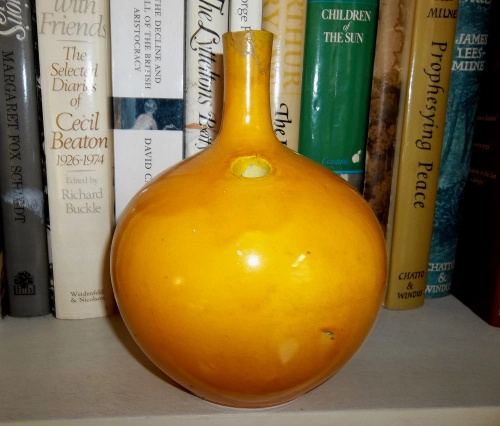
    P.S. The picture is of an antique English drinking jar given me by my friend Andrea.

    Food for threadbare gourmets

    A faithful follower e-mailed me yesterday and asked if I had a recipe for Simnel cake. This is the light fruit cake that’s traditional at Easter, so I told her I’d blog it today. I use Nigella Lawson’s recipe with my own adaptations.

    When I make it, I prepare the tin as usual, and then cream 175 g of soft unsalted butter with 175 g of caster sugar. Then mix 225 g of SR flour with half a teasp of cinnamon, a quarter of a teasp of ginger and 25 g of ground almonds. Add one egg with some of the flour mixture to the butter mixture, and mix two more eggs into the rest of the mix in the same way, before adding two tblsp of milk. Finally, fold in 500g of mixed dried fruit, plus some chopped glace cherries if you like them.

    At this stage I put half the cake mix in the tin, roll out about 400g of marzipan, cut into a cake sized circle and place on the cake mix, then cover with the rest of the cake. Bake for an hour at 170 C, then turn it down to 150C and cook for another hour and a half. It’s cooked when it’s risen and firm. Let it cool completely on a rack before taking it from the tin.

    When cool, paint the top with apricot jam, and roll out another 400g of marzipan and stick it on. With 200g of marzipan, make balls representing the eleven apostles – Judas surplus to requirements here – and stick them on using an egg white – beaten to just frothy. Some people quickly put it under the grill to make it look slightly toasted.

  • Ordeal by wardrobe

    Illustration from the post “Ordeal by wardrobe”

    There will not be many people wearing soft fuchsia coloured leather gloves in the North Island of New Zealand this winter, but I will be one of them.

    They were a gift from my daughter last Christmas. She brought forward the present giving ceremony, and insisted that I open my presents first before anyone else opened theirs, because she wanted to see the look on my face when I saw them. She’d brought them back from London months before. I hoped my face showed everything she hoped when I unwrapped them. I can’t put them away. They sit on my dressing table – a symbol – of many things.

    But her solicitude for my wardrobe doesn’t stop at leather gloves. This weekend she pounced, and said that the following day we were going to go through my clothes, and I was going to sort everything into keep, store and throw away! I had a friend who had also undergone this ordeal by wardrobe, when her daughters dismissed all her lovely clothes as ‘tragic,” so I knew what I was in for.

    I had to agree that something had to be done, as I was always losing things in the muddle of too many hangars on the rail. As the morning wore away, it got easier and easier to let go.

    “You’ve got too many white T-shirts.” was the first pronouncement. “There are five days in the week, how many do you think you can wear?” Resisting the temptation to correct her arithmetic I feebly tried to think why I would want more than a dozen white T- shirts, but nothing came to mind…

    “No more brown, or dull sludgy colours” was the next diktat. “They don’t suit you. You need bright clear colours.” No arguing with the considered opinion of an expert… so out went two thirds of my wardrobe.

    I tried to salvage a few comfortable jumpers and slide them into the store –and- second- thoughts pile. “No,” said the arbiter – “how long is it since you bought that? – fifteen years? – Well it may have looked nice then, but it’s hopelessly out of date now – anyway, it’s got moth holes”…

    No, that’s worn, no, that’s got pilling, no, that’s the wrong colour … gradually the wardrobe emptied, and the to-keep pile was pitifully small. The throw- out pile (for the womens’ refuge) was huge.

    “No, you have to give up labels”, she pronounced. “But I always cut mine out,” I protested… “Yes, but look – you just said ‘but that’s a Jaeger, ‘when I tried to throw away that jumper.”

    “Okay, I get it”, I sighed. “I can’t believe you’d have bought this,” she exclaimed, holding up a black and gold embroidered evening coat.” “No, I can’t either,” I agreed, “so I’ve never worn it”. “Right, Trademe”, she said. “Anything with tags you haven’t worn we can sell and just think, even if you only get five dollars each for all this stuff you’ve never worn, it’s all money towards a new wardrobe!”

    By now she’d found various un-worn shirts I had had made that had never worked.“I hope by the time I’m your age, I’m not making these sort of mistakes,” she muttered…“What are these?” she cried, holding up a pair of well tailored tartan pyjamas beautifully piped in red. “What on earth have you got these for? How long have you had them?”

    “Exactly nineteen years,” I replied truthfully. “I saw a picture in a magazine of a model wearing pyjamas like these, cuddled up in front of a log fire with a cup of hot chocolate, looking so cosy and glamorous.” She looked at me disbelievingly. “Have you ever worn them, have you ever done that?”“Not yet”, I admitted, “but I might.” She opened her mouth to say something withering, but then took pity on me –“OK, you can have your dreams,” she said, and dropped the pyjamas on the to-keep pile.

    By now we had descended into the bottom of the wardrobe to the shoe department. While I sat on a small stool scrabbling around in the darkness, she took the opportunity to tweet her friends. “Sorting my mum’s wardrobe” went the message – “keep, store and throw.” Back came a flutter of twitters from people who obviously had time on their hands that morning. The opinion seemed to be unanimous – too hard basket for them… I thought to myself, now at least one third of Auckland knows I’m throwing away my clothes.

    There had been a time when my daughter needed a whole cupboard for her shoe fetish, but no more, it seems. “If I buy a new pair, I gash another pair,” she lectured me… so out went shabby oldies, Moroccan slippers, shoes that pinched, boots that had the wrong sort of heel… the good news was that I found a pair of beautiful black suede indoor shoes that I’d never even worn and had lost about seven years ago. Needless to say a whole harvest of handbags was dissipated. “But you know I’m a bag lady,” I whimpered….

    At the end she shook her head in a tolerant and kindly way. ”I’m proud of you, I never thought you’d do it so quickly and easily – now don’t you feel better?” she coaxed…” A lot lighter?” “Definitely a lot lighter”, I answered, looking at the giant pile destined for the womens’ refuge… a smaller pile that I could have second thoughts about and store, and then the emasculated line of shirts and skirts, trousers and jackets hanging on the rail.

    But as I looked, I had to admit she was right. She’d even hung them so I could see what to wear with what. Best of all, I’d found the three jackets she’d lavished on me last year that I’d forgotten about – one Jaeger and two Ralph Lauren… labels, I said!

    Yes, there is nothing like a daughter… and thankfully, they keep you on your toes, as they can always see room for improvement. I do hope she approves of what I choose to wear with the fuchsia pink leather gloves when winter comes. Maybe I‘d better get her advice – after she‘s finished stacking the three metres of fire-wood sitting in my garage… there really is nothing like a daughter!

    PS. She checked out this story, and said she could add a few more items – what about that lost evening bag you were so thrilled to find under a pile of jumpers? Enough is enough, I said firmly.

    Food for threadbare gourmets

    Our neighbours have a banana tree which is weighed down with small sweet bananas, and they don’t eat them. This largesse comes our way, and I use this recipe when we have too many to eat.

    Mash a cup of bananas, and melt 150gms of butter. Put both in a dish and add two eggs and a cup of sugar… I often use brown for the taste. Mix them together and then add two cups of self raising flour. Dissolve a teasp of baking soda in 3 tablspns of milk, and stir that in too. Beat lightly, before tipping the mixture into a greased 20cm cake tin, the base lined with baking paper. Bake at 180 degrees for 50 to 55 minutes. It’s cooked when the cake springs back when lightly touched. Lovely with thick lemon icing.

    Food for thought

    Comparison is the thief of joy. Anonymous

  • Pooh Bear has the answers

    Illustration from the post “Pooh Bear has the answers”

    I’ve only been on one teddy bear’s picnic. There were lots of teddy bears, crammed into a little dolls pram, my three year old grand- daughter and me. We solemnly walked the pram to a tree in the park in Melbourne next to the house where they lived.

    There, on a cold, slightly misty winter’s afternoon, we carefully propped a huddle of teddies of different sizes and varying shades from honey to dark brown, around the base of a tree. After careful discussion as to what teddy bears might eat, we had plumped for very small brown bread and honey sandwiches – we thought that arbiter of bear behaviour, Pooh Bear, would have approved, and that was all we needed to know really. We thought bears would probably only have wanted to drink water, so that was easily solved….

    I was thrilled that she still remembers this occasion now she’s old enough to be at university. And she remembers too, jumping on our shadows the year before, and learning to sing ‘Kumbaya, my Lord’ when she was even smaller (in an English accent!). These memories may be more precious to me than to my grand-daughter, and most grand-parents will understand just how precious they are.

    When I look back to my memories with my grandmother, I marvel at what I learned from her, much more, I suspect than today’s grand children learn from theirs. She taught me to knit and sew and do French knitting, and embroider dozens of stitches I’d forgotten till leafing through an old Mrs Beaton cook book recently – daisy stitch, herringbone stitch, blanket stitch, chain stitch, back stitch, buttonhole stitch, cross stitch. She told me the names of flowers and saints and cousins I’d never seen, the stories of dead great uncles in the war. She taught me prayers and proverbs and songs.

    But somehow, once the days of reading aloud Pooh Bear and Dr Seuss and Dear Dinosaur had passed, all my grand-children were so engrossed in their play stations and favourite, regular afternoon TV programmes, that there was rarely a space for the sort of boredom or blank days we used to have in my childhood; those times when for lack of something better to do, we mastered a new skill and learned to knit, or read a book considered too hard or too boring before, and which was now discovered to be a treasure.

    It was on those long empty days that I discovered the joys of rambling alone with the dog, or daring to cross the weir by the mill with friends, or digging around the Roman mines, hoping after two thousand years to find a Roman coin; it was when we picked primroses in the woods, and carried catkins and pussy willow home as spring announced itself … As we grew older we made egg sandwiches and took a bottle of ginger pop to picnic on empty beaches with names like Man o’ War Bay and Arish Mell Gap, coming home tired and sunburned.

    But my grand-children have done it differently. Today they’re not free to roam alone as we were – instead, they went on exciting holidays, in the tropics or to fishing lodges, or learned to sail or ski. But then they’d come to stay with me, and do ordinary and yet totally absorbing things. Leaving their play stations, they’d feed the eels in the river at the bottom of the garden, spend days making boats out of flax leaves, and floating them down the waterfall, building dams, playing Pooh Sticks.

    They could spend an afternoon totally absorbed in throwing stones down into another river, far below, and listening for the plop. Another morning in the city when I took all four of them to a secret spot above the harbour, where old oak trees spread, they spent a whole morning searching for acorns and throwing them down into the water. Not aimlessly, but aiming.

    And not a question of little things please little minds, but being ‘in the zone’, alive and present. Blowing bubbles from my veranda and seeing who could make the biggest one that drifted furthest and lasted longest; or the ritual playing of hunt the thimble with the same silver thimble every time, seemed to give them more fun and shrieks of laughter than watching their Japanese TV serials and videos or war games on the computer. And grandparents have time for long conversations about the size of universe and whether ice-cream is good for you, and what dogs are dreaming about – and about important things – like ethics – which even small children understand in terms of right and wrong, or better still, kind or unkind …

    Sometimes I think that this is one of the few gifts we can give our grand-children in this busy technological age when our grandchildren know more than their grandparents, and learn to teach us, instead of us teaching them. We can give them the time and the space to savour the little things. We can listen to them uncritically. We can give them unconditional love, because we don’t have to make sure they eat up all their vegetables. And the utter bliss of it is that they give us the same unconditional love too. “I’ve got to, but I’ll still be your darling”, said one when I asked him not to grow up!

    It’s that ubiquitous bear, Pooh, that ‘bear of very little brain’, who puts into words what I would say to my precious ones in the future. He says so memorably and so truly: “If ever there is tomorrow when we’re not together… there is something you must always remember. You are braver than you believe, stronger than you seem, and smarter than you think. But the most important thing is, even if we’re apart… I’ll always be with you.”

    Food for threadbare gourmets

    It’s that wonderful time of year for both birds and people – when the figs are ripe. A friend made the most delicious salad the other day using real lettuce – not mixtures of baby leaves – and tossed them with chopped- not sliced – cucumber, fresh peas, and thinly sliced figs, with a vinaigrette sauce. The sweetness of the figs with the crunchiness of the cucumber and the crispness of the lettuce was delicious with cold lamb and couscous.

    Food for thought

    …’It often takes great courage to follow intuition. It takes a Viking, who is unafraid to sail in unknown seas…. to live intuitively is to live fourth-dimensionally’… Florence Scovel Shinn, 1871 – 1940 New Thought writer who influenced Louise Hay.

  • Poignant symbolism

    Illustration from the post “Poignant symbolism”

    ‘Mummy doesn’t like carnations,’ the nine year old told him coldly, her information holding a world of meaning as she correctly assessed that the man at the front door was a suitor.

    She was right, and though he persevered on that occasion, he never gave me carnations again. It’s a shame about carnations, but at the time I could only see the sad, scentless etoliated versions wrapped in cheap cellophane and sold on garage fore-courts. They symbolised the capitalism and commercialism that exploits and corrupts even beauty.

    The real thing has a big, heavy deliciously clove- scented head, with a tangle of frilly petals, and was originally used by the Romans for wreaths and garlands, known in Latin as corona. When these flowers first came to England with the legionaries nearly 2000 years ago, their name was coronation, until the word evolved into carnation.

    I was just as dismissive about daffodils, when I was presented with a bouquet – or rather some bouquets – which I rather regret now. In my salad days when I was a twenty two year old in the army, and stationed outside a beautiful village in Shakespeare country, I was the only girl in an all male officers’ mess. I had my own little cottage where I lived with the mongrel I’d rescued and dignified by calling him Rupert.

    Late one night there was a loud knocking, so I dragged myself from deep sleep, hurried on my pink dressing gown, and stumbled to the door. Grouped there were all the young officers who had gone to watch a rugby match at Twickenham. It had taken them many hours to get back here, judging by the time – two o’ clock in the morning – and one of the things which had delayed them, apart from merrymaking at every pub on the way back, was that they had also stopped at every roundabout, it seemed, between my cottage and London.

    Each roundabout they had stripped of its spring flowers, and here at my door was the result of their labours. Each young man was wearing a proud grin and holding a big bunch of golden daffodils in the moonlight. Sadly, I was not amused, deeply disapproved, and was more intent on getting them to go away, and stopping Rupert from barking and waking senior officers slumbering nearby, than in being grateful for their generosity at the expense of every town council between here and London!

    So I did know how my three year old grand- daughter felt when I gave her a disappointing bunch of flowers. I’d chosen a big blowsy thank you bouquet for her mother, and had as much pleasure in choosing the flowers as my daughter- in –law had in receiving them. My grand-daughter was also ravished by them, so I decided to walk back to the shop through the bitter Melbourne winter’s day and get her the little bunch of flowers I’d refrained from getting on the first visit.

    I brought home a posy of exquisite purple violets, the perfect symbol, I thought, for my exquisite flower-like little grand- daughter. She took one look at the dainty flowers and burst into indignant tears, and then threw an uninhibited tantrum in which she expressed her un-utterable disappointment at not having a big grown-up bunch of flowers like her mother’s. Mortified, I could see her point.

    Two years later a small posy of white rosebuds with one word ‘Mummy’ on Princess Diana’s coffin reduced half a world to tears.

    The symbolism of flowers is far more profound that the sentimental Victorian descriptions of the language of flowers. The flaming red poppy, whose name is now synonymous with the word Flanders, is a poignant reminder still, of every young man who died in the terrible war that my grandmother called The Great War.

    And in the next terrible war flowers softened another battlefield. I remember my father telling me how the hills of Tunisia were smothered in glorious spring flowers as his tank regiment fought their way to join up with Montgomery’s army.

    Bruce Chatwin painted an unforgettable image of flowers in that same war, in his book ‘The Songlines’. On the first page he wrote of a Cossack from a village near Rostov on Don, who was seized by the Germans to be carted off for slave labour to Germany. One night, somewhere in the Ukraine, he jumped from the cattle-truck shunting him and other captives away from their homelands and fell into a field of sunflowers.

    Soldiers in grey uniforms hunted him up and down the long lines of yellow sunflowers, but somehow he managed to elude them. I can still see in my mind those rows of strong, towering green stalks and leaves, great, yellow tangled- petalled heads benignly sheltering the fugitive crouched beneath.

    I can never forget the endless fields of shimmering purple lupins alive with dancing blue butterflies, stretching along- side thousands of burnt -out tanks near Belsen concentration camp in Germany just after the war. And I could never bear the pink rose bay willowherb, which grew on every English bomb site… the only plant that seemed to thrive in those derelict tragic places. They came to symbolise for me as a small girl, all the horror and sadness and destruction of the war I didn’t understand.

    But perhaps the most powerful flower image of all, is that glorious girl on an American campus in the sixties, walking up to a row of armed, helmeted men, and tremblingly pushing a flower into the barrel of a gun pointed at her, her hand shaking slightly as she dared the outrageous. A girl and a flower speaking the in-effable language of peace.

    Food for threadbare gourmets

    Sometimes home-made mayonnaise can seem a bit heavy, but I use a quick and easy French recipe to lighten it up, learned from my French neighbour. After making the mayonnaise, beat the white of an egg until stiff, and then gently beat it into the freshly made mayonnaise. It gives it a lovely creamy texture, and is particularly good with fish like freshly poached salmon. Another variation is to use a clove of garlic when making the mayonnaise and then add finely chopped avocado with the egg- white. This is a good accompaniment to the chicken mousse from the last post.

    Food for thought

    That is at bottom the only courage that is demanded of us: to have courage for the most strange, the most singular and the most inexplicable that we may encounter. That mankind has in this sense been cowardly has done life endless harm; the experiences that are called ‘visions’, the whole so-called “spirit-world,” death, all those things that are so closely akin to us, have by daily parrying been so crowded out of life that the senses with which we could grasp them are atrophied. To say nothing of God. Rainer Maria Rilke 1875 – 1926 Austrian mystical poet

  • Nuns and their habits

    Illustration from the post “Nuns and their habits”

    I can’t help feeling that nuns are getting a bad press at the moment after seeing the film Philomena, and like everyone else in the cinema, running out of tissues. I thought back to the nuns at my convent… mostly French or Belgian, a couple of English and a few Polish ones. Some were old, some were beautiful, some were wise and some were silly – at least to a bigoted ten year old.

    My father didn’t know about my past in which I’d read all my grandmothers anti-Popish books, which included Westward Ho, and Foxe’s Martyrs, a catalogue of the three hundred people Mary Tudor burned for being Protestant. So sending me to a convent for a good education seemed a good idea to him.

    I didn’t discuss it with him, for on our first day with our new parents, I’d been told I had to do exactly as I was told – always – so there didn’t seem to be any room for discussion. So a prejudiced Protestant got to observe the strange Catholic goings-on at her new school!

    The nuns all looked wonderful in their no-expense spared rich plum-red gabardine habits, with wide swinging pleated skirts and wide sleeves. They wore a long snowy white veil over the wimple which framed their faces and had a splendid thick knotted red cord round their waists to which they attached their rosaries.

    We had a roller skating rink where we skated most days, and obsessed about how many ball-bearings our skates had. At night when I boarded for a while, and when everyone was supposed to be in bed and asleep, we could look down from the gabled windows, and see the nuns swirling round the rink on our borrowed roller skates,red habits swinging, veils flying. An unforgettable sight.

    The order had been formed by three aristocratic Belgian ladies, and we heard their history interminably when we sat in silence in the refectory at lunch, while tall, serious, severely beautiful Mother John stood at the carved lectern and read it to us during retreats. Retreats and the numerous saints Feast Days were a wonderful way of not doing schoolwork, which my parents disapproved of, since they were paying school fees.

    During retreat, for several days we never spoke (which I loved even then), and did nothing but pray, draw holy pictures, tally what good deeds we’d managed to perform each day, using a flower as a symbol (I used a violet), process around the school grounds singing hymns, and if we were Catholic, celebrate mass with a portly priest imported for the job. I couldn’t bear him and the way all the nuns fawned over and spoiled the only man who ever came into their orbit! Apart from no speaking and mass, Feast Days were the same round of prayers and processing.

    Mother Michael was our housemistress, a tall bony woman, English, and almost the only nun there who had no charm. She wore thick horn-rimmed spectacles, and I noticed uncharitably that in the chapel at prayers every day after lunch, she twiddled her Bride of Christ gold wedding ring and didn’t seem particularly devout.

    I rather enjoyed this lunch-time prayer ritual, it also cut into time for lessons, as we walked in a long crocodile along the corridors on miles of polished linoed floors, passing numerous statues of saints frequently adorned with rosaries or necklaces. I thought most of the statues were ‘soppy’, a word we used then, and actually I think they probably were – mass-produced, sentimental, pastel- coloured and idealised images. I glared at them all like a latter-day Cromwell.

    Chapel however, with its scent of incense was a pleasure, and a respite from effort and intrigue. Yes, the convent was a hotbed of intrigue and occasionally swept by gusts of vague hysteria – what convent girls would probably call ‘scharmerei’ – with favourites, crushes and gossip part of the mix.

    I was Mother Michael’s favourite for more than a term. It was, in a good Catholic phrase – purgatory – because I was imprisoned every day in the airy second floor cloakroom in the Georgian house which was the home of the junior girls. It was a pleasant sunny room, but it might just as well have been a dungeon because I was chained, as it were, to a chair, and every lunch break Mother Michael undid my long dark brown plaits and spent the rest of the lunch hour break brushing my hair.

    Friends came and went, washing their hands and changing their indoor shoes, but I was pinned to my penitential chair with my hair loose. Just before the bell Mother Michael would re-plait it, dragging it round my face like a Victorian orphan, and every day when I got home my stepmother would ask what was going on, and when I told her, say it had to stop. I would have loved it to stop, but I didn’t know how to make it stop.

    It went on until Mother Michael found another pair of promising plaits, not as long as mine, but long enough. The new favourite was rather smug to me, but I knew what she was in for, and watched with some pleasure as Barbara found herself nailed to the chair, and like me, unable to join in the games of skipping and hopscotch, playing five stones and weaving cats cradles going on outside. Mother Michael had seriously interfered with my social life, and I felt no pity for her next victim.

    The other nuns were civilised and kind, unbigoted and happy. Unlike the only teacher who wasn’t a nun, and who constantly tried to outdo them in piety and holiness. She was the maths teacher, so it was inevitable that our relationship would founder.

    In fact it never recovered from the day when I finally rebelled and tried to speak my mind. As an Irishwoman, her constant theme was the ‘puir’ persecuted Catholics and all the dreadful things Protestants had done to them, including executing Guy Fawkes and his co-conspirators – we never celebrated Guy Fawkes day at the convent – and ‘puir ‘ St Thomas More, beheaded by Henry VIII.

    Baulking at having to pray for the souls of my Protestant parents because they weren’t Catholic – after we’d interrupted long division yet again to recite the Angelus – my stroppy ten-year old self started to tell her about the Inquisition, and Borgia Popes etc. But I got no further than the Inquisition. “Oh what a pack of Protestant lies!“ she shrieked dramatically, clapping her hands over her ears.

    Not only was my relationship soured with Miss Cummins, but it never recovered from the disapproval of all the other Catholics in the room either… I paid the price for this rebellion, and was always left until last to be picked for rounders teams and netball. I left the convent after a year without regret, and yet looking back I’ve had more fun from my memories of that unique environment than from some of my more conventional schools.

    The beautiful High Victorian Gothic building, which housed the foreign nuns so far from their homes in Europe, and generations of schoolgirls, has now been turned into smart flats, surrounded by the glorious trees and grounds where we played so happily, watched by little red squirrels perched in the black branches of bare trees silhouetted against the snow.

    I wonder if the skating rink is still there. I think no-one since would have enjoyed it as much as those gentle souls swirling silently around in the dusk, plum coloured habits swaying, veils flying and rosaries swinging. I do hope they bypassed purgatory and skipped straight into heaven.

    Food for threadbare gourmets

    Going cold turkey day after day post Christmas is not my idea of enjoying food. So after the second day I chop it into small pieces and freeze it. Yesterday we were ready to eat more turkey, so I defrosted it, stirred small pieces into a thick white sauce with plenty of nutmeg, some parsley and plenty of chopped mushrooms fried in butter. Served over savoury rice, it was good. Into the hot basmati rice I stir a chopped fried onion, plus a handful of peas, a handful of sultanas soaked in boiling water to plump them out, and plenty of toasted slivered almonds, salt and pepper plus more parsley. It beats the boredom of cold turkey.

    Food for thought

    The angels keep their ancient places;

    Turn but a stone, and start a wing!

    ‘Tis ye, ‘tis your estranged faces,

    That miss the many splendoured thing

    Francis Thompson 1859-1907, great English poet, mystic, vagrant who lived on the streets for most of his drug-addicted life.