Category: Nature & Garden

  • Storms of Delight

    Illustration from the post “Storms of Delight”

    I awoke to the roaring of a savage sea hurling itself onto the rocks below. The window is always open so that I can hear the sea.

    Looking out, it was a grey wolf sea, with a steel-grey haze obliterating the islands that hover on the horizon. White capped rollers raced in across cruel grey and glacier- green water, and when the waves hit the rocks spilled over in sheets of white foam blowing high in the air. Low tide is almost more spectacular than high tide, because the water hits the rocks instead of flowing over most of them.

    Later, I put on a hood and jacket and walked out into the storm. The wind was thrashing the trees and making much the same sound as the roaring sea. First I walked to the garden of some friends overlooking the little harbour. It’s usually like a shining green jewel set deep in high rock and forested walls. It was calm, the only sign of the storm being the muddy-looking water.

    These friends own the goats and are away overseas for some weeks, so I pocketed the lemons lying under the tree. It was only a little tree, but had been so nurtured and well fed, that where one lemon would normally hang, between five and ten weighted down each fragile branch. The scent of the blossom still growing swirled round the tree before flying in the wind.

    As I walked down their long drive, between two rows of palm trees, three little speckled red hens came running out of a nearby garden, and solemnly picked their way behind me in single file. I felt like turning round to stroke them, but they weren’t keen on this. The way they followed me reminded me of Konrad Lorenz’s imprinted geese, and I hoped these little hens weren’t busy imprinting themselves on me. They gave up in the end, and returned home to where their supper was awaiting them in the hands of a pretty girl in a cream poncho.

    Strolling back in the flying rain I walked down the cul de sac to say hello to the three goats, and give them a little leafy, twiggy treat. Robert, the grumpy old billy- goat, would keep dropping his mouthful in order to snatch the little darlings’ twigs from their mouths. So I had to do a dodgy dance to try to fend him off while the babies managed an uninterrupted munch for a few minutes.

    As I turned round to come home, I heard a piteous whine. It was Zeb, the black and white pointer who lives opposite the goats, and sometimes escapes to come and see me. She had her head to the fence, hoping I’d come and say hello to her too. Of course I did, and while I was doing so, Kate, her owner, came out and asked if I’d like some new-laid eggs. Would I? So when Zeb and I had finished our tete- a- tete, I returned home the delighted carrier of six fresh eggs.

    I laid them carefully with the glowing yellow lemons on the garden seat at the top of the steps, and continued my wander in the storm. We live on a tiny peninsula sticking out into the sea, our house facing one way, and on the other side of the little neck of land, the old village graveyard faces out to sea in the other direction. Beneath spreading trees, it holds the graves of the earliest settlers in this place, and the latest inhabitants.

    I walked on the wet grass between the graves, heading for the end of the cemetery where it ends in a deep crevasse where the sea throws itself against this neck of land. Here I look down on a flat rock fifty feet below. The seas crash over it in rough weather, or lap against the sides on calm days, revealing tempting still green depths and white rock below the waterline, where I’d love to swim if I could get down there. Today it was almost invisible beneath thick sheets of green water swirling over it and spumes of foam flying through the air.

    As I stood looking down here, as I so often do, I realised that every time I come here, I think of Pincher Martin, and William Golding’s description of hell. Pincher Martin scrabbling desperately to escape the raging seas, and clinging onto the slippery rock and slipping back down again into the tormenting cauldron of murderous waves… over and over again … not a pleasant remembrance, and one I try to banish, but it always comes back … just as I never see the spire of Salisbury Cathedral, in the flesh or in pictures, without thinking of Golding’s ‘The Spire’ and his painful story of spiritual disintegration. Thank goodness I’ve avoided reading ‘The Lord of the Flies’, as I know I would be tormented by that too.

    Today, the wind crashing through the old pohutakawa trees – which were probably growing here when my hero, Captain James Cook sailed past in 1769 – was bringing down lots of small twigs and gnarly broken branches. When they’re dry they’re wonderful to start the fire with, and the peasant in me can’t resist gathering bundles. This was a successful foray and I returned home with a big armful of wet branches and twigs to dry out in the garage. Pohutakawa trees grow to the size of a good oak tree, and have dark green, hard, crunchy leaves all the year round. They’re sometimes called the New Zealand Christmas tree because at Christmas they’re smothered in flaming red blossom, and here, where the whole coast is ringed with them, they are a unique sight.

    And so back home to a blazing log fire, with the haunting and tender sounds of Handel’s opera Julius Caesar still ringing through my head. I went to see it for the second time in three days yesterday, five hours of it, and would see it again – and again, if it was available. Today I Googled Caesar and Cleopatra, since I only knew of Anthony and Cleopatra. And yes, Handel hadn’t messed around with history, Caesar and Cleopatra had had a love affair, she had borne his only son, and she stayed with him in Rome until his assassination.

    So well before her alliance with Mark Anthony, she had loved Caesar, and he her.Knowing this made the exquisite songs of their love affair in opera seem even more poignant.Cleopatra inveigled her way into Caesar’s presence rolled up in a carpet, and in the opera sang a song of enchantment for him. I read somewhere that Cleopatra’s glorious song to Caesar: “v’adoro pupille” (I adore you, eyes,) is the most seductive love song ever written. I can believe it. In Natalie Dessay’s version she didn’t seduce, she poured out her heart. It was beautiful.

    And this life seems so beautiful too, with all its gifts and grace notes, allusive thoughts and memories, the stormy seas and wild winds, the hens and the goats, the centuries of music and aeons of love, the lemons, the eggs and the firewood!

    Food for Threadbare Gourmets

    The pantry was bare. So I made a treat I haven’t made for years – cheese aigrettes. All I needed were things like eggs, flour, and grated Parmesan which I always have in the deep freeze. So into a saucepan went two oz butter and half a pint of water. When boiling I added 4 oz flour and stirred hard until the whole mixture was coming away from the sides of the saucepan, leaving it clean.

    Off the heat I mixed in 3oz Parmesan and two egg yolks, beating them in separately. Add salt and pepper, and then fold in the stiffly whisked egg whites.That’s the easy part. When the mixture is cold, drop small rough pieces, about a teasp size or bigger, into hot fat. Don’t fry too quickly or the outside will brown before it’s cooked inside. But if the fat is too cold, the aigrettes will become greasy. It takes about four minutes for each batch to cook.

    Fish them out with a slotted spoon onto some kitchen paper to drain, and serve with grated parmesan sprinkled over, and a dash of cayenne pepper. With salad, they’re crunchy, filling and delicious.

    Food for Thought

    Life, for all its agonies of despair and loss and guilt, is exciting and beautiful, amusing and artful and endearing, full of liking, and of love, at times a poem and a high adventure, at times noble and at times very gay; and whatever (if anything) is to come after it, we shall not have this life again.

    From Towers of Trebizond by Rose Macaulay English novelist 1881 – 1958
  • Serendipity and the Private Life of Rabbits

    Illustration from the post “Serendipity and the Private Life of Rabbits”

    I don’t know what made me ask. Serendipity. A visiting friend had said his wife hadn’t come with him to see us because they had guests from overseas – a palaeontologist and partner.

    Out popped the words, “Not Ronald Lockley’s son?” I’d once been told that his son was a palaeontologist. It was, and he came, and we were a mutual admiration group for his father. Synchronistically I had just been re-reading his father’s autobiographical book ‘Orielton’. Mostly because I wanted to refresh my mind about rabbits!

    Ronald Lockley was the brilliant naturalist who did the research on rabbits which was the basis for Richard Adams’ famous book: ‘Watership Down’. Richard Adams made millions out of this book which has never been out of print, while Ronald wrote over sixty five books to keep the wolf from his door!

    But in ‘Orielton’ he tells not only how he organised his amazing research into the life and domestic habits of wild rabbits, but how he also gained an insight into rabbit psychology, when he adopted an injured baby rabbit. His son – the one who came to talk – helped to keep it alive overnight and then That Rabbit, or TR as she was called, became part of the household.

    The household lived in a remote and rambling beautiful Georgian manor surrounded by parkland of lakes, woodland, farms and gardens in Wales. A succession of other famous naturalists, Spanish domestics and would-be students and helpers passed through it, and the family and its animals lived a rich and lively life. Ronald’s interests and observation ranged over the private life of the large spiders inhabiting his home, to the badgers, birds, bats, rabbits, hares, and stoats, otters, ants and bees ranging the estate. This house which had rung with laughter, music, wit and brilliance from the likes of Ronald and Julian Huxley and Ludwig Koch, he finally handed over to the Field Studies Council, before leaving England.

    Ronald was already well known among naturalists before he published his four year study of “The Private Life of the Rabbit”, having lived on, and written about the uninhabited island of Stokkum, off the Welsh Coast. Here from 1928, he pioneered studies of migratory birds, established the first British bird observatory in 1933, and carried out extensive pioneering research on breeding Manx Shearwaters, Atlantic Puffins and European Storm-petrels – wonderful names… In the thirties he had made an Oscar winning film on gannets with Julian Huxley, but here at Orielton it was rabbits that took up most of his attention.

    That Rabbit – TR – slept in the cat basket by the fireside, and when she was awake was “excessively playful” according to Ronald. She invented a version of hide and seek which she played on the stairs with anyone who would join in, and would chew through the string of s cotton reel Ronald used to roll around for her, seize the reel in her mouth and rush off dodging through the furniture as though playing rugby, enticing Ronald to chase her. If he was busy, she’d chew through his slippers, wreck his socks, and if all else failed, leap onto his type writer and push her face into his to get his attention.

    After an unfortunate incident with a stoat, Ronald devised a system of In and Out doors which closed behind TR so the stoat couldn’t chase her inside. She learned immediately how to work this system, just as she had instantly worked out how to organise her toiletry, and never messed inside.

    For afternoon tea in the garden with the rest of the family, she enjoyed weak tea with milk and a little sugar … and as time went by, Ronald realised that if he had not had this relationship with TR, he would never, as he said, have understood the soul of a rabbit. Even as an adult, TR sought out his company and showed a deep attachment to him.

    The end of the story came when on one of their walks together, TR encountered a young buck rabbit… and then again. She left home and set up house with one of her own kind. But this was not the end of the story.

    One night when everyone was sitting round the fire they heard the In-door, and TR came hopping through. She went straight to the cat basket, and grabbed in her teeth the dolls blanket which she used to cuddle up in, and then made a dash for the Out- door.

    She had remembered as she prepared her burrow for her first litter of babies, that soft warm rug by the fire-side that she had always used!

    Ronald had given me ‘Orielton’, with several others of his books, and I was such an ungrateful insensitive person in my younger days that I’d never got round to reading them. Natural history just didn’t do it for me then, and I was too wrapped up in my teenagers and complicated life generally.

    I used to meet him when I was delivering my weekly column to the newspaper, and Ronald was delivering his naturalist column. (no e-mail copy then!) He had come to this country to live, because he felt that the UK was not committed to looking after the environment. We loved each other, and yet when I left Auckland to live in the country, we lost touch. It makes me sad now, Ronald was never really appreciated in this country – no-one really knew or recognised his work back then in the seventies and eighties.

    But as usual he made his mark on the place. He was involved in setting up the bird sanctuary at Miranda where every year, hundreds of thousands of godwits gather to begin their stupendous flight to the other side of the world – Siberia – to breed. He also created a little protected reserve around the house on the cliff where he lived, overlooking the sea on the edge of Auckland. I still have the book he gave me about his life in that: “House Above The Sea”, as it was called.

    If fame means having an obituary in the New York Times, an entry in Wikipaedia and in various biographical tomes, Ronald does have fame. But I actually feel that the words from Ecclesiasticus describe him best: “and some there be which have no memorial…. these were merciful men, whose righteousness has not been forgotten.”

    Richard Adams, who made a fortune out of Ronald’s research – which he acknowledged – said of Ronald that he was a “sensitive and clear-sighted lover of this beautiful earth.” The gentle humorous man I knew was also a lover of all beauty. He died in 2000 at ninety-six, and as I wrote this, these words came into my mind: “Swim with the dolphins deep in the sea, Soar in the sky with the birds and be free…”

    Food for Threadbare Gourmets

    I needed a cake in a hurry the other day, and it was serendipitous too, because there was enough left for coffee when my expected visitors arrived the next day to talk of Ronald Lockley.

    For this easy lemon cake you need 225 g each of soft butter, caster sugar and SR flour, four eggs and a lemon. Just beat the butter, sugar, eggs and grated lemon rind. When creamy, add the flour and beat gently. When blended pour into a medium sized greased and floured loaf tin and bake for fifty minutes at 160 deg C. I make a glaze of the juice of the lemon, a tablesp of caster sugar, and a teasp of butter. Melt and stir together and brush over the loaf when cooked.

    Food for Thought

    In a Bath Teashop

    “Let us not speak, for the love we bear one another –

    Let us hold hands and look.”

    She, such a very ordinary little woman;

    He, such a thumping crook;

    But both, for a moment, little lower than the angels

    In the teashop’s ingle-nook.

    John Betjeman 1906 -1984 Much loved and much read Poet Laureate, and eccentric. As an under-graduate he took his teddy- bear Archibald Ormsby-Gore to Oxford with him, which was immortalised in the book: ‘ Brideshead Revisited’ by Evelyn Waugh.

  • The longest journey

    Illustration from the post “The longest journey”

    I’m sitting by the wood fire with the rain falling steadily outside onto the green garden. It’s fragrant with the scent of all the cyclamens I bought this year to put in pots. I hadn’t realised what a beautiful perfume they had. I picked some roses before the rain drenched them, Monteverdi’s exquisite lilting Vespers – trumpets and choirs – is playing, and I had for lunch a delicious helping of the grocer’s bargain Gorgonzola Dolce with fresh sour dough bread.

    And coffee. My coffee tastes entirely different now that I’ve learnt to put the milk in first, thanks to the coffee drinking bloggers who commented on the blog I’d written about tea, and how Milk in First – so frowned upon by the pukka – is actually more delicious than milk poured in after the tea. So I’m now drinking coffee milk in first.

    I’ve been watching a blackbird pecking at a red apple nailed to the fence outside the window. The sparrows love their grain in the swinging blue and white bowl suspended from a tree near the bird-bath. As I watched them, I was amazed to see a host of different birds in the garden, so unusual in this country.

    There was a wood pigeon sitting in the guava tree in its approved partridge in a pear tree fashion, three pink-breasted grey doves pecking on the grass, a couple of tuis frisking in the bottle brush tree, sparrows in the feeding bowl, fan tails flitting around between plum tree and bird bath, a couple of lime-green and grey wax- eyes flickering among the leaves, and to my astonishment, a gold finch pecking around the green copper with pink cyclamen – the pink and the gold, and the verdigris of the copper a delight.

    The tiny wax-eyes or silver -eyes, which are half the size of a sparrow – would top the list of NZ birds I love. Victorian Walter Buller, the earliest NZ authority on birds, called them silver-eyes. They ‘re supposed to have arrived in New Zealand in June 1856. Buller wrote: ‘…in the early part of June of that year, I first heard of its occurrence at Waikanae, a native settlement on the west coast, about forty miles from Wellington. The native mailman brought in word that a new bird had been seen, and that it was a visitor from another land.

    ‘A week later he brought intelligence that large flocks had appeared, and that the “tau-hou” (stranger) swarmed in the brushwood near the coast; reporting further that they seemed weary after their journey, and that the natives caught many of them alive’. Buller tells us that they were then seen in numbers in Wellington, and greatly welcomed as they ate the aphis known as American Blight which was ruining the settlers’ apple trees. The little silver-eye has flourished here ever since its epic thousand-mile journey across the Tasman.

    Why did they come, flocks of them, not just a few blown by the wind? What a great heart in a tiny frame, and what impelled each one to embark on this huge migration across an ocean? Flocks of them sometimes clung exhausted to the masts of ships in mid- ocean. How did they know that a land, New Zealand, was awaiting them at the other side of the trackless sea? And how sad, that at the end of the endless journey, tiny wings beating against the winds, they were so exhausted, that many were caught by hand by Maoris and ended their lives precipitately in the Promised Land.

    Whenever I see the tiny green creatures flitting in and out of the birdbath, sipping the honey in the bottle-brush tree, and nibbling the apples I put out in winter, I remember their great journey and noble hearts. Was their quest a search for a better life, like so many of the settlers, who in those same years also sailed across oceans for six months to reach here, surviving perils which included drowning, sickness and starvation?

    This quest of men and birds took not just courage but a leap of imagination, and I wonder if these are the times now when we must all also take another leap of imagination and courage to save the dear earth that we know – to take, in Christopher Fry’s words, “the longest stride of soul men ever took”. Eckhart Tolle has warned that all the structures that we’ve always known will start to crumble, and we are now seeing trusted institutions, organisations, freedom, democracy, justice, free speech, free press, the environment – all under threat.

    So this must be the time to take that long stride of soul – to create new ways of living on this planet, salvaging the best, and joining together to share peace and goodwill, as well as food and resources. The Dalai Lama has said that meditating is not enough – we need to act – and Thich Nhat Hanh has warned us that we can’t go on the way we are doing.

    He says otherwise: “ … there is no doubt that our civilisation will be destroyed. This will require enlightenment, awakening. The Buddha attained individual awakening. Now we need a collective enlightenment to stop this course of destruction.” So enlightenment, it seems, is a journey which we can’t delay, and however difficult this may seem, and whatever it means to different people – as Lao Tzu so famously said nearly fifteen hundred years ago – a journey of a thousand leagues begins with the first step.

    Food for Threadbare Gourmets

    As a threadbare gourmet, I pride myself on getting at least eight meals out of a chicken, so I put the legs into the deep freeze to take out when I wanted them. After de-frosting and taking the skin off, I added them to a pan in which I’d sauted garlic and chopped mushrooms in butter and cream. I also crumbled a chicken cube in a little boiling water and added it to the mix to boil up and thicken. Then I stirred in half a teasp of Dijon mustard, some nutmeg, salt and freshly ground black pepper. Sometimes I serve this on pasta, this time I served it with buttery, creamy mashed potatoes, peas, and carrots.

    Food for Thought

    Life is an endless struggle full of frustration and challenges, but eventually you find a hair stylist you like!

  • The mystery of other lives

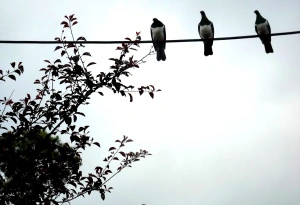
    Not a picture of hear no evil, see no evil and speak no evil, but a picture of the three fat wood pigeons sitting on the power line outside our house yesterday.

    Illustration from the post “The mystery of other lives”

    They used to be plentiful, but between the Maoris and the settlers they nearly became extinct. They’re now protected, and their numbers are increasing. The Maoris call them kereru, we call them wood pigeons, and they are big, heavy, iridescent green and bronze, with a white bib, and they crash around the trees, so we can hear them coming.

    This morning, waiting for the kettle to boil while I made a cup of tea to take back to bed, I stood at the bench looking out of the kitchen window, and watched one of these pigeons in the guava tree, gobbling up the tiny yellow fruit.

    I was fascinated to see how this big heavy unwieldy bird kept his balance on the thin frail branches. He moved from fruit to fruit, gobbling them up, without ever looking or checking to see where he was putting his feet. He knew instinctively how to move, whether the branch was strong enough for him, and how to keep his balance without thinking. I watched him for a long time, in awe of his skill and his knowing.

    I took the tea-tray back to bed, and lay back on the pillows looking out of the window on the other side of the house. The loquat tree, just beyond the window, which is covered in blossom, was alive with movement, and I saw the tui, another native bird, also feeding on the flowers. He too, moved from twig to twig, hanging upside down, sideways, whichever way suited him, to reach the blossoms and the nectar.

    As I watched this bird, with his bright white bobble of feathers jiggling at his throat, which caused the early settlers to call him the parson – bird, I felt I was watching something familiar, and then realised that this was the same knowing and instinct that I’d just been watching in the wood pigeon.

    During the nightas I turned over in my sleep, I heard a morepork, the New Zealand owl calling, very close; later, the huffing

    of a possum in the loquat tree, which sounds like the hissing of a python and what I feared were rats rustling in the roof above. I hoped the hedgehogs were still busy hoovering up the snails and slugs in the garden.

    When I drove through the little hamlet at the edge of the sea on my way to shop the other day, I slowed down when I saw a couple of ducks crossing the road ahead. They had a purpose. They were making for a drive-way where a mulberry tree hung over the fence, and the ripe fruit had fallen on the ground.

    The ducks were feasting… how did they know the fruit was there, that this drive was the only way to get at it, and that this is the time of year for fruit? And how did they know how to cross the road, and get out of the way of cars?

    And on the way home I dodged a quail family scuttling along the side of the road with half a dozen speckled brown babies. In our last house, I once looked out of the window to see a quail family sitting in a row on a fence, all six babies snuggled up against their parents. It was a picture of such love and content, and one that stayed in my mind, so that whenever I remember it, I re-live the feeling of joy in the sight.

    Henry Beston wrote in ‘The Outermost House’: ‘We patronise them for their incompleteness, for their tragic fate in having taken form so far below ourselves. And therein do we err. For the animal shall not be measured by man. In a world older and more complete than ours, they move finished and complete, gifted with the extension of the senses we have lost or never attained, living by voices we shall never hear. They are not brethren, they are not underlings: they are other nations, caught with ourselves in the net of life and time, fellow prisoners of the splendour and travail of the earth.’

    This wonderful passage says it all… the mystery of other lives, other consciousness, and the sacredness of all life. I love the phrase: ‘they are other nations’. It gives them dignity and mana, and no longer are they lesser beings on whom we can practise our cruelty and our indifference.

    Long ago, when I was a young reporter, I was sent to interview a woman who had a black cat. When she called it, this cat came bounding towards her, running like a dog. She told me it had never learned to purr, and it never miaowed. And it thought it was a dog, because it had been reared by a dog.

    The dog was a black cocker spaniel, whose puppies had died. She was so unhappy that they got a black kitten for her, and she reared it as her own, teaching it to run like a dog. The kitten watched her mother, and copied her behaviour, but she didn’t know she was a cat, since her mother didn’t know she was a cat either. So how do we know when animals and birds know instinctively what to do and when they know it from copying?

    Living in the country, I feel we are on the fringes of these other nations, catching glimpses of their mysterious lives, and hearing their calls to each other. Sometimes I sit in the garden and hear one bird calling in a tree, and another answering in a tree in the distance. Where a hawk is hovering, the tiny birds set up a warning, and the ducks quack in fear on the pond as it drifts overhead.

    I love the sound of the birds calling in the middle of the night, in that dark stillness. In the morning the songs of the birds are different – full of pleasure at the coming of a new day. I love watching the sparrows and the finches bathing in the little bird bath in the vegetable garden, and the way they flock down to the wheat I scatter on the lawn.

    It’s hard to describe the pleasure of just being with these other beings, other nations. And when I see the black backed gulls, hovering, wheeling, gliding on the wind currents above the cliffs, dazzling white against the deep blue sea, I feel a wild wonder and joy at their beauty and their freedom. So many nations, so many mysteries.

    Food for Threadbare Gourmets

    I had some silver beet – or chard – to use up. So I chopped up an onion, and softened it in butter and oil, added a chopped up rasher of bacon, and then the chopped up chard. When it was all wilted, I added a handful of raisins, some pine nuts, and salt and pepper. It’s so good, and would make a good vegetarian meal with the bacon left out, and served with rice.

    Food for Thought

    It is the very nature of Grace to fill spaces that have been empty.

    Goethe 1749 -1832 Poet, novelist, playwright, scientist, statesman, theatre director, critic and amateur artist

  • Bullied by the birds

    Illustration from the post “Bullied by the birds”

    It’s two months since I wrote a blog about the drought called Summer days and thirsty hedgehogs, and since that time we have had no rain.

    The country is split between those who live in towns- and so many NZ towns and cities are on the coast – and those who live in the country. The townies, as country dwellers call them, are loving every moment of the long hot summer, revelling in long days at the beach, splashing in swimming pools, lolling around in their gardens, and sitting outside at cafes and restaurants enjoying leisurely meals in the soft twilit evenings.

    Families take off at weekends with their tents and boats and kayaks for old fashioned summer camping days by the sea, in the certain knowledge that there will be no rain. At the same time country folk are measuring how many inches of water are left in their water-tanks, or joining the two or three week long queues to have water delivered. I see trees and hedges dying, and my heart aches.

    Farmers are selling their stock since they can’t afford to feed them, for there is no growth in the dry brown paddocks: drying off their milking herds, and worrying about hay for the winter. Gardeners like me, are carting buckets of water from their baths to moisten around trees, watering roses and hydrangeas and salvias all struggling to stay alive in the baking heat, and trying to coax dahlias and Japanese anenomes, usually the splendour of the garden at this time of year, to open their stunted blossoms.

    I fill the bowls of water around the garden regularly throughout the day, and anyone foolish enough to knock on my door with census papers, Jehovah’s Witness leaflets, or to fix the faulty electric plug for me, all get their ears bashed to put out water for birds and thirsty creatures. I’ve rung the local rag, and got my daughter to Twitter, and hope the SPCA will remember my message about ringing radio stations to remind their listeners.

    But one person cannot defeat climate change! This is our third drought in four years, and in the worst one four years ago, we lost so many birds and creatures. The native pigeon population was decimated, as young birds had no water, and people talked of seeing pigeons drop from the sky, dead from de-hydration. The kiwis who dig their long sharp beaks into the ground for bugs and worms starved because the ground was so hard they couldn’t break into it, and when they did, the worms and other food had retreated deep down to damper layers of soil.

    This year, another native bird, the kokako, is not breeding at all – for fascinating reasons – the females can see that there are none of the berries on the rimu trees which they normally eat, and are therefore refusing to mate, knowing there’s no sustenance for their offspring. And hedgehogs are dying of thirst.

    I’m thinking I’m going to have to start feeding the birds again. I used to feed the handful of sparrows and a chaffinch couple who lived around here – under a tree a little way from the house, and where I could see from the sitting room window.I also fed the dozen or so mynahs, a little way down from the tree so they wouldn’t frighten off the smaller birds. Moist wholemeal bread for the mynahs, wheat and birdseed, and when I ran out, porridge flakes for the others. They loved it all. They told their friends. Within a couple of weeks I had at least a hundred sparrows, four or five doves, some itinerant blackbirds, chaffinches and an occasional thrush.

    They had also worked out from whence this largesse came . They waited in the plum tree outside the kitchen window and watched me until I came out with their breakfast. And for a couple of hours they sat and barracked me from the plum tree and the garage roof in the afternoon, until I sallied forth with afternoon tea – theirs.

    A great whoosh of wings accompanied me to the tree. Then I had to make sure that the neighbour’s ancient lonely dog was not hovering in hope of a dog biscuit. If she was, I had to return with the bird food, and dig out a biscuit and walk her down the road with it, away from the bird food which she would have gobbled up. Dog distracted, back to the birds.

    If I was out, they would be waiting for me at the bottom of the road. They recognised my white car, and swooped from telegraph pole to telegraph pole all the way down the road with the car. They’d then hover round the garage yelling “she’s back, she’s back” till I came out. If I went for a walk, they’d fly down the road with me, and wait on the corner.

    Finally the worm turned. There were so many birds I couldn’t keep up with them, and was buying a large sack of wheat from the farmers shop each week, as well as extra bread for the big greedy mynahs – money I could ill-afford. The garden was becoming white with droppings, and I was back to the chaos of when I’d had a bird table. The sparrows could probably have made a pot of tea themselves, they’d watched me so intently through the kitchen window for so long.

    A short holiday in Melbourne solved the problem. They gave up waiting. I felt guilty but relieved. They didn’t need the food out here in the country. It was just my hobby which had got out of hand. But now, with a hearty respect for the intelligence of bird brains, I think I’m going to have to soften my heart and help them out in this emergency.

    That heart sinks at the thought of being bullied by them all again. I’ve done a lot of inner work over the years about letting go of being victim, and preserving myself from being bullied any more, but I’m not sure I can handle being bullied by the birds. It may be a step too far for my fragile self esteem, and feeding the birds may be my last big challenge!

    Food for Threadbare Gourmets

    We had some lovely summer pears from a neighbour which cried out to be transformed into pear and almond tart. I used the wonderful recipe for pastry which doesn’t involve rubbing the flour into the butter. Instead I melt and cool the butter and just stir it into the other ingredients. The resulting dough doesn’t need rolling, but is just pressed gently into a shallow greased tart dish. It doesn’t need pricking or weighting. Just pre-cook for ten minutes in a moderate oven. You then add the frangipane and the sliced pears and cook for three quarters of an hour or more until the frangipane is just firm.

    The pastry takes 125 gm butter, melted and cooled, a generous 100 gms of sugar, pinch of salt, half a teasp each of almond essence, and vanilla essence, two generous tablesp of ground almonds and 180 gms of flour. I love frangipane, and will give the recipe in the next post. It’s the perfect base for pears, plums, apricots, peaches, and I love the sound of the word… it sounds… fragrant!

    Food for Thought

    An old pond – a frog tumbles in – the splash of water

    One of the most famous haiku by the most famous haiku master, Matsuo Basha 1644 -1694 He spent much of his life wandering through Japan, like the medieval troubadours and minnesingers of Europe, three hundred years earlier.

  • Summer Days and Thirsty Hedgehogs

    It’s high summer in our village, the sea is postcard turquoise blue, and scored with white wakes from little fizz boats having fun. I watch the big game fishing boats with tourists going out with tall fishing rods at the ready, poised to hunt giant marlin and other innocent creatures of the deep – and disapprove. All around me holiday houses are filled, and laughter and calls of children punctuate the buzz of lawnmowers.

    Yesterday a homemade cricket match with children and adults on the grass across from our oak tree, filled the afternoon with joyful noise. The click of ball on bat, the shouts, the laughter, the groans, the cheers, the guffaws sounded like the archetypical holiday games of childhood that fertilise the memory, so that looking back in later years, all summers seemed sunny and filled with laughter.

    This morning I sat outside in the sun having my breakfast, and watched monarch butterflies flirting, fluttering and feeding among the pink flowers of the mutabilis rose and lavatera, and rose-red cannas. Reading Anne Dillard I learn that monarch butterflies smell of honeysuckle… do they really, or was honeysuckle the last flower they’d been sampling when the researcher sniffed their beauty? The other side of the garden where it’s shady, blue hydrangeas are blooming amidst the foliage of acanthus and queen of the night, the blue African primrose is flowering profusely on the edge of the ivy, while blue agapanthus spring out of the greenery further away.

    Pale blue petunias echo the colour of the faded painted wrought iron chair on which their pots rest. A tiny green silver eye dived determinedly past me and into the trellis where wisteria, honeysuckle and red and purple fuchsia tangle with each other. He rustled noisily and industriously among the leaves, eating aphids or grubs, and then flew into the plum tree and wiped his beak on a branch… didn’t realise that eating aphids was a messy business for birds!

    And now, as I write this, a speckled cream-breasted thrush has just quietly hopped past the open French door, followed closely by a bumble- bee, buzzing and bouncing along the ground in an irritated sort of way. Ever since I got home from Tai Chi the neighbour’s black cat has been purring, first at my feet, then on my lap, and now on the chair beside my chair. What with the gentle susurrations of the wind in the flax bushes and the pururi leaves, the whirring and clicking of cicadas in the trees outside the window, and the receding low-tide sighing softly across the exposed sea-weed – though there is no sound of spoken word – it is not a silent world this afternoon. And since every sound is the sound of the earth getting on with the business of being, it is sweet and satisfying.

    The wind which has blown across the Tasman from the terrible forest fires in Australia, has been unceasing, and the ground is dry and hard. Ponds are drying up, and birds are spending much time not just at the bird bath, but also at the dog’s drinking bowl outside on the road. Thirsty birds as well as dogs keep me busy re-filling it. Yesterday when I went up the path with a jug to top it up, someone had dropped three one dollar coins in the bowl. I love it – a random act of fun – and yet obviously my bowl is very tempting because it’s the fourth time in the last few years that I’ve found coins in the water!

    I’ve heard several people talking about finding hedgehogs in their swimming pools, unable to get out… they don’t seem to realise that they’re looking for water. As I drove back down our road after shopping the other day, I saw a hedgehog weaving an unsteady path across the road. I stopped the car, jumped out, and picked up the little ball of prickles, and carried it home. As I delicately carried her, so as not to be impaled on the prickles, she uncurled, and I felt her warm leathery legs hang down. I stood her in the flat water bowl in the garden, so she knew in her confused state that water was right there. I left her there drinking, while I walked back to retrieve the car.

    She’d shuffled off (into the piles of dead leaves, I trust) when I got back, but I’m putting out cat-food, in the hope the hedgehog gets to it before any other wild-life – like rats. I’ve also now got shallow plant pot holders all over the garden filled with water for little creatures. I hope the little thing sticks around…I like the thought of a hedgehog in the garden.

    They are amongst the oldest mammals, fifteen million years old. They have between five and six and a half thousand prickles, and beautiful quizzical little faces framed by their prickles. Anyone who grew up on Beatrix Potter is unable to resist them – shades of Mrs Tiggywinkle and Fuzzypeg – there are hedgehog hospitals in the UK, and patrols to rescue hedgehogs trapped at the bottom of cattle grids. Conservationists in this country don’t like them as they eat native birds eggs as well as all the garden pests. I am a one- woman Society for the Protection of Hedgehogs.

    I found a pair of snails crawling up a big deep bowl of water I always have in the courtyard, and to my amazement, found them at the water’s edge some time later. Wasps also drink from the dog’s water bowl. With streams and ponds covered over in towns and cities, there’s little water for thirsty creatures. A hundred and fifty years ago, an English millionairesse and philanthropist, Angela Burdett-Coutts donated horse troughs and fountains for animals in English towns … but if anyone tried to do the same now, I could imagine the red tape and town planning regulations and resource management restrictions preventing anyone from re-instating drinking places for thirsty animals.

    When I lived in town I always had a drinking bowl on the pavement outside my gate. It was a big deep blue and white china bowl I’d brought from Hong Kong, and everyone told me I was mad, it would get stolen as all the students on their way to lectures, and cleaners on their way to hospital trailed past our house. But it never was, and even late at night I’d see cats drinking from my bowl, the only water around.

    When we moved I asked the doctor who bought the house if he’d keep it filled if I left it there. He promised, but when I met him six months later and checked that he was still filling it, he told me it had been stolen two days after we left!

    Here in my village, everyone respects my drinking bowl, except the birds who bath in it, so I’m always changing the water because it gets so dirty. Who knew that birds were so dusty! I see dogs straining at the lead to get to it – they know it’s waiting for them. And being a village, people stop to talk to me sitting in my garden, and thank me for the water. And then there are the ones who drop coins in it – I hope they make a wish as they do!

    Food for Threadbare Gourmets

    This is a lovely summer starter, and cheap withal! I’ve used it since I was a very new wife fifty years ago, so you could say it’s stood the test of time! You need one orange per person and some black olives. Peel it so that all the pith has been removed, cut it in half, and then slice thinly across, keeping the juice, and taking out the centre line of pith.

    Arrange the slices in individual dishes, dot with olives and then pour this vinaigrette over. For the vinaigrette peel and finely chop an onion, chop two to three tablesps of mint, and one of parsley, and make up the vinaigrette – one third wine vinegar, two thirds olive oil. Mix all the ingredients together, and add salt and black pepper to taste. I add any orange juice that has run out, and only pour the vinaigrette over the oranges just before serving.

    It’s summery and refreshing, and the mint and onion with the orange is tangy and different.The oranges and black olives and green mint look beautiful too.

    Food for Thought

    Education is identical with helping the child realise his potentialities. The opposite of education is manipulation, which is based on the absence of faith in the growth of potentialities, and on the conviction that a child will be right only if the adults put into him what is desirable and suppress what seems to be undesirable.

    From The Art of Loving by Erich Fromm 1900 – 1980 social psychologist, philosopher and writer.

  • Watching the Whales

    This morning I saw a pod of whales swim past. I missed the dolphins in the harbour a couple of weeks ago, when the children went in to swim with them. But I think I may have been the only one to see the whales.

    I went out in the early morning to bin the rubbish, and walked up to the edge of the cliff to look out to sea. The sea was calm and almost silver, the sky so pale and clear, that the horizon and sky almost merged.

    As I stood there in the stillness, a fin appeared, and then the rest of the whale, and a white fountain before it plunged back into the trackless sea. And then another, a little further over, and then another, fins and fountains of water…less than quarter of a mile away.

    For a few minutes they sprang and blew and dived. Then I saw them no more. But I was blissed out… just to know that there was still life in the sea. It’s only in the last twenty years that anything has been known in this country about orcas, or killer whales as they’re also known. There are three groups, it’s now estimated, and about three hundred only in New Zealand waters. They live in pods of two or three according to researchers, but I’ve seen up to a dozen adults and their babies cruising up Auckland Harbour.

    The ones I saw this morning were Antarctic orcas, a steely grey, compared to the black of other groups… and a long way from the Antarctic. They travel fast at more than 50 kilometres an hour, and though the males are between 20 and 30 feet long, the females slightly smaller, they are not truly whales, but belong to the dolphin family.

    We have a marine reserve a few miles north of our harbour – the first to be established in the world – and it teems with fish of all kinds, the way the sea used to be before man pillaged these unpolluted waters and in less than two hundred years managed to deplete them to the point of worry. I sometimes wonder if the fish know they’re safe in the reserve, the way the ducks all fly to safety in the lakes and ponds in the parks around the city, in the days before the duck shooting season starts.( how do they know the date ?)

    When Thor Heyerdahl, the Norwegian anthropologist who sailed across the Pacific in 1947, made his voyage, the world was still fairly un-despoiled. (writers may be cheered to know that his book, The Kontiki Expedition, which was a best seller, was turned down about two hundred times by agents and publishers, including author William Saroyan)

    Heyerdahl, who wanted to prove that people had sailed from South America across the Pacific and peopled islands in the Pacific, made his boat the way the ancient Incas would have done – a sort of raft out of balsa-wood. I’ve recently re-read this book and the picture he gives of the ocean made me ache for the same experience.

    He described the intimacy of being at sea-level, with the sea washing over the raft, so that they never sank in rough weather, and how when they killed a big fish like a shark to eat, all the shark’s pilot fish then attached themselves to the raft. The natural balsa wood of the structure also began to grow its own collection of sea-weed under the water, and among the pilot fish and the sea- weed, hermit crabs and barnacles began to make their home.

    So this floating travelling home for six men became an organic part of the ocean, with its own micro-life, bobbing along like a cork on top of the water, but also in it. They were part of the life of the great ocean, visited by strange un-named and unknown forms of deep sea life, and travelling with the winds and the currents, accompanied sometimes by dolphins, sometimes by sharks, flying fish landing on the raft, and at all times, living as an integral part of the sea and the winds, the storms and the stars.

    The immense nostalgia that I feel on reading Heyerdahl’s description of what was a pristine ocean, untouched by pollution, is because of course, it is a very different experience today. The water is now filled with floating plastic on its way along the currents to tag onto the huge continents of plastic rubbish which kill birds and fish, and slowly bio-degrade into tiny particles which will make their way into the fish, and finally into the human race, a well-deserved fate. And not just plastic rubbish, of course, but floating lost containers, hidden in the water, which are a constant hazard for boats.

    A couple of years ago, David de Rothschild and a handful of adventurers, including Heyerdahl’s grandson Olav, built a similar raft, called Plastiki. Rothschild wanted to make the point about all the waste that we don’t recycle. His boat was built, from amongst other things, 12,500 used plastic bottles, and fitted with solar panels, propeller turbines, urine to water recovery systems, and was completely ‘green”.

    He sailed from Sausalito, California to Sydney, taking nearly four months. His report on the ocean was devastating. He saw hardly any fish, – the crew couldn’t have survived by fishing every day, as Heyerdahl had done – the ocean was empty, except for plastic rubbish and other floating discards. The plastic of course, was heading for the Great Pacific Rubbish Dump, which I see official sources have tried to downplay, and suggest is not as bad as it seems.

    But if you follow up the unbiased reports, the pictures are horrifying; of dying seals entangled in nets, dead ones with plastic rings clamping their mouths shut; fish and birds strangled by plastic bags and fishing lines; and worst of all, a turtle who must have got entangled in a plastic ring less than a foot wide as a baby, who is now a grown animal, strangled in his middle by this plastic ring and completely deformed. These pictures will prick your conscience.

    The plastic mountain is not just growing, but also breaking down, so that shards of plastic are entering the food chain through the fish. So the chances that we too may start to ingest the rubbish from the oceans is quite high – sailors passing across the Atlantic have also reported that they were never out of sight of rubbish floating in that great ocean too.

    So what can we do? We are consumers. We can start to refuse to buy stuff that’s wrapped in plastic, and everything is. We can lobby our politicians and convince them that doing something about this issue is quite as important as drilling for oil. We can spread the word so that more and more people become aware that we are endangering our oceans.

    One English scientist was so appalled when she saw the Great Pacific Rubbish Dump, that she went home, and lobbied her home town, and they are now plastic- free; no more plastic bags in shops and supermarkets, and they are now working on the rest of the plastic menace.

    The crazy thing is, if we all used string bags and baskets like we used to, we wouldn’t need a lot of that oil that they’re looking for under the ocean. Bloggers of the world unite, and refuse to go on using plastic wrappings and plastic bags and all the other plastic throwaway stuff that doesn’t last as long as a china bowl, or a wooden chair. Unwrap the shirt, the scissors, the mosquito repellent, every single item, and leave the rubbish on the counter – let’s be counter revolutionaries and clean up our world.

    If you want to know more, there’s lots about it on Google. The Great Pacific Rubbish Dump will take you straight there.

    Food for Threadbare Gourmets

    A friend came for lunch on a chilly spring day, so we had celery soup, followed by one soft cream cheese, and one soft blue one locally made, with tomatoes and celery and hot rolls, followed by my standby, lemon tartlets with homemade lemon curd given me by a friend at the weekend, prettied up with a dab of crème fraiche, and coffee.

    The celery soup was good, I added a leek to the sauted onion and celery, for another layer of taste, and a small potato for thickening. When the stock (a couple of vegetarian bouillon cubes) had been added, and the soup had been whizzed and was just about ready, I whizzed up some of the celery leaves and some parsley with half a cup of milk in the blender, poured it onto the soup and brought it back to hot to serve straight away. The sharp green flecks of parsley looked lovely in the smooth pale green soup, and the celery leaves gave it a zingy peppery taste. We had a nice chilled Pinot Gris with the cheese.

    Food for Thought

    If it is to be it is up to me.

    Advice from an anonymous English schoolmaster to his new students. I’ve used it before, but it seemed appropriate today.

  • Snails Have Feelings Too!

    Not exactly breakfast at Tiffany’s but breakfast at the river cafe. And not exactly breakfast either – I preferred a freshly baked friand and two cups of coffee – my way.

    I sat in the spring sunshine and watched the ducks, bottoms up, having their breakfast. The sparrows hopped so close that I could see the tiny inky black dots like a bib in front of the male birds’ necks. As I walked up the steps to the grocer, the scent of the miniature lemon bushes flanking the water-slide bisecting the flight of steps wafted past. The cherry trees were in that delicate stage of fading blossom with a faint green haze of leaf buds emerging. Altogether, so enjoyable that I decided to take my time going home.

    Turning down a country road with a few houses at scattered intervals, I slowly drove down peering up long drives trying to see the houses at the end. One long and infinite drive was lined with poplars, the translucent apricot- coloured spring leaves just uncurling, shiny and shimmering with the sun striking through them, and their bunches of pale green catkins wriggling in the breeze.. On one side of the road was a meadow snowy with daisies, and a little further down, was another one sparkling with gold buttercups.

    They wouldn’t gladden a modern farmer’s heart, but they did mine. Cows no longer browse on all the herbs and grasses that their system needs, they just get cultivated grass of one variety which feeds them: but this doesn’t give them the balance of minerals and herbs they instinctively seek out when left in organic fields with all these nutrients available to them.

    I only know this from a farming friend whose cows needed copper injections, but when someone left the gate open, they rushed out and began browsing in the mixed grasses along the roadside. When their health improved immediately, he was converted there and then to organic farming. I also heard a radio programme last week in which an organic farmer said his vet’s bills dropped from over two thousand dollars a month, to a hundred and eighty a month when he switched over to organic.

    Further down the road some horses were grazing contentedly in the sun, one beautiful palamino stretched out on his side soaking up the warmth. I hastily drew up at this curve in the road, for a big clump of deep blue Norfolk Island forget-me-nots had self-seeded and were sprawling along the verge. I snapped off two sprays which had gone to seed and put them carefully on the front seat so I could see if any seeds fell off.

    Heading back I detoured to a tiny wharf on the edge of the estuary. The first settlers who came here in 1850 had landed their goods from Auckland here, and by 1880 this little wharf had been built. All the traffic into this region came up from Auckland and was decanted ashore here. A few years later, an enterprising local man built a shop out over the water next to the wharf, so that fresh goods could be taken straight off the boats, and this tiny space between cliff and sea became the hub of the area.

    Now, only the restored wharf remains, and I stood there in the sunny silence watching the tide flow up the river, clear and blue. There were some huge shells down on the mud, so I climbed down the steep steps to gather a handful, magenta and maroon and plum colours merging into sherry and then cream. Big curved shells, and flat fluted ones, with not a chip or a mark on them.

    As I stepped towards them, my black patent shoes sank deep into the mud, and I had a moment’s panic. But then thought, well you can always wash patent leather. I gathered a handful of shells, and then wiping the soles of my shoes in the grass, stopped in another bay with a tiny boat building industry, before driving home.

    I put the forget-me-not stalks in a flower bed to dry and seed, but when I put the shells to dry in the sun, I found I’d inadvertently brought a muddy looking snail shell home too. I could see there was a live sea-snail inside, so put it carefully out of the sun to take back. It was only about an inch wide.

    I was going to take it to the harbour, but then thought that was a bit unfair. If I’d been abducted accidentally by giants or aliens, I’d want to be dropped back home, so I did the same for the snail or crab.

    Many people think it fanciful to attribute human feelings to other species, but since they can show fear and joy and all the other human emotions, why not credit them with other responses too? Some Christian authorities describe it as anthropomorphism, and use the term patronisingly and derogatively – okay for St Francis, but not for the rest of us!

    But since we know that even a snail’s brain contains between 5,000 and 100,000 giant neurons, and they know when they’re being carted to market in a basket, and have lifted the lid in a concerted effort, broken out and escaped in recorded instances, can we really assume that any creature has no feelings or intelligence?

    Elisabeth Tova Bailey wrote an exquisite book called ‘The Sound of a Wild Snail Eating’, a story about her companionship with a snail that came into her sickroom in a potted cyclamen. Snails, she discovered, lay eggs in different places, and visit them all regularly until their babies are hatched. So snails are maternal. The secret life of snails we can only guess at!

    After reading her book I’ve been unable to put out snail bait in the garden. I either grow plants they don’t like, do companion planting, or in the case of petunias, put out some lettuce leaves by them at night, and they obligingly eat the lettuce leaves instead of the petunias. I know of a couple who go out late at night and gently gather up all the snails in their garden and taken them to a wild place where they can do no harm to a garden.

    We don’t know what place snails occupy in the great chain of creation, but what we Are learning is that every creature seems to have a purpose. We are learning that now GM plants are bred with pesticides in them that kill off pests, good insects are also dying, and bumble bees who ingest pesticides, lose their sense of direction. In Africa where pesticides are widely used, not only are they polluting the lakes and rivers causing fish to die, and fishermen to lose their livelihoods, but the animals and birds that feed on creatures that have absorbed pesticides are also dying.

    So it seems to me that every little snail and spider and insect may just matter more than we realise. That to tinker with the ecological chain, is as destructive to our planet as drilling for oil in the seas, burning down forests, clubbing baby seals to death, and all the other hostile acts that we perpetrate on our world. So I was happy to return my little captive to its home in this world – which is also our home – and the only one we will ever have.

    Food for Threadbare Gourmets

    There was plenty of risotto left over from the day before, so before putting it into the fridge that night I had fashioned it into patties. The next day they had set so firmly I didn’t bother to roll them in flour, but just put them straight into some hot olive oil and butter, and fried both sides. The crispy outside, and soft tasty inside were delicious, and sprinkled with parmesan, I almost felt the leftovers were better than the original dish.

    Food for Thought

    Man is so made that he can carry the weight of twenty four hours – no more. Directly he weighs down with the years behind and the days ahead, his back breaks. I have promised to help you with … today only; the past I have taken from you …

    From God Calling written by Two Listeners in the thirties. You can Google it and find the messages for each day. The language is slightly dated after 70 years, but the messages are still timely.

  • Gaia Knows Us

    There isn’t a notice saying ‘people give way to birds and plants’, but it’s fairly obvious. It’s quite a mission for anyone to come to my door. First they have to dodge the overhanging branches of the red bottle brush tree, rustling with singing tuis and silver- eyes, and monarch butterflies fluttering in and out. They have to make their way past this tree, between banks of blue agapanthus bending over the path, and down the steps, before pushing past self-seeded white valerian springing across the steps, and bending down beneath the overhanging branches of the plum tree, laden at the moment with tiny red fruit which will ripen into lovely sour little plums by Christmas – perfect for cooking with red wine, bay leaves and cinnamon…

    I hope they will avoid stepping on the bricks where some self- seeded love- in- the- mist are pushing their way up in the cracks, and at the bottom of the steps, they have to avoid a self- seeded garden of valerian, orange nasturtiums and that wonderful purple spiky flower which I think some people consider a weed, because it grows so prolifically. I particularly love self seeded plants.

    As they reach the door, the curling suckers of the purple wisteria I was forced to cut back before it prised the roof off, are beginning to wave their pale translucent leaves, and the honeysuckle I grew from a cutting taken from a country road is just beginning to sprawl across the trellis.

    The other path into the garden is just as tricky for visitors. They have to negotiate two steps down onto a side path. But I erected a trellis arch above it, and now it’s enveloped with Albertine rose and all its prickles, intertwined with ivy and star jasmine. No room to put their hands on the trellis to steady themselves as they come down that path. And having negotiated the steps, they then have to dodge the overhanging branches of the guava tree – its fruit is the nice red tangy sort, which makes lovely guava jelly, but also makes the path hazardous when they drop.

    When visitors get here, they never notice the lovely antique wrought iron French door knocker I’ve nailed up by the door, so after using their knuckles to knock tentatively and fruitlessly on the door, they make their way round to the French doors. When they finally get inside, a warm welcome awaits them, and they’ve worked for it!

    Last year I wouldn’t even let them go down the main path, and re-routed everyone to the hazardous steps and prickly roses. There was a blackbird nesting in the bottle brush tree. I twined fine chicken wire around the trunk so that the beloved and wicked little black cat wouldn’t get up there. She had sat on the steps under the trellis for weeks, and I hadn’t realised why until winter, when all the leaves had gone from the Albertine, and there was a half finished nest, abandoned by some canny thrushes. The blackbirds made it safely. I used to tiptoe up the path and look up very slowly so as not to frighten them and there would be a head and a tail peeping over the nest, until the day when there were several little heads and open beaks stretching up instead.

    This green garden is a tangle of shrubs and plants. When we first came here, there were only big smooth grey river stones sitting on weed-mat, and planted with cactus, a few succulents and spiky yuccas, which I gave away. The grand-children helped me toss the stones into a corner, but most of them were cemented in around every garden bed and along every path. A demented stonemason must have spent a fortune on these big round river stones. So the only thing to do was cover them. Out came the cactus and the rest, and in went ivy – I just couldn’t get the weed-mat up, so I planted ivy on top.

    Big square terracotta pots with my topiaried box plants were spaced along a terrace, and now it’s a green garden with a few beds riotous with self seeded flowers and perennials like hollyhocks, fox gloves, day lilies, ageratum, lavatera and marguerites. In autumn, dahlias and white Japanese anenomes brighten the green backdrop. At the moment bright orange cliveas, nasturtiums and pink and orange impatiens light up the bosky green bower.

    A friend with a flowerless sculpture garden -with just trees and grass and water – came to see this tiny garden last year. She said: “It talks to me – all those flowers have a meaning for me”. They have meaning for me too, holding memories of childhood, past gardens and friends. The Mexican daisies that I carefully allow to spread, even though they are on the politically incorrect list, came from a friend called Oiroa, Oi for short. They’ve been known to us for nearly forty years as Oi’s daisies, and their roots carried from garden to garden. Then there’s Keith’s Kreepies, the little purple spreading ajuga.

    In a big pot by the front door is a rose that has also been carried from garden to garden. I’ve Googled a description of it, and now know it’s a Reine des Violettes which has no prickles. The scent fills the whole garden for the month that its deep pinky- purple tightly layered petalled heads bloom. So many petals – between 50 and 75 – according to the official description, and bred in France in 1860. It was given to me by a friend who’d spent six months at Findhorn, the famous New Age centre in Scotland where they grow astonishing crops in poor sandy soil by communicating with Gaia – the consciousness of the planet- and the devas of the place. Marjorie came back home and put these principles into practise on her farmlet where she grew macadamias to fund her husband’s sub-Antarctic Islands explorations in his yacht, and grew most of her own food. She gave me this cutting from a rose growing by her door.

    At her funeral her daughter told us that at a gathering some years before, each person was asked to say what creature they thought they were like. And what creature they would like to be. Gentle un-assuming Marjorie felt she was a worm, beavering away out of sight under the earth doing a vital job, but hidden and un-appreciated. She said she would like to be a bee, doing another vital job, pollinating and making honey, buzzing around in the sunshine, enjoying the beauty. The third aspect of this exercise was how others saw her. And they saw her as a thrush, a beautiful song bird, bringing joy to the garden and to other gardeners and friends.

    Her daughter told us that the day Marjorie died, her garden was suddenly full of bees buzzing in all the flowers, and as her girls gathered at the house, the air was alive with the sound of thrushes singing. And when she left the house for the last time, a flight of birds flew over the garden. Gaia knew her faithful daughter, and Gaia “works in mysterious ways”.

    Food for Threadbare Gourmet

    Still pushing the barrow for broccoli, I love the way the Japanese serve it with sesame sauce. Whenever we are out together in a Japanese restaurant, my daughter and I always order it. You can buy bottles of sesame sauce, but it’s not the same. I can’t be bothered to get all the Japanese ingredients just for this, so I adapt the bottled bought stuff, by adding it to a little mayonnaise – the bought stuff – and stirring it altogether.

    Or I make a peanut sauce, which is not the same, but just as delicious. You need four tablesp of peanut butter, two tablsp of brown sugar, one tablsp of vinegar (I use cider vinegar) two tablesp of water, and three tablsp of soy sauce. Mix them altogether over a gentle heat until smooth. I use crunchy peanut butter so it has some texture. Pour over steamed broccoli, this makes a delicious vegetarian dish.

    Food for Thought

    Some people try to turn back their odometers. Not me. I want people to know why I look like this. I’ve travelled a long way, and some of the roads weren’t paved.

    I agree with him! This is another quip from Will Rogers, famous part Cherokee cowboy, entertainer, wit, film star and newspaper columnist who died when his plane crashed in 1935

  • Acorns Oaks and Art

    Spring, and the oak tree we planted in the gully beyond the sitting room window has suddenly shimmered into leaf.

    I treasure these first days when the young fretted edge of the bright leaves are still frilly, and brilliant green and translucent. They’ll weather into darker green, leathery- looking foliage as the summer months go by, but this is spring, and the word is verdant. This particular oak belongs to a group known as marcescent , which means they keep their brown leaves until spring, so it’s gone from brown to green in the space of a few weeks.

    One of my toddler grandsons and I grew it from an acorn which had rooted itself in one of my pots. Every time we moved house I carefully lugged it along, and every time the grandson came to stay, or visit, he inspected ‘his’ tree. Once I planted it, and it flourished for three years in a corner where it would bug no-one else by taking their light or stealing their space. But then after another heart scare for my husband, we left that three level house to squeeze ourselves into this little cottage by the sea next door to my daughter’s holiday home.

    I couldn’t leave the oak behind. It was like one of my grand-children and had enjoyed nearly as much feeding and nurturing as them. So we dug it up, and re-instated it here. It’s not even on our land, but on a paper road, which legend has it was mapped out by a surveyor in England in the nineteenth century, and thus he didn’t realise he’d planned it to run straight down into the sea. So the road will never be activated, and this is a safe space for my tree.

    It doesn’t spoil anyone else’s view, and there’s plenty of room for it to spread its branches. It’s grown so much in the six years we’ve been here, that it now hides the neighbouring house across the reserve, and gives me shade in summer, and lets the sun into the sitting room in winter.,

    All in all, an ideal tree! I was reading the wonderful American writer Annie Dillard the other day, and she describes communing with a sycamore. She goes on to describe Xerxes, King of Persia – who on one of his marches through Asia Minor with his huge army – came upon a single exquisite plane tree, the same family as a sycamore. He was so ravished by its beauty that he halted his army and stayed there for several days in contemplation of this work of nature. She imagines his army halted, puzzled, thirsty and weary, waiting on the hot and treeless plain. And after a few days, still rapt with the glory of creation, Xerxes, warlord, invader, builder of monstrous palaces which are now lost demesnes, orders a goldsmith to be rooted out of the tents, to come and forge a medal to preserve that moment forever.

    But though the Xerxes and his goldsmith couldn’t really manage to embalm that moment in time, the great composer Handel did. Written over two thousand years after Xerxes died, Handel’s opera Serse, opens with the king singing “Tender and beautiful fronds of my beloved plane tree”, from the famous largo: ’Ombre mai fu’, one of the best known pieces of classical music

    However, loving beauty didn’t make Xerxes a nice person – it doesn’t, it seems… murderous Nazis like Hermann Goering collected beauty, but it didn’t rub off on them! Xerxes was the man who had the Hellespont whipped with three hundred strokes and chains dumped in it when a storm destroyed his fleet! We won’t go into what Goering did.

    But my oak, unlike Xerxes’ plane tree, is a stranger in a strange land – what is known as an exotic tree in New Zealand, where it is not a native. In its native land – England – it’s host to 284 plants, insects, birds and animals, compared with five in a chestnut, and one in a plane tree. Like my oak here, they are both alien species in England.

    So in England, my oak would be hosting birds, plants, insects and creatures, from the oak bush crickets which browse in its crown, to the roe and fallow deer which seek its shade. There are bugs that feed on oak flowers, beetles that eat the bark, and caterpillars that eat the young leaves. The insects attract birds – nuthatch, tree creeper, pied flycatcher, wood warbler, (wonderful names) while the great spotted woodpecker nests in holes drilled in rotten branches.

    Acorns feed jays and squirrels, and all the wild life attracts predators like weasels and sparrowhawks. Indigenous wildflowers grow at its roots, bluebells, primroses and wood anemones. Lichens and fungus grow on it, and mistletoe, of course, famously grows on the oak for the use of both Druids and Christmas revellers. Though the acorns are poisonous to other domestic animals, pigs thrive on them.

    Yet here in New Zealand, I look out on an empty oak, which actually makes me sad. No bugs or beetles, or birds. I have to treasure it for its changing beauty alone, in a country where nearly all the trees are evergreen, and which never change with the seasons. Neither will it last for an age like ancient English oaks planted in the time of Elizabeth the First. My tree has catapulted skywards, and like the other oaks here, will reach its prime in a hundred years, and then slowly decay for the next fifty years.

    So like Xerxes and his goldsmith, I just have an impression of an oak. I don’t have the essence of an oak, supporting dozens and dozens of tiny lives and plant growth, but just have to make the most of what the tree and I share – mutual love and memories of all the places we’ve lived in together. Xerxes had his tree immortalised by Handel’s genius, so perhaps I can lay claim on Handel too, and celebrate my oak tree with his lovely song from another opera, Semele: ‘Where e’er you walk, cool gales shall fan the breeze, trees where you sit shall cast into a shade’.

    PS You can listen to both Handel’s songs on Youtube, both food for the soul. Enjoy beautiful Kathleen Battle or exquisite Andreas Scholl singing ‘Ombre mai fu’, and the matchless Kathleen Ferrier or legendary Leontyne Price singing ‘Where’er you walk’. I hope you love them too.

    Food for Threadbare Gourmets

    Morning tea with friends in their airy house overlooking the harbour, all the windows open in the sunshine on the first day after we put the clocks forward for summer. Amongst other goodies we had coffee and gingerbread, and my friend gave me the recipe.

    Melt 250 gm butter with a firmly packed cup of molasses or dark cane sugar, stirring to mix. Take off the heat, and add half a cup of dark rum, three quarters of a cup of full cream milk, half a cup of ginger marmalade, two large eggs and the grated rind of three oranges. Meanwhile, in a large bowl sift three cups of SR flour, two teasp baking soda, two tablesp of ground ginger, two teasp of cinnamon, one teasp each of ground nutmeg and cardamom, half a teasp of ground cloves and make a well in the centre.

    Pour in the melted mixture stirring to form a smooth batter. Beat in about 120 gm of chopped crystallised ginger. Pour into a greased lined tin 23 cm square according to this recipe. Bake at 180 degrees for an hour and a half until well risen and firm to the touch. Cool in the tin. It’s better kept for two days wrapped in an air tight container before eating, and butter when you cut into slices. The recipe used marmalade instead of ginger marmalade, but I don’t like orange marmalade, and it also suggested the grated rind of two limes and lemons as well as the oranges. I wouldn’t. But I can’t wait to try my bowdlerised version, and I think I’d sprinkle some sugar on the top before baking.

    Food for Thought.

    Life beats down and crushes the soul, and art reminds you that you have one.

    Stella Adler 1901 – 1992 Actress, and founder of the Stella Adler Studio of Acting in NY, and Stella Adler Academy of Acting in Los Angeles. Her students included Marlon Brando, Judy Garland, Warren Beatty, Martin Sheen, Robert de Niro, Melanie Griffiths, Harvey Keitel and others.